

The U.S. job market is entering a slower decade, with total employment projected to grow by only 5.9 million jobs. That pace makes career planning far more urgent for your household budget.
Automation and artificial intelligence rarely erase a profession overnight, yet they steadily shrink routine openings and alter daily duties. Spotting those shifts early keeps you ahead of sudden layoffs or stagnant pay.
Below, you will see six familiar careers facing deep disruption by 2036 alongside real wage benchmarks. You will also learn how to fund a smart pivot without draining your savings.
How Federal Data Maps the Next Decade of Work
To look ahead toward 2036, economists rely on the latest official 10-year forecast from the U.S. Bureau of Labor Statistics. Released on August 27, 2026, those BLS job projections cover the 2025–2035 window, while the 2026–2036 dataset arrives in 2027.
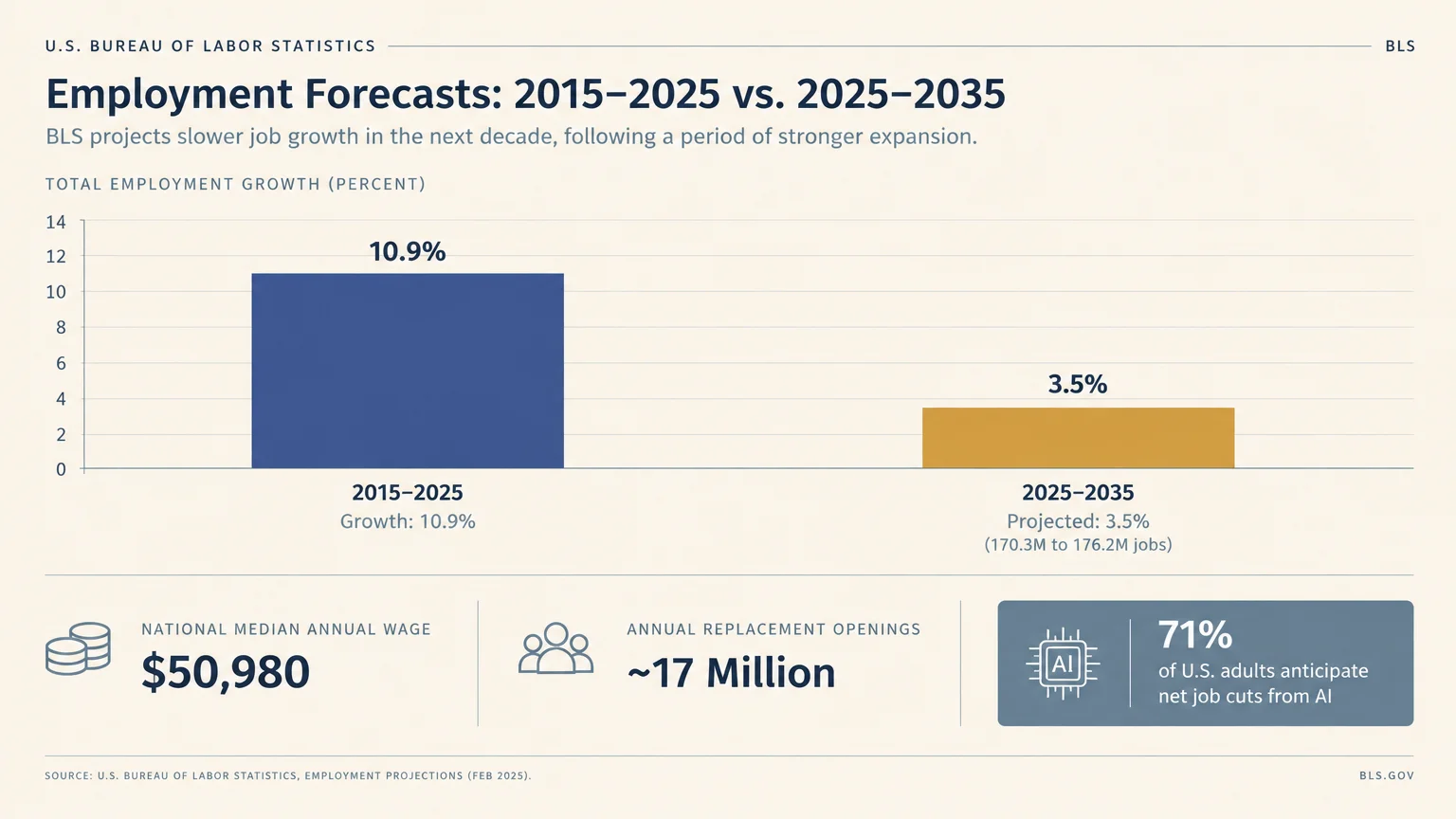
The headline numbers point to a noticeably cooler labor market than workers experienced over the prior ten years. Total U.S. employment is projected to rise 3.5 percent—from 170.3 million to 176.2 million jobs—compared with 10.9 percent growth between 2015 and 2025.
Even in a slower economy, hiring does not freeze completely. Across all occupations, the median annual wage stood at $50,980 in May 2025, and the economy should still generate roughly 17 million job openings annually.
Most of those openings come from replacement needs as older workers retire or switch fields rather than brand-new roles. For workers in declining occupations, understanding that distinction helps you plan an orderly exit instead of waiting for a pink slip.
Workplace technology is accelerating those shifts across both offices and storefronts. A supplemental BLS dataset now tracks roughly 800 occupations across four AI exposure tiers from low to very high, though agency economists caution that high exposure alone does not guarantee job cuts.
Worker sentiment reflects growing anxiety about what comes next. Research from the Pew Research Center shows 21 percent of U.S. workers already used AI for at least part of their job as of September 2025, up from 16 percent a year earlier.
In a June 2026 Pew survey, 71 percent of U.S. adults said AI will likely reduce the number of jobs over the next 20 years. Among adults ages 18 to 34, 55 percent reported feeling more concerned than excited about AI.
Six Careers Facing Major Shifts Before 2036
When analysts flag jobs at risk, the biggest disruptions rarely look like science-fiction layoffs. Instead, employers stop backfilling departing staff, consolidate duties, and ask fewer employees to manage smarter software.
Here are six major U.S. careers projected to shrink or transform sharply over the coming decade, along with practical ways to reposition your skills.
1. Cashiers: From Checkout Lines to Order Fulfillment
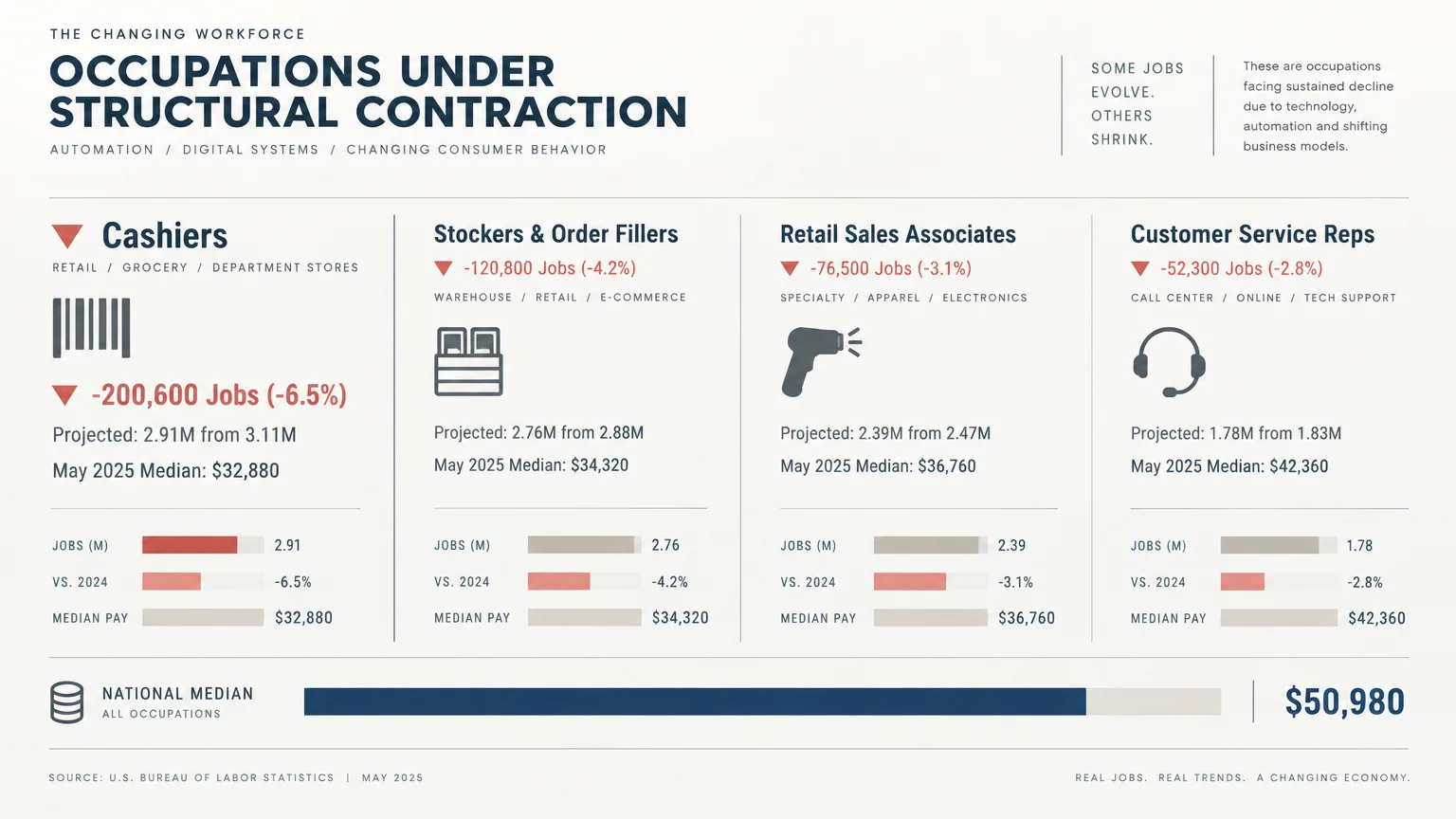
Cashiers top the federal list for total numeric job losses over the 2025–2035 forecast window. Employment is projected to drop by 200,600 positions—a 6.5 percent decline from 3.11 million down to 2.91 million workers.
With a May 2025 median annual wage of $32,880, cashiers already sit well below the national median paycheck. Self-checkout kiosks, mobile scan-and-go apps, and online ordering continue to chip away at traditional staffed registers.
That does not mean every retail worker vanishes from the front of the store by 2036. Remaining cashiers spend less time scanning groceries and more time troubleshooting self-checkout lanes, verifying IDs, and pulling curbside pickup orders.
Your next move: If you work a register today, volunteer for inventory control, store receiving, or customer-service desk escalations. Those responsibilities build transferable logistics and problem-solving credentials that translate into higher-paying warehouse coordination or medical front-desk roles.
2. General Office Clerks: Fewer Desks, Broader Software Duties
Office and administrative support ranks among the hardest-hit broad job categories, projected to shrink by 4.0 percent—or 752,000 jobs—by 2035. Within that group, general office clerks alone face a projected loss of 156,200 jobs, down 6.0 percent from 2.60 million to 2.44 million.
Secretaries and administrative assistants outside legal, medical, and executive suites face an identical 6.0 percent contraction, shedding 114,100 roles. General office clerks earned a May 2025 median wage of $45,010, while those general administrative assistants earned $47,540.
Automated phone routing, digital document signing, and shared cloud calendars eliminate much of the routine filing and scheduling that once justified dedicated clerical staff. Instead, managers and specialists now handle basic administrative tasks themselves using software templates.
Your next move: Pivot away from pure scheduling and toward specialized industry administration, such as medical billing coordination or project operations. Learning electronic health records or enterprise workflow tools puts you closer to revenue-generating teams that employers protect during cuts.
3. Customer Service Representatives: High Turnover Masks Shrinking Headcount
Customer service representatives face a projected drop of 141,800 positions by 2035, a 5.3 percent decline from 2.67 million to 2.52 million workers. Their May 2025 median annual pay stood at $44,770.
At first glance, hiring still looks lively because high turnover produces roughly 289,500 replacement openings every year. However, automated chatbots and self-service billing portals now absorb basic password resets, shipping checks, and routine cancellations.
By 2036, human representatives will rarely handle simple, scripted questions. Remaining agents will spend their shifts resolving angry escalations, complex policy exceptions, and multi-step fraud claims that automated scripts mishandle.
Your next move: Move up the complexity ladder before routine call-center quotas tighten further. Target technical support tiers, insurance claims adjusting, or business-to-business client onboarding, where nuanced judgment and relationship management command higher salaries.
4. Bookkeeping, Accounting, and Auditing Clerks: Routine Ledger Work Fades
Software has transformed small-business accounting over the last decade, and the squeeze on routine finance staff continues. Bookkeeping, accounting, and auditing clerks are projected to lose 85,600 jobs by 2035, falling 5.6 percent from 1.53 million to 1.45 million.
Payroll and timekeeping clerks face an even steeper percentage drop of 15.9 percent, losing 25,400 roles. Bookkeeping clerks earned a May 2025 median wage of $50,670, while payroll clerks earned $58,260.
Bank feeds, optical receipt scanning, and automated payroll platforms now reconcile transactions in seconds without manual ledger entry. Still, retiring bookkeepers leave roughly 144,100 replacement openings per year, giving current workers breathing room to adapt.
Your next move: Shift from entering numbers to interpreting them and managing compliance. Earning an Enrolled Agent credential, specializing in multi-state payroll taxes, or learning financial analytics software positions you as an indispensable advisor rather than a data processor.
5. Bank Tellers: Branches Shrink Into Financial Sales Hubs
Few storefronts have changed faster than neighborhood bank branches, and teller jobs reflect that shift. Federal projections point to a 13.2 percent contraction—or 44,700 fewer tellers—shrinking the workforce from 339,200 to 294,500 by 2035.
Bank tellers earned a May 2025 median wage of $43,030, and turnover still leaves about 26,800 annual openings. Yet mobile check deposits, peer-to-peer payment apps, and smart ATMs handle the vast majority of everyday cash and check transactions.
Inside remaining branches, traditional teller windows are giving way to open lobbies staffed by universal bankers. Those employees verify identity anomalies, open complex accounts, explain credit products, and help customers navigate digital fraud recovery.
Your next move: Ask your employer to sponsor licensing or training in mortgage origination, consumer underwriting, or retirement account servicing. Moving into loan processing or advisory support puts your banking background to work in higher-margin departments.
6. Computer Programmers: Routine Coding Splits From Systems Architecture
Many workers assume every technology career is automatically safe from jobs shrinking over the next decade, but federal data tells a sharper story. Computer programmers—who earned a May 2025 median wage of $100,390—face a projected 7.3 percent decline through 2035, leaving roughly 4,400 annual openings.
Computer user support specialists also face a modest 3.5 percent dip, shedding 26,200 jobs from a $61,860 median wage. In contrast, software developers are projected to grow 10.2 percent, adding 174,700 jobs at a $135,980 median wage.
Information security analysts look even stronger, surging 21.0 percent with 40,600 new roles and a $129,180 median paycheck. AI coding assistants increasingly generate boilerplate code and routine scripts, squeezing workers who strictly translate specs into basic syntax.
Your next move: Stop competing on speed at writing isolated code snippets. Build skills in system architecture, cloud security, and debugging complex AI-assisted software pipelines—areas where human oversight and security accountability remain essential.
How These 6 Shrinking Roles Compare at a Glance
Looking at projected headcount drops alongside median pay helps you weigh how urgently you need a transition plan. High annual turnover can buy you months or years to retrain while still collecting a paycheck.
| Occupation | Projected Change (2025–2035) | May 2025 Median Wage | How the Daily Work Shifts |
|---|---|---|---|
| Cashiers | -200,600 jobs (-6.5%) | $32,880 | Self-checkout oversight and online pickup fulfillment |
| General office clerks | -156,200 jobs (-6.0%) | $45,010 | Software templates absorb routine filing and routing |
| Customer service representatives | -141,800 jobs (-5.3%) | $44,770 | Chatbots take basics; humans handle complex escalations |
| Bookkeeping and auditing clerks | -85,600 jobs (-5.6%) | $50,670 | Automated feeds replace entry; exception review stays |
| Bank tellers | -44,700 jobs (-13.2%) | $43,030 | Shift toward universal banking and product guidance |
| Computer programmers | -7.3% (~4,400 annual openings) | $100,390 | AI drafts routine code; architecture and testing grow |
Several adjacent office and logistics jobs face even steeper percentage drops through 2035. Shipping, receiving, and inventory clerks are projected to lose 62,800 positions—a 7.6 percent slide from a $45,260 median wage—while sales jobs overall dip 1.4 percent.
If your job centers on typing or routine order entry, pay close attention to these steep clerical contractions in federal tables:
- Word processors and typists: down 34.4 percent (-13,900 jobs; $49,280 median)
- Telephone operators and switchboard operators: down 27.6 percent and 26.0 percent
- Data entry keyers: down 25.5 percent (-33,600 jobs; $41,340 median)
- Telemarketers: down 21.4 percent ($35,450 median)
- Order clerks: down 17.5 percent ($46,170 median)
Where Employers Are Hiring Instead—and What Pays More
Global employer data echoes these federal trends on the future of jobs. The World Economic Forum Future of Jobs Report 2025—surveying more than 1,000 employers representing 14 million workers across 55 economies—projects 92 million roles displaced globally alongside 170 million created by 2030.
That nets 78 million new positions globally, yet 39 percent of workers’ core skills are expected to transform or grow outdated by 2030. Among surveyed employers, 86 percent expect AI and information processing to reshape their businesses, and 40 percent expect headcount cuts where automation fits.
Employers globally flagged postal service clerks (-34 percent), bank tellers, data entry clerks, cashiers, and administrative assistants among the fastest-shrinking roles. At the same time, hiring criteria are shifting away from four-year diplomas: 81 percent of employers expect to prioritize work experience and 48 percent plan to use skills assessments by 2030, compared with 43 percent relying on university degrees.
Back in the United States, utilities lead all major industry sectors with projected 9.8 percent growth—adding 58,800 jobs as power grids expand for electrification and AI data centers. Private healthcare and social assistance ranks close behind at 9.5 percent growth, adding over 2.2 million jobs, or roughly 37 percent of all net new U.S. roles.
Several fast-growing or high-volume careers offer accessible mid-skill entry points or strong pay raises over clerical work:
- Wind turbine service technicians: +29.5 percent projected growth, $64,120 median wage
- Solar photovoltaic installers: +36.5 percent growth, $53,140 median wage
- Industrial machinery mechanics: +79,700 new jobs, $64,520 median wage
- Physical therapist assistants: +23.0 percent growth, $68,380 median wage
- Medical assistants: +107,600 new jobs, $45,690 median wage
- Registered nurses: +194,700 new jobs, $97,550 median wage
- Nurse practitioners: +41.0 percent growth, $132,300 median wage
- Data scientists: +34.6 percent growth, $120,230 median wage
Other steady growth areas include construction laborers (+109,300 jobs; $47,120 median), mental health and substance abuse counselors (+98,000 jobs; $59,350 median), psychiatric technicians (+22.3 percent; $45,130 median), and home health and personal care aides (+847,300 jobs; $35,800 median).

How to Fund a Career Pivot Without Wrecking Your Budget
Switching careers costs money, even if you only take an evening certificate while working full time. Before enrolling in any program, inspect your cash cushion.
In its May 2026 Report on the Economic Well-Being of U.S. Households, the Federal Reserve found that only 55 percent of U.S. adults hold three months of emergency savings, down from 59 percent in 2021. That buffer drops to 42 percent among adults with a high school diploma or GED and 51 percent among those with some college or an associate degree, versus 72 percent for bachelor’s degree holders.
Even more concerning, only 63 percent of adults could cover an unexpected $400 expense strictly with cash or its equivalent, leaving 37 percent scrambling to borrow or sell items. If your job sits in a shrinking category, build that initial $400 emergency buffer first, then keep working toward three months of bare-bones living expenses before giving notice.
Once your cash floor is steady, avoid expensive private loans by tapping newly expanded federal grant rules through Federal Student Aid. For the 2026–27 award year, the maximum traditional Federal Pell Grant reaches $7,395.
Even better for working adults, the new Workforce Pell Grant program took effect on July 1, 2026, with the first eligible program approved on August 4, 2026. Created under Public Law 119-21 with final Department of Education rules published May 19, 2026, Workforce Pell lets eligible students apply prorated Pell Grants toward short-term career training.
To qualify for Workforce Pell funding, a program must meet strict consumer-protection benchmarks:
- Run between 8 and under 15 weeks in length, spanning 150 to 599 clock hours.
- Align directly with high-skill, high-wage, or in-demand occupations recognized by your state.
- Prove at least a 70 percent student completion rate and a 70 percent job placement rate.
- Cap tuition and fees against graduates’ verified value-added earnings so debt does not outpace raises.
Traditional public community colleges remain another budget-friendly route if you need an associate degree or longer certificate. Average public two-year in-district tuition and fees totaled $4,150 per year in 2025–26, while a full commuting student budget—factoring in housing, food, transportation, and books—averaged about $21,320.
Using a traditional Pell Grant of up to $7,395—or a Workforce Pell Grant for a 10-to-14-week trade, healthcare, or IT program—can cover tuition completely while you keep your day job and avoid high-interest student loans.
What Can Go Wrong
Even well-intentioned career transitions backfire when financial shortcuts or rushed timelines create bigger problems than the shrinking job you left behind. Watch out for these four common traps:
- Paying cash for unvetted bootcamps: Private tech or trade academies outside the federal aid system can charge thousands without proving job placement. Stick to programs eligible for Workforce Pell or accredited community colleges that meet the 70 percent completion and placement threshold.
- Quitting too early out of panic: Seeing a 5 percent or 13 percent 10-year decline does not mean your job vanishes next Tuesday. Replacement turnover still creates tens or hundreds of thousands of annual openings in customer service, bookkeeping, and banking—use that steady paycheck to pay for evening classes.
- Raiding retirement accounts prematurely: Pulling money out of a 401(k) or IRA to pay tuition triggers ordinary income taxes and potential early-withdrawal penalties under standard IRS rules. Exhaust federal grants, employer tuition reimbursement, and community college payment plans before touching retirement savings.
- Chasing credentials employers no longer require: Taking on four years of university debt for an entry-level tech or operations pivot often makes little financial sense when 81 percent of surveyed employers expect to rely on work experience and 48 percent on skills assessments by 2030.

Where Outside Advice Pays Off
General career articles help you spot broad trends, yet personal taxes, benefits, and household budgets involve trade-offs that require one-on-one guidance. Consider getting tailored advice in these three situations:
- Navigating mid-career benefit losses: If a career switch forces you into part-time study or a temporary pay cut, a fee-only Certified Financial Planner can model your cash runway, health insurance subsidies, and retirement contributions before you leave a salaried role.
- Maximizing education tax breaks: A Certified Public Accountant or Enrolled Agent can clarify how Workforce Pell grants interact with federal education tax credits and whether employer tuition assistance stays tax-free under current IRS limits.
- Verifying local grant eligibility: Sit down with a community college financial aid officer or a counselor at your state workforce center to confirm which short-term local programs hold active Workforce Pell approval and verified employer hiring partnerships.
Frequently Asked Questions
Does high AI exposure mean a job will disappear by 2036?
No. Federal labor economists explicitly note that AI exposure scores measure how much technology overlaps with existing tasks, not whether headcount will rise or fall. Many roles transform—shifting workers from routine entry toward oversight, sales, or exception handling—rather than disappearing.
Can I get federal grant money for a short trade or tech certificate?
Yes. As of July 1, 2026, Workforce Pell Grants cover accredited short-term programs lasting 8 to under 15 weeks that align with in-demand state jobs and meet 70 percent completion and placement standards. Longer programs may qualify for the traditional Federal Pell Grant of up to $7,395 for 2026–27.
Which shrinking careers still hire regularly if I need steady income right now?
High-headcount roles with rapid turnover continue hiring even as total positions shrink. Customer service representatives generate about 289,500 replacement openings per year, bookkeeping clerks generate roughly 144,100, and bank tellers offer around 26,800 annual openings.
Are all tech careers safe from automation over the next decade?
No. Computer programmers face a projected 7.3 percent decline through 2035, and computer user support specialists dip 3.5 percent. Meanwhile, software developers grow 10.2 percent, information security analysts surge 21.0 percent, and data scientists expand 34.6 percent.
Putting Your Next Career Move in Motion
Start this week by listing the three tasks that consume most of your workday and checking whether software or self-service tools already handle them elsewhere. If your role overlaps heavily with automated duties, price out an accredited 8-to-14-week Workforce Pell certificate or an in-district community college program while building your cash cushion.
This is general informational content based on widely accepted guidance. Individual results vary. Verify current details—rules, prices, eligibility, regulations—with official sources before making important decisions.
Last updated: November 2026. Rules, prices, and details change—verify current information with official sources before acting on it.









Leave a Reply