

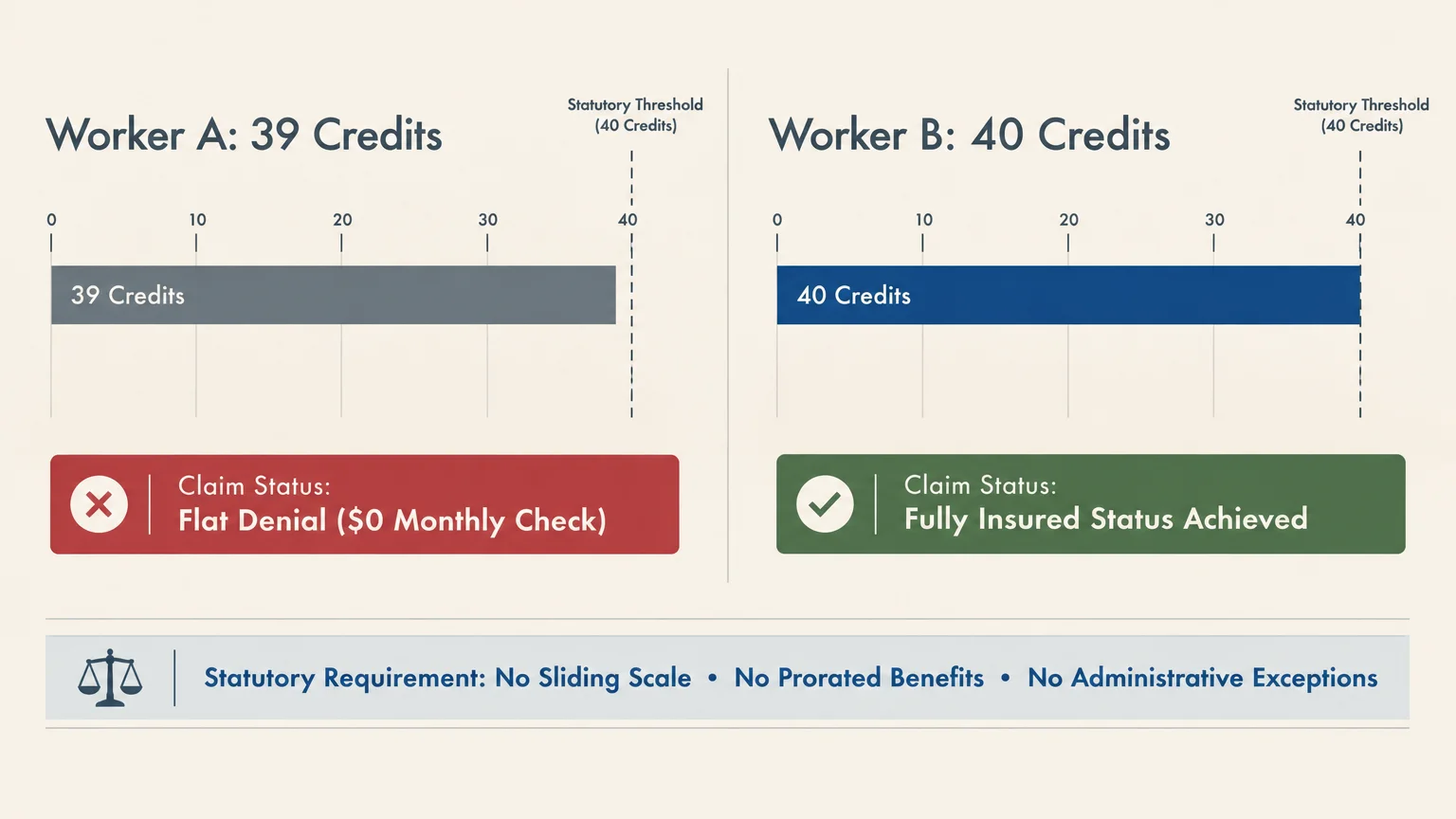
Applying for Social Security with 38 or 39 credits yields a flat denial rather than a reduced monthly check. The system requires exactly 40 credits for retirement eligibility, offering zero partial payouts if you fall short.
Missing just one or two credits freezes your monthly income and triggers expensive premiums for Medicare Part A. Fortunately, you can fix this shortfall through targeted part-time work, spousal options, or earnings corrections.
Reviewing your record today protects you from costly surprises when you reach retirement age. Here is how the credit system works and the exact steps you can take to secure your benefits.
The All-or-Nothing Reality of Social Security Credits
Social Security enforces an absolute threshold for retirement benefits. You must accumulate 40 work credits across your lifetime to qualify for monthly retirement payments on your own record.
If you submit an application with 39 credits, the agency denies your claim immediately. The federal program provides no sliding scale, grace period, or prorated distribution for workers who fall short.
According to the Social Security Administration, reaching 40 credits earns you “fully insured” status. Without that benchmark, your retirement balance remains zero regardless of your age.
A formal rejection letter arrives in your mailbox when you apply without adequate coverage. This notice confirms that you lack the mandatory quarters of coverage and outlines your right to appeal clerical errors.
Appealing an accurate credit count will not change the outcome. Administrative law judges cannot bend federal statutory minimums to grant exceptions for hardship or near-misses.
Many workers confuse credit counts with the formula used to calculate their actual benefit check. Credits merely open the door to retirement benefits, while your 35 highest earning years dictate your monthly payment.
Earning 39 credits means you likely worked nearly a decade in covered employment. Losing out on benefits after years of payroll tax deductions represents a substantial financial loss.
How Social Security Work Credits Accumulate
Work credits represent the basic building blocks of your Social Security eligibility. The government historically referred to these credits as “quarters of coverage,” though the rules have since evolved.
You no longer need to work in specific three-month calendar windows to earn coverage. The agency calculates your credits based on your total annual earnings, regardless of when you earned the money.
In 2026, you earn one credit for every $1,890 in covered wages or self-employment earnings. You secure the annual maximum of four credits once your earnings reach $7,560.
Federal law adjusts these wage thresholds annually to account for national wage growth. In 2027, the earnings requirement increases to $1,970 per credit, requiring $7,880 for the full four credits.
Federal law caps your credit accumulation at four credits per calendar year. You cannot earn extra credits in a single year, even if you earn hundreds of thousands of dollars.
Because of this annual limit, closing a two-credit gap requires at least one calendar year of eligible earnings. Resolving a five-credit deficit demands work across at least two separate tax years.
Under federal law, credits earned remain on your record indefinitely, meaning previous work is never lost regardless of how much time passes between jobs.
A career break to raise children or care for aging parents will not erase your past progress. The credits you earned at age twenty remain intact when you turn sixty-two.
The Costly Medicare Part A Penalty
Failing to reach 40 work credits impacts far more than your monthly retirement payments. It directly affects your healthcare costs when you transition onto Medicare at age 65.
Most Americans receive Medicare Part A hospital coverage without paying a monthly premium. Premium-free Part A requires the same 40 work credits mandated for Social Security retirement benefits.
Guidance from Medicare.gov outlines the monthly premiums charged to individuals who lack sufficient work history. If you fall short, you must buy into Part A directly.
In 2026, individuals with 30 to 39 credits must pay a reduced Part A premium of $311 each month. That requirement adds over $3,700 in mandatory annual healthcare costs.
Workers with fewer than 30 credits face the full Medicare Part A premium. In 2026, that full rate costs $565 per month, translating to $6,780 every year.
Couples face double the financial strain if neither partner earned 40 credits. Paying dual premiums for basic hospital coverage can rapidly deplete a modest retirement savings portfolio.
| Credit Total | 2026 Part A Monthly Premium | Annual Out-of-Pocket Cost | Social Security Retirement Status |
|---|---|---|---|
| 40 or more credits | $0 (Premium-Free) | $0 | Eligible for standard monthly checks |
| 30 to 39 credits | $311 per month | $3,732 per year | Ineligible on own record ($0) |
| Fewer than 30 credits | $565 per month | $6,780 per year | Ineligible on own record ($0) |
Delaying your Part A enrollment because of these high monthly costs can trigger lifetime late-enrollment penalties. The federal government adds a 10% penalty to your monthly premium if you fail to sign up on time.
You must pay that 10% surcharge for twice the number of years you delayed enrollment. Earning those final missing credits eliminates this ongoing financial drain entirely.

Closing the Gap: Practical Ways to Earn Missing Credits
Closing a small credit deficit is often straightforward because the annual earnings thresholds remain relatively low. You do not need a high-paying executive role to secure your remaining quarters.
In 2026, earning just $1,890 satisfies the requirement for a single credit. Working part-time for roughly 120 hours at $16 per hour generates enough wages to cross that line.
Seasonal retail jobs, poll working during elections, or warehouse shifts during the holidays provide accessible paths to bridge the gap. Any employer who withholds FICA taxes credits your earnings to your Social Security record.
Strategic calendar timing helps you capture credits rapidly across two tax cycles. Earning $7,560 late in 2026 and $7,880 early in 2027 secures eight full credits in just a few months.
- Take a seasonal retail or hospitality position during peak holiday shopping months.
- Work as a substitute teacher or bus driver for your local school district.
- Provide home care services through a licensed agency that reports W-2 payroll wages.
- Accept temporary census or municipal election roles that operate on official government payrolls.
Ensure your employer pays you as a standard W-2 employee rather than an off-the-books laborer. Informal cash arrangements generate zero credits because no one reports the earnings to the government.
Self-Employment Rules and FICA Tax Obligations
Freelancing, consulting, or launching a small business provides another viable path to earning credits. Driving for rideshare platforms, tutoring, or selling handmade goods all qualify as covered work.
The Internal Revenue Service requires self-employed individuals to pay self-employment tax on net business earnings. You must report this income using Schedule C and Schedule SE on your federal tax return.
Self-employed workers pay the full 12.4% Social Security tax rate on their net profits. Standard employees split this cost equally with their employers, paying 6.2% each.
Your credits stem from your net profit rather than your gross revenue. Deducting too many business expenses can drop your net profit below the credit earnings threshold.
Aggressive tax write-offs may lower your income tax bill, but they can unintentionally wipe out your work credits. Balance tax deductions carefully when you need eligible self-employment earnings to qualify.
Keep meticulous financial records, including customer invoices, bank deposits, and platform earnings summaries. The IRS and Social Security Administration can audit reported self-employment income before crediting quarters.

Spousal and Divorced Spousal Benefits
If you cannot return to work to earn 40 credits, you might qualify for benefits through your spouse. The Social Security system allows dependents to claim payments based on a partner’s work history.
A married individual can receive up to 50% of their spouse’s Full Retirement Age benefit amount. To qualify, your spouse must possess 40 credits and must have already filed for their own benefits.
Claiming spousal benefits does not reduce your partner’s monthly check in any way. The program pays your auxiliary benefit alongside your spouse’s primary payment.
Divorced individuals can also access benefits using an ex-spouse’s work record. To qualify, your previous marriage must have lasted at least 10 consecutive years.
You must remain currently unmarried and be at least 62 years old to claim divorced spousal payments. Your former partner does not need to apply first, provided you have been divorced for two years.
Survivor benefits offer another critical layer of protection for individuals missing work credits. A surviving spouse can claim up to 100% of a deceased partner’s monthly benefit check.
| Benefit Category | Credit Requirement for Claimant | Key Eligibility Rules | Maximum Payout Level |
|---|---|---|---|
| Personal Retirement | 40 personal credits | Must reach at least age 62 | 100% of personal primary insurance amount |
| Spousal Benefit | 0 personal credits | Spouse must have 40 credits and be claiming | Up to 50% of spouse’s full retirement benefit |
| Divorced Spousal Benefit | 0 personal credits | 10-year marriage; currently unmarried; age 62+ | Up to 50% of ex-spouse’s full retirement benefit |
| Survivor Benefit | 0 personal credits | Deceased spouse was fully insured; age 60+ | Up to 100% of deceased spouse’s benefit |
Spouses eligible for auxiliary benefits also receive premium-free Medicare Part A at age 65. Your partner’s 40 credits shield you from paying steep monthly Part A buy-in charges.
International Totalization Agreements
Individuals who spent portions of their careers working overseas might qualify for benefits through international treaties. The United States maintains bilateral totalization agreements with approximately 30 foreign nations.
These international pacts prevent double taxation and help workers combine foreign and domestic pension credits. They protect mobile workers who split careers across international borders.
You cannot use foreign credits if you have zero work history within the United States. Federal regulations require you to earn at least six U.S. work credits to activate an agreement.
Six credits equal roughly one and a half years of covered domestic employment. Once you hit that baseline, the agency combines your foreign work history with your U.S. records.
The agency calculates a prorated monthly payment based on the actual time you spent working in the United States. This arrangement allows individuals with 35 U.S. credits to secure a legitimate monthly check.
Supplemental Security Income as an Alternative
Low-income seniors who lack 40 credits may qualify for Supplemental Security Income. Known as SSI, this program operates separately from standard Title II Social Security retirement insurance.
General federal tax revenues fund the SSI program rather than dedicated payroll taxes. Consequently, applicants do not need any work credits to qualify for monthly cash assistance.
To qualify, you must be at least 65 years old, totally blind, or permanently disabled. You must also satisfy strict financial limits regarding your personal income and assets.
In 2026, the maximum federal SSI payment equals $994 per month for an eligible individual. Eligible married couples can receive up to $1,491 per month.
A 3.6% cost-of-living adjustment boosts these figures for 2027, with payments starting December 31, 2026. The maximum individual rate rises to $1,029 monthly, while couples receive up to $1,544.
The asset restrictions for SSI remain exceptionally strict. An individual cannot own more than $2,000 in countable resources, while couples face a $3,000 ceiling.
The government excludes your primary home, one personal vehicle, and ordinary household belongings from that calculation. Qualifying for SSI typically triggers automatic Medicaid coverage in most states.
Auditing and Fixing Your SSA Record
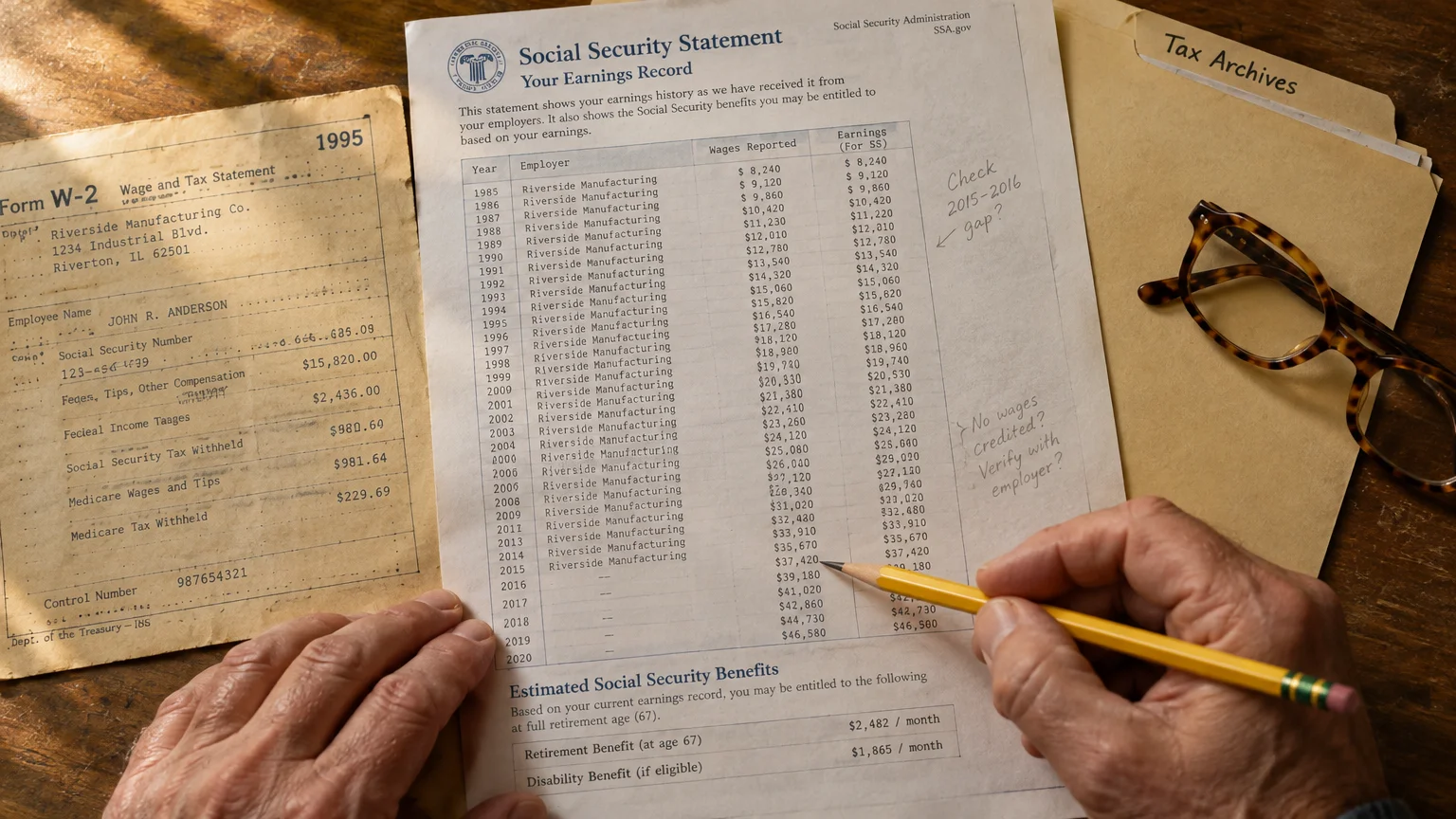
Never assume your reported credit tally is accurate without reviewing the raw figures yourself. Employers make reporting typos, payroll processors swap numbers, and name changes cause earnings to vanish.
You can inspect your complete history by setting up an account through SSA.gov. Download your detailed Social Security Statement to verify your reported earnings for every single year.
Compare your official online statement against your personal tax files and old W-2 statements. If you spot a year showing zero earnings despite active work, you must request an official correction.
Federal law enforces a time limit for correcting earnings records: three years, three months, and fifteen days after the close of the tax year. However, specific exceptions allow corrections past this statutory deadline.
You can correct missing wages at any time if you provide an official W-2 form or an employer tax return. Submit Form SSA-7008 along with your historical wage documentation to request an audit.
Correcting an omitted tax year can instantly push your credit total across the 40-credit finish line. Verifying your paperwork early prevents lengthy bureaucratic delays when you prepare to claim.
Common Mistakes to Avoid
Navigating Social Security when you lack sufficient credits exposes you to several expensive pitfalls. Avoiding common missteps preserves your financial independence and simplifies retirement planning.
The first major mistake involves filing a formal retirement application when you know you hold only 38 or 39 credits. An automatic denial generates unnecessary paperwork and delays your financial timeline.
Another dangerous trap is accepting cash wages to avoid paying payroll taxes. While untaxed cash feels convenient today, it deprives you of the legal credits needed to unlock retirement checks and healthcare.
Self-employed workers frequently make the error of over-deducting routine business expenses. Writing down your net business income to zero eliminates income taxes but erases your annual work credits.
Many seniors also postpone enrolling in Medicare Part A because they cannot stomach the monthly premium. Delaying enrollment triggers cumulative lifetime penalties that permanently inflate your healthcare expenses.
Finally, divorced seniors regularly forget to explore claims on their former spouse’s work record. Letting benefits sit unclaimed after a decade-long marriage leaves substantial federal money on the table.

Getting Expert Input
Resolving missing work credits often requires professional coordination across tax law, family law, and retirement planning. Consulting a qualified specialist ensures you execute your strategy efficiently.
Work with a Certified Public Accountant if you need to file delinquent or amended tax returns. A CPA balances deductible business expenses against the net earnings required to secure your final credits.
Consult a family law attorney if you plan to claim spousal or survivor benefits following a contested divorce. Legal counsel ensures you have the documentation needed to prove marriage duration and legal eligibility.
Seek guidance from an international tax specialist if you earned pension credits in another nation. An expert clarifies bilateral totalization agreements and helps you assemble foreign work records.
Speak with an elder law attorney if you plan to apply for Supplemental Security Income. They help you structure your personal assets legally to meet strict federal resource limits without violating Medicaid regulations.
Frequently Asked Questions
Can I simply buy missing Social Security credits?
No, you cannot write a personal check to the federal government to purchase missing work credits. You must earn credits legitimately through wages subject to FICA taxes or through net self-employment earnings.
Do Social Security work credits ever expire?
Social Security credits never expire or disappear from your permanent earnings record. Credits earned during your teenage years remain credited to your profile decades later when you apply for retirement benefits.
What happens to the payroll taxes I paid if I never reach 40 credits?
The federal government does not refund Social Security payroll taxes if you fail to reach 40 credits. Those tax revenues remain inside the Social Security Trust Funds to support the broader national insurance system.
Can I earn all four annual credits in a single month?
Yes, you can earn all four credits in one month if your gross income exceeds the annual ceiling. Earning $7,560 in January 2026 secures the maximum four credits for that entire calendar year.
Does earning more than 40 credits increase my benefit payment?
Earning additional credits past 40 does not increase your retirement payment. The agency bases your monthly payment amount on your highest 35 years of indexed earnings, not your total credit tally.
Protecting Your Future Benefits
Missing a few Social Security credits creates an immediate roadblock, but you have clear, actionable paths to resolve it. Whether you pick up seasonal work, report freelance earnings, or claim auxiliary benefits, proactive planning pays dividends.
Log in to your online Social Security account today to audit your lifetime quarters of coverage. Identifying a gap now gives you the time needed to earn missing credits and secure your retirement safety net.
This is general informational content based on widely accepted guidance. Individual results vary. Verify current details—rules, prices, eligibility, regulations—with official sources before making important decisions.
Last updated: November 2026. Rules, prices, and details change—verify current information with official sources before acting on it.









Leave a Reply