

You pay your bills on time every month, yet your credit score drops without warning. Lingering credit card balances quietly suppress your credit score by driving up your credit utilization ratio.
Scoring models interpret elevated balances as signs of growing financial risk, regardless of your perfect payment track record. Applying targeted balance-management techniques will lower credit utilization and quickly improve your credit score.
Discover how card balances damage your standing and six practical steps you can take today to eliminate the drag on your credit profile.
The Hidden Mechanics: How Card Balances Weigh Down Your Score
Credit scoring algorithms evaluate how much revolving debt you carry against your assigned credit limits. This mathematical comparison establishes your credit utilization ratio.
Many consumers assume that making minimum monthly payments on time protects their credit profile completely. While timely payments satisfy your payment history, carrying high balances directly damages another core scoring component.
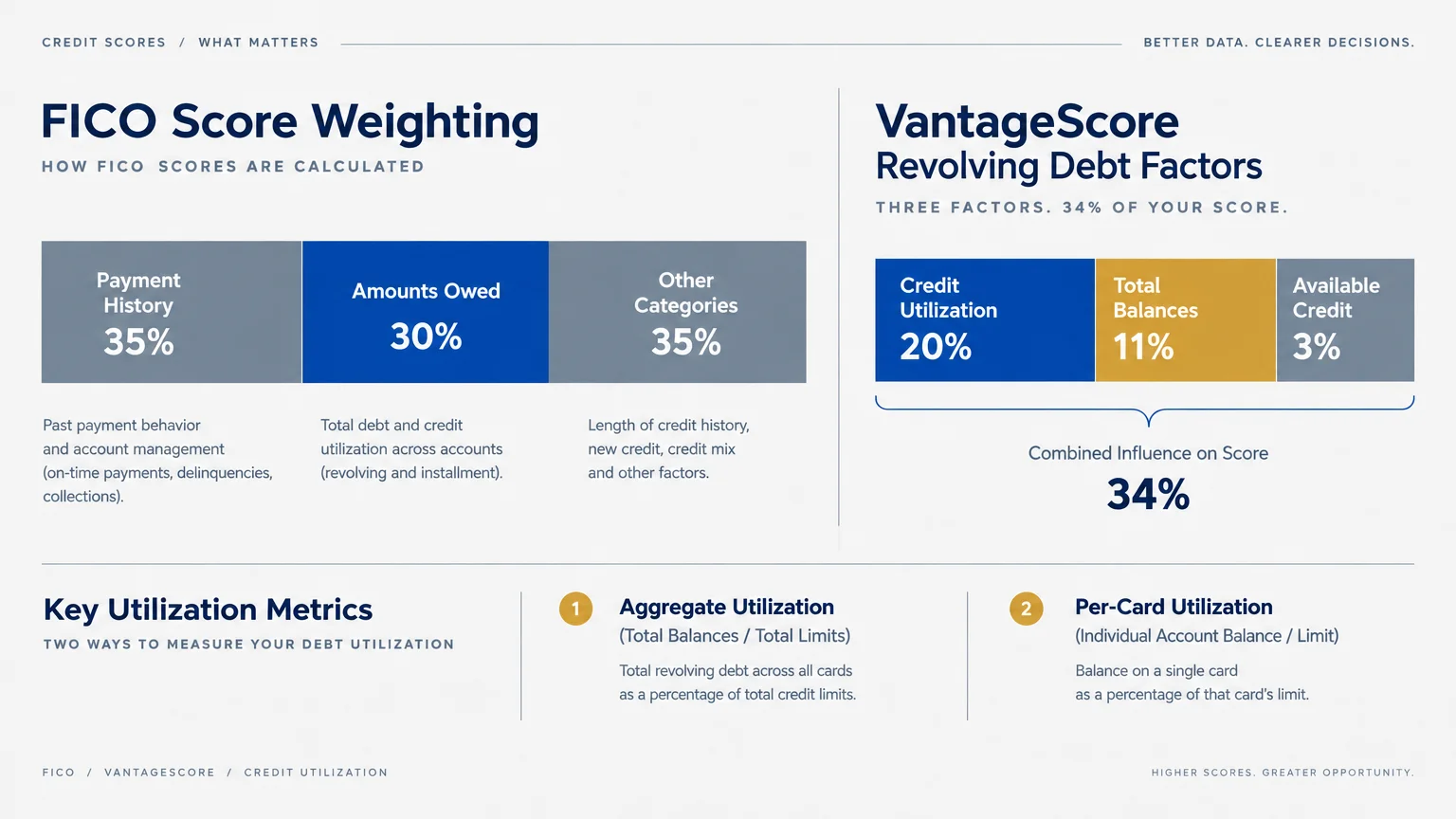
In standard FICO scoring calculations, “amounts owed” dictates thirty percent of your total credit score. Only your payment history holds greater weight at thirty-five percent.
VantageScore credit models evaluate card debt with comparable intensity. VantageScore allocates twenty percent of your score to utilization, eleven percent to total balances, and three percent to available credit.
When you combine these components, revolving balances govern over a third of your credit profile calculation. Carrying significant debt can erase dozens of points faster than occasional credit inquiries ever could.
Scoring systems evaluate credit card balances across two distinct levels: aggregate utilization and per-card utilization. Both metrics influence lending risk calculations simultaneously.
Aggregate utilization measures your combined credit card balances against your total combined borrowing limit. Per-card utilization measures the specific balance against the assigned limit on each individual account.
Maxing out a single retail card can heavily suppress your score, even if three other cards have zero balances. Credit algorithms view a fully depleted limit as an indicator of personal cash-flow strain.
According to the Consumer Financial Protection Bureau, maintaining low balances relative to your credit limits demonstrates responsible debt management to prospective lenders.
Scoring engines calculate utilization using the balance reported on your monthly billing statement. They do not distinguish between debt revolving for months and recent purchases you plan to pay off immediately.
Why People Are Talking About This
Household budgets across the country face mounting pressure from persistent revolving debt. Data released by the Federal Reserve Bank of New York reveals total U.S. credit card debt reached a record $1.29 trillion in late 2026.
Experian reporting shows the average consumer credit card balance climbed to $6,659 per borrower, while TransUnion documented an average balance of $6,610. Experian also found the national average credit utilization rate sits at 28.3%.
Lingering balances trigger compounding interest charges due to elevated borrowing costs. The Federal Reserve reports the average credit card APR on accounts assessed interest reached 22.36%, while the average rate across all accounts is 21.19%.
New cardholder offers frequently feature interest rates ranging between 23.96% and 24.88%. At the same time, Experian found the average minimum monthly payment climbed to $189, reducing the speed of self-directed debt payoff.
Shifts in lending technology have brought revolving balances under intense industry scrutiny. On September 9, 2026, the Federal Housing Finance Agency expanded VantageScore 4.0 to all approved mortgage lenders through Fannie Mae and Freddie Mac.
Traditional credit scoring models evaluate a static snapshot of credit balances on the day credit bureaus pull your file. In contrast, VantageScore 4.0 analyzes trended credit data spanning twenty-four months of borrowing behavior.
This trended framework examines whether your balances consistently shrink or simply revolve from month to month. Borrowers actively reducing card balances receive higher ratings than those maintaining static balances over extended periods.
The 6 Steps to Reclaim Your Credit Score
Eliminating credit balance drag does not require immediate debt payoff in every circumstance. Strategic timing, balance reallocation, and structural debt adjustments can dramatically improve your credit score within one to two billing cycles.
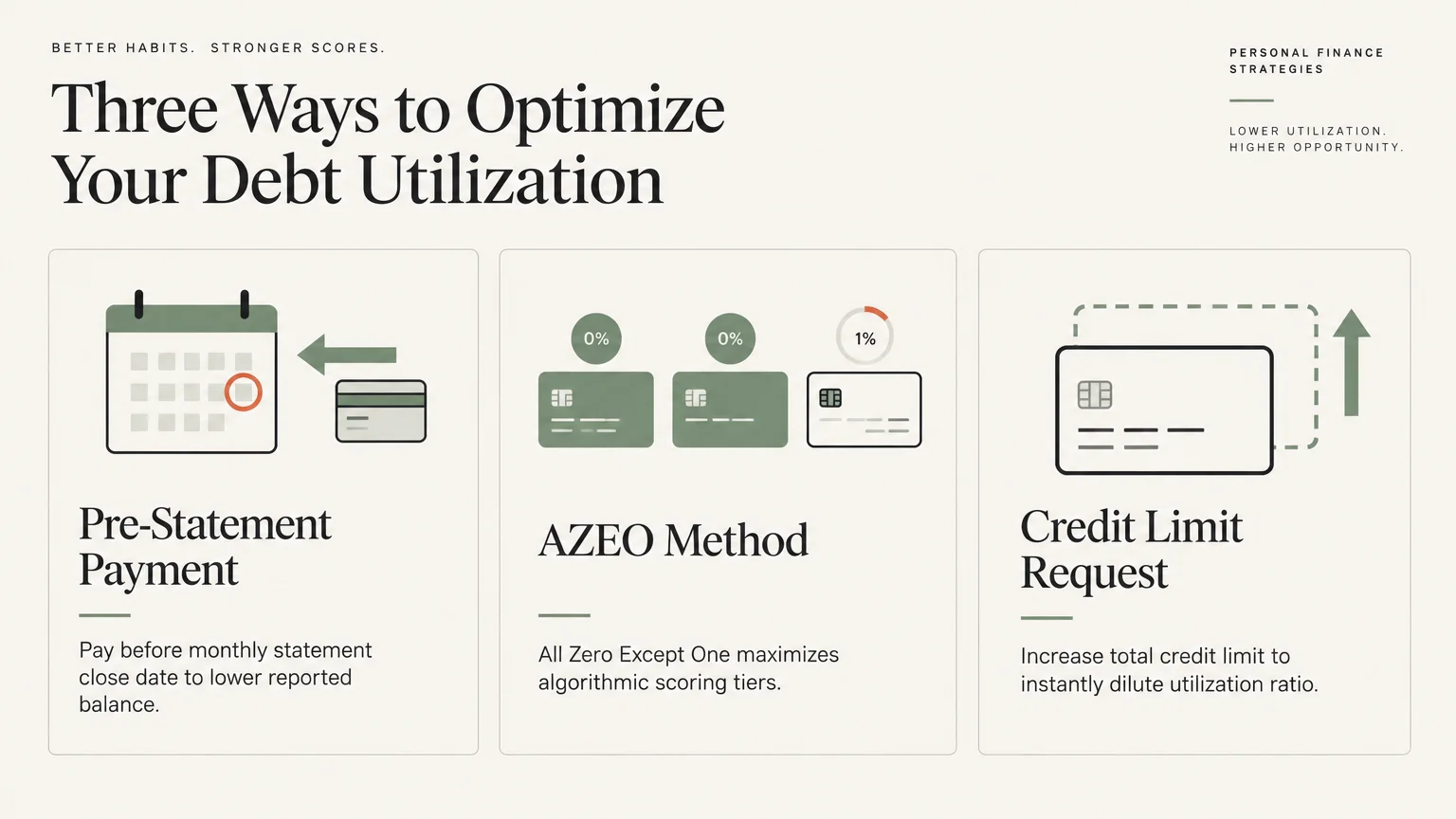
Step 1: Align Your Payments With the Statement Closing Date
Most cardholders schedule monthly payments to coincide with their official payment due date. However, relying strictly on your due date allows elevated balances to report to credit bureaus every month.
Credit card issuers report account details to bureaus on your statement closing date, not your payment due date. Statement closing dates generally occur twenty to twenty-five days before your scheduled payment deadline.
If you charge expenses throughout the month and pay the balance on your due date, your statement balance reports as high debt. The credit bureau records that peak figure rather than your subsequent bank payment.
Locate the statement closing date printed on your physical billing statement or online account portal. Schedule your primary balance payment two to three business days before that closing date arrives.
When the billing cycle closes, your issuer transmits a minimal balance to Equifax, Experian, and TransUnion. According to credit education research published by Experian, lowering this reported figure immediately reduces your utilization ratio.
Step 2: Implement the Multiple-Payment Strategy
You do not need to restrict yourself to a single credit card transaction per month. Adopting a structured pattern of weekly or bi-weekly micropayments keeps your ongoing balance artificially low at all times.
If you use credit cards for recurring family purchases, card balances accumulate steadily throughout the billing cycle. An unexpected mid-cycle credit pull by a prospective lender captures that elevated spending peak.
Submitting smaller payments each payday prevents purchases from stacking into an unmanageable statement balance. This consistent payment cadence ensures your utilization stays depressed throughout the entire month.
Bi-weekly payments also accelerate debt reduction by minimizing daily balance totals. Lowering daily balances reduces interest accumulation on accounts carrying revolving debt subject to the national 22.36% average APR.
Confirm that each transfer clears before your billing cycle concludes. Consistency eliminates erratic utilization spikes that can cause sudden score fluctuations from month to month.
Step 3: Request Strategic Credit Limit Increases
Your credit utilization ratio functions as an ordinary mathematical fraction containing a balance numerator and a credit limit denominator. Increasing the denominator automatically drives down your overall utilization percentage without requiring immediate cash reserves.
Contact your card issuers directly through their mobile apps or customer service lines to request limit increases. Issuers frequently grant credit expansion requests if your income has increased and your account shows consistent on-time payments.
Before submitting any credit limit increase request, ask the representative whether the review requires a hard credit inquiry. Many major credit card institutions now evaluate credit limit increases using soft inquiries that preserve your current score.
A higher credit limit only benefits your financial profile if you avoid using the additional spending capacity. Treat expanded limits strictly as an algorithmic tool designed to dilute your utilization percentage.
For instance, carrying a $3,000 balance against a $6,000 limit produces a 50% utilization rate. Increasing that limit to $12,000 immediately reduces your utilization to 25%, safely below the standard 30% warning threshold.
Step 4: Target High-Utilization Cards First
Traditional debt repayment methods focus on interest rates via the avalanche method or behavioral motivation via the snowball method. In contrast, credit score optimization requires a ratio-targeted repayment model.
Scoring engines penalize accounts that breach specific per-card utilization thresholds, particularly at thirty, fifty, and seventy percent. A card approaching its credit limit causes disproportionate damage to your credit rating.
Review each revolving card account and calculate its individual balance-to-limit percentage. Direct all surplus debt-reduction funds toward the account operating closest to its maximum limit.
Once you reduce that account below the thirty percent threshold, redirect your capital toward the next highest card. Systematically lowering individual ratios eliminates per-card scoring penalties across both FICO and VantageScore models.
This targeted method works alongside long-term debt goals while producing rapid credit score improvements that facilitate better borrowing terms.
Step 5: Consolidate Balances to an Amortizing Personal Loan
Credit scoring models differentiate sharply between revolving credit lines and amortizing installment loans. While card balances heavily impact utilization metrics, personal installment loans do not factor into revolving utilization calculations.
If you carry substantial balances across multiple cards, refinancing that debt into a fixed-rate personal loan clears your revolving balances immediately. Your credit reports will display zero balances across all consolidated credit card accounts.
Consolidation can also reduce borrowing costs compared to prevailing credit card rates. The Federal Reserve’s G.19 Consumer Credit report reflects an average 22.36% rate on interest-bearing cards, whereas personal loans frequently offer lower fixed rates to qualified borrowers.
Installment loans enforce structural repayment discipline through fixed monthly schedules and predetermined payoff dates. VantageScore 4.0 models reward the steady, predictable balance reductions characteristic of structured installment loans.
Never treat cleared credit cards as available spending money after completing a consolidation loan. Charging new purchases on consolidated accounts creates overlapping debt obligations that can quickly overwhelm your monthly budget.
Step 6: Keep Zero-Balance Cards Active and Open
After paying off an expensive credit card, many consumers immediately close the account to celebrate their achievement. Unfortunately, closing a paid-off credit card often causes unintended damage to your credit score.
Closing an account instantly removes its credit limit from your aggregate credit limit calculation. This sudden reduction in total borrowing capacity causes your utilization ratio to spike across any remaining balances.
Open credit accounts also support the average age of your credit accounts over time. While closed accounts remain on your credit history for up to ten years, keeping them active provides ongoing stability.
To keep zero-balance cards active without risk, assign a small recurring subscription charge to the account. Enroll the card in automatic payments to settle the full statement balance each month.
This automated habit prevents the issuer from canceling the card for inactivity, preserving your available borrowing capacity and protecting your credit score indefinitely.
Comparing Credit Utilization Strategies
Every balance-reduction method offers distinct trade-offs between execution effort, implementation speed, and financial impact. Choosing the appropriate approach depends on your current cash reserves and credit goals.
| Strategy | Implementation Effort | Speed of Impact | Primary Cost or Risk | Best Situation |
|---|---|---|---|---|
| Payment Timing Adjustment | Low | Fast (1 Billing Cycle) | None | Cardholders who pay in full but still report elevated balances. |
| Multiple Micropayments | Low | Fast (1–2 Billing Cycles) | Requires frequent tracking | Active card users with high monthly spending volumes. |
| Credit Limit Increase | Low to Medium | Immediate (Upon Approval) | Potential hard inquiry risk | Cardholders with rising incomes and solid payment records. |
| Ratio-Targeted Paydown | Medium | Moderate (2–3 Billing Cycles) | Requires discretionary cash | Borrowers with one or two cards near maximum limits. |
| Installment Loan Refinancing | Medium to High | Immediate (Once Funded) | Origination fees and re-borrowing temptation | Borrowers managing large balances across high-rate cards. |
| Retaining Open Accounts | Low | Ongoing Protection | Inactivity closures if unmanaged | Consumers who recently eliminated revolving card debt. |
Combining multiple techniques often produces faster results than relying on a single method. For instance, pairing a limit increase with earlier payment dates can lower your utilization ratio overnight.
Evaluate your available cash flow and upcoming borrowing plans before committing to a specific path. If you plan to apply for a mortgage soon, avoid strategies that generate hard credit inquiries.
Things to Watch Out For
Managing credit card balances requires precision to avoid common pitfalls that can undermine your progress. Even well-intentioned balance adjustments can backfire if executed without understanding scoring rules.
One frequent mistake is falling into the all-zero balance penalty. If every revolving credit card reports a zero balance simultaneously, scoring algorithms deduct a modest number of points for inactivity.
To avoid this penalty, allow a single credit card to report a minimal balance—such as one percent of its limit—before paying it off. This practice, known as All Zero Except One, demonstrates active, responsible credit management.
Another risk involves balance transfer fee accumulation. Transferring debt between cards often incurs a transaction fee between three and five percent, eroding your expected interest savings.
Promotional balance transfer offers also carry strict terms; missing a single payment deadline can revoke your introductory rate and trigger immediate penalty APRs exceeding twenty-five percent.
Watch out for automatic account closures triggered by long-term inactivity. Card issuers routinely review inactive accounts and may close them without warning, instantly reducing your total available credit limit.
Finally, avoid using newly cleared credit cards to fund non-essential purchases after securing an installment loan. Re-accumulating credit card debt while servicing a consolidation loan creates severe financial stress.

When DIY Isn’t Enough
Self-directed balance-reduction strategies work effectively when you possess sufficient income to manage debt obligations. However, structural financial difficulties require professional intervention rather than simple timing adjustments.
If your mandatory minimum card payments exceed twenty percent of your take-home pay, standard repayment strategies are rarely sufficient. At that threshold, high interest rates consume your payments and prevent meaningful principal reduction.
Consider seeking assistance if your accounts carry interest rates above twenty-two percent and your balances remain unchanged after six months of payments. In this scenario, compounding interest neutralizes your repayment efforts.
Professional guidance is also essential if you face sudden income loss or unmanageable medical debt. Qualified non-profit credit counseling agencies can negotiate Debt Management Plans that reduce interest rates and waive late fees.
When selecting professional assistance, choose agencies accredited by the National Foundation for Credit Counseling. Reputable counselors evaluate your complete financial situation rather than selling predatory credit repair schemes.
Frequently Asked Questions
Does paying off my balance in full mean my utilization is zero?
Not necessarily. Card issuers report your balance on your statement closing date, which occurs weeks before your payment is due. If you use your card regularly, that statement balance reports to bureaus even if you pay it completely on your due date.
What is the optimal credit utilization percentage?
While industry guidelines recommend keeping utilization below 30%, top credit scores typically reflect utilization rates below 10%. Maintaining a small balance of roughly 1% across your accounts produces the strongest scoring outcomes.
How quickly does my credit score update after paying down a balance?
Credit scores generally update within thirty days of submitting a substantial payment. Most card issuers report account balances to credit bureaus once per billing cycle, reflecting the new balance on your subsequent credit file update.
Will requesting a credit limit increase hurt my credit score?
It depends on your issuer’s review process. Many lenders now process credit limit increases using soft credit inquiries that do not impact your credit rating, though some still require a hard inquiry that temporarily reduces your score.
Moving Forward With Confidence
Credit scoring models do not hold a permanent memory of past credit utilization under standard FICO algorithms. Once you reduce your reported balances, past utilization spikes disappear from current score calculations, allowing your credit rating to recover quickly.
Adopt a proactive payment routine by scheduling transactions before statement closing dates and monitoring per-card ratios. Taking control of your credit card balances protects your borrowing power, lowers interest costs, and secures your long-term financial health.
The information here is meant for educational purposes. Specific circumstances—including health conditions, finances, location, and goals—may require different approaches. When in doubt, consult a licensed professional or check official sources directly.
Last updated: November 2026. Rules, prices, and details change—verify current information with official sources before acting on it.









Leave a Reply