

You do not need a four-year college degree or mountains of student debt to earn a solid living. Across the country, skilled trades are desperate for workers and offering starting compensation that easily surpasses traditional desk jobs.
American employers face an urgent shortfall of qualified talent as older tradespeople retire faster than newcomers step in. This widespread labor deficit gives you exceptional bargaining leverage and rapid wage growth early in your career.
These 12 high-demand trade careers pay median salaries exceeding $60,000 a year, with many veteran technicians taking home well over six figures.
The Skilled Labor Shortage Creating High-Paying Opportunities
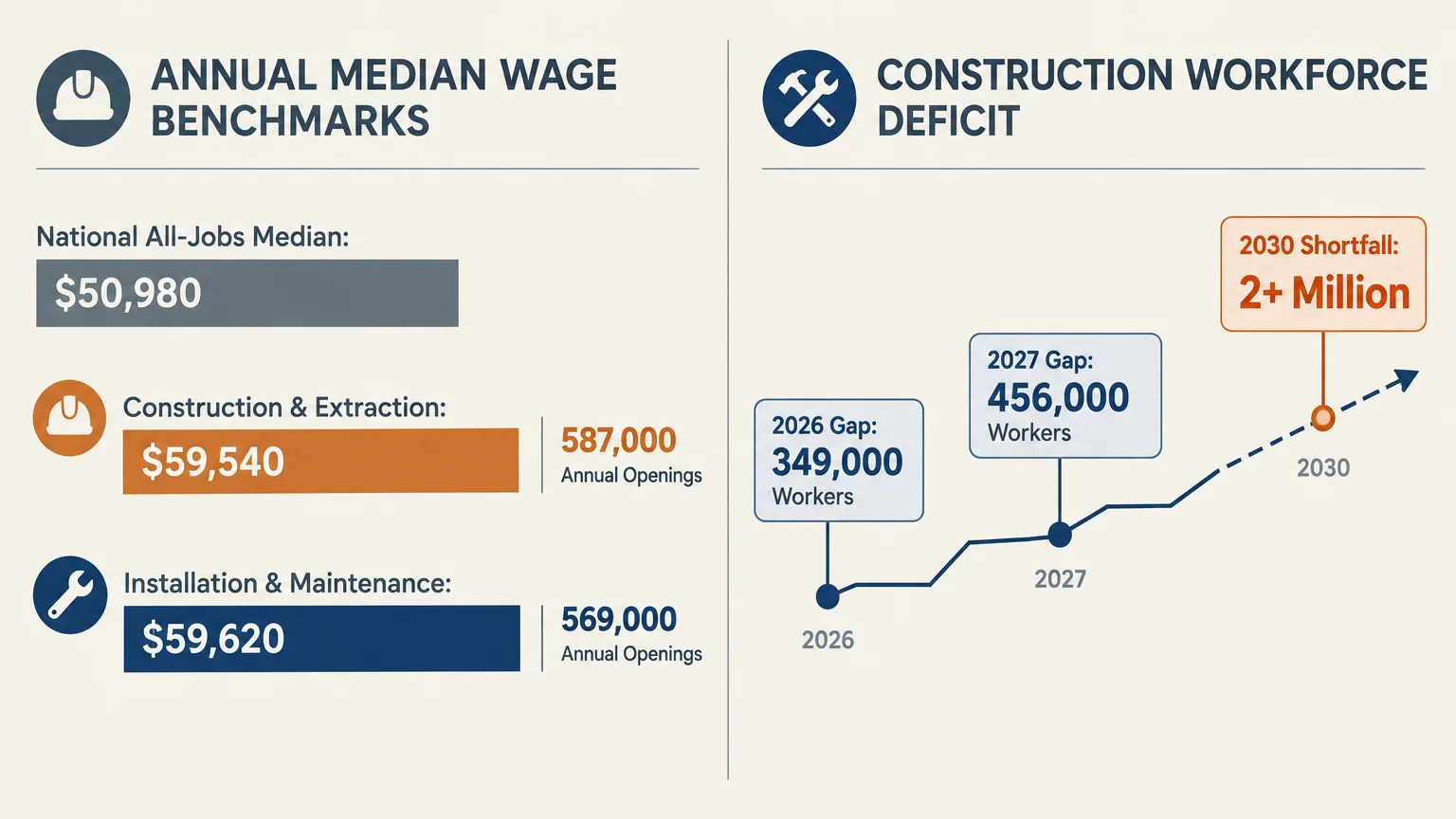
The national median annual wage across all American jobs sits at $50,980. In contrast, construction and extraction occupations now deliver a median wage of $59,540, with 587,000 projected openings each year.
Installation, maintenance, and repair roles offer a median annual income of $59,620 and generate 569,000 openings annually. Both sectors consistently beat broader employment benchmarks while facing severe labor deficits.
According to workforce research from the Associated Builders and Contractors, the construction sector needed 349,000 net new workers in 2026 just to meet baseline demand. That staffing gap expands to 456,000 workers in 2027.
Corporate leaders recognize this bottleneck. In August 2026, major corporations launched the Alliance for America’s Skilled Trades across 30 states to combat a projected deficit of over 2 million trade workers by 2030.
Founding corporate members include Ford, Carhartt, BlackRock, and Google. These companies understand that modern infrastructure, domestic manufacturing, and technology facilities cannot expand without trained hands-on technicians.
This dynamic shifts economic leverage directly into your pocket. Sponsoring contractors and service companies are raising starting pay, providing paid apprenticeships, and offering signing bonuses to secure reliable staff.
Comparison of High-Paying Trade Careers
The table below summarizes median earnings, projected growth rates, and primary training pathways based on data from the U.S. Bureau of Labor Statistics.
| Trade Occupation | Median Annual Pay | Projected Growth | Typical Entry Path |
|---|---|---|---|
| Elevator and Escalator Installers | $109,910 | 5.7% | Apprenticeship |
| Radiation Therapists | $105,310 | High replacement | Associate Degree |
| Dental Hygienists | $98,100 | 8.0% | Associate Degree |
| Diagnostic Medical Sonographers | $96,590 | 14.0% | Associate Degree or Certificate |
| Electrical Power-Line Installers | $95,320 | 10.0% | Apprenticeship or Technical School |
| Aircraft and Avionics Technicians | $80,180 | 6.0% | FAA Certificate or Apprenticeship |
| Wind Turbine Service Technicians | $64,120 | 30.0% | Technical Certificate |
| Industrial Machinery Mechanics | $64,100 | 14.0% | Apprenticeship or On-the-Job Training |
| Heavy Equipment Technicians | $63,850 | 7.0% | Technical Certificate or Apprenticeship |
| Plumbers, Pipefitters, Steamfitters | $63,800 | 7.0% | Apprenticeship |
| Electricians | $63,190 | 9.0% | Apprenticeship |
| HVAC/R Technicians | $61,010 | 11.0% | Technical Certificate or Apprenticeship |
12 High-Demand Trades Paying Over $60,000
1. Elevator and Escalator Installers and Repairers
Elevator and escalator technicians assemble, install, maintain, and troubleshoot complex vertical transportation systems. You keep passengers moving safely through commercial office towers, airports, hospitals, and residential buildings.
These skilled technicians earn a median annual wage of $109,910, or $52.84 per hour. Top earners in the highest tenth percentile take home more than $158,890 annually.
Employment is projected to grow 5.7% through 2035, yielding roughly 1,900 job openings each year. Continuous commercial construction and mandatory municipal safety modernizations ensure consistent call volume for qualified mechanics.
You can enter this trade with a high school diploma or equivalent. Most technicians complete a four-year registered apprenticeship through a union or private contractor, earning progressive wages while learning hydraulic, mechanical, and electrical controls.
2. Radiation Therapists
Radiation therapists administer targeted radiation treatments to oncology patients using high-energy linear accelerators. You collaborate directly with radiation oncologists, medical physicists, and oncology nurses to safely execute customized treatment regimens.
This specialized healthcare trade delivers a median annual wage of $105,310, which equals $50.63 per hour. Experienced therapists in the upper tenth percentile command salaries exceeding $156,710.
Oncology clinics and regional cancer centers report high replacement demand across the country. Facilities require dependable clinicians to replace retiring practitioners and maintain continuous patient treatment schedules without delays.
You can enter the field by completing an accredited two-year associate degree program in radiation therapy. Most states require clinical licensing and national certification through the American Registry of Radiologic Technologists.
3. Dental Hygienists
Dental hygienists perform cleanings, examine patients for oral systemic diseases, and provide preventative dental care. You work alongside dentists while operating with high clinical independence throughout your daily schedule.
The median annual wage for dental hygienists reaches $98,100, which works out to $47.16 per hour. Many hygienists structure flexible working arrangements, dividing their time between multiple practices to maximize their earnings.
The field is projected to grow 8% through 2035, creating 15,000 annual openings. According to an April 2026 report from the American Dental Association, 91% of recruiting dentists say hiring a hygienist is very or extremely challenging.
You need an associate degree in dental hygiene from an accredited community college or vocational institute. Once you pass your national board examinations and clinical tests, your state license opens doors to immediate job offers.
4. Diagnostic Medical Sonographers
Diagnostic medical sonographers use sophisticated high-frequency ultrasound equipment to capture internal body images. You help physicians diagnose medical conditions by examining abdominal organs, cardiovascular systems, and fetal development.
Sonographers earn a median annual wage of $96,590. This reflects an extraordinary 27% increase from the $75,920 median wage recorded in 2020, highlighting intense clinical demand.
Employment is projected to surge 14% through 2035, generating about 6,000 openings each year. Hospitals, diagnostic laboratories, and outpatient clinics constantly compete for qualified scanning technicians to meet patient intake volumes.
You can enter this profession by finishing an accredited two-year associate degree or a one-year postsecondary certificate. Professional credentials from the American Registry for Diagnostic Medical Sonography provide maximum hiring advantage and wage leverage.
5. Electrical Power-Line Installers and Repairers
Power-line installers and repairers—frequently called lineworkers—construct and service the nationwide electric grid. You climb utility poles and operate bucket trucks to maintain high-voltage distribution lines, transformers, and electrical substations.
Lineworkers earn a median annual wage of $95,320. Emergency storm restoration work and voluntary overtime frequently push total yearly compensation above $130,000 for seasoned field workers.
Job openings are projected to expand 10% through 2035, producing 10,900 positions per year. Massive grid modernization projects and frequent extreme weather events require utilities to maintain large, capable field crews.
You need a high school diploma and a commercial driver’s license to begin. Sponsoring utilities and trade unions guide you through multi-year apprenticeships combining hands-on line construction with rigorous high-voltage safety instruction.
6. Aircraft and Avionics Equipment Mechanics and Technicians
Aircraft mechanics inspect, overhaul, and service jet engines and airframes, while avionics technicians maintain radar, navigation, and flight control electronics. You ensure every aircraft satisfies strict federal flight safety benchmarks.
The combined occupational group earns a median annual wage of $80,180. Aircraft mechanics specifically earn a median of $79,870, while avionics specialists take home a median of $82,280.
Projected job growth stands at 6% through 2035, creating 13,100 openings each year. Commercial carriers and cargo fleets face an urgent talent shortage as baby boomer mechanics retire in record numbers.
You can qualify by completing an FAA-approved aviation maintenance technician school program to earn your Airframe and Powerplant (A&P) certificate. Sponsoring military maintenance experience or 18 to 30 months of documented civilian on-the-job training also qualifies you.
7. Wind Turbine Service Technicians
Wind turbine technicians inspect, troubleshoot, and repair wind energy generators. You operate hundreds of feet above ground to service pitch systems, main gearboxes, and electrical components.
These technicians earn a median annual wage of $64,120, or $30.83 per hour. Technicians who travel between utility-scale wind farms often earn substantial per-diem travel allowances that supplement base pay.
The Bureau of Labor Statistics projects wind technician employment to surge 30% through 2035, making it one of America’s fastest-growing careers. The industry generates roughly 1,500 new openings annually.
You can prepare for this trade by completing a one- to two-year certificate program at a technical college. Sponsoring wind farm operators provide safety certifications, tower rescue instruction, and specific original equipment manufacturer training.
8. Industrial Machinery Mechanics, Maintenance Workers, and Millwrights
Industrial machinery mechanics and millwrights install, align, and repair complex manufacturing equipment. You maintain robotic assembly lines, industrial pumps, conveyor systems, and hydraulic drives inside high-volume distribution and manufacturing plants.
Technicians earn a median annual salary of $64,100, which equals $30.82 per hour. Premium pay differentials for overnight industrial shifts often increase base hourly compensation.
The field is projected to grow 14% through 2035, far faster than the national occupational average. The ongoing expansion of domestic factories, food processing facilities, and automated warehouses creates steady demand for your technical problem-solving skills.
Most employers hire candidates with a high school diploma and technical aptitude. You can advance quickly through registered industrial apprenticeships that teach precision shaft alignment, programmable logic controllers, and welding techniques.
9. Heavy Vehicle and Mobile Equipment Service Technicians
Heavy vehicle technicians repair and overhaul bulldozers, hydraulic excavators, agricultural combines, and railway maintenance machinery. You diagnose complex diesel engines, electrical harnesses, and high-pressure fluid systems.
These mobile equipment technicians earn a median annual wage of $63,850, or $30.70 per hour. Mobile service mechanics who operate field repair trucks often earn significantly higher wages through overtime.
Employment is projected to grow 7% through 2035, producing 20,300 annual openings across the country. Federal highway spending and modern agricultural production ensure steady work for technicians servicing vital equipment fleets.
You can enter the industry with a high school diploma and vocational coursework in diesel mechanics. Leading equipment dealerships regularly sponsor tuition and pay for specialized manufacturer brand certifications.
10. Plumbers, Pipefitters, and Steamfitters
Plumbers, pipefitters, and steamfitters assemble and maintain piping networks carrying water, chemicals, steam, and gases. You work on residential plumbing, commercial high-rises, manufacturing plants, and municipal water facilities.
The median annual wage for plumbers is $63,800. Top union journeymen and independent plumbing contractors frequently earn more than $108,420 per year.
The profession will expand 7% through 2035, opening approximately 42,000 positions annually. Continuous residential construction, industrial infrastructure updates, and aging city water main replacements sustain constant demand.
You can launch your career through a four- to five-year registered apprenticeship program. Apprentices earn progressive hourly pay on real job sites while completing mandatory classroom hours in blueprint reading and plumbing code.
11. Electricians
Electricians install, connect, and troubleshoot electrical power, lighting, and industrial automation networks. You wire new buildings, install commercial solar arrays, and wire control systems in heavy industrial plants.
Electricians command a median annual wage of $63,190. Top journeymen and master wiremen earn more than $108,510 annually.
Employment is projected to expand 9% through 2035, creating 72,700 openings each year. The rapid construction of artificial intelligence data centers, semiconductor chip factories, and electric vehicle charging networks fuels massive nationwide demand.
You can begin with a high school diploma and an aptitude for algebra. Joining a joint union or non-union apprenticeship provides 8,000 hours of paid field work and comprehensive technical instruction.
12. Heating, Air Conditioning, and Refrigeration (HVAC/R) Mechanics
HVAC/R technicians install, maintain, and overhaul climate control systems and commercial refrigeration freezers. You work inside homes, supermarkets, hospitals, and office complexes to preserve air quality and perishable goods.
Technicians earn a median annual wage of $61,010, or $29.33 per hour. Specialists who service advanced industrial chillers and commercial supermarket racks routinely earn over $95,210.
The trade is projected to grow 11% through 2035, creating 40,600 job openings every year. Rapid conversions to energy-efficient electric heat pumps and stricter environmental refrigerant regulations guarantee ongoing system replacement projects.
You can enter the trade through a postsecondary certificate program or a multi-year contractor apprenticeship. Securing mandatory EPA Section 608 certification allows you to handle and reclaim regulated refrigerants legally.

How to Fund Your Trade Training Without Student Loans
Traditional four-year universities often leave students burdened with excessive debt before their first professional paycheck. Skilled trades offer practical alternatives that let you earn income while mastering your craft.
Registered apprenticeships represent the gold standard of debt-free career development. Sponsoring employers pay you an hourly wage that increases as you achieve technical milestones, while covering your instructional costs.
You can leverage several funding methods to build your skills without borrowing:
- Joint Apprenticeship Training Committees (JATCs): Union-backed training centers provide tuition-free instruction and structured job placement for electricians, plumbers, and elevator mechanics.
- Federal Pell Grants: Accredited community college trade programs accept need-based Pell Grants, which provide gift aid that you never have to repay.
- Employer Sponsorship Programs: Equipment dealerships and mechanical contractors routinely hire entry-level shop helpers and pay their vocational school tuition in exchange for work commitments.
- State Workforce Development Grants: Many state labor departments offer dedicated grants that cover tools, safety boots, and certification testing fees for high-demand occupations.
Taking advantage of these programs ensures you start your career with money in your savings account. You avoid the monthly student loan payments that strain so many household budgets.
Things to Watch Out For Before Choosing a Trade
Entering the skilled trades provides a reliable path to financial independence, but every profession involves real-world trade-offs. You should evaluate these potential challenges before selecting a career path.
Scenario 1: Significant physical wear and tear. Trades like pipefitting, line work, and roofing demand regular heavy lifting, awkward positions, and outdoor exposure. You must prioritize workplace ergonomics, proper lifting technique, and safety gear early to avoid chronic joint problems.
Scenario 2: Unpredictable emergency call schedules. Lineworkers, elevator technicians, and commercial refrigeration specialists frequently handle mandatory weekend, holiday, and night call-outs. You must weigh the lucrative overtime earnings against potential disruptions to your personal and family routines.
Scenario 3: Restrictive state licensing hurdles. Electricians and plumbers must log thousands of documented on-the-job apprentice hours before sitting for journeyman licensing exams. Relocating to another state may require supplemental testing or additional documented hours if licensing reciprocity does not apply.
Scenario 4: High upfront tool expenses. Many non-union contractors expect entry-level technicians to supply their own hand tools, meters, and protective boots. You should budget between $1,000 and $2,500 across your first two years to assemble a durable professional toolset.
Scenario 5: Seasonal work interruptions. Construction trades in northern states often slow down during harsh winter conditions. You must establish a dedicated three- to six-month emergency cash cushion to cover seasonal gaps between commercial job assignments.
When DIY Isn’t Enough: Navigating Complex Trade Decisions
Choosing a trade career seems simple, but specific professional milestones benefit from structured advice. Making uninformed decisions can cost you valuable training hours and earnings.
Speak with a union business agent or apprenticeship director when comparing union and non-union pathways. They can provide exact wage schedules, employer-funded health coverage details, and pension vesting terms for your local market.
Consult state occupational licensing boards before enrolling in private trade academies. Unaccredited private schools sometimes charge steep tuition fees without offering the qualified instructional hours your state demands for professional licensing.
Seek advice from a qualified tax professional once overtime pay or per-diem travel stipends start rolling in. Navigating higher tax brackets, tool deduction rules, and multi-state tax filings requires knowledgeable financial guidance.
Connect with seasoned master tradespeople through local trade association chapters. Experienced mentors can help you identify profitable technical niches that protect your earning power as you mature in your field.
Frequently Asked Questions
Can you really earn $60,000 during your first year in a trade?
Most entry-level trade apprentices start between $35,000 and $48,000 while learning baseline skills. However, apprentices who volunteer for overtime, weekend calls, and travel stipends frequently surpass $60,000 in their first twelve months.
Which trade offers the fastest training timeline for strong pay?
Wind turbine technicians and diagnostic medical sonographers offer some of the fastest pathways. You can complete certificate or associate programs in 12 to 24 months and immediately qualify for jobs paying over $64,000 to $96,000.
Are these trade careers protected from artificial intelligence and automation?
Yes, skilled hands-on trades remain heavily insulated from artificial intelligence. Diagnosing unpredictable field conditions, maneuvering tight spaces, and handling delicate wiring requires physical dexterity and situational problem-solving that software and robotics cannot replicate.
Do you need a college degree to move into trade management?
No, you do not need a bachelor’s degree to manage trade operations. Contractors and utility firms regularly promote experienced journeymen into estimator, field superintendent, project manager, and safety director roles based purely on proven field competence.
Moving Forward in the Trades
The nationwide shortage of skilled tradespeople creates a compelling opportunity for budget-conscious Americans. You can secure a six-figure income potential and lifelong job security without taking on the heavy debt of a four-year college degree.
Take your first step today by contacting your local trade union hall, visiting a community college vocational office, or researching open apprentice applications in your area. Exploring your local training options gives you the clarity you need to launch a rewarding career.
This is general informational content based on widely accepted guidance. Individual results vary. Verify current details—rules, prices, eligibility, regulations—with official sources before making important decisions.
Last updated: November 2026. Rules, prices, and details change—verify current information with official sources before acting on it.









Leave a Reply