
Splitting a $90,000 investment across three established pharmaceutical companies can generate $3,650 in dependable annual cash flow. That steady passive income delivers an average of $10 every single day straight into your brokerage account.
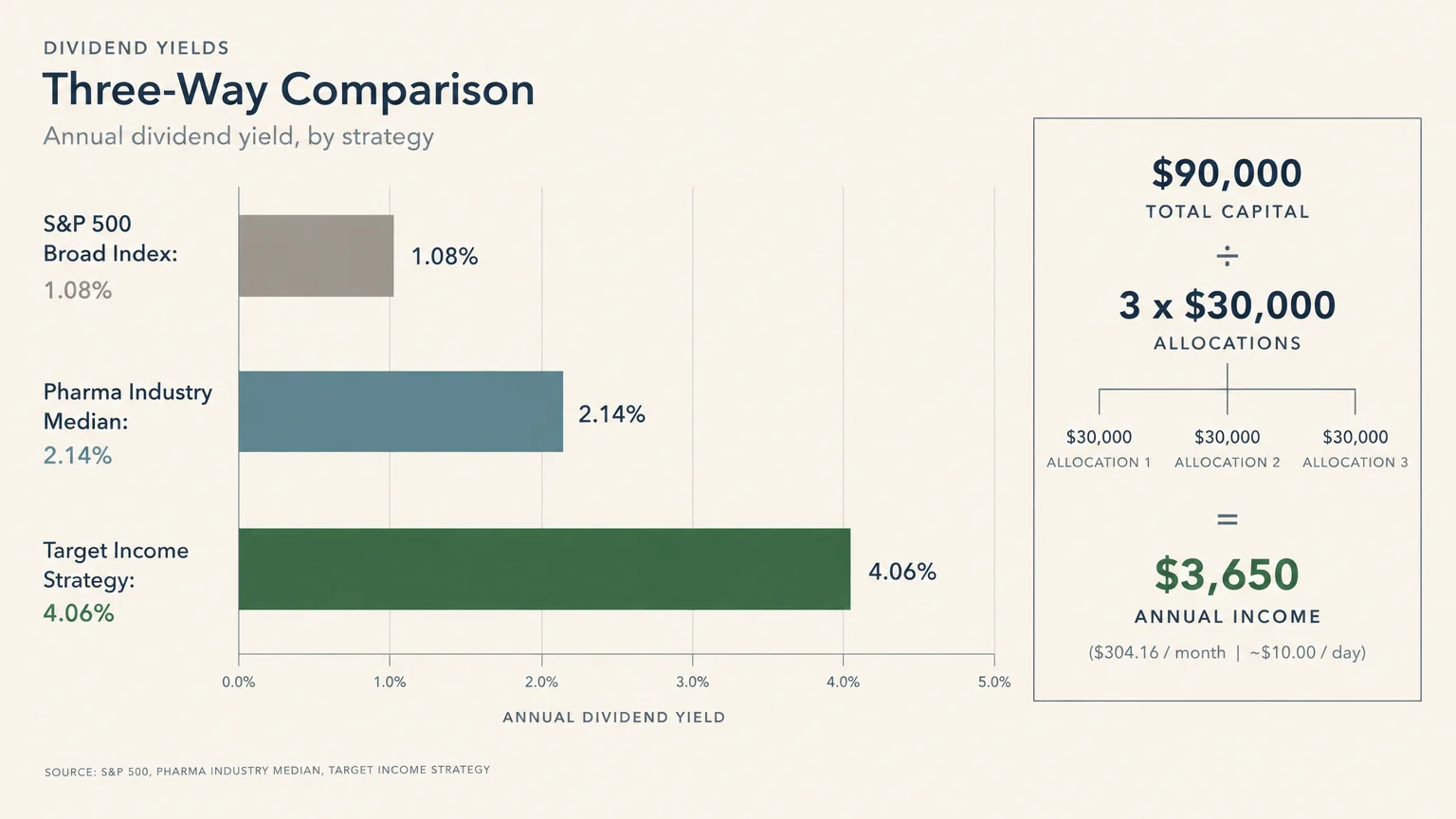
Achieving this target requires an average portfolio dividend yield of roughly 4.06%. That figure nearly quadruples the payout of the standard S&P 500 index while harnessing non-cyclical healthcare demand.
Balancing high immediate yields with consistent annual increases helps you protect your capital against inflation. Here is how you can assemble a resilient pharmaceutical income stream.
The 4.06% Yield Target: Breaking Down the Math
Generating $3,650 annually from a $90,000 principal requires an average dividend yield of exactly 4.055%, rounded to 4.06%. This payout translates to $304.16 every month, or approximately $10 every single day.
Securing a durable 4.06% return demands selective stock picking in today’s equity market. The broad S&P 500 index offers an average dividend yield of only 1.06% to 1.08%.
A standard index fund allocating that same capital produces less than $1,000 each year. You would fall far short of your everyday income goals without harvesting principal.
The pharmaceutical sector provides a practical solution for yield-focused investors. The median dividend yield across the drug manufacturing industry sits at 2.11% to 2.14%.
Established pharmaceutical leaders generate robust operating cash flow that easily surpasses broad industry medians. That financial strength allows select blue-chip drugmakers to fund distributions well above 4%.
Allocating $30,000 into each of three distinct drug manufacturers creates an equally weighted foundation. This structure balances immediate high income with long-term dividend growth.
Stock 1: Pfizer (NYSE: PFE) — The High-Yield Foundation
Pfizer trades around $29.25 to $30.50 per share, offering one of the highest yields among large healthcare companies. Its generous yield provides the heavy lifting for your income goal.
The company pays a quarterly dividend of $0.43 per share, which equals $1.72 on an annualized basis. This payout establishes an attractive dividend yield of roughly 5.72% to 5.88%.
Investing $30,000 into Pfizer purchases roughly 1,000 shares at prevailing prices. Those shares generate approximately $1,720 to $1,750 in gross dividend income each year.
Pfizer maintains an extraordinary record of returning cash to shareholders. The company made its 352nd consecutive quarterly dividend payment in December 2026, following a November 6, 2026 ex-dividend date.
Income investors frequently question whether elevated yields remain sustainable over several years. Pfizer’s dividend distributions currently consume about 41% of its operating cash flow.
That modest cash flow burden leaves ample capital to fund commercial operations and clinical development. Management also raised full-year 2026 guidance on November 3, 2026, following solid operational performance.
Stock 2: Bristol Myers Squibb (NYSE: BMY) — The Core Cash Generator
Bristol Myers Squibb trades between $62.67 and $63.73 per share, matching your exact portfolio yield target. It serves as the balanced middle pillar of your healthcare income strategy.
The company distributes $0.63 per share quarterly, totaling $2.52 per share annualized. That payout provides a steady dividend yield between 4.01% and 4.08%.
A $30,000 position in Bristol Myers Squibb secures about 475 shares. This allocation contributes roughly $1,200 to $1,218 in passive dividend income each year.
Bristol Myers Squibb has raised its shareholder dividend for 16 consecutive years. The board demonstrated that ongoing commitment by lifting the quarterly payout from $0.62 in January 2026.
Earnings comfortably cover this steady shareholder payout. The annual dividend consumes roughly 38% to 40% of projected 2026 non-GAAP earnings of $6.35 to $6.55 per share.
Investors must still track patent transitions over the coming years. Bristol Myers Squibb anticipates a $1.5 billion to $2 billion revenue step-down for blood-thinner Eliquis in 2027.
The company is countering that patent expiration through newer oncology treatments and targeted cardiovascular therapies. Its conservative payout ratio provides an essential buffer while new drugs scale.

Stock 3: AbbVie (NYSE: ABBV) — The Proven Dividend Growth Engine
AbbVie trades between $290.79 and $294.98 per share, serving as the portfolio’s dividend growth engine. It supplies compounding dividend increases that protect your purchasing power over time.
The company paid $1.73 per share quarterly in late 2026, delivering an annualized payout of $6.92. That payout delivered a trailing dividend yield of roughly 2.35%.
Management declared a fresh dividend hike to $1.82 quarterly, or $7.28 annualized, starting in early 2027. This increase lifts your forward dividend yield to approximately 2.48%.
A $30,000 allocation secures about 102 shares of AbbVie. At the updated forward rate, those shares generate roughly $744 in annual dividend income.
AbbVie holds Dividend King status, boasting 53 consecutive years of dividend increases when including its Abbott heritage. The company has raised payouts every single year since its 2013 corporate spinoff.
AbbVie recently proved its operational resilience by navigating the loss of patent exclusivity on Humira. While Humira revenue dropped 31.2%, total third-quarter 2026 net revenue rose 10.3% to $17.4 billion.
Newer immunology therapies drove that revenue expansion, led by Skyrizi’s 22.7% sales growth. That operational rebound ensures the company can maintain its long streak of annual dividend increases.
Portfolio Blueprint: Allocation and Cash Flow Breakdown
Combining these three pharmaceutical giants creates a diversified income engine. The high yield from Pfizer offsets the lower initial yield from AbbVie, while Bristol Myers Squibb anchors the middle.
The blended return comfortably exceeds your annual baseline income requirement. You generate between $3,712 and $3,735 each year, leaving a cash cushion above your $3,650 target.
| Company Name | Ticker | Capital Allocated | Share Price Range | Annual Dividend | Dividend Yield | Expected Annual Income |
|---|---|---|---|---|---|---|
| Pfizer Inc. | PFE | $30,000 | $29.25 – $30.50 | $1.72 | 5.72% – 5.88% | ~$1,750 |
| Bristol Myers Squibb | BMY | $30,000 | $62.67 – $63.73 | $2.52 | 4.01% – 4.08% | ~$1,218 |
| AbbVie Inc. | ABBV | $30,000 | $290.79 – $294.98 | $7.28 (Forward) | 2.48% (Forward) | ~$744 |
| Total Portfolio | — | $90,000 | — | — | ~4.15% (Blended) | ~$3,712 – $3,735 |
This equal allocation shields you from single-company shocks while providing predictable cash flow. You collect income distributions nearly every month throughout the calendar year.
Pfizer distributes cash in March, June, September, and December. Bristol Myers Squibb and AbbVie distribute dividends in February, May, August, and November.
Alternative Drug Stocks for Dividend Portfolios
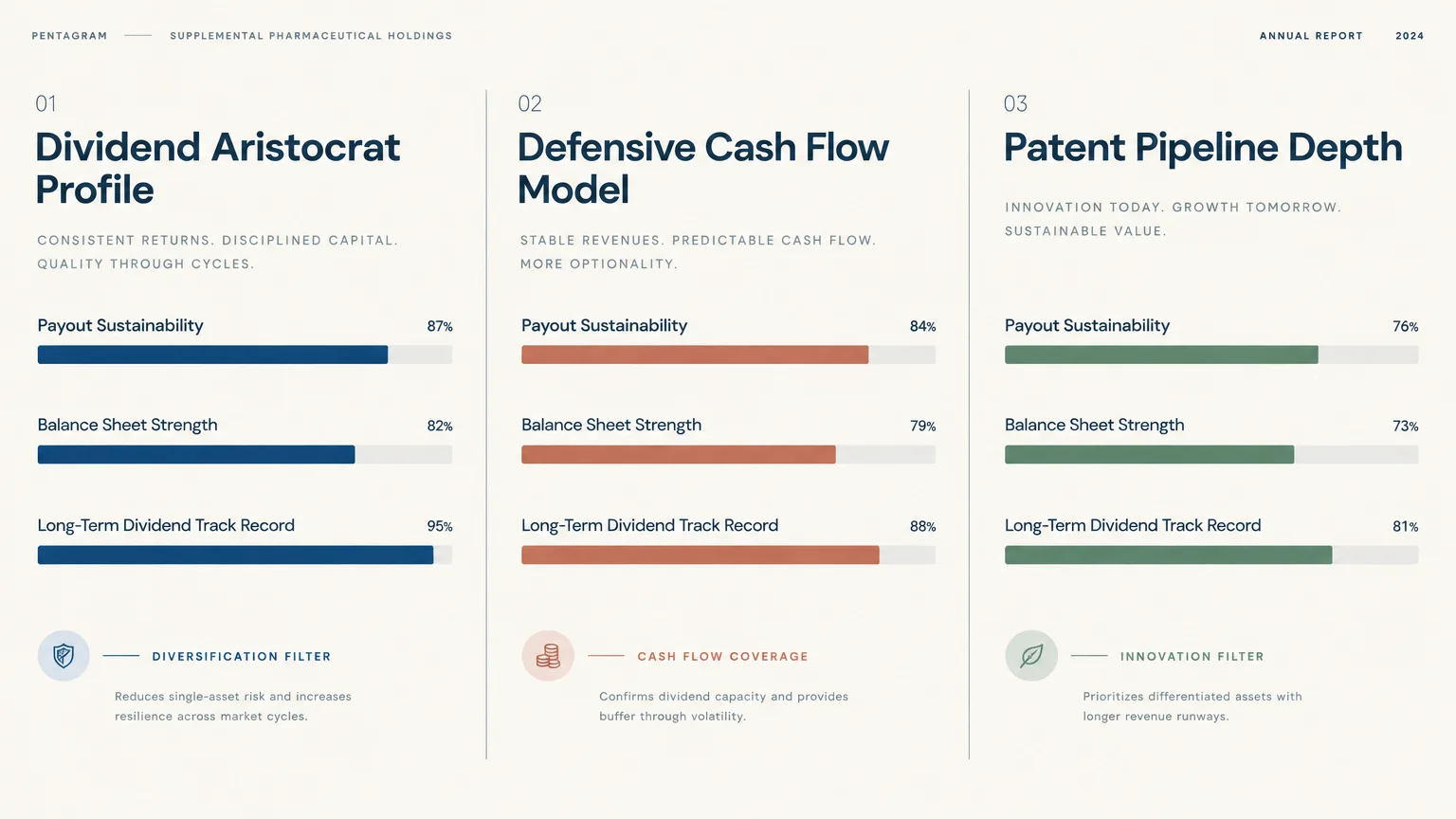
You can customize this healthcare income strategy based on your personal yield preferences. Several other established global pharmaceutical firms offer competitive payouts and stable operating fundamentals.
- Sanofi (NASDAQ: SNY): Trades around $43.13 to $48.06 per American Depositary Receipt (ADR) and yields 5.14% to 5.66%. The French drugmaker paid $2.42 per ADR in June 2026, marking 31 consecutive years of dividend increases in euros.
- GSK (NYSE: GSK): Yields roughly 3.61% and declared a quarterly distribution of $0.4518 per ADR in late 2026. The British pharmaceutical company provides strong exposure to vaccines and specialty medicines.
- Merck (NYSE: MRK): Trades between $122.41 and $147.12 per share with an annual payout of $3.40 ($0.85 quarterly). It delivers a yield of 2.32% to 2.78%, supported by oncology blockbuster Keytruda.
- Amgen (NASDAQ: AMGN): Trades from $447.95 to $465.23 and pays $10.08 annually ($2.52 quarterly). That distribution translates to a dividend yield of 2.17% to 2.25%.
- Gilead Sciences (NASDAQ: GILD): Trades around $159.20 to $170.87 per share, yielding 1.97% to 2.06%. The company pays $3.28 per share annually ($0.82 quarterly) backed by its dominant HIV drug franchise.
- Johnson & Johnson (NYSE: JNJ): Trades near $280.00 to $281.20, paying $5.36 annually ($1.34 quarterly) for a yield of 1.93% to 1.94%. The healthcare titan boasts 64 consecutive years of dividend hikes.
Swapping higher-yielding names like Sanofi into your portfolio raises immediate cash flow. Conversely, adding lower-yielding giants like Johnson & Johnson lowers total yield while maximizing capital preservation.
Why Healthcare Dividends Remain Resilient in Any Economy
Pharmaceutical businesses possess structural economic advantages that make their cash flows remarkably resilient. Consumers cannot defer essential medications during recessions, high inflation, or broader stock market volatility.
This inelastic demand gives pharmaceutical producers consistent revenue throughout every phase of the economic cycle. Hospital systems, insurers, and patients continue paying for life-saving therapies regardless of economic conditions.
Drug manufacturing also benefits from immense barriers to entry. Bringing a novel pharmaceutical compound from discovery through clinical trials requires years of research and billions of dollars in capital.
Patent exclusivity grants pharmaceutical creators temporary monopoly pricing power on breakthrough medications. That intellectual property protection generates operating profit margins that regularly exceed broader market benchmarks.
Global demographic trends provide another powerful tailwind for healthcare providers. Aging populations across North America, Europe, and Asia require higher volumes of prescription treatments each year.
These structural advantages allow well-run drug companies to generate substantial free cash flow. Management teams routinely share that excess cash directly with investors through dependable quarterly distributions.
Tax Rules and Strategies: Keeping More of Your Payout
Taxes can dramatically diminish your investment returns if you fail to plan your account placement. Fortunately, most pharmaceutical dividends qualify for favorable federal capital gains tax rates rather than ordinary income rates.
According to the Internal Revenue Service, qualified dividends receive preferential tax treatment if you meet specific holding period standards. You must hold the underlying shares for more than 60 days during the 121-day window surrounding the ex-dividend date.
For budget-conscious investors and retirees, the federal qualified dividend tax rates offer an exceptional benefit:
- 0% Tax Bracket: Applies to taxable income up to $49,450 for Single filers or $98,900 for Married Filing Jointly. If your income falls below these levels, you pay zero federal tax on your $3,650 payout.
- 15% Tax Bracket: Applies to taxable income between $49,451 and $545,500 for Single filers, or $98,901 to $613,700 for Married Filing Jointly. Most middle-income investors pay 15% on qualified distributions.
- 20% Tax Bracket: Applies to taxable income exceeding $545,500 for Single filers or $613,700 for Married couples filing jointly.
Research from the U.S. Securities and Exchange Commission highlights that tax efficiency plays an essential role in long-term compounding. Choosing the right account structure determines how much cash you keep.
Holding dividend stocks inside a taxable brokerage account works well if your total taxable income falls within the 0% bracket. You collect your quarterly distributions entirely free of federal income tax.
Investors in higher tax brackets should consider holding high-yielding stocks like Pfizer inside a Roth IRA. In a Roth account, your dividends compound tax-free and withdrawals remain completely tax-exempt in retirement.
Traditional IRAs and 401(k) rollovers defer taxes until withdrawal, but distributions eventually face ordinary income tax rates. Weigh your current tax bracket against your anticipated retirement income before allocating your $90,000.
Things to Watch Out For: Key Risks in Pharmaceutical Stocks
Investing in individual pharmaceutical companies carries specific risks that differ from owning broad index funds. You must monitor company-specific operational developments to protect your capital and income stream.
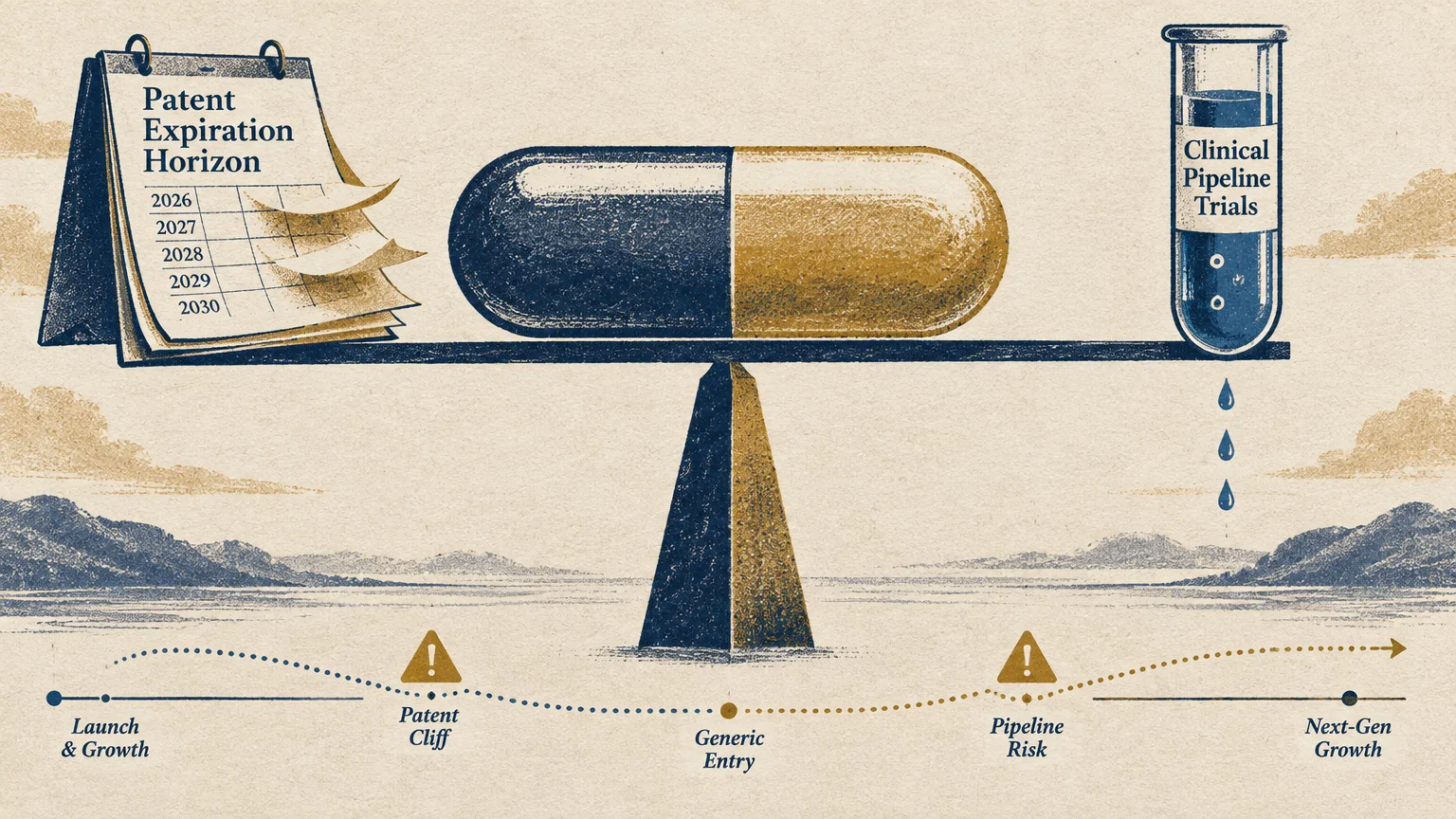
Patent Cliffs and Generic Competition: When a blockbuster drug loses patent exclusivity, generic competitors flood the market and slash product revenue. For example, AbbVie successfully countered steep Humira sales declines with Skyrizi, while Bristol Myers Squibb faces a $1.5 billion to $2 billion drop for Eliquis in 2027.
Clinical Trial Failures: Developing new pharmaceutical therapies involves substantial clinical trial risk. When an experimental drug fails a Phase 3 study, the company loses development capital and anticipated future revenue.
Regulatory and Pricing Scrutiny: Government drug negotiation programs and healthcare reform legislation can pressure prescription prices. Investors must assess how Medicare price negotiations impact long-term cash flow for major treatments.
Elevated Debt from Acquisitions: Large pharmaceutical companies frequently acquire smaller biotechnology firms to replenish depleted drug pipelines. If a company takes on excessive debt for an acquisition, rising interest costs can jeopardize dividend growth.
Dividend Cuts from Stretched Payout Ratios: When distributions consume more than 80% of free cash flow, the risk of a dividend reduction escalates. Always verify that operating cash flow covers dividend payments by a wide margin.
How to Deploy Your $90,000: Execution Strategies
Deciding how to enter the market depends on your risk tolerance and emotional comfort. You can deploy your capital either through a lump-sum purchase or dollar-cost averaging.
A lump-sum purchase puts your full $90,000 to work immediately, capturing dividends from the next scheduled distribution date. This method maximizes your immediate income generation if share prices remain steady or rise.
Dollar-cost averaging involves splitting your $90,000 into smaller equal tranches invested over three to six months. This disciplined strategy reduces the risk of buying shares right before a short-term market dip.
Consider your preferred payout method once your shares sit securely in your brokerage account. You can enroll in an automated Dividend Reinvestment Plan (DRIP) or receive distributions as cash.
A DRIP reinvests your quarterly distributions into additional fractional shares without trading commissions. This compounding process accelerates portfolio growth if you do not need immediate spending money.
If you rely on your portfolio for everyday living costs, instruct your broker to deposit dividends directly into a cash account. That automated distribution system delivers predictable income to cover groceries, utilities, or property taxes.

When DIY Isn’t Enough
Managing an income portfolio often seems straightforward, but complex financial circumstances can complicate your strategy. In certain situations, hiring a Certified Financial Planner (CFP) or a certified public accountant (CPA) is essential.
Managing Medicare IRMAA Surcharges: Generating additional taxable income can push your modified adjusted gross income over Medicare thresholds. Crossing those limits triggers substantial monthly surcharges on your Medicare Part B and Part D premiums.
Liquidating Concentrated Assets with Heavy Capital Gains: If you must sell existing appreciated assets to raise $90,000, you could trigger significant capital gains taxes. A tax advisor can structure tax-loss harvesting or installment sales to minimize your tax liability.
Coordinating Required Minimum Distributions (RMDs): Retirees over age 73 must take mandatory withdrawals from traditional retirement accounts. A financial professional can coordinate dividend distributions with RMD rules to prevent steep IRS penalties.
Structuring Multi-Generational Estate Plans: Leaving dividend-paying stocks to children or grandchildren involves stepped-up basis rules and potential trust structures. An estate attorney ensures your assets transfer smoothly while minimizing probate costs.
Frequently Asked Questions
Can you live off dividends from drug stocks in retirement?
Yes, many retirees cover essential living expenses using dividend income without selling underlying shares. However, holding a concentrated portfolio in just three stocks carries risk; diversifying across multiple sectors provides greater safety.
How do I check if a pharmaceutical dividend is safe from cuts?
Review the company’s dividend payout ratio relative to free cash flow and non-GAAP earnings. Payout ratios below 60% generally indicate that the company can easily sustain distributions even during earnings slowdowns.
What happens if one of these companies cuts its dividend?
A dividend reduction directly lowers your annual income and often leads to a drop in share price. If a company slashes its payout, re-evaluate its business fundamentals and consider reallocating to a healthier dividend payer.
Are dividends from Pfizer, Bristol Myers Squibb, and AbbVie qualified?
Yes, distributions from these three domestic corporations qualify for preferential tax rates if you satisfy holding period requirements. You must hold your shares for more than 60 days around the ex-dividend date.
Taking Action on Your Dividend Plan
Building a $3,650 annual passive income stream from a $90,000 investment is a practical financial goal. By balancing Pfizer’s high initial yield, Bristol Myers Squibb’s steady cash generation, and AbbVie’s dividend growth, you build an effective income engine.
Take time to review your tax bracket and select the ideal account type before purchasing shares. Regular monitoring of quarterly earnings and patent pipelines will help keep your healthcare portfolio productive for years to come.
This article provides general information only. Every reader’s situation is different—what works for others may not be the right fit for you. For personalized guidance on health, legal, or financial matters, consult a qualified professional.
Last updated: November 2026. Rules, prices, and details change—verify current information with official sources before acting on it.









Leave a Reply