

Your accumulated decades of professional judgment, crisis management, and industry knowledge are irreplaceable assets in today’s shifting workforce. Many employers actively seek seasoned talent over entry-level candidates to solve complex challenges without hand-holding.
Whether you want a lucrative second career, flexible semi-retirement income, or a fresh direction, certain fields prize your background. Discovering these opportunities helps you build financial security while putting your hard-earned wisdom to profitable use.
These 12 high-impact roles welcome mature workers, offer competitive compensation, and reward the strategic problem-solving that only life experience provides.
Why Experience Commands a Premium in Today’s Workforce
The modern labor market increasingly rewards institutional knowledge and steady leadership over raw speed. Organizations facing turbulent economic shifts need professionals who have already navigated multiple business cycles.
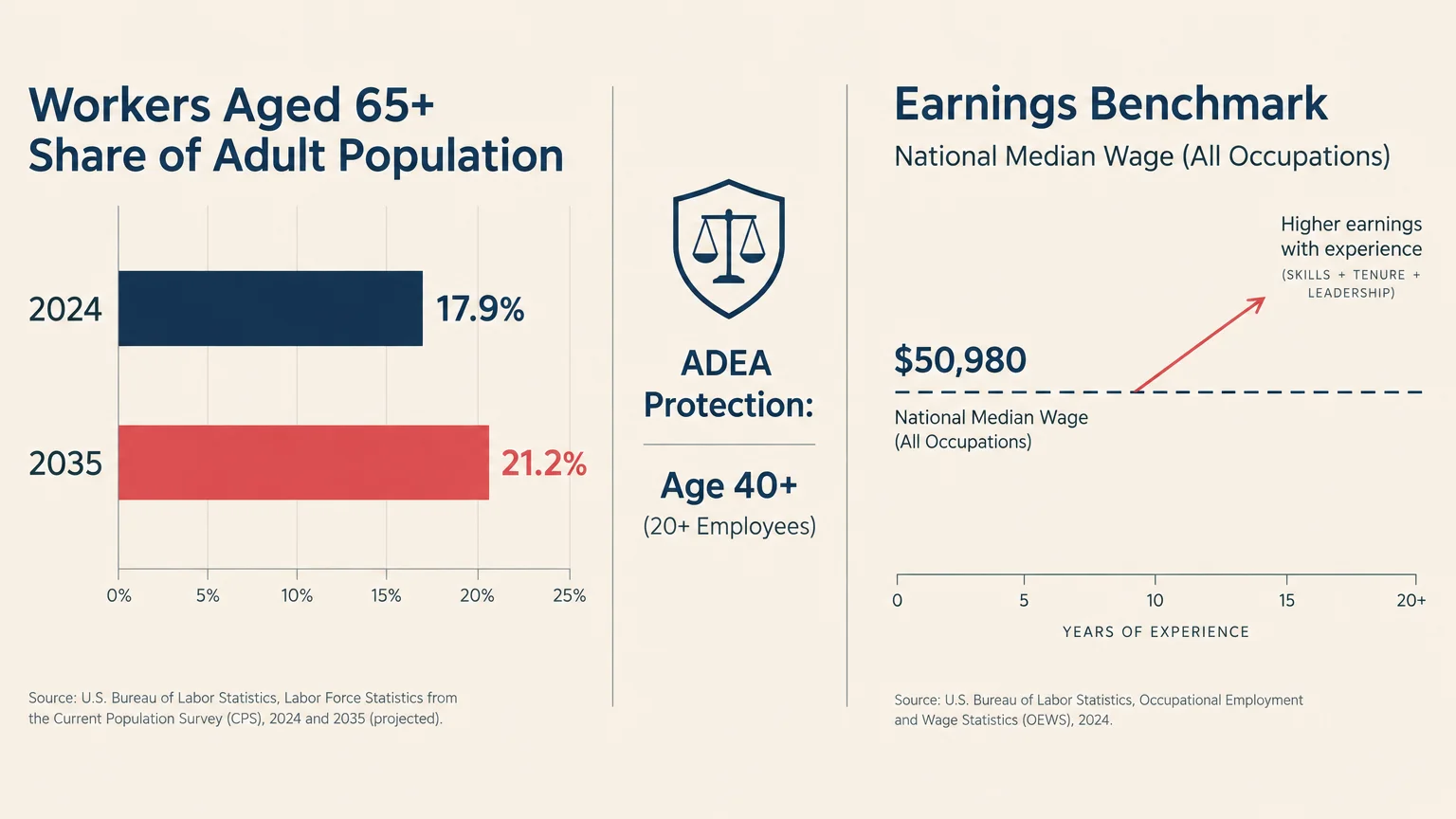
Demographic trends clearly highlight this transformation. According to data from the U.S. Bureau of Labor Statistics, workers aged 65 and older represent the fastest-growing age segment of the domestic labor force.
Their share of the adult population is projected to reach 21.2% by 2035, up from 17.9% in 2024. As businesses recognize this reality, age-friendly employers are redesigning roles to retain critical institutional expertise.
Federal law reinforces your workplace standing. The Equal Employment Opportunity Commission enforces the Age Discrimination in Employment Act (ADEA), which protects job seekers and workers aged 40 and older at firms with 20 or more employees.
While the overall national median wage across all occupations sits at $50,980, experience-driven positions often yield earnings well above that baseline. Seasoned professionals who target the right industries gain significant compensation advantages.

12 High-Value Roles That Reward Decades of Experience
The following twelve career paths actively favor mature professionals. They prioritize steady judgment, practical problem-solving, and emotional intelligence over entry-level credentialing.
1. Management Analyst (Business Consultant)
Management analysts examine organizational operations, pinpoint inefficiencies, and recommend procedural overhauls. Companies regularly contract external consultants who bring real-world industry perspective rather than purely theoretical textbook solutions.
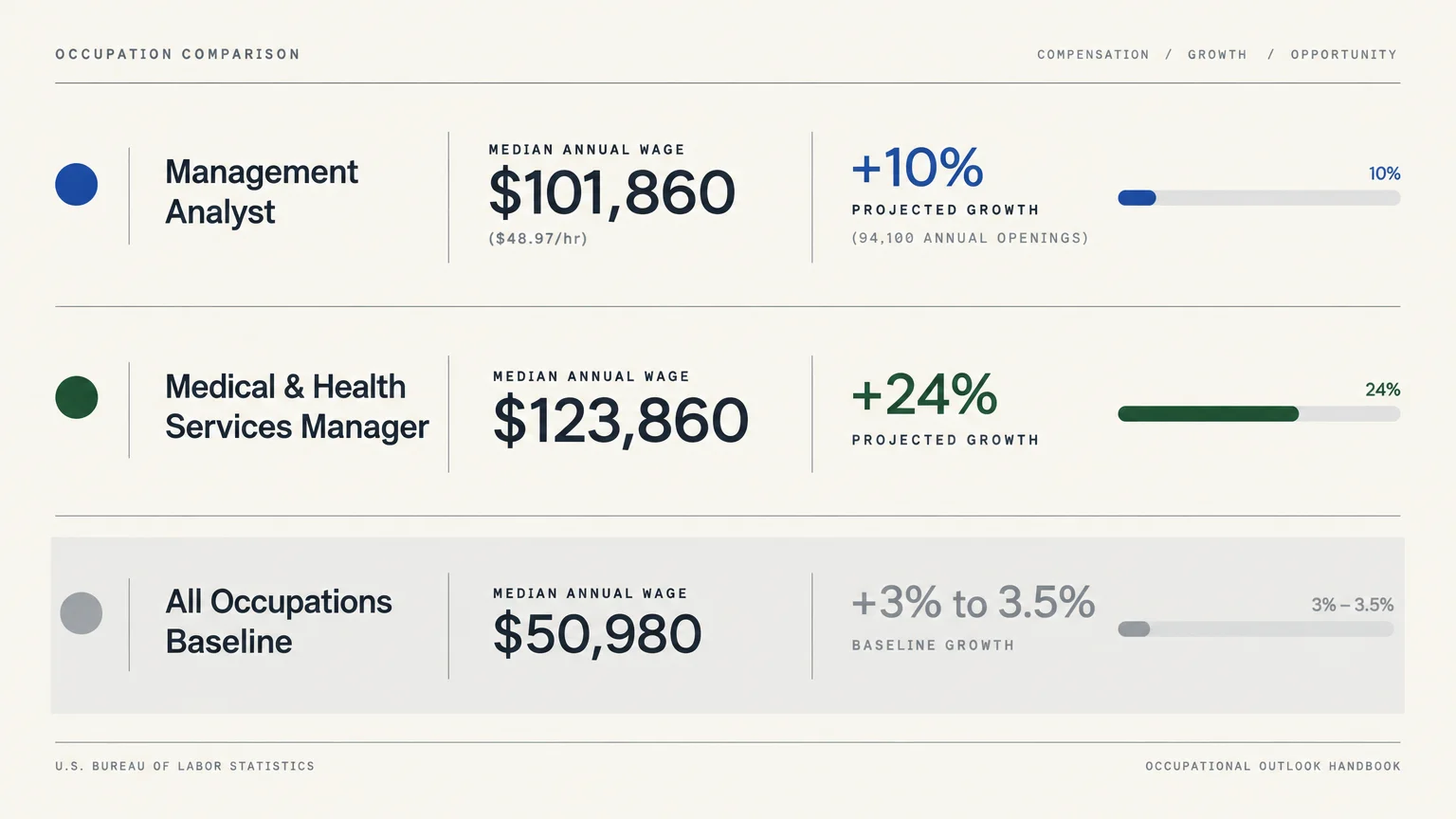
According to the BLS, management analysts earn a median annual wage of $101,860 ($48.97 per hour). The field is expanding rapidly, with 10% projected employment growth through 2035 and roughly 94,100 annual openings.
Your previous management background translates immediately into consulting engagements. You can work with established consulting practices or launch an independent advisory firm focused on your legacy industry.
2. Medical and Health Services Manager
Healthcare administrators oversee the business operations, staffing, and regulatory compliance of medical facilities, clinics, and specialized practices. This sector prizes candidates who remain unflappable while directing complex logistical systems.
The role offers a median annual salary of $123,860. The BLS projects staggering 24% job growth for healthcare administrators through 2035, far outpacing the overall national employment growth baseline of 3% to 3.5%.
Transitioning into healthcare administration from corporate operations or logistics requires bridging specialized terminology. Completing a targeted graduate certificate or healthcare compliance credential often opens immediate doors.
3. Personal Financial Advisor
Personal financial advisors guide individuals through retirement planning, investment allocation, estate strategies, and tax decisions. Clients trusting someone with their life savings inherently gravitate toward advisors who have successfully weathered market downturns.
The median annual wage for personal financial advisors is $105,070, with approximately 17,100 job openings projected each year. Seasoned professionals can build fee-only advisory practices or partner with existing wealth management brokerages.
To succeed, you must pass licensing exams such as the Series 65 or earn designations like the Certified Financial Planner (CFP). Your personal life experience provides a massive competitive advantage when consoling anxious clients.
4. Human Resources Manager
Human resources managers supervise recruitment, design retention programs, mediate workplace disputes, and align staffing with strategic business goals. Resolving sensitive interpersonal friction demands diplomacy and maturity that junior employees rarely possess.
HR managers command a median annual salary of $149,280 ($71.77 per hour). The BLS projects 6% employment growth through 2035, generating roughly 16,800 annual openings nationwide.
Longtime executives and department heads frequently transition into human resources consulting. Earning a credential from the Society for Human Resource Management (SHRM) helps validate your legal and compliance knowledge.
5. Project Management Specialist
Project managers organize cross-functional teams, coordinate budgets, monitor deadlines, and resolve operational bottlenecks. Seasoned leaders excel here because they anticipate complications long before projects run off schedule.
The median annual pay for project management specialists is $102,320. The BLS anticipates 7% employment growth through 2035, creating roughly 76,500 new openings annually across various sectors.
Securing a Project Management Professional (PMP) credential can quickly formalize decades of informal leadership. This role also provides immense contract and remote work flexibility for semi-retired professionals.
6. Accountant and Auditor
Accountants prepare financial statements, conduct internal reviews, ensure regulatory adherence, and analyze tax liabilities. Corporate boards value the meticulous ethical standards and pattern recognition that experienced financial auditors provide.
Accountants and auditors earn a median annual income of $83,680. Projected employment growth stands at 5% through 2035, yielding approximately 115,300 openings each year.
Whether you hold a CPA or offer small business bookkeeping, seasonal tax preparation and outsourced fractional controller roles offer lucrative part-time schedules. Experience ensures you spot balance-sheet irregularities effortlessly.
7. Postsecondary Teacher (Adjunct Instructor)
Higher education institutions, vocational schools, and community colleges continuously recruit real-world practitioners to teach specialized subjects. Academic departments value instructors who bring actionable corporate insights into the classroom.
Postsecondary teachers earn a median annual wage of $85,330 across all fields. Instructors specializing in health fields earn a median salary of $107,310.
Most community colleges require a master’s degree in your discipline rather than a doctorate. Teaching provides predictable semester schedules, extensive breaks, and deep personal fulfillment as you mentor emerging talent.
8. Training and Development Manager
Training managers design corporate learning programs, run leadership workshops, and oversee continuous education for enterprise workforces. Organizations need seasoned professionals who understand executive succession and skill development.
The median pay for training and development managers reaches $133,000 annually ($63.94 per hour). Non-managerial training specialists earn a median of $69,280, with an impressive 11% projected job growth rate.
If you enjoy public speaking, coaching, and instructional design, this path offers extraordinary value. It enables you to monetize your accumulated industry expertise by teaching it to junior employees.
9. Executive Administrative Assistant
Executive assistants support corporate officers, university presidents, and healthcare leaders by coordinating schedules, handling sensitive correspondence, and managing office operations. Discretion and poise under pressure are mandatory requirements.
Executive secretaries earn a median annual wage of $76,590 ($36.82 per hour). This represents a substantial premium over general administrative assistants, who earn a median of $48,310.
High-level leaders rely on executive assistants who can anticipate needs and handle board communications without supervision. This position provides steady hours, excellent benefits, and minimal requirement for evening work.
10. Property and Community Association Manager
Property managers oversee commercial real estate, residential apartment complexes, and homeowner associations (HOAs). They handle contractor negotiations, maintenance budgets, resident communications, and local code enforcement.
The median pay for property and community association managers is $69,990 ($33.65 per hour), with 4% projected job growth. Approximately 31% of professionals in this occupation are self-employed.
Your life experience in home maintenance, conflict resolution, and budgeting makes you a natural candidate. The role offers varied daily work that balances office management with on-site inspections.
11. Health Education Specialist and Patient Advocate
Patient advocates and health educators help individuals navigate hospital systems, decipher medical billing, understand treatment plans, and access community resources. Older adults facing healthcare crises deeply appreciate having an empathetic, experienced ally.
Health education specialists earn a median annual wage of $64,070 ($30.80 per hour), with 6% projected employment growth through 2035. Private patient advocacy practices allow practitioners to bill premium hourly consultation rates.
Former nurses, social workers, and insurance administrators transition smoothly into this career. It offers profound personal impact alongside flexible consulting hours tailored to your availability.
12. Real Estate Sales Agent
Real estate agents assist clients with buying, selling, and leasing residential or commercial properties. Decades of local community residency, deep networking contacts, and negotiating maturity give older agents a distinct edge.
The median annual income for real estate agents is $52,830 ($25.40 per hour), with top producers earning far more through commissions. Around 32,600 positions open annually across the country.
Obtaining a state license takes only a few months of study and exam preparation. You control your schedule completely, allowing you to scale transaction volume up or down based on your personal budget.
Comparing Top Experience-Friendly Careers
Reviewing compensation, job growth, and baseline qualifications helps you select the right target. The table below details key metrics for these high-demand occupations.
| Occupation | Median Annual Wage | Projected Growth (2025–2035) | Core Advantage of Experience |
|---|---|---|---|
| Human Resources Manager | $149,280 | 6% | Crisis mitigation and executive mediation poise |
| Training & Development Manager | $133,000 | 6% | Institutional memory and mentorship capability |
| Medical & Health Services Manager | $123,860 | 24% | Operational discipline and regulatory command |
| Personal Financial Advisor | $105,070 | 1% | Client trust through shared financial life stages |
| Project Management Specialist | $102,320 | 7% | Stakeholder diplomacy and risk anticipation |
| Management Analyst | $101,860 | 10% | Cross-industry pattern recognition |
| Postsecondary Teacher | $85,330 | 3% | Practical real-world case knowledge |
| Accountant and Auditor | $83,680 | 5% | Tax precision and compliance instincts |
| Executive Administrative Assistant | $76,590 | -6% | C-suite discretion and gatekeeping authority |
| Property Association Manager | $69,990 | 4% | Vendor management and community diplomacy |
| Health Education Specialist | $64,070 | 6% | Compassionate healthcare system navigation |
| Real Estate Sales Agent | $52,830 | 2% | Extensive local personal networks |

Protecting Social Security and Optimizing Taxes
Earning an active income in your late 50s, 60s, or 70s requires careful tax planning. Failing to understand federal earning thresholds can lead to surprising benefit withholdings and tax bills.
If you claim Social Security before your full retirement age (FRA), your earnings are subject to the Social Security Retirement Earnings Test. For workers born in 1960 or later, FRA is 67.
If you are under FRA for the entire calendar year, you can earn up to $24,480 in 2026 ($25,560 in 2027). Beyond that limit, the Social Security Administration temporarily withholds $1 in benefits for every $2 earned.
In the calendar year you reach full retirement age, a higher earnings limit applies. You can earn up to $65,160 in 2026 ($67,920 in 2027) before FRA month, with $1 withheld for every $3 earned above the limit.
Once you reach your FRA month, the earnings cap vanishes completely. You can earn unlimited wages with zero withholding penalties, and the SSA will recalculate your monthly benefit upward to credit previously withheld amounts.
To reduce tax liabilities on second-career income, consider establishing retirement plans. Self-employed consultants can shield significant earnings from taxes using Solo 401(k)s or SEP-IRAs while continuing to build their wealth.

Things to Watch Out For
Transitioning into a new role requires evaluating hidden trade-offs. Watch out for these four common pitfalls before accepting an offer or launching an advisory firm.
- Triggering Social Security Withholding Traps: Earning substantial wage income while collecting early retirement benefits can temporarily pause your monthly checks. Map out your gross income carefully against the $24,480 threshold if you are under age 67.
- Overlooking Self-Employment Tax Burdens: Transitioning from a corporate W-2 role to 1099 consulting triggers the full 15.3% self-employment tax for Medicare and Social Security. Calculate quarterly estimated tax payments to prevent costly year-end IRS penalties.
- Misjudging Digital Workflow Expectations: While employers value your strategic insights, they still require functional digital literacy. Be prepared to navigate modern platforms like Slack, Microsoft Teams, Asana, and cloud-based accounting systems independently.
- Medicare Part B Coordination Conflicts: Leaving a large employer (20+ workers) with group coverage for small-firm consulting requires enrolling in Medicare Part B within your eight-month Special Enrollment Period. Missing this window creates permanent lifetime late-enrollment penalties.

When DIY Isn’t Enough
Navigating career shifts and late-career earnings involves overlapping legal, financial, and regulatory frameworks. You should consult professional specialists in the following scenarios:
- Suspected Workplace Age Discrimination: If you face subtle age-related hiring bias, sudden demotions, or mandatory retirement hints, an employment attorney can assess your protections under the ADEA.
- Calculating Breakeven Social Security Ages: A fee-only financial planner can analyze whether working longer and delaying Social Security claims until age 70 generates optimal lifetime wealth for your household.
- Forming a Consulting Entity: A certified public accountant (CPA) can help you decide between an LLC, S-Corporation, or sole proprietorship to optimize self-employment taxes and legal liability.
- Navigating Executive Severance and Non-Competes: When leaving a legacy corporate employer, an attorney should review non-solicitation clauses to ensure your proposed consulting work does not violate contractual terms.
Frequently Asked Questions
What laws protect mature workers during interviews and hiring?
The Age Discrimination in Employment Act (ADEA) makes it illegal for employers with 20 or more staff members to discriminate against applicants aged 40 and older. Employers cannot specify age preferences in job postings or ask age-identifying interview questions without valid occupational reasons.
Can I collect Social Security and work full-time without penalty?
Yes, provided you have reached your full retirement age (age 67 for those born in 1960 or later). After reaching your FRA month, your earnings will not trigger benefit withholdings, regardless of how much you make.
How should I format my resume to highlight experience over age?
Use a modern hybrid resume format that emphasizes relevant skills, major leadership outcomes, and recent professional achievements. Limit your detailed work history to the past 10 to 15 years, and omit college graduation dates to keep the focus strictly on capabilities.
Which experience-based roles offer the highest remote work flexibility?
Management analysts, project management specialists, and corporate trainers enjoy the greatest remote flexibility. Many organizations routinely hire independent contractors in these fields on completely virtual agreements.
Moving Forward with Confidence
Your professional experience represents a deep reservoir of capability that modern businesses desperately need. By pursuing fields that prioritize judgment, problem-solving, and emotional poise, you can secure strong compensation without starting at the bottom.
Take time to audit your transferable skills, update your resume to emphasize recent project results, and consult licensing requirements where applicable. Your accumulated wisdom remains your greatest economic asset.
This is general informational content based on widely accepted guidance. Individual results vary. Verify current details—rules, prices, eligibility, regulations—with official sources before making important decisions.
Last updated: November 2026. Rules, prices, and details change—verify current information with official sources before acting on it.









Leave a Reply