

Economic downturns expose weak financial foundations quickly, leaving unprepared households vulnerable to sudden income drops and severe budget shortfalls. Learning historical financial lessons helps you shield your savings before volatile markets disrupt your daily life.
The Great Recession wiped out trillions in personal wealth, yet it also provided an enduring playbook for personal resilience. You can insulate your budget today by applying the proven strategies that carried disciplined savers through past turbulence.
From sizing your emergency fund to eliminating high-cost debt, concrete habits can safeguard your family from broad macroeconomic shocks. Reviewing the core takeaways from the 2008 downturn gives you actionable tools to protect your balance sheet.

Why People Are Talking About This
Macroeconomic shifts can disrupt household stability without warning. Many working adults recall the uncertainty of 2008 and want to protect their family budgets against future shocks.
The Great Recession lasted 18 months, running from December 2007 to June 2009. Real gross domestic product contracted by 4.2%, representing the sharpest post-war economic contraction in modern American history.
Millions of Americans lost homes, careers, and retirement savings during this prolonged downturn. However, analyzing those structural shocks offers clear, repeatable strategies for personal financial defense today.
Economic expansions inevitably give way to market contractions over time. By implementing proven safeguards in advance, you can protect your standard of living before the next downturn arrives.

Lesson 1: Size Your Emergency Fund for Realistic Job Searches
A conventional three-month savings cushion often proves inadequate during a prolonged structural slump. The 2008 downturn demonstrated that re-entering the labor market can take substantially longer than normal.
Between February 2008 and February 2010, the domestic economy shed approximately 8.7 million jobs. According to the Bureau of Labor Statistics, national unemployment doubled from 4.7% in November 2007 to 10.0% in October 2009.
Total national employment did not fully recover to pre-recession levels until May 2014. That six-year recovery timeline forced many workers to draw down their savings for months on end.
If your household depends on a single wage earner, build a liquid cash reserve of six to nine months of core living expenses. Dual-income homes with stable positions may comfortably maintain three to six months.
Focus your target balance strictly on essential needs such as shelter, groceries, utilities, and debt minimums. Exclude discretionary luxuries like travel or dining out from this survival baseline calculation.
Keep these reserves in a federally insured high-yield savings account rather than certificates of deposit or investment vehicles. Immediate liquidity matters far more than yield when emergencies strike.
Revisit your baseline spending numbers every quarter to reflect inflation and changing family requirements. Maintaining an appropriately sized emergency fund buys critical breathing room while you search for new employment.
Lesson 2: Avoid Panic-Selling During Steep Market Declines
Watching your retirement balances plunge causes severe emotional anxiety. However, the 2008 market collapse demonstrated that panicking during a crash locks in temporary losses permanently.
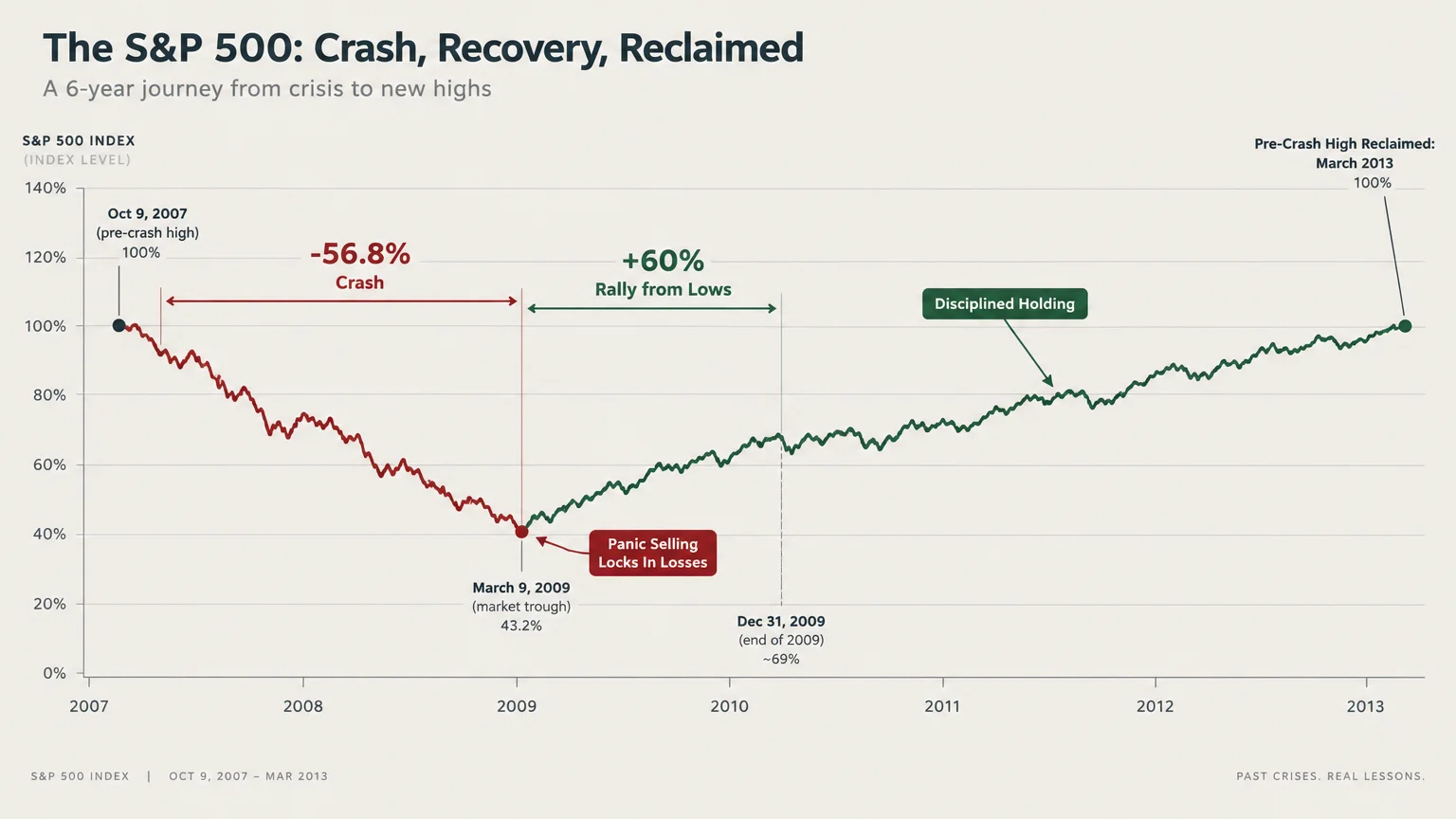
Between October 9, 2007, and March 9, 2009, the S&P 500 index tumbled 56.8%. Retail investors who abandoned equity funds near the trough missed one of the sharpest rallies in history.
The index rallied over 60% from its March 2009 low by the end of that calendar year. By March 2013, the S&P 500 had fully recovered to its pre-crash high, rewarding disciplined investors.
Attempting to time market bottoms almost always backfires for individual investors. Exiting the market forces you to make two perfect decisions: when to sell and when to buy back in.
The stock market is a device for transferring money from the impatient to the patient.
Automate your monthly investment contributions through consistent dollar-cost averaging. Purchasing fund shares while prices are depressed enables you to accumulate more shares at bargain rates.
Align your asset allocation with your true investment time horizon well before volatility appears. If steep drops cause panic, adjust your portfolio toward bonds during calm periods rather than amidst a collapse.
Lesson 3: Treat Home Equity as Illiquid Capital Rather Than an ATM
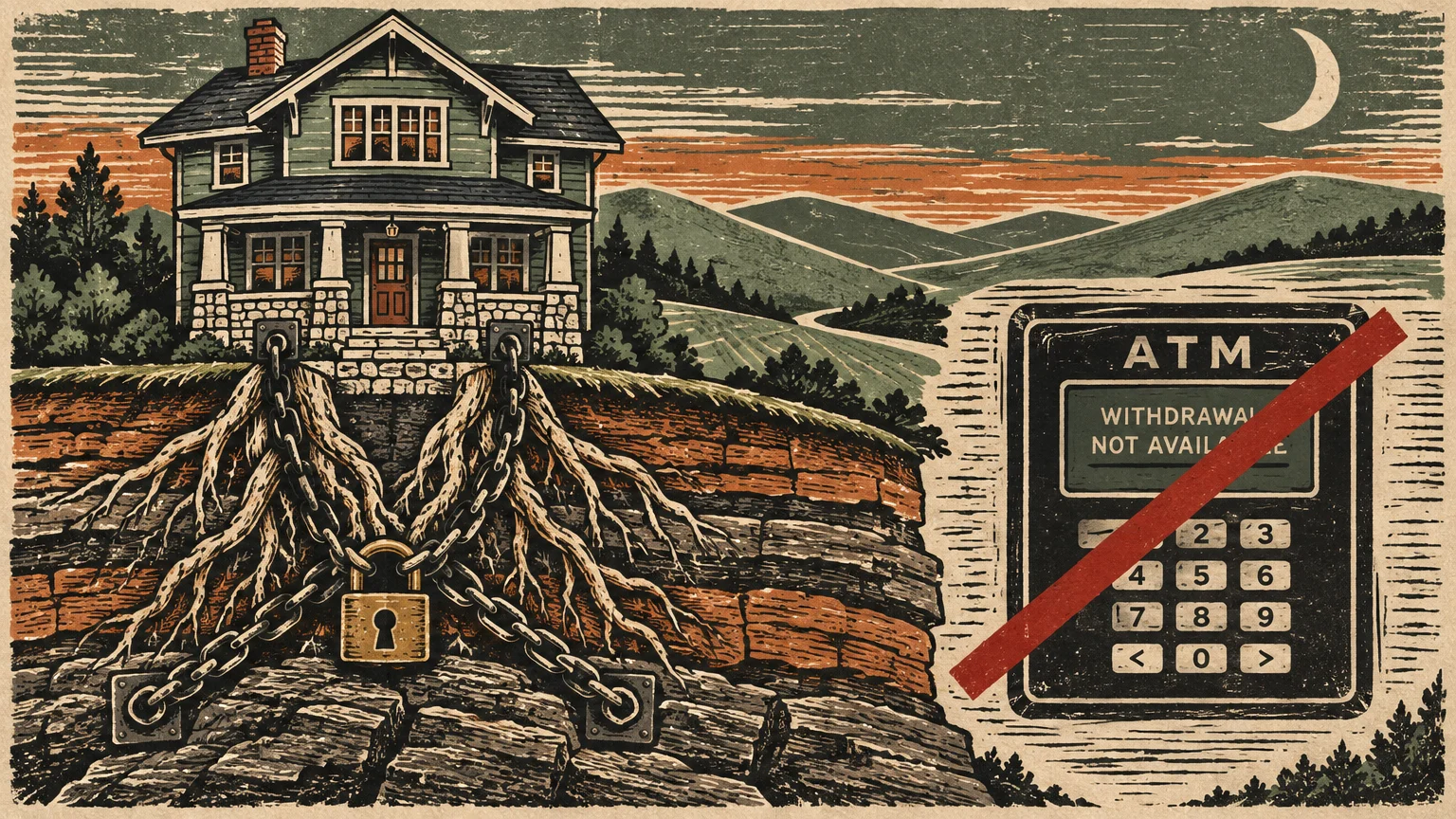
In the years leading up to 2007, millions of homeowners treated their property equity like a high-limit credit card. When residential real estate valuations dropped, borrowers across the nation found themselves deeply underwater.
American households suffered a staggering loss of roughly $16 trillion in net worth during the crisis. Collapsing housing values wiped out the primary wealth engine for millions of working families.
Borrowing against home equity to purchase consumer goods or fund vacations creates extreme personal risk. If regional real estate markets soften, lenders can freeze or cancel your credit lines without warning.
View your primary residence primarily as secure shelter rather than an easy piggy bank. Maintaining at least 20% equity in your home establishes a protective cushion against downward price corrections.
If you choose to tap home equity, reserve those funds for capital improvements that genuinely improve home value. Avoid extracting equity to cover daily deficits or speculative investments.
Always secure fixed-rate mortgage terms whenever you buy or refinance property. Predictable housing expenses protect your monthly cash flow when macroeconomic conditions turn volatile.

Lesson 4: Eliminate High-Cost Debt to Safeguard Monthly Cash Flow
Heavy monthly debt service compounds personal stress when unexpected income interruptions occur. During the Great Recession, inflexible consumer debts pushed overextended families toward bankruptcy and foreclosure.
Carrying credit card balances, personal installment loans, and costly auto payments constricts your cash flow. Every fixed monthly bill reduces the disposable income available for food, medicine, and utilities.
Guidance from the Consumer Financial Protection Bureau emphasizes that compounding revolving interest drains wealth rapidly. Eliminating high-interest consumer debt directly decreases your required monthly survival budget.
Use the debt avalanche approach to pay down debts in order of interest rate, saving the most money. Alternatively, apply the debt snowball method to eliminate small balances first and generate rapid behavioral wins.
Refinance variable-rate debt into fixed-rate options whenever favorable borrowing conditions exist. Avoid carrying high-interest revolving balances from month to month under any circumstances.
Minimizing fixed monthly debt obligations dramatically enhances your financial stamina. When your baseline survival costs are low, an emergency fund lasts substantially longer during extended unemployment.

Lesson 5: Verify Your Cash Sits Within Federal Deposit Insurance Limits
Banking sector instability created widespread panic among depositors as prominent institutions collapsed in 2008. Verifying that your deposits fall within federal safety guarantees remains vital for protecting your principal.
In October 2008, the Emergency Economic Stabilization Act raised federal deposit insurance from $100,000 to $250,000 per depositor. Congress made this higher threshold permanent through the Dodd-Frank Act in 2010.
The Federal Deposit Insurance Corporation and National Credit Union Administration protect up to $250,000 per depositor, per institution, per ownership category.
Modern regulations cap total insurance coverage for trust accounts at $1,250,000 per owner when naming five or more beneficiaries. Keeping cash reserves within these precise guidelines prevents permanent loss if an institution fails.
If your liquid savings exceed the $250,000 threshold, distribute funds across separate chartered institutions. You can also leverage insured cash sweep programs to disperse funds across a network of banks.
Always ensure your financial provider is a chartered, federally insured bank or credit union. Using direct, fully insured banking services protects your liquid funds regardless of external market turmoil.

Lesson 6: Diversify Beyond Single Assets and Company Stock
Over-allocating investments into a single company or sector devastated countless workers during the 2008 crash. Employees who concentrated their retirement assets in employer stock lost their jobs and life savings simultaneously.
Long-term economic research from the Federal Reserve Bank of St. Louis confirms that deep contractions affect broad swaths of the corporate sector. Relying too heavily on a single firm leaves your balance sheet dangerously exposed.
Cap your employer company stock holdings at no more than 10% to 15% of your total portfolio. Because your salary already ties your livelihood to that employer, diversify your investments elsewhere.
Establish a core portfolio grounded in low-fee, broad-market index funds representing domestic and international companies. Integrating short-term or intermediate treasury bonds provides stability during market drops.
Rebalance your investment portfolio annually to maintain your preferred asset allocation targets. Systematically selling overperforming assets to buy cheaper asset classes maintains discipline and dampens total portfolio volatility.
Asset diversification protects your retirement capital from catastrophic corporate failures. Spreading your capital across hundreds of diversified holdings cushions against localized economic shocks.

Lesson 7: Establish a Spending Buffer Before Economic Stress Arrives
Spending every dollar you earn leaves you defenseless when unexpected macroeconomic stress hits. Households that maintained a wide gap between their living costs and income weathered the 2008 downturn with minimal hardship.
A deliberate spending buffer requires keeping your essential living obligations well below your take-home pay. That financial cushion absorbs unexpected price surges or income cuts without threatening your shelter or stability.
Review your recurring expenses, digital subscriptions, and utility bills every six months to root out inefficiencies. Trimming small leaks creates cumulative monthly margins that strengthen your cash position over time.
Practice running your household on a bare-bones survival budget for one month each year. This test run highlights non-essential spending categories and prepares you to cut back quickly if income drops.
Avoid lifestyle inflation whenever you receive salary increases, annual bonuses, or tax refunds. Channelling surplus income into debt reduction and liquid savings accelerates your path toward true financial independence.
Living below your means grants you autonomy and invaluable peace of mind. A modest baseline lifestyle remains the single most effective shield against turbulent economic cycles.
Comparing Financial Moves: 2008 Mistakes vs. Resilient Modern Habits
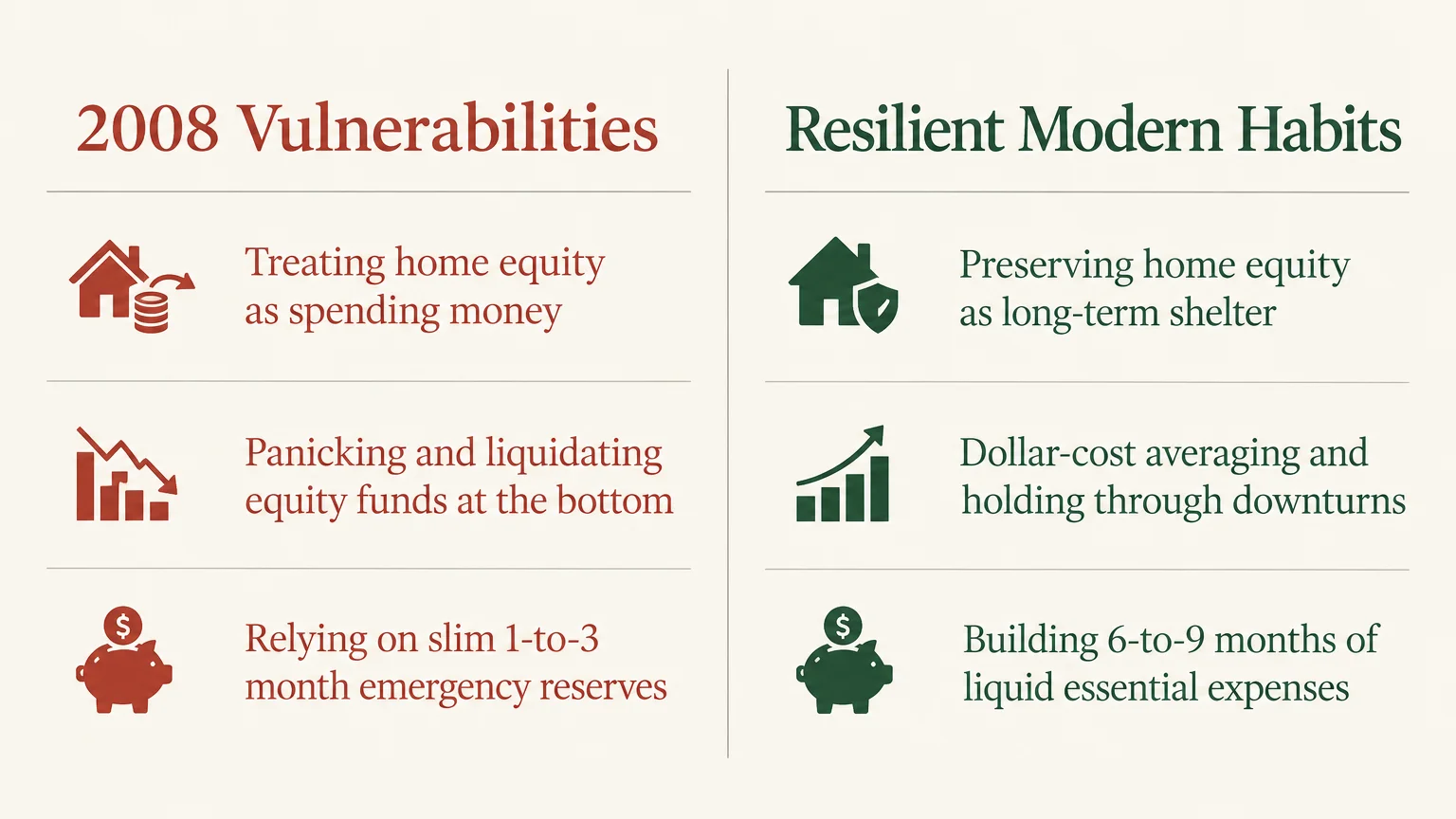
Reviewing past consumer missteps helps identify where modern financial defensive habits make the biggest difference. The comparison below illustrates how common practices during 2008 contrast with durable wealth-building behaviors.
| Financial Area | 2008 Vulnerability | Resilient Modern Strategy |
|---|---|---|
| Cash Reserves | Holding under 3 months of cash or relying on credit cards. | Maintaining 3 to 9 months of expenses in a high-yield savings account. |
| Market Volatility | Liquidating portfolios near the bottom during bear markets. | Holding steady, rebalancing, and continuing automated contributions. |
| Consumer Debt | Carrying high-interest balances with minimum monthly payments. | Aggressively eliminating consumer loans using avalanche or snowball methods. |
| Home Equity | Using home equity lines to finance routine lifestyle consumption. | Preserving at least 20% equity and relying on fixed-rate financing. |
| Bank Safety | Ignoring deposit limits and banking with uninsured entities. | Tracking the $250,000 FDIC/NCUA thresholds across account categories. |
| Asset Allocation | Concentrating retirement assets heavily in employer stock. | Capping single stocks under 15% and holding low-cost broad index funds. |
| Monthly Cash Flow | Operating at zero monthly margin with maximum lifestyle creep. | Maintaining a 15% to 20% buffer between take-home pay and core expenses. |
Adopting these resilient money habits before economic conditions deteriorate provides structural financial strength. Consistent preparation transforms potential household crises into manageable financial adjustments.

Immediate Steps to Recession-Proof Your Household
Building financial resilience does not require complicated financial maneuvers or elite wealth. You can implement several defensive adjustments right now to insulate your budget from potential economic shifts.
- Review your current monthly bank statements to calculate your exact baseline survival budget.
- Transfer non-essential savings into a federally insured high-yield account earning competitive interest.
- Verify that your total deposits across accounts at any single bank do not exceed $250,000.
- List your consumer debts in order of interest rate and automate aggressive payoff contributions.
- Check your workplace 401(k) to confirm that employer stock comprises less than 15% of your portfolio.
- Set up automated monthly transfers to your investment accounts using dollar-cost averaging.
Completing these foundational tasks builds immediate momentum for your household balance sheet. Taking proactive steps today prevents costly panic when unexpected economic challenges arise.

Things to Watch Out For
Even well-intentioned financial preparations can fail if you overlook subtle traps and systemic vulnerabilities. Keep these critical scenarios in mind when building your personal recession playbook.
1. Locking Cash into Illiquid Vehicles
Tying all your emergency reserves into multi-year certificates of deposit can trigger steep early withdrawal penalties during sudden crises. Always keep a portion of your emergency cushion in instantly accessible high-yield savings accounts.
Similarly, relying on home equity lines of credit as your primary safety net poses extreme hazards. Financial institutions frequently freeze credit limits when local property markets soften.
2. Over-Adjusting Portfolio Risk After Market Drops
Fleeing to cash after your investment portfolio has already dropped locks in massive paper losses. This reaction prevents you from participating in the rapid market recoveries that historically follow severe downturns.
Instead, evaluate your true risk capacity while markets are calm. Rebalancing your asset allocation gradually ensures your risk exposure matches your genuine investment timeline.
3. Overlooking Career Vulnerabilities
Relying exclusively on a single employer leaves your household finances exposed if company layoffs occur. Neglecting to update your professional network or professional skills during stable periods increases your vulnerability.
Cultivating diverse professional skills or exploring side income channels expands your employment options. Multiple income streams soften the blow if your primary industry faces widespread downsizing.
4. Confusing Deposit Insurance Categories
Assuming all business, joint, and personal funds are insured together can expose large cash balances to institutional failures. Exceeding the $250,000 threshold at a single bank leaves excess funds uninsured.
Verify that your accounts qualify under distinct legal ownership categories such as single, joint, or revocable trust accounts. Structuring your deposits properly ensures full federal protection across all your banking relationships.

When DIY Isn’t Enough
While personal financial discipline solves many everyday challenges, complex economic decisions often demand specialized guidance. Consider hiring qualified professionals when encountering these specific situations.
1. Managing Pre-Retirement Sequence of Returns
Navigating sequence-of-returns risk becomes dangerous when you retire right before a macroeconomic downturn begins. A fee-only financial planner can structure defensive withdrawal buckets to protect your principal.
These advisors help model retirement cash flow scenarios so you do not liquidate depressed equities during bear markets. Professional modeling provides clarity during volatile economic environments.
2. Complex Trust Structuring Beyond Limits
Balancing substantial family assets requires careful legal structuring to remain within federal protection limits. Estate attorneys ensure your living trusts comply with current FDIC beneficiary rules.
Improperly drafted trust agreements can unintentionally forfeit insurance coverage on deposits exceeding standard thresholds. Professional estate planning eliminates compliance errors and protects multi-generational savings.
3. High-Stress Debt Settlement or Bankruptcy
If sudden job loss creates insurmountable consumer debt, dealing with creditors directly can become overwhelming. Working with an accredited nonprofit credit counseling agency helps you establish realistic debt management plans.
Nonprofit counselors negotiate lower interest rates and waived fees with major lenders on your behalf. In severe distress, consulting a bankruptcy attorney provides vital legal protection against aggressive collections.
4. Small Business Liquidity Management
Small business owners face unique balance sheet challenges during broad macroeconomic downturns. Certified Public Accountants (CPAs) help optimize payroll structures, tax deductions, and working capital buffers during downturns.
Relying on specialized financial counsel prevents business distress from spilling over into your personal household assets. Expert guidance safeguards your enterprise while preserving personal balance sheet solvency.
Frequently Asked Questions
How big should an emergency fund be to survive a recession?
Most financial planners recommend holding three to six months of essential living expenses. If your household relies on a single income or works in a volatile industry, aiming for six to nine months provides greater safety.
What was the deepest point of the stock market crash in the Great Recession?
The S&P 500 reached its lowest point on March 9, 2009, having dropped 56.8% from its peak in October 2007. The index subsequently staged an aggressive recovery, gaining more than 60% by the end of 2009.
How does the FDIC protect my cash if a bank fails?
The FDIC provides up to $250,000 in insurance coverage per depositor, per insured institution, for each ownership category. This protection ensures you do not lose insured principal if your financial institution closes.
Why is home equity considered a risky emergency fund source?
Home equity lines of credit are not guaranteed, and lenders can freeze or reduce them during severe downturns. Furthermore, falling home prices can eliminate equity when you need cash the most.
Moving Forward With Confidence
The financial turbulence of 2008 demonstrated that disciplined planning provides the ultimate defense against economic uncertainty. Taking deliberate steps to clear high-cost debt, preserve cash, and maintain diversified investments protects your household from external shocks.
The information here is meant for educational purposes. Specific circumstances—including health conditions, finances, location, and goals—may require different approaches. When in doubt, consult a licensed professional or check official sources directly.
Last updated: November 2026. Rules, prices, and details change—verify current information with official sources before acting on it.








Leave a Reply