

The Internal Revenue Service has officially released the updated capital gains tax brackets for the 2027 tax year. Selling profitable stocks or mutual funds next year might trigger a much smaller tax bill than you expect.
Thanks to an annual inflation adjustment across federal income tiers, thousands of everyday investors can lock in substantial gains completely tax-free.
Knowing exactly where these new thresholds sit allows you to time your asset sales strategically. The updated numbers offer practical ways to protect your hard-earned investment growth.
The Essentials: Key Highlights for 2027
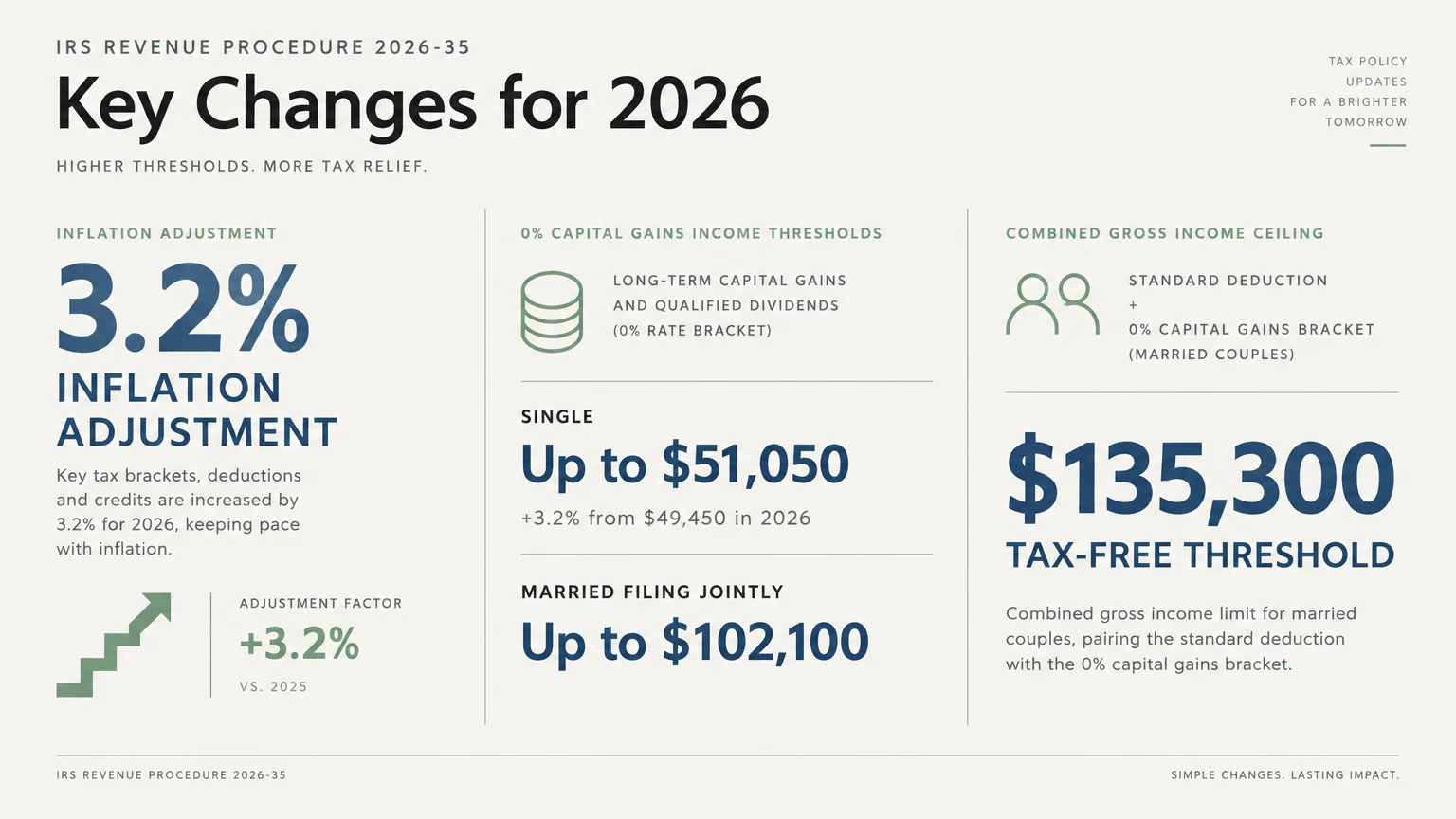
The IRS issued Revenue Procedure 2026-35 on November 5, 2026, establishing updated tax schedules for 2027. This adjustment reflects a 3.2% inflation increase across individual brackets.
These updated rules govern investments you sell between January 1, 2027, and December 31, 2027. You will report those financial transactions on the tax return you file in early 2028.
Assets sold during 2026 remain subject to 2026 tax schedules. You will settle those 2026 taxes by April 15, 2027.
Long-term rates remain split into three distinct federal tiers: 0%, 15%, and 20%. The income ceilings required to trigger each rate increased noticeably.
Higher standard deductions expand your opportunities to realize tax-free gains. Married couples filing jointly can now earn up to $135,300 in total gross income without owing federal taxes on their profits.
How the IRS Classifies Capital Gains
Before checking your tax rate, verify how long you owned your asset. The federal government taxes your profits differently based on your holding period.
If you hold an asset for one year or less, the IRS treats your profit as a short-term capital gain. The government taxes short-term gains at your ordinary income tax rate.
Holding an asset for more than one year grants you long-term capital gains treatment. These preferential rates are significantly lower than ordinary income tax brackets.
According to the IRS Capital Gains Guidance, qualified dividends also receive these lower long-term tax rates. Most regular dividend payments from domestic corporations fall into this category.
The holding period begins the day after you acquire an asset. It concludes on the exact day you sell that property or security.
The Official 2027 Long-Term Capital Gains Tax Brackets
Your capital gains tax rate depends on your total taxable income. Taxable income represents your adjusted gross income minus either your standard deduction or your itemized deductions.
The table below displays the official income ranges for each long-term capital gains tier for the 2027 tax year.
| Filing Status | 0% Rate Bracket | 15% Rate Bracket | 20% Rate Bracket |
|---|---|---|---|
| Single | Up to $51,050 | $51,051 to $563,200 | Over $563,200 |
| Married Filing Jointly | Up to $102,100 | $102,101 to $633,600 | Over $633,600 |
| Head of Household | Up to $68,350 | $68,351 to $598,400 | Over $598,400 |
| Married Filing Separately | Up to $51,050 | $51,051 to $316,800 | Over $316,800 |
| Estates and Trusts | Up to $3,400 | $3,401 to $16,750 | Over $16,750 |
Single filers can now earn up to $51,050 in taxable income before paying 15% on long-term profits. That represents an increase from $49,450 in 2026.
Married couples filing jointly cross into the 15% bracket only after exceeding $102,100 in taxable income. In 2026, that boundary sat at $98,900.
Head-of-household filers enjoy a 0% ceiling of $68,350 for 2027. This threshold climbed from $66,200 in the previous year.
The top 20% bracket now begins at $563,200 for single taxpayers and $633,600 for married joint filers. Most retail investors remain well below these upper thresholds.

The Power of the 0% Capital Gains Bracket
Many investors mistakenly believe the 0% bracket applies only to non-working or low-income households. In practice, the standard deduction expands this tax-free allowance substantially.
Because brackets apply to taxable income rather than gross income, you deduct your standard deduction first. That deduction shields a major slice of your everyday earnings from tax calculations.
For 2027, the standard deduction rises to $16,600 for single taxpayers and $33,200 for married couples filing jointly. Head-of-household filers receive a standard deduction of $24,925.
When you combine the standard deduction with the 0% bracket, your effective gross income ceiling expands dramatically.
| Filing Status | 2027 Standard Deduction | 0% Taxable Limit | Maximum Gross Income for 0% Gains |
|---|---|---|---|
| Single | $16,600 | $51,050 | $67,650 |
| Married Filing Jointly | $33,200 | $102,100 | $135,300 |
| Head of Household | $24,925 | $68,350 | $93,275 |
| Married Filing Separately | $16,600 | $51,050 | $67,650 |
Consider a married couple earning $90,000 in combined salary in 2027. After claiming their $33,200 standard deduction, their taxable income sits at just $56,800.
Because their taxable income sits far below the $102,100 joint ceiling, they have plenty of room left. They could realize up to $45,300 in long-term capital gains at a federal tax rate of 0%.
A single filer earning $40,000 in gross wages can use this same mechanism. Subtracting their $16,600 standard deduction leaves $23,400 in taxable earnings.
That single filer can harvest up to $27,650 in long-term profits without paying a penny in federal taxes.
Standard Deduction Enhancements for Older Adults
Seniors enjoy even larger gross income buffers before paying capital gains taxes. Taxpayers age 65 and older receive an additional standard deduction bump under regular IRS rules.
For 2027, that additional standard deduction rises to $2,100 for single and head-of-household filers. Married seniors receive an extra $1,700 per qualifying spouse.
If both spouses in a married household are 65 or older, their combined standard deduction reaches $36,600. That structure allows them to collect up to $138,700 in total gross income while staying in the 0% gains tier.
Eligible seniors may also explore temporary bonus deductions under recent legislation. The 2025 OBBBA enacted an optional $6,000 senior bonus deduction for individuals and $12,000 for couples.
This temporary bonus phases out for modified adjusted gross incomes between $75,000 and $175,000 for single filers. For joint filers, that phaseout range spans $150,000 to $250,000.
Eligible retirees can combine these stacked deductions to harvest substantial stock portfolio gains tax-free. Always confirm your income phaseouts before claiming temporary deductions.
Short-Term Capital Gains: The High Cost of Rapid Trading
Selling assets you have owned for 365 days or less produces short-term gains. The tax code treats these profits like regular wages from an employer.
Short-term gains do not benefit from the 0%, 15%, or 20% rate caps. Instead, they climb through the seven ordinary federal tax brackets: 10%, 12%, 22%, 24%, 32%, 35%, and 37%.
Official inflation updates in IRS Revenue Procedure 2026-35 adjusted these ordinary income brackets upward for 2027. The top 37% bracket now begins at $661,375 for single individuals and $793,650 for married couples filing jointly.
Selling an appreciated asset a few days before reaching the one-year milestone can cause severe financial damage. A single filer earning $80,000 faces a 22% marginal tax rate on short-term profits.
Waiting until day 366 cuts that federal rate to 15%. That single timing decision saves seven full percentage points in taxes.
Track your purchase dates carefully inside every brokerage account. Setting automated sale alerts can prevent you from accidentally triggering ordinary income tax rates.

The Net Investment Income Tax (NIIT) and High Earners
High-earning investors face an additional layer of investment taxation known as the Net Investment Income Tax. Congress created this 3.8% surtax to fund healthcare provisions.
The surtax applies to whichever amount is smaller: your net investment income or the excess of your Modified Adjusted Gross Income (MAGI) over statutory thresholds. Details appear on the IRS Net Investment Income Tax page.
Unlike standard brackets, lawmakers did not index NIIT income limits to inflation. These thresholds have remained fixed since their introduction in 2013.
- Single and Head of Household: $200,000
- Married Filing Jointly: $250,000
- Married Filing Separately: $125,000
Because inflation pushes wages higher while NIIT limits remain frozen, more middle-class investors get caught each year. Economists refer to this process as bracket creep.
If you fall into the 15% capital gains bracket and exceed the NIIT limit, your effective federal rate becomes 18.8%. Investors in the top 20% bracket face a total federal rate of 23.8%.
Net investment income includes capital gains, taxable dividends, interest, rental royalties, and non-qualified annuity distributions. Traditional IRA distributions and municipal bond interest do not trigger the 3.8% surtax directly.
Tax-Loss Harvesting: Turning Portfolio Drops into Tax Savings
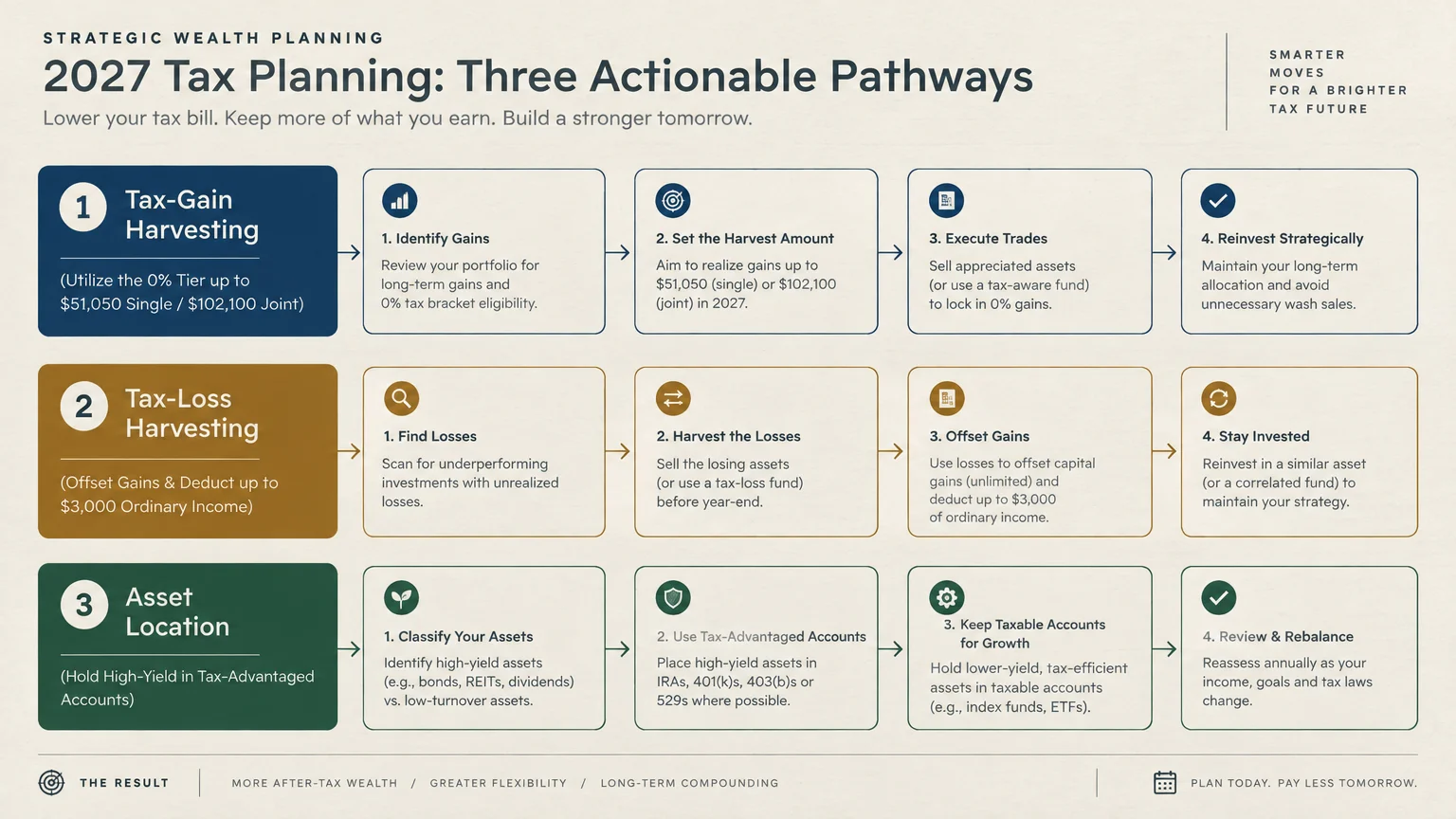
Market declines present valuable opportunities to reduce your overall tax bill. Tax-loss harvesting allows you to offset profitable sales by realizing losses in underperforming holdings.
The IRS requires you to net like gains against like losses first. You offset short-term losses against short-term gains, and long-term losses against long-term gains.
After offsetting matching categories, you can use any excess losses against the other gain category. If total losses still exceed total gains, you receive an extra tax deduction.
Federal tax rules allow you to deduct up to $3,000 of excess net investment losses against ordinary income each year. Married individuals filing separately can deduct up to $1,500.
Deducting $3,000 against ordinary income lowers your baseline taxable earnings directly. If you sit in the 22% bracket, that deduction generates $660 in cash tax savings.
Any remaining net capital losses do not disappear. You can carry unused investment losses forward into future tax years indefinitely.
Be careful to avoid the wash-sale rule when harvesting portfolio losses. You cannot claim a tax loss if you purchase a substantially identical security within 30 days before or after the sale.
Selling Real Estate: How Section 121 Protects Your Home Equity
Your personal home represents one of the largest capital assets you will ever own. Fortunately, federal tax law offers generous exemptions when you sell your primary residence.
Under Section 121 of the Internal Revenue Code, individuals can exclude up to $250,000 in capital gains from home sales. Married couples filing jointly can exclude up to $500,000.
To qualify for this exclusion, you must satisfy both ownership and use tests. You must have owned and lived in the house as your primary home for at least two out of the five years preceding the sale.
The two years of residency do not need to occur consecutively. Living in the property for 24 total months across that five-year window fulfills federal requirements.
You can claim this substantial tax exclusion once every two years. Profits exceeding the exclusion limits get taxed under regular long-term capital gains rates.
Keep detailed records of all home capital improvements over the years. Remodeling kitchens, replacing roofs, and adding rooms increase your cost basis, shrinking your taxable profit upon sale.
Practical Moves to Lower Your Investment Taxes in 2027
Proactive financial management lets you legally minimize capital gains liabilities. Deploying thoughtful tax strategies ensures you keep more of your investment returns.
Consider tax-gain harvesting if you expect your income to dip into the 0% bracket during 2027. You can sell appreciated stock at a 0% rate and repurchase it immediately.
Unlike tax-loss sales, the wash-sale rule does not apply to profitable trades. Selling and immediately rebuying resets your cost basis higher without generating a tax bill.
Pay close attention to asset location across your various accounts. Place dividend-heavy stock funds and high-yield bonds inside tax-advantaged accounts like IRAs or 401(k) plans.
Hold broad-market stock index funds inside taxable brokerage accounts. Broad index funds generate minimal annual turnover, shielding you from unwanted capital gains distributions.
Donate appreciated stock directly to registered charities instead of giving cash. Donating shares held over one year eliminates the capital gains tax while securing a full fair-market-value deduction.
The Bigger Picture: Inflation Adjustments and Wealth Preservation
The IRS updates tax brackets each autumn using the Chained Consumer Price Index for All Urban Consumers. This measurement tracks broad changes in living expenses across the United States.
The 3.2% bracket expansion for 2027 shields everyday workers and retirees from artificial tax hikes. Without inflation adjustments, cost-of-living pay raises would push taxpayers into higher brackets automatically.
Official tax updates appear on the IRS Newsroom each fall. Reviewing these figures early allows you to structure financial moves before the calendar year starts.
Aligning portfolio withdrawals with updated income brackets keeps your lifetime tax burden manageable. Thoughtful planning protects your wealth against both inflation and excessive taxation.
Worth Keeping in Mind
Tax rules contain subtle complexities that can catch even experienced investors off guard. Review these critical pitfalls before executing investment sales in 2027.
- State Income Taxes: Federal 0% brackets do not shield you from state income taxes. Many states tax investment earnings as ordinary income with zero preferential rates.
- The Capital Gains Stacking Trap: The IRS adds capital gains on top of your wage earnings when determining your tax bracket. A large investment profit can push your total income past the 0% ceiling.
- Medicare IRMAA Surcharges: Realizing large capital gains boosts your Modified Adjusted Gross Income. This spike can trigger higher Medicare Part B and Part D premium surcharges two years later.
- Dividend Reinvestment Basis Errors: Many investors reinvest dividends automatically without adjusting their cost basis records. Forgetting to account for reinvested payouts leads to paying taxes twice on the same dollars.

When to Get Professional Help
While self-directed investing works well for simple portfolios, certain situations require specialized expertise. Consider hiring a certified tax professional or financial planner under these conditions.
- Selling Inherited or Gifted Property: Inherited assets generally receive a stepped-up basis, whereas gifted assets carry the donor’s original basis. Calculating basis errors on family properties can trigger severe IRS penalties.
- Exercising Corporate Stock Options: Cashing in incentive stock options or non-qualified stock options generates intricate tax events. Exercising options improperly can trigger unexpected Alternative Minimum Tax liabilities.
- Managing Complex Trust Distributions: Trust and estate tax brackets reach the top 20% tier at just $16,750 of income in 2027. Distributing income to beneficiaries requires precise fiduciary planning.
- Navigating Major Retirement Transitions: Coordinating Social Security, pension payments, required minimum distributions, and taxable asset sales requires careful orchestration. A professional helps prevent costly tax spikes.
Frequently Asked Questions About 2027 Capital Gains Taxes
When do the 2027 capital gains brackets take effect?
The 2027 brackets apply to all asset sales completed between January 1, 2027, and December 31, 2027. You will report these investment profits when filing your 2027 tax return in early 2028.
Do capital gains increase my overall tax bracket?
Capital gains do not raise the tax rate applied to your regular wages. However, ordinary income fills the lowest tax brackets first, pushing your capital gains into higher rate tiers.
How are qualified dividends taxed under the 2027 rules?
Qualified dividends receive the identical preferential tax treatment as long-term capital gains. They are taxed at 0%, 15%, or 20% based on your total taxable income.
Can I use cryptocurrency losses to offset stock gains?
Yes, the IRS classifies cryptocurrency as property for federal tax purposes. Capital losses from digital assets can offset capital gains generated from traditional stocks, mutual funds, or real estate.
Take Charge of Your 2027 Investments
Understanding the 2027 capital gains brackets empowers you to keep more of your investment profits. Higher income thresholds and increased standard deductions provide substantial breathing room for everyday household budgets.
Review your taxable holdings before making major sales, and always track your holding periods closely. A patient approach to selling assets can save you thousands of dollars in unnecessary tax payments.
This article provides general information only. Every reader’s situation is different—what works for others may not be the right fit for you. For personalized guidance on health, legal, or financial matters, consult a qualified professional.
Last updated: November 2026. Rules, prices, and details change—verify current information with official sources before acting on it.








Leave a Reply