
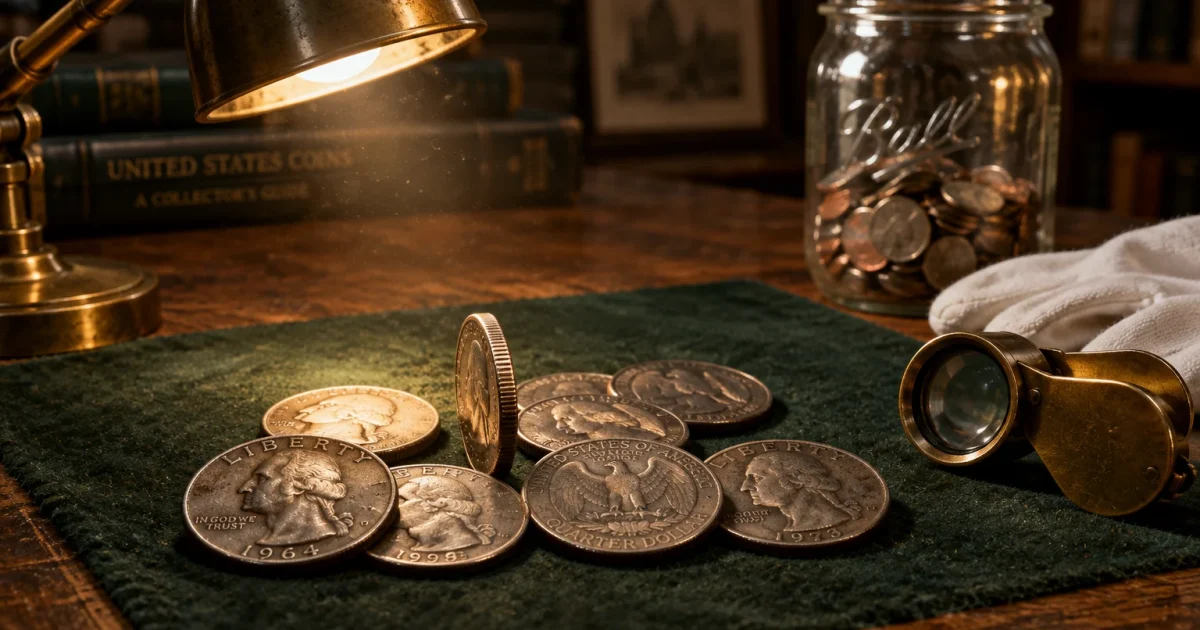
Most people toss pocket change into a jar or feed it into a parking meter without a second glance. Yet a single overlooked coin in your wallet could quietly pay for your weekly groceries—or an entire vacation.
Thanks to surging silver prices, low-mintage key dates, and striking mint errors, several U.S. quarters command hundreds or even thousands of dollars. Knowing which dates and details to check turns everyday spare change into real money.
Before you roll your change for the bank, scan your quarters against these 12 high-value standouts. You will also learn how to avoid costly preservation mistakes and spot viral coin myths.
At a Glance
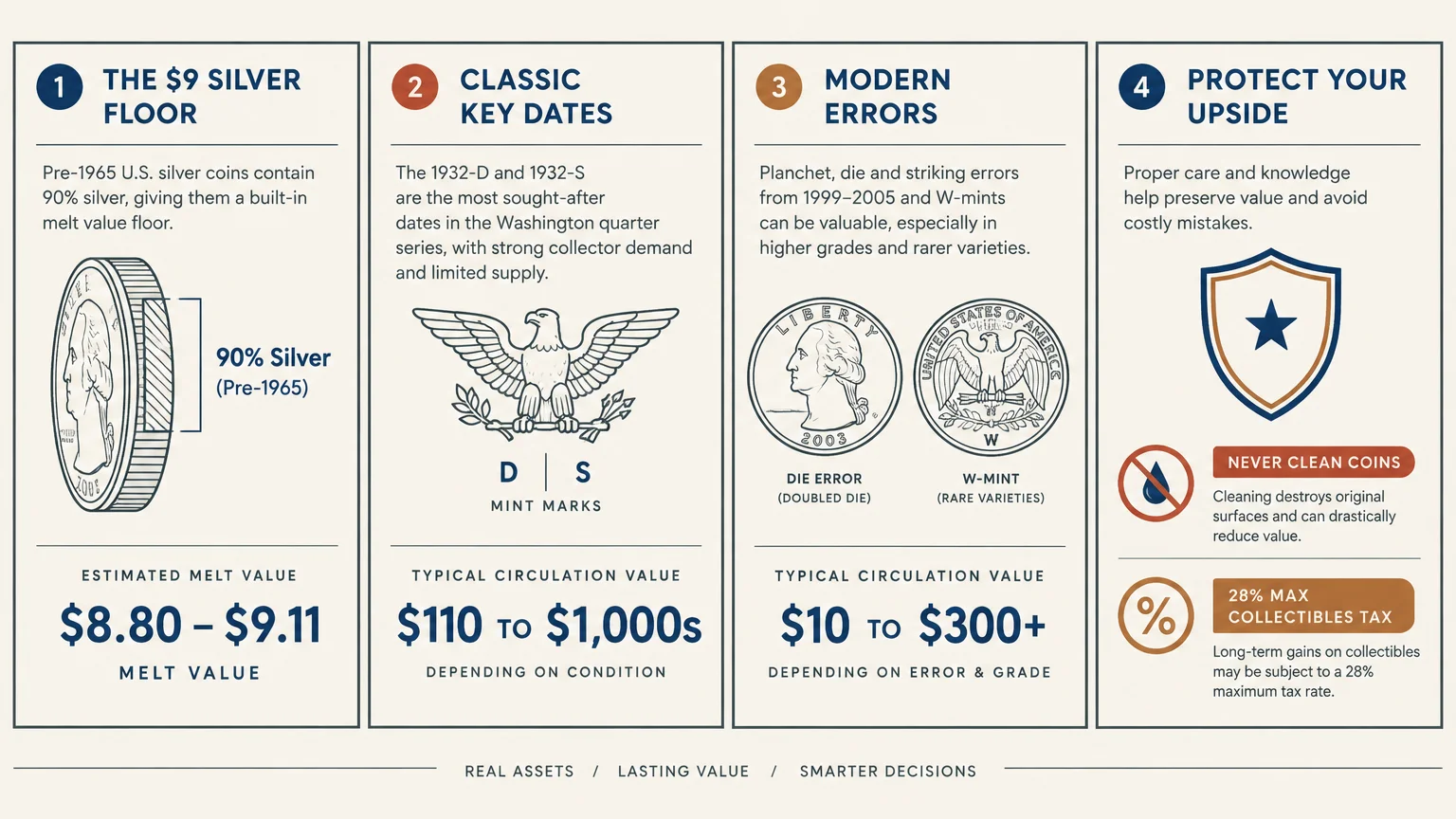
- The $9 silver floor: Any U.S. quarter dated 1964 or earlier contains 90% silver, giving it a melt value around $8.80 to $9.11 as of November 2026.
- Classic key dates and doubled dies: Early Washington quarters like the 1932-D, 1932-S, and 1937 Doubled Die routinely bring $110 to several thousand dollars.
- Modern pocket-change treasures: Mint errors from 1999 to 2005 and 2019–2020 West Point (“W”) quarters still turn up in circulation for $10 to $300+.
- Protect your upside: Never clean a suspect coin, skip professional grading unless a coin tops roughly $200, and factor in the 28% maximum federal collectibles tax rate on long-term gains.
Check the Date and Rim First: Silver vs. Clad Value
Before hunting for rare dates or subtle mint errors, sort your quarters by year. Under the Coinage Act of 1965, the U.S. Mint removed silver from standard circulating quarters.
Every Washington quarter struck from 1932 through 1964 is composed of 90% silver and 10% copper. Each coin weighs 6.25 grams and holds 0.1808 troy ounces of pure silver, according to NGC and Bullion Exchanges.
With silver spot trading near $48.65 to $48.74 per troy ounce in mid-November 2026, those pre-1965 coins carry a massive intrinsic floor. NGC’s silver melt table updated November 2, 2026, lists a standard 90% silver quarter at $9.11 in melt value alone.
By comparison, standard quarters minted from 1965 to the present weigh 5.670 grams and contain zero silver. According to the U.S. Mint, modern clad quarters bond copper-nickel outer layers to a pure copper core—91.67% copper and 8.33% nickel overall.
You can spot the difference in two seconds by looking at the edge of a coin stack. Pre-1965 silver quarters show a solid silver-gray edge, while modern clad coins display a distinct copper-brown stripe.
Any 1964 or older quarter is already worth roughly 35 times face value just for its metal. The 12 valuable quarters below go far beyond that baseline.
Classic Silver Key Dates and Early Errors (1932–1965)
Older coins rarely circulate today, yet they still surface in inherited jars, estate cleanouts, and bank-wrapped rolls. These six silver-era and transitional quarters hold serious value for collectors.
1. 1932-D Washington Quarter
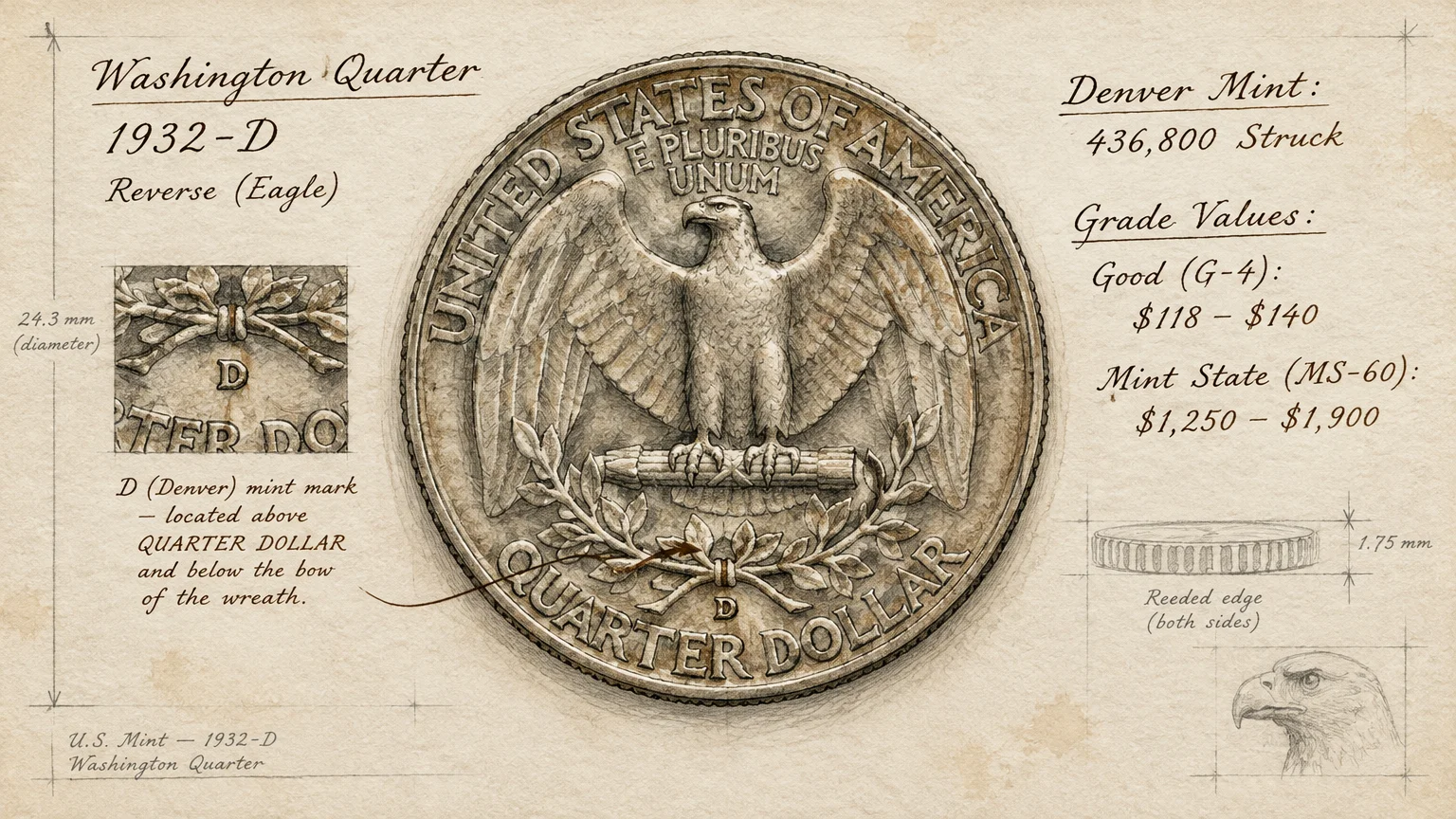
When the Washington quarter debuted in 1932 during the Great Depression, the Denver Mint struck just 436,800 pieces. That tiny first-year mintage makes the 1932-D one of the most sought-after rare quarters in coin collecting.
Look on the reverse (tails side) below the wreath and above the word “QUARTER” for a small “D” mint mark. Even heavily worn Good (G-4) examples trade around $118 to $140, based on USA Coin Book and Money Metals figures.
Higher grades climb fast—About Uncirculated (AU-50) coins reach $444 to $700, while Mint State (MS-60) pieces sell for $1,250 to $1,900. Top-tier MS-65+ survivors have realized $12,166 to over $78,000 at auction.
Because counterfeiters frequently add fake “D” mint marks to common 1932 Philadelphia quarters, Money Metals recommends third-party authentication before buying or selling one.
2. 1932-S Washington Quarter
The San Francisco Mint produced even fewer quarters in 1932, striking just 408,000 coins. That figure remains the lowest mintage of any regular-issue Washington quarter.
Check the same spot below the reverse wreath for a small “S” mint mark. Heavily circulated G-4 coins bring $109 to $130, and AU-50 examples typically trade between $287 and $350.
Uncirculated MS-60 specimens command $533 to $650, while pristine high Mint State coins bring $3,092 up to $28,000–$47,500 at major auctions. Like its Denver twin, the 1932-S is a frequent target for altered mint marks.
3. 1937 Doubled Die Obverse (DDO) Quarter
The Philadelphia Mint struck 19,701,542 quarters in 1937, and nearly all of them are worth little more than their silver melt value. A rare die-hubbing mistake on a small batch changed everything.
Use a 10x jeweler’s loupe to examine the front (obverse) of any 1937 quarter without a mint mark. Look for dramatic doubling on the words “IN GOD WE TRUST,” “LIBERTY,” and the “1937” date.
Verified 1937 DDO quarters trade for $110 to $287 even in worn G-4 condition. AU-50 pieces reach $700 to $1,885, and Mint State examples (MS-60 to MS-65) sell for $1,600 to $11,098.
4. 1943 Doubled Die Obverse (DDO) Quarter
With nearly 99.7 million Philadelphia quarters struck in 1943, most survivors trade strictly for silver content. However, one distinct Doubled Die Obverse variety sits near the top of wartime quarter errors.
Under magnification, you will see clear, separated doubling across “IN GOD WE TRUST,” “LIBERTY,” and the date on the obverse. Even low-grade circulated examples routinely bring $900 to $1,004 or more.
According to Money Metals and USA Coin Book, AU and Mint State 1943 DDO quarters command $3,500 to $7,500+. Inspect every 1943-P quarter closely before tossing it into a junk-silver tube.
5. 1950-D/S Overmintmark Quarter
Mint workers in 1950 reused a reverse working die originally stamped for San Francisco and punched a “D” directly over the existing “S.” Out of 21,075,600 total 1950-D quarters, only a fraction show this unmistakable overmintmark.
Examine the mint mark beneath the wreath on the reverse with a magnifying glass. You should see the curved upper and lower loops of the underlying “S” peeking out behind the bold “D.”
Lower circulated grades sell for $55 to $75, making this one of the most accessible classic varieties to spot. Clean AU-50 to MS-65 specimens fetch $225 to $400 or more.
6. 1965 Silver Planchet Transitional Error Quarter
When production shifted from silver to clad coinage in 1965, a handful of leftover 1964 90% silver blanks slipped into the presses. The result is one of the most famous wrong-planchet coins worth money in modern U.S. numismatics.
You do not need expensive lab gear to screen a suspicious 1965 quarter—start with a digital gram scale and a quick edge check. A normal 1965 clad quarter weighs 5.67 grams and shows a copper stripe on its reeded edge.
A genuine 1965 silver transitional error weighs approximately 6.25 grams and displays a solid silver edge. Auction records typically range from $7,000 to $17,000+ depending on preservation, with a PCGS XF-45 specimen realizing $7,200 at Heritage Auctions.
Modern Clad, Bicentennial, and West Point Quarters (1976–2020)
You do not need to inherit an old coin album to find valuable quarters. Six standout issues from the past 50 years—several still circulating—can deliver impressive returns.
7. 1976-S 40% Silver Bicentennial Quarter (and 1976-D Wrong-Planchet Errors)
America’s 200th-anniversary quarters carry the dual date “1776–1976” and a Colonial drummer reverse. The U.S. Mint struck these clad pieces across both 1975 and 1976, and ordinary circulated examples remain worth 25 cents.
The valuable exceptions start with the collector-only 1976-S quarters struck on 40% silver blanks. Look for the “S” mint mark on the obverse and check the rim for a pale silver edge rather than a heavy copper band.
Typical 1976-S 40% silver coins trade for $3.50 to $20, while top-graded Mint State pieces hold a PCGS auction record of $19,200. Meanwhile, a major 1976-D error struck on a smaller clad dime planchet (NGC MS-64) sold for $6,900 at Heritage Auctions.
8. 1982-P and 1983-P Washington Quarters (High Uncirculated Grades)
Most quarters from the early 1980s look completely ordinary—and circulated ones are indeed worth 25 cents. What makes 1982-P and 1983-P quarters unique is a quirk in U.S. Mint history.
The Mint did not sell official Uncirculated Mint Sets in 1982 or 1983, so dealers never set aside fresh coins in bulk. Despite massive mintages of 500,931,000 (1982-P) and 673,535,000 (1983-P), pristine survivors are genuinely scarce.
Raw MS-64 examples bring $5 to $10, while certified MS-65 coins trade for $85 to $100+. At the extreme top of the population, certified Mint State specimens have hit auction records of $10,200 (1982-P) and $15,862.50 (1983-P).
If you stumble across an unopened 1982 or 1983 bank roll—or bright, mark-free coins from an old souvenir set—set them aside carefully.
9. 1999-P Delaware “Spitting Horse” State Quarter
The 50 State Quarters Program kicked off in 1999 with Delaware, honoring Caesar Rodney’s historic horseback ride. Early Philadelphia dies developed a noticeable crack running straight from the horse’s mouth toward the rim.
Collectors nicknamed this raised die-crack line the “Spitting Horse.” It is visible with the naked eye or a basic magnifying glass on the reverse of 1999-P Delaware quarters.
Circulated examples commonly sell for $5 to $20 on marketplaces like eBay, according to COINage Magazine. Dramatic die-break variations and crisp Mint State pieces can bring $100 to $500.
10. 2004-D Wisconsin “Extra Leaf” State Quarter
Discovered in December 2004 by collector Robert Ford, the 2004-D Wisconsin varieties remain the undisputed stars of modern pocket-change coin collecting. PCGS ranks the High Leaf and Low Leaf varieties #18 and #19 on its Top 100 Modern Coins list.
Inspect the reverse of any 2004-D Wisconsin quarter right next to the ear of corn on the left side of the husk. Normal coins have one arched husk leaf curving downward on the left.
On the High Leaf variety, a second curved leaf points upward toward the corn cob; on the Low Leaf variety, an extra leaf curves downward below the standard husk. Estimated populations sit around 15,000 High Leaf and 20,000 Low Leaf coins.
PCGS calls these the only major varieties in the entire Statehood Quarters Program. Certified Mint State examples typically sell for $100 to $330, while top-graded specimens fetch $1,200 to $6,000.
11. 2005-P Kansas “In God We Rust” & 2005-P Minnesota “Extra Tree” Quarters
Two 2005 Philadelphia State Quarters offer fun, easy-to-spot hunting right out of cash-register change. On the 2005-P Kansas quarter, thick grease clogged the obverse die over the letter “T” in “TRUST.”
The weak or completely missing letter makes the motto read “IN GOD WE RUST.” Ordinary circulated pieces trade for $5 to $10, while dramatic certified examples with a fully vanished letter reach around $100.
On the 2005-P Minnesota quarter, check the pine tree line to the right of the fishing boat on the reverse. Die gouges and doubling created an “Extra Tree” (or extra branch) sticking up beside the main fourth tree, trading from $5 up to $300+ depending on prominence and grade.
12. 2019-W and 2020-W West Point Mint Quarters
In 2019 and 2020, the U.S. Mint ran a rare treasure hunt designed specifically for everyday Americans. Officials struck 2,000,000 quarters for each of five America the Beautiful designs in 2019 and five designs in 2020 at the West Point Mint.
Instead of selling those 10,000,000 coins per year to collectors, the Mint mixed them straight into circulating Denver and Philadelphia coin bags. Every single one entered circulation at face value.
Check the right side of the obverse behind Washington’s ponytail for a “W” mint mark. All 2020-W quarters also carry a small “V75” privy mark honoring the 75th anniversary of the end of World War II.
Even worn 2019-W and 2020-W quarters routinely sell for $10 to $40 online. Ultra-high-grade MS-67 and MS-68 certified survivors can command hundreds to thousands of dollars.
Keep your eyes peeled for two notable honorable mentions while sorting modern rolls, too. The ultra-rare 2000-P Sacagawea Dollar/Washington Quarter “mule” error sold for $144,000 in 2022, and prominent 2022 Maya Angelou “Drooling George” die chips trade from $20 up to $1,900 in top grades.
Side-by-Side Value Comparison of All 12 Quarters
Use this quick reference table when sorting through jars, bank rolls, or inherited coin boxes. Values fluctuate constantly based on grade, eye appeal, and collector demand.
| Quarter Issue | Key Identifier | Circulated Value Range | High Mint State / Auction Record |
|---|---|---|---|
| 1932-D Washington | “D” mint mark on reverse | $118–$700 (G-4 to AU-50) | $1,250–$78,000+ |
| 1932-S Washington | “S” mint mark on reverse | $109–$350 (G-4 to AU-50) | $533–$47,500 |
| 1937 Doubled Die Obverse | Doubled date & motto (no mint mark) | $110–$1,885 (G-4 to AU-50) | $1,600–$11,098 |
| 1943 Doubled Die Obverse | Doubled date & motto (no mint mark) | $900–$1,004+ (low grades) | $3,500–$7,500+ |
| 1950-D/S Overmintmark | “D” punched over “S” on reverse | $55–$75 (lower circulated) | $225–$400+ |
| 1965 Silver Planchet Error | 6.25g weight, solid silver edge | $7,000+ (XF-45 sold $7,200) | $7,000–$17,000+ |
| 1976-S 40% Silver & 1976-D Errors | “S” mint mark (silver) or wrong planchet | $3.50–$20 (typical 1976-S) | $19,200 (1976-S); $6,900 (1976-D dime error) |
| 1982-P & 1983-P Uncirculated | Mark-free luster, no official Mint Sets | $0.25 (circulated); $5–$10 (MS-64) | $85–$100+ (MS-65); $10,200–$15,862.50 |
| 1999-P Delaware “Spitting Horse” | Raised die crack from horse’s mouth | $5–$20 | $100–$500 |
| 2004-D Wisconsin “Extra Leaf” | Extra High or Low leaf near corn cob | $100–$330 (typical certified MS) | $1,200–$6,000 |
| 2005-P Kansas & Minnesota Errors | Missing “T” in TRUST / Extra tree | $5–$10 (ordinary Kansas); $5+ (MN) | ~$100 (KS); $300+ (MN) |
| 2019-W & 2020-W West Point | “W” mint mark; “V75” mark on 2020-W | $10–$40 | Hundreds to thousands (MS-67/68) |
2026 Quarter Updates and Viral Myths to Ignore
Fresh U.S. Mint releases in 2026 have sparked renewed interest in checking pocket change. To mark America’s 250th anniversary, the U.S. Mint is releasing five circulating Semiquincentennial quarter designs inscribed “1776 ~ 2026.”
Those five designs honor the Mayflower Compact, the Revolutionary War, the Declaration of Independence, the U.S. Constitution, and the Gettysburg Address. Circulating clad versions remain worth 25 cents unless verified mint errors emerge.
Separately, on July 4, 2026, the Philadelphia Mint struck just 250 edge-numbered, 2.5-ounce silver Declaration of Independence quarters bearing a “July 4” privy mark for future auction. You will not find those ultra-scarce bullion pieces in register change.
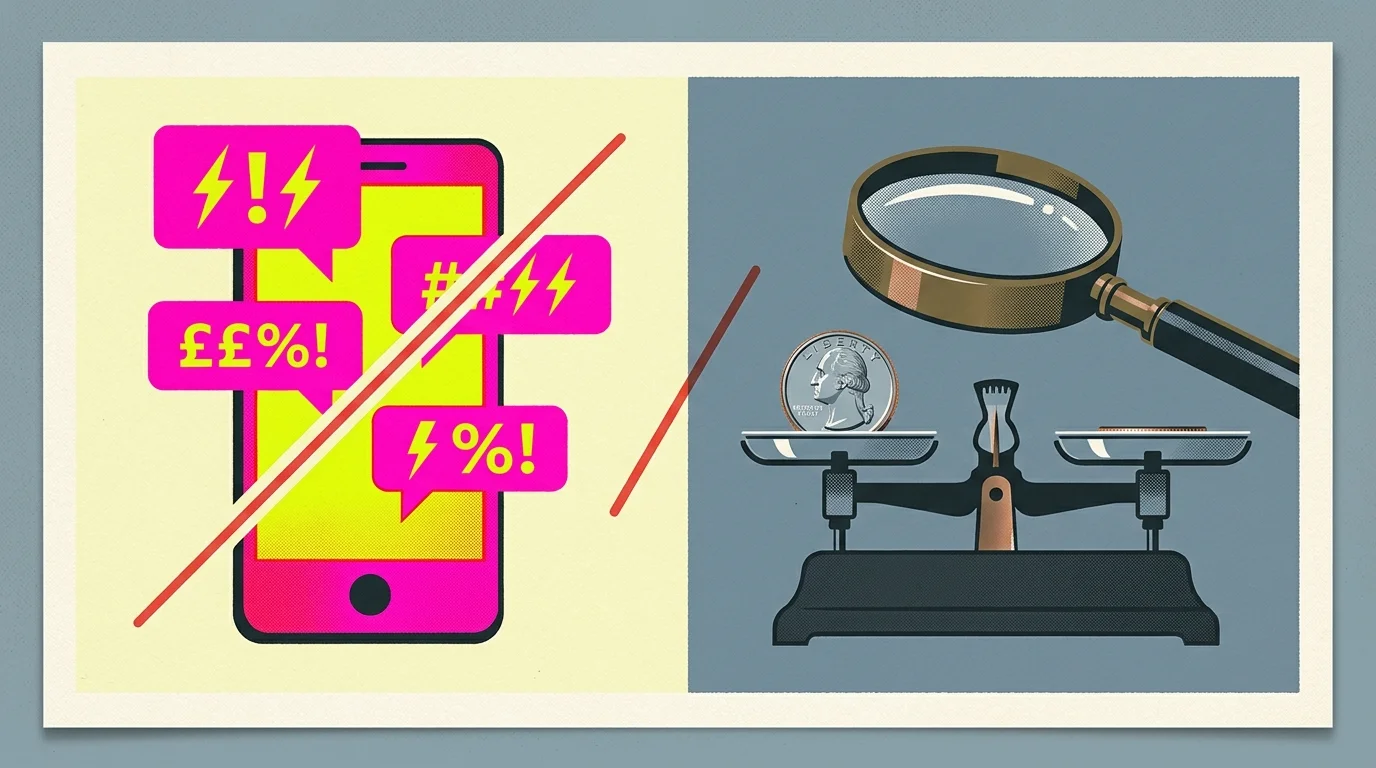
While watching new releases, ignore viral social media posts claiming 2022–2025 American Women Quarters reading “IN COD WE TRUST” are worth thousands. That rounded “G” is simply the standard stylized serif font from Laura Gardin Fraser’s 1931 portrait—ordinary circulated examples remain worth 25 cents.
Common Mistakes to Avoid
Finding a rare coin is only half the battle. A few missteps at home can destroy most of your coin’s collector premium overnight.
- Cleaning, polishing, or wiping a coin: Never rub a suspect quarter with a cloth, baking soda, or silver polish. Even gentle wiping leaves microscopic hairlines that strip original luster, trigger a “Cleaned/Details” grading label, and slash market value by 50% to 90%.
- Overpaying for grading on modest finds: Under NGC’s 2026 fee schedule, submitting a coin costs $20 for Modern (1965–present) or $25 for Economy (pre-1965), plus $20 add-ons for VarietyPlus or Mint Error attribution. Coin authentication guides recommend paying for third-party grading only when a coin’s realistic value reaches roughly $200 or more.
- Mistaking normal damage for a mint error: Parking-lot scratches, acid discoloration, and Vice-job imprints happen after a coin leaves the Mint. Post-mint damage carries zero collector premium, so compare suspicious quarters against verified reference photos first.
- Buying uncertified 1932-D or 1932-S quarters online: Altered mint marks on 1932 quarters fool inexperienced buyers every week. Stick to PCGS- or NGC-encapsulated coins if you decide to buy key dates rather than search change.
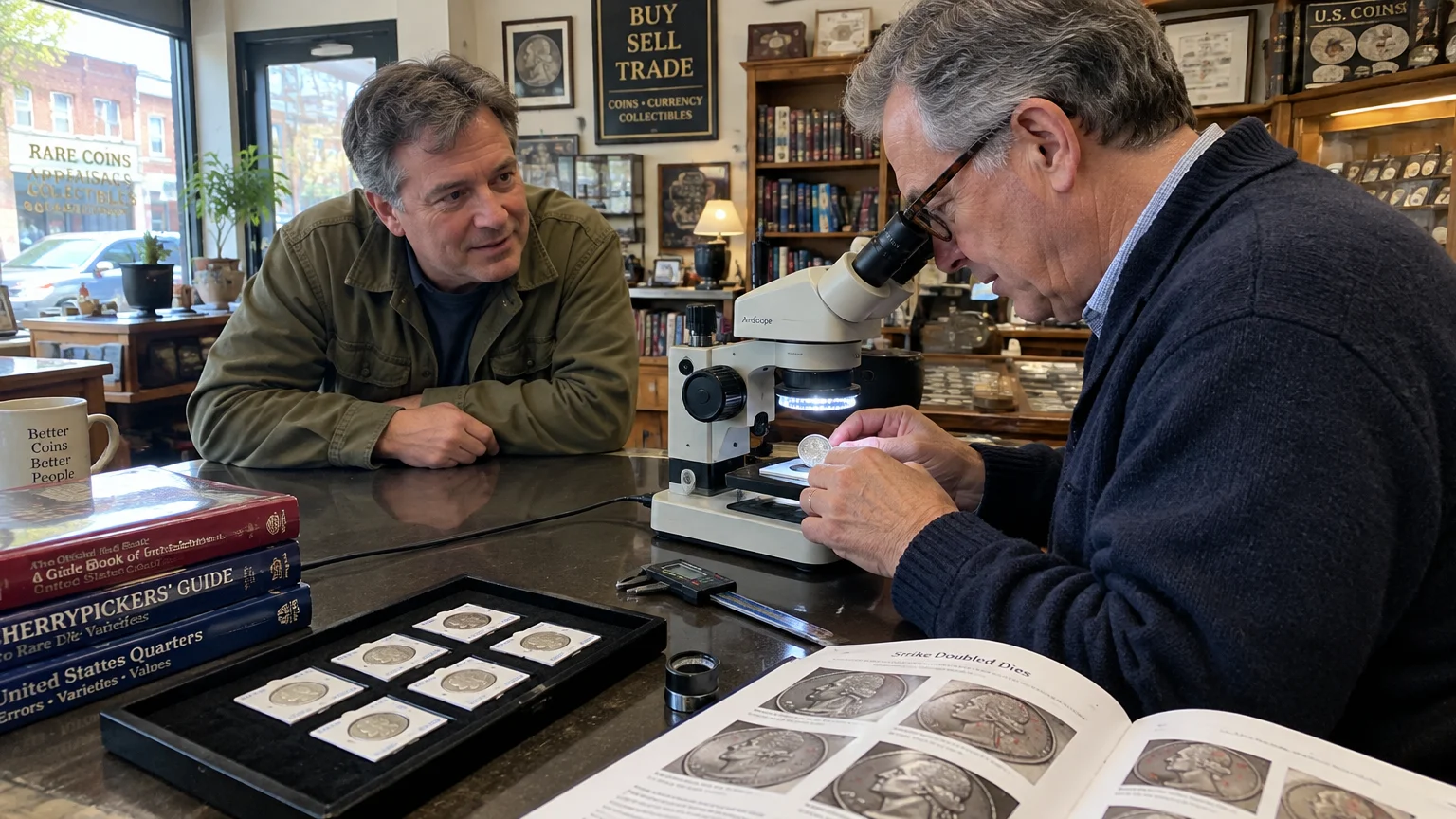
Getting Expert Input
If you pull a high-value candidate from an old jar or bank roll, getting qualified help protects both your wallet and your tax bill. Here is when outside expertise pays off.
- Authenticating a suspected key date or major error: Take high-value candidates—such as a 1932-D, 1932-S, 1965 silver planchet, or 2004-D Extra Leaf—to a reputable local coin dealer or submit them directly to PCGS or NGC. Skip general pawn shops, which rarely pay full collector premiums.
- Valuing an inherited collection: Before splitting or selling a family estate coin box, seek a written appraisal from an established numismatic dealer. Comparing offers from at least two reputable buyers helps establish fair market value.
- Planning for taxes on big sales: Under Internal Revenue Code Section 408(m), the IRS classifies coins and precious metals—even pre-1965 silver coins sold for melt value—as collectibles. Net gains on coins held over one year face a maximum 28% federal long-term capital gains rate rather than standard 15% or 20% stock rates.
- Documenting your cost basis: Coins held one year or less are taxed as ordinary income if sold at a profit. Consult a CPA or qualified tax professional if you sell rare coins or large silver holdings so you report basis and holding periods accurately.
Frequently Asked Questions
Is it legal to melt down pre-1965 silver quarters?
Yes. Federal rules under 31 CFR Part 82 prohibit melting or exporting only U.S. pennies (1-cent) and nickels (5-cent), meaning melting silver or clad quarters is legal—though altering any U.S. coin with intent to defraud remains illegal under 18 U.S.C. 331.
Are 1776–1976 Bicentennial quarters worth more than 25 cents?
Standard clad “1776–1976” quarters with no mint mark or a “D” mint mark were struck in huge numbers and remain worth 25 cents in circulated shape. Only the collector-only 1976-S 40% silver editions, pristine high-grade specimens, or verified errors like wrong-planchet strikes carry extra value.
What is the easiest rare quarter to find in pocket change right now?
Your best realistic shot in everyday change is spotting a 2019-W or 2020-W West Point quarter, which brings $10 to $40 even in circulated shape. Checking the date for pre-1965 silver—worth $8.80 to $9.11 in November 2026 melt value—also pays off regularly.
How should I store a valuable quarter after finding it?
Hold the coin strictly by its reeded edges so skin oils do not etch fingerprints into the metal. Slip it into an archival, PVC-free Mylar flip or rigid plastic capsule until you decide whether to sell or submit it for grading.
Start Checking Your Change Tonight
Make a quick habit of glancing at the dates, mint marks, and edges before dropping quarters into vending machines or Coinstar kiosks. A 10-second scan costs nothing, yet catching just one 90% silver coin or West Point “W” quarter puts an instant $9 to $40 back in your pocket.
This is general informational content based on widely accepted guidance. Individual results vary. Verify current details—rules, prices, eligibility, regulations—with official sources before making important decisions.
Last updated: November 2026. Rules, prices, and details change—verify current information with official sources before acting on it.









Leave a Reply