

Holiday seasonal work no longer means standing at a cash register for minimum entry pay. Across logistics, event planning, bookkeeping, and customer support, 2026 seasonal roles routinely pay $20 to $29 per hour.
With U.S. holiday retail sales projected at $1.013 trillion and online spending reaching $275.1 billion, employers are competing hard for dependable help. Your reliability and schedule flexibility give you a distinct advantage.
Targeting the right seasonal roles protects both your energy and your retirement income. Here are the best-paying holiday jobs for retirees this year alongside the tax, Social Security, and Medicare rules you should check first.
At a Glance: What Holiday Hiring Looks Like in 2026
Major employers are posting hundreds of thousands of openings this winter, even as overall retail hiring stays selective. The National Retail Federation projects retailers will add 325,000 to 375,000 seasonal workers this holiday season.
Outplacement firm Challenger, Gray & Christmas forecasts roughly 450,000 fourth-quarter retail seasonal job gains, down 2.5% from 2025. Still, five of the largest U.S. companies announced 470,400 seasonal hires through October 2026—up 26% over October 2025.
Competition for those openings is noticeably brisker this year. Indeed data cited in November 2026 showed seasonal job postings up about 10% year over year while applicant searches jumped 28%.
Even with more applicants, hiring managers still struggle to find punctual, customer-ready staff. An October 2026 Express Employment Professionals/Harris Poll survey found 15% of U.S. companies plan fall seasonal hiring, and 38% plan to hire more seasonal workers than last year.
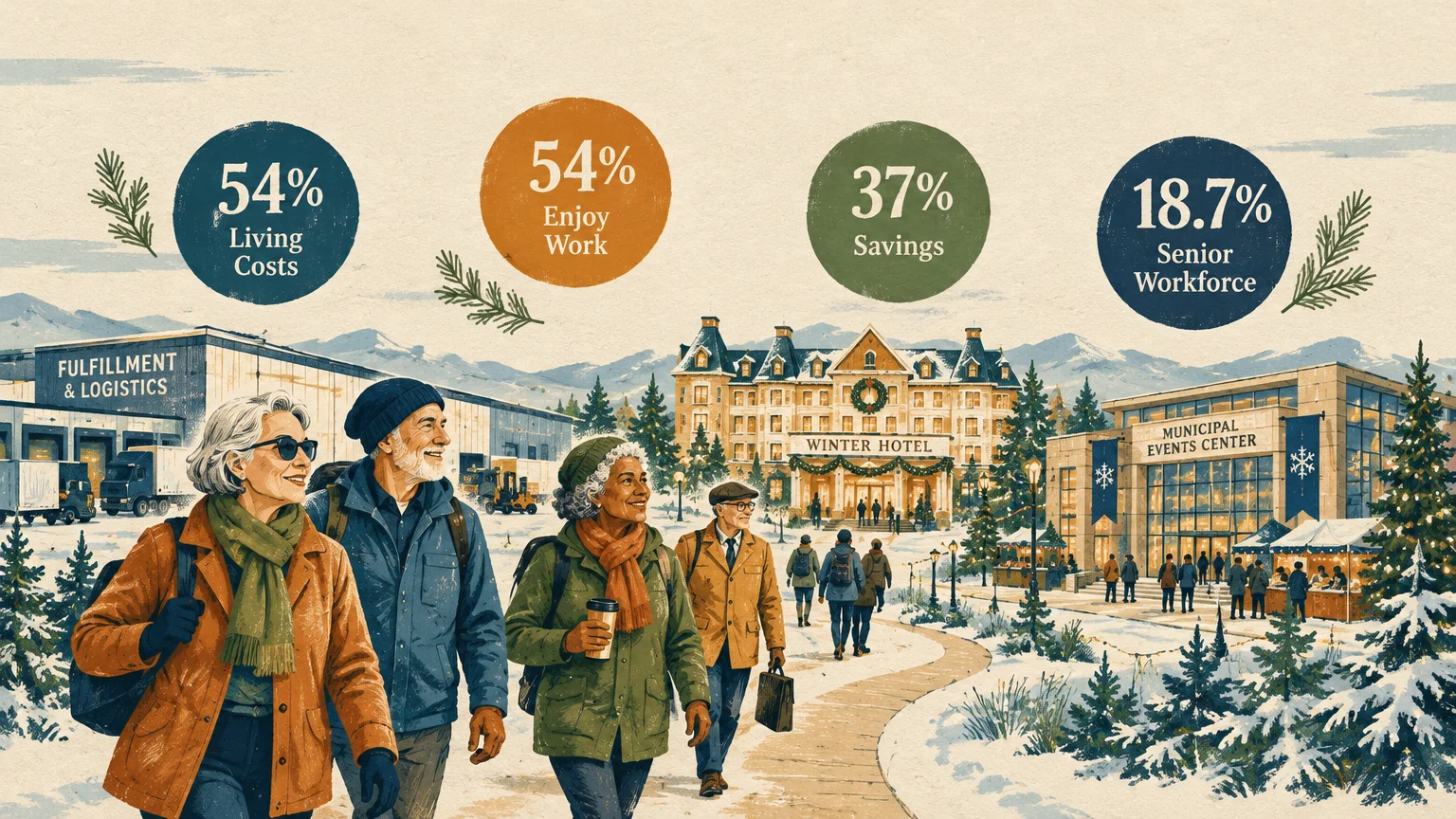
More retirees are stepping into that gap every year. According to the U.S. Bureau of Labor Statistics (BLS), the labor force participation rate for Americans age 65 and older stood at 18.7% in October 2026.
A ResumeBuilder.com survey of 3,574 U.S. seniors published in October 2026 showed nearly 1 in 8 have returned to work or plan to rejoin in 2026, alongside 16% who never retired. Respondents most often cited enjoying work (54%), high living costs (54%), and insufficient savings (37%).
Others pointed to combating boredom (34%), Social Security worries (26%), and Medicare expenses (19%). Seasonal work lets you address those financial goals in eight to twelve weeks without locking into a year-round schedule.
The Best-Paying Seasonal Jobs for Retirees This Holiday Season
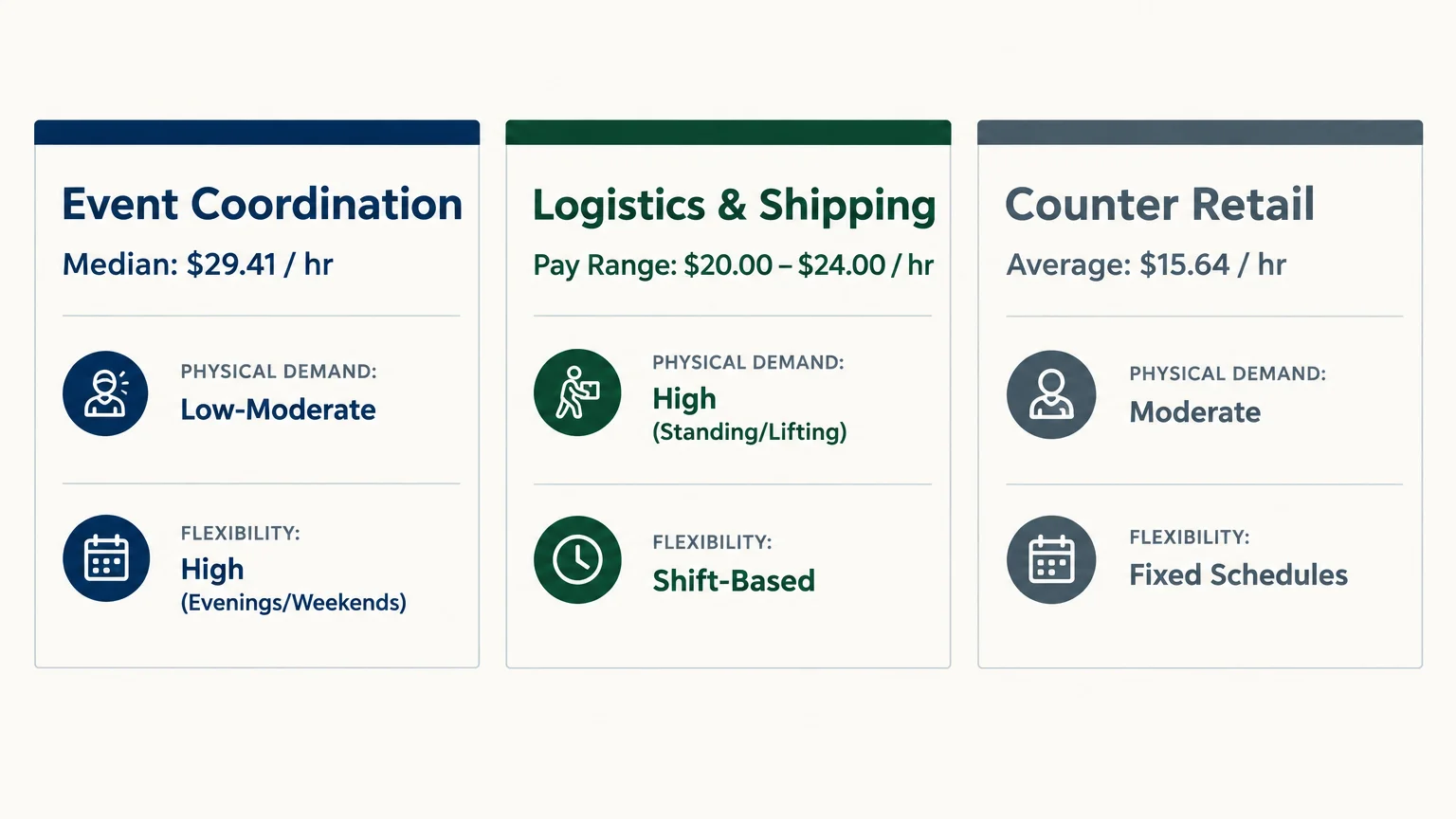
The widest pay gap in seasonal hiring separates traditional counter retail from specialized, administrative, and logistics roles. ZipRecruiter reports an average U.S. holiday seasonal wage of $15.64 per hour as of November 2026, with typical pay spanning $11.30 to $19.47 per hour.
You can beat that average substantially by matching your prior career skills—or a willingness to work peak shipping schedules—to higher-tier openings. The categories below pair national BLS median wage benchmarks from May 2025 data (released May 2026) with live 2026 employer pay ranges.
1. Meeting, Convention, and Event Planners
Corporate holiday parties, winter fundraisers, charity galas, and convention programs spike between mid-November and mid-January. BLS data shows meeting, convention, and event planners earn a median wage of $29.41 per hour nationwide.
Even entry-level or part-time event coordination shifts beat standard retail pay. Indeed Flex lists typical holiday hospitality and event shifts at $15 to $25 per hour plus tips.
Hotels, catering companies, museums, and local chambers of commerce frequently bring in seasonal coordinators to manage vendor check-ins, seating charts, and guest registration. Former teachers, office managers, and hospitality veterans transition into these roles with minimal training.
2. Seasonal Tax Preparers
Tax preparation firms begin recruiting, onboarding, and training seasonal preparers during late fall ahead of the January filing rush. Tax preparers earn a national BLS median wage of $26.40 per hour.
Many national tax chains offer structured training classes in November and December so you are certified before clients arrive in January. Paid shifts then run through mid-April, making this one of the most lucrative winter bridges on the market.
You work indoors at a desk, set predictable weekly hours, and build a skill you can return to every winter. Retirees with banking, payroll, or financial backgrounds often qualify for higher starting tiers or performance bonuses.
3. Bookkeeping, Accounting, and Auditing Clerks
Small businesses, nonprofits, and retail franchises face intense year-end pressure to reconcile accounts, process invoices, and close books for 2026. Bookkeeping, accounting, and auditing clerks earn a BLS median wage of $24.36 per hour.
Temporary staffing agencies and CPA offices routinely hire retired bookkeepers for 15 to 30 hours per week between November and February. Many assignments allow hybrid or fully remote work once you complete initial onboarding.
Familiarity with standard accounting software and spreadsheet reconciliation puts you near the front of the applicant pool. Because accuracy matters more than speed on foot, these desks fit retirees seeking low-impact, mentally engaging work.
4. Package Delivery Drivers and Seasonal Logistics Coordinators
Parcel carriers and fulfillment hubs offer some of the fastest hiring timelines and highest starting wages for seasonal workers. In October 2026, UPS announced plans to hire 100,000 seasonal workers for the peak shipping rush.
A November 2026 Jobcube analysis of 13,611 new seasonal listings found UPS accounted for 63% of postings and advertised a median pay of $23.00 per hour. FedEx seasonal listings showed a median advertised rate near $20 per hour, with 59% specifying part-time schedules.
Amazon announced plans on October 20, 2026, to hire more than 300,000 seasonal, part-time, and full-time U.S. operations workers at an average seasonal wage of $20 per hour. Beginning January 1, 2027, qualifying Amazon seasonal staff scheduled 30 or more hours weekly also gain day-one healthcare eligibility.
Those health plans start at $5 per week with $5 copays, a notable perk if you retired before age 65 and bridge private coverage. Elsewhere in logistics, GXO Logistics announced 22,000 seasonal openings and the U.S. Postal Service announced 10,000 seasonal openings.
Indeed Flex lists broad warehouse and logistics holiday shifts at $16 to $25 per hour plus overtime. Meanwhile, BLS reports a national median wage of $18.85 per hour for couriers and messengers.
Not every logistics role requires hauling heavy boxes onto a truck. Look specifically for personal-vehicle delivery helper roles, seasonal driver helpers, parcel sorting clerks, or warehouse inventory auditors if you want lighter physical duties.
5. Remote and In-Person Customer Service Representatives
Online holiday spending is projected to hit $275.1 billion in 2026—including $47.5 billion during Cyber Week alone—which creates massive call-center and chat volume. BLS reports a median wage of $21.53 per hour for customer service representatives.
Airlines, health insurers during open enrollment, catalog retailers, and financial firms ramp up remote support teams from October through January. Working from a quiet spare bedroom removes winter commuting costs and lets you choose early-morning or split shifts.
Employers prize calm communication and patience when resolving delayed shipments or billing questions. To avoid equipment surprises, verify before accepting an offer whether the company ships a laptop and headset or requires you to use your own desktop.
6. Holiday Tutors and Short-Term Substitute Teachers
Winter brings semester finals, college application deadlines, and heightened teacher absences during cold and flu season. Tutors earn a BLS median wage of $20.84 per hour and a mean wage of $23.10 per hour.
Short-term substitute teachers earn a BLS median wage of $20.03 per hour and a mean wage of $22.32 per hour. Both roles let you choose exact days or evenings on your calendar without committing to an entire semester.
Private tutoring centers and online platforms look for retirees fluent in algebra, reading comprehension, writing, or test prep. Public school districts often maintain streamlined substitute registries for retired educators and professionals with bachelor’s degrees.
7. Tour Guides, Recreation Workers, and Event Ushers
Botanical garden light displays, holiday train excursions, historic home tours, and winter theater seasons rely heavily on outgoing retirees. BLS lists median wages of $18.33 per hour for tour and travel guides and $17.58 per hour for recreation workers.
Ushers, lobby attendants, and ticket takers earn a BLS median wage of $15.82 per hour. Many venues sweeten modest hourly pay with complimentary show tickets, museum memberships, or free parking.
These assignments thrive on evening and weekend shifts when you want social interaction without sales quotas. Check local performing arts centers, ski lodges, municipal recreation departments, and holiday markets by early November.
8. Specialty Retail and Store-Based Associates
General retail pays less on average, with BLS reporting a median of $17.03 per hour ($17.94 mean) for retail salespersons and Indeed Flex citing $14 to $20 per hour. Still, selective big-box and specialty stores beat the market average or offer generous discounts.
Target advertises $15 to $24 per hour locally and showed a $17.25 per hour median across November 2026 seasonal postings. Michaels announced more than 10,000 seasonal openings that include a 30% employee discount—helpful if you already buy holiday crafts and framing.
Dick’s Sporting Goods and Foot Locker planned more than 11,000 combined seasonal hires for the winter shopping rush. Ask specifically about store-fulfillment shopper roles or fitting-room host shifts if you prefer steady walking over stationary standing at a register.
Side-by-Side Comparison: Pay, Flexibility, and Physical Demand
Comparing headline pay alongside physical strain and scheduling control makes it easier to pick a sustainable fit. The table below summarizes key 2026 seasonal options using BLS median pay data and published 2026 employer benchmarks.
| Job Category | Benchmark Pay | Physical Demand | Best Fit For |
|---|---|---|---|
| Meeting and Event Planners | $29.41/hr median (BLS); $15–$25/hr + tips (events) | Moderate (walking, setup oversight) | Organized communicators, former managers |
| Seasonal Tax Preparers | $26.40/hr median (BLS) | Low (seated desk work) | Detail-oriented workers seeking Nov–Apr hours |
| Bookkeeping and Accounting Clerks | $24.36/hr median (BLS) | Low (seated, often hybrid/remote) | Retirees with finance or spreadsheet skills |
| Package Delivery and Logistics | $20.00–$23.00/hr median (Amazon, FedEx, UPS) | Moderate to High (lifting, outdoor routes) | Active retirees wanting maximum short-term pay |
| Customer Service Representatives | $21.53/hr median (BLS) | Low (phone/chat from home or office) | Patient problem-solvers avoiding winter commutes |
| Tutors and Substitute Teachers | $20.03–$20.84/hr median (BLS) | Low to Moderate (classroom or desk) | Former teachers and subject-matter specialists |
| Tour Guides and Recreation Staff | $17.58–$18.33/hr median (BLS) | Moderate (standing, light walking) | Social retirees wanting venues and cultural perks |
| Specialty Retail Associates | $17.03/hr median (BLS); $15–$24/hr (Target) | Moderate (standing, stocking, brisk pace) | Shoppers who value store discounts |
How Holiday Earnings Affect Social Security Benefits
Before accepting extra December or January shifts, check how your age interacts with the Social Security retirement earnings test. Once you reach Full Retirement Age (FRA)—age 67 for anyone born January 2, 1960, or later—you face zero earnings limit.
According to the Social Security Administration (SSA), once you hit FRA, you can earn any amount from seasonal or permanent work without reducing your monthly benefit. The earnings test only applies if you collect retirement benefits while younger than FRA.
If you are under FRA for all of 2026, SSA deducts $1 in benefits for every $2 you earn above $24,480 ($2,040 per month under the first-year monthly rule). In 2027, that annual limit increases to $25,560 ($2,130 per month).
If you reach FRA during 2026, a much higher threshold applies: $65,160 ($5,430 per month), rising to $67,920 ($5,660 per month) in 2027. Under that rule, SSA deducts $1 for every $3 earned above the limit in the months prior to your FRA month.
Because holiday jobs often run from November 2026 through January 2027, your paychecks straddle two separate calendar-year limits. Knowing which year each paycheck lands in—since SSA counts wages when earned for employees, or net earnings for self-employment—helps you avoid unexpected benefit pauses.
Keep in mind that withheld Social Security benefits are not permanently lost. When you reach FRA, SSA recalculates and increases your monthly check to credit back the months or amounts previously withheld due to work earnings.

Tax Rules, the $6,000 Senior Deduction, and 1099 Changes
Holiday earnings alter your tax picture in ways that go beyond regular income tax brackets. Even if you already collect Social Security, your W-2 seasonal pay remains subject to standard FICA payroll taxes.
Employers withhold 6.2% for Social Security (up to the $184,500 wage cap in 2026, rising to $192,300 in 2027) and 1.45% for Medicare with no income cap. If you take 1099 gig or independent contractor work instead, you owe 15.3% self-employment tax starting at just $400 of net earnings.
Fortunately, a major new federal tax break softens the blow for older seasonal workers. Under Public Law 119-21—the One, Big, Beautiful Bill Act (OBBBA)—taxpayers age 65 or older before year-end can claim an extra $6,000 deduction from 2025 through 2028.
Married couples filing jointly qualify for $12,000 if both spouses are 65 or older. Per guidance from the Internal Revenue Service (IRS), this $6,000 senior deduction stacks on top of your regular or senior standard deduction—or itemized deductions—and phases out above $75,000 MAGI ($150,000 joint).
Two other 2026 federal tax updates directly affect seasonal workers:
- Higher Form 1099 thresholds: For payments made in tax year 2026, the federal reporting threshold for Form 1099-NEC and most 1099-MISC categories rose from $600 to $2,000, while Form 1099-K reverted to $20,000 and 200+ transactions. Even if you earn under $2,000 and never receive a form, every dollar of profit remains taxable.
- Higher 2026 business mileage rate: For July 1 through December 31, 2026, the IRS raised the standard business mileage rate to 76 cents per mile, up from 72.5 cents during the first half of 2026. Only self-employed 1099 drivers can deduct business mileage federally, though W-2 employers can reimburse up to that rate tax-free.
- Standard overtime rules: Under federal law, W-2 seasonal employees qualify for standard overtime at 1.5 times regular hourly pay after working 40 hours in a single workweek. However, federal law does not require employers to pay extra holiday premium rates for working Thanksgiving, Christmas, or New Year’s shifts.
Understanding whether an employer classifies your role as W-2 or 1099 prevents painful April tax surprises. A $22-per-hour seasonal contract role can net noticeably less than a $20-per-hour W-2 job once you cover both halves of payroll taxes yourself.
Medicare Premiums and the Two-Year IRMAA Trap
Extra seasonal income earned in November and December 2026 can quietly raise your healthcare costs two years down the road. For 2026, the standard Medicare Part B monthly premium is $202.90, according to the Centers for Medicare & Medicaid Services.
The Social Security Administration uses a two-year lookback to determine Income-Related Monthly Adjustment Amount (IRMAA) surcharges for Medicare Part B and Part D. That means the Modified Adjusted Gross Income (MAGI) reported on your 2026 tax return sets your Medicare premiums for 2028.
Higher-income beneficiaries pay 35% to 85% of total Part B program costs rather than the standard 25% share. Worse, IRMAA operates as a strict cliff rather than a gradual phase-in.
Exceeding an IRMAA income threshold by just $1 triggers the full surcharge tier for the entire calendar year, as outlined on Medicare.gov. If your retirement withdrawals, pension, and Social Security already put you near an IRMAA line, cap your December earnings—or shift overtime hours into January 2027.

How to Land a High-Paying Seasonal Role Before Peak Rush
With seasonal applicant searches rising faster than job listings in late 2026, early and strategic applications make a measurable difference. Use the checklist below to lock in better hours and stronger pay before schedules fill up:
- Lead with reliability and availability: Emphasize decades of punctuality, zero-drama customer service, and willingness to cover weekday mornings or split shifts that younger students avoid.
- Ask about physical requirements up front: Confirm how many hours require standing on concrete, whether stools are permitted at registers, and maximum lifting weights before signing onboarding paperwork.
- Weigh discounts against hourly pay: A 30% employee discount only beats a $3-per-hour higher wage if you already planned to spend heavily at that specific store.
- Clarify January transition plans: Express Employment Professionals/Harris Poll data shows 87% of U.S. hiring managers use seasonal roles to spot permanent hires, and 44% hope to retain some workers long-term. Ask during your interview whether top performers can drop to 10 or 15 hours per week after New Year’s.
Tailoring a clean, one-page resume around recent skills—software familiarity, inventory accuracy, conflict resolution, or tutoring credentials—keeps automated screening software from filtering you out. Apply directly on employer career portals rather than relying solely on third-party aggregators, since major logistics and retail chains update store-level openings daily.
Worth Keeping in Mind
Even strong hourly rates can backfire if you overlook fine print in your offer letter or retirement budget. Watch out for these common seasonal pitfalls before taking your first shift:
- Triggering an IRMAA cliff in late December: A few extra holiday overtime shifts can push your 2026 MAGI over a bracket by a few dollars and add hundreds or thousands to your 2028 Medicare Part B and Part D bills.
- Confusing 1099 gross pay with W-2 take-home pay: Self-employed holiday couriers and freelance event helpers must pay 15.3% self-employment tax above $400 net profit, though tracking every delivery mile at the 76-cent-per-mile rate for late 2026 helps offset taxable income.
- Assuming holiday shifts pay automatic bonuses: Federal law mandates 1.5× overtime pay past 40 weekly hours for non-exempt W-2 workers, not automatic double time on holidays; confirm any holiday differential in writing before agreeing to Black Friday or Christmas Eve shifts.
- Misreading the new $2,000 Form 1099-NEC threshold: Earning $1,500 on side seasonal projects in 2026 means a client likely will not mail a 1099-NEC, yet the IRS still requires you to report that income on your return.

When to Get Professional Help
Most retirees with straightforward Social Security and standard deduction filings can estimate seasonal take-home pay on their own. However, consulting a CPA, enrolled agent, or fee-only fiduciary financial planner makes smart financial sense in several situations:
- You sit near a Medicare IRMAA or tax bracket threshold: A tax professional can project how seasonal wages interact with Required Minimum Distributions (RMDs), Roth conversions, and the $6,000 senior deduction phaseout above $75,000 MAGI ($150,000 joint).
- You claim Social Security before Full Retirement Age: An advisor or SSA specialist can help time seasonal paychecks across December 2026 and January 2027 so you stay under the $24,480 (2026) and $25,560 (2027) earnings limits.
- You take 1099 seasonal delivery or consulting work: An accountant can verify quarterly estimated tax payments and confirm proper mileage logging at the late-2026 rate of 76 cents per mile.
- You receive a state or union pension with return-to-work limits: Certain public-sector pensions restrict hours or earnings—even outside the public agency—making a quick benefits review essential before onboarding.
Frequently Asked Questions
Do I still pay Social Security taxes on seasonal wages if I already collect benefits?
Yes. Employers must withhold 6.2% for Social Security (up to the $184,500 cap in 2026) and 1.45% for Medicare from W-2 seasonal paychecks regardless of your age or benefit status, though higher recent earnings can occasionally nudge your future benefit upward.
Which seasonal jobs pay the most without heavy lifting?
Meeting and event planners ($29.41/hour median), seasonal tax preparers ($26.40/hour median), bookkeeping clerks ($24.36/hour median), remote customer service representatives ($21.53/hour median), and tutors ($20.84/hour median) top the list for low-impact work. Most operate indoors at desks, classrooms, or home offices.
Can holiday seasonal work turn into a permanent part-time job in 2027?
Yes, and employers actively look for keepers during the winter rush. Survey data from Express Employment Professionals/Harris Poll shows 87% of hiring managers use seasonal hiring to identify permanent talent, and 44% hope to retain seasonal workers once holiday traffic slows.
How does the new $6,000 senior tax deduction work for seasonal income?
Through tax year 2028, taxpayers age 65 or older can deduct an extra $6,000 ($12,000 if married filing jointly and both spouses are 65+) on top of standard or itemized deductions. That cushion shields a substantial chunk of holiday wages, provided your MAGI stays below the $75,000 single or $150,000 joint phaseout.
Putting Your Seasonal Paycheck to Work
A well-chosen seasonal job this winter can cover holiday travel, pad an emergency fund, or pay down lingering debt without locking you into a 12-month routine. Focus on higher-margin roles—logistics support, bookkeeping, tax prep, tutoring, or event coordination—that reward your experience at $20 per hour or more.
Run a quick check on your 2026 MAGI, your Full Retirement Age status, and your preferred weekly hours before accepting an offer. This article provides general information only. Every reader’s situation is different—what works for others may not be the right fit for you. For personalized guidance on health, legal, or financial matters, consult a qualified professional.
Last updated: November 2026. Rules, prices, and details change—verify current information with official sources before acting on it.









**TraceEagle — Free, All-Platform Network Packet Capture & Debugging Tool**
– Raw packet capture at the NIC level: DNS, QUIC, TCP/UDP — nothing slips through, granularity on par with Wireshark
– Auto-decrypts on capture: no proxy setup, no key import, no environment config — ciphertext becomes plaintext instantly
– Built for the hard cases: no jailbreak, no cert install, bypasses certificate pinning, decodes HTTP/3 & QUIC
– Full debugging toolkit: breakpoint editing, request replay, one-click load testing (true p99), reverse-engineer OpenAPI from traffic, generate code
– AI-powered capture: built-in MCP service exposing 40+ tools as APIs — let your AI assistant capture and debug on demand
Free across all platforms. Perfect for integration testing, mobile app debugging, API security, load testing, and network troubleshooting.