

Every dollar you save on federal and state taxes leaves more money in your nest egg for travel, healthcare, and everyday living expenses. While many retirees focus exclusively on standard deductions or managing required minimum distributions, dollar-for-dollar tax credits offer direct bottom-line reductions on your final tax bill. Whether you work part-time, care for an aging spouse, modernize your home for energy efficiency, or retired before Medicare eligibility, several lucrative credits regularly slip under the radar. Claiming these overlooked tax breaks can recover hundreds or even thousands of dollars each filing season. Here are nine tax credits retirees commonly overlook, along with exact eligibility thresholds and filing steps.

1. Credit for the Elderly or the Disabled (IRS Schedule R)
The federal Credit for the Elderly or the Disabled (Internal Revenue Code Section 22) directly supports lower-income older adults and individuals on permanent disability. To qualify by age, you must be 65 or older by the end of the tax year. If you are under 65, you can still qualify if you retired on permanent and total disability and receive taxable disability income.
The credit equals 15% of an initial base amount determined by your filing status:
- Single, head of household, or qualifying surviving spouse: $5,000 initial base ($750 maximum credit).
- Married filing jointly (one spouse qualifies): $5,000 initial base ($750 maximum credit).
- Married filing jointly (both spouses qualify): $7,500 initial base ($1,125 maximum credit).
- Married filing separately: $3,750 initial base ($562.50 maximum credit), provided you lived apart from your spouse all year.
The IRS reduces your initial base dollar-for-dollar by any nontaxable Social Security benefits, nontaxable pensions, or veterans’ disability pensions you receive. Furthermore, the base decreases by half of the amount by which your Adjusted Gross Income (AGI) exceeds statutory thresholds ($7,500 for single filers; $10,000 for married couples filing jointly). Consequently, the credit phases out completely if your AGI reaches $17,500 for single filers, $20,000 for married couples with one qualifying spouse, or $25,000 for joint filers where both spouses qualify.
While strict income caps exclude retirees with substantial pensions or investment portfolios, this credit provides valuable relief for seniors living primarily on modest taxable distributions or small earned incomes. You calculate and claim this nonrefundable credit by attaching Schedule R to Form 1040.

2. Retirement Savings Contributions Credit (The Saver’s Credit)
Many people assume the Retirement Savings Contributions Credit (Form 8880) targets only younger entry-level workers. However, working retirees—such as consultants, part-time retail workers, seasonal tax preparers, or rideshare drivers—frequently qualify. If you earn wages in retirement and funnel a portion of that money back into an eligible retirement vehicle, you can slash your tax liability.
Eligible contributions include deposits made to traditional or Roth IRAs, 401(k) plans, 403(b) plans, SIMPLE IRAs, SEP-IRAs, and ABLE accounts. The credit awards you a tax credit worth 50%, 20%, or 10% of your contributions, capped at a maximum contribution base of $2,000 for individuals ($4,000 for married couples filing jointly). This delivers a maximum credit of $1,000 per person or $2,000 for joint filers.
Income thresholds determine your exact credit percentage:
- Tax Year 2025: The 50% credit applies to single filers with an AGI up to $23,000 ($46,000 for married filing jointly). The credit fully phases out at an AGI of $39,500 for single filers and $79,000 for married joint filers.
- Tax Year 2026: The 50% credit applies to single filers with an AGI up to $23,500 ($47,000 for married filing jointly). The credit phases out entirely above $40,250 for single filers and $80,500 for married joint filers.
Keep in mind that under the SECURE 2.0 Act, the Saver’s Credit will transition in tax year 2027 into the Saver’s Match. Rather than applying a nonrefundable credit on your tax return, the federal government will deposit a direct matching contribution of up to 50% (capped at $1,000 per individual) directly into your IRA or retirement plan. Until then, you can capture this tax credit every year you generate earned income and make qualifying deposits.

3. Earned Income Tax Credit (EITC) for Working Seniors
The Earned Income Tax Credit (EITC) stands out as one of the most substantial refundable tax credits in the federal tax code. A persistent tax myth claims that EITC is reserved solely for working families with dependent children. In reality, older adults working part-time without qualifying dependent children can claim the childless EITC.
Past tax rules imposed an upper age ceiling of 65 on the childless EITC, but legislative reforms permanently eliminated that maximum age restriction. As long as you are at least 25 years old and have taxable earned income (wages, tips, or net self-employment earnings), you can claim the credit regardless of how old you are. For tax year 2025, a childless individual with an AGI under $18,590 ($25,510 for married filing jointly) can receive a refundable credit of up to $632. If you support a qualifying grandchild in your home, your maximum credit can exceed $7,000 depending on family size.
Because the EITC is fully refundable, you receive the full balance as a cash refund even if your total federal income tax liability equals zero. However, your investment income (such as taxable interest, ordinary dividends, and net capital gains) must remain below the annual cap ($11,600 in 2025; $11,950 in 2026) to maintain eligibility.

4. Credit for Other Dependents (Family Tax Credit)
Retirees frequently provide shelter, groceries, and financial support to extended family members. If you care for an aging parent, an adult child with disabilities, or another dependent relative who does not qualify for the Child Tax Credit, you can claim the Credit for Other Dependents (ODC).
Established under Internal Revenue Code Section 24(h)(4), this provision grants a nonrefundable credit of up to $500 per qualifying dependent. Unlike standard deductions that merely lower your taxable income, this credit directly wipes out up to $500 of your tax bill per person.
To claim an adult relative as a dependent for this credit, the individual must satisfy three primary tests:
- Relationship or Household Test: The person must either be related to you (parent, stepparent, sibling, in-law, or adult child) or live with you as a member of your household for the entire calendar year.
- Gross Income Test: The dependent’s gross taxable income must fall below the annual statutory threshold ($5,050 for 2025; $5,200 for 2026). Nontaxable Social Security income does not count toward this gross income ceiling.
- Support Test: You must provide more than 50% of the individual’s total financial support during the tax year, including housing, food, medical care, and clothing.
The Credit for Other Dependents features generous phaseout limits. The credit only begins to phase out if your Modified Adjusted Gross Income (MAGI) exceeds $200,000 for single filers or $400,000 for married couples filing jointly, making it accessible to virtually all middle-income retirees.

5. Child and Dependent Care Credit (IRS Form 2441) for Incapacitated Adults
Most taxpayers associate the Child and Dependent Care Credit exclusively with nursery schools and summer camps. However, the underlying statute specifically covers care expenses incurred for a physically or mentally incapacitated spouse or dependent adult.
If you work, consult, or actively seek employment while managing caregiving responsibilities at home, you can claim qualifying care expenses paid to adult day care centers, in-home care attendants, or specialized companion aides. The qualifying individual must have lived with you for more than half the year and must be physically or mentally incapable of self-care.
Under current rules, you can claim up to $3,000 in qualifying expenses for one individual, or up to $6,000 for two or more qualifying individuals. The credit percentage ranges from 20% to 35% of your eligible expenses, depending on your AGI. A retiree earning an AGI under $15,000 qualifies for the full 35% rate ($1,050 for one dependent; $2,100 for two), while those with an AGI above $43,000 receive a 20% credit ($600 for one dependent; $1,200 for two).
To claim the credit, file Form 2441 with your Form 1040. You must report the care provider’s legal name, physical address, and Social Security Number or Employer Identification Number (EIN).

6. Premium Tax Credit (IRS Form 8962) for Early Retirees
Retiring before age 65 creates a critical health insurance bridge between employer group coverage and Medicare enrollment. Purchasing an individual health plan through the Affordable Care Act (ACA) marketplace can carry steep monthly premiums, but the Premium Tax Credit (IRS Form 8962) provides substantial relief.
The Premium Tax Credit caps your required health insurance premium contribution at a statutory percentage of your household income. If you choose an ACA marketplace benchmark Silver plan, the federal government covers the remainder of the premium cost through advance monthly payments or a lump-sum credit on your tax return.
Early retirees can actively optimize their income to maximize this credit. Because eligibility depends strictly on your household Modified Adjusted Gross Income—not your total net worth or liquid assets—strategic retirement distributions allow you to control your tax outcome. Consider these actionable distribution tactics:
- Withdraw living expenses from non-taxable Roth IRA accounts or cash savings to keep your taxable income low.
- Harvest long-term capital gains within the 0% federal tax bracket while keeping total MAGI inside target ACA subsidy ranges.
- Limit taxable traditional IRA distributions until Medicare coverage begins at age 65.
Even minor adjustments to your income distributions can save thousands of dollars annually on health insurance premiums during your early retirement years.

7. Clean Energy and Energy Efficient Home Improvement Credits
Retirees aging in place often update aging HVAC units, replace drafty windows, or install clean energy systems to permanently lower monthly utility bills. The federal government offers two major tax credits for these home upgrades under Internal Revenue Code Sections 25C and 25D.
The Energy Efficient Home Improvement Credit (IRC § 25C) reimburses 30% of the cost of qualified energy-saving home upgrades, with specific annual caps:
- Electric or Natural Gas Heat Pumps & Heat Pump Water Heaters: Up to $2,000 per year.
- Exterior Windows and Skylights: Up to $600 per year.
- Exterior Doors: Up to $250 per door ($500 annual maximum).
- Home Energy Audits: Up to $150 per year conducted by a certified inspector.
- Overall Annual Limit: Up to $1,200 per year for standard building envelope components, or up to $3,200 if you install a qualified heat pump.
Because the Section 25C credit resets annually through 2032, you can phase your home improvements across multiple tax years—replacing exterior doors and windows in year one, and installing a new heat pump in year two—to claim the maximum credit each time.
The Residential Clean Energy Credit (IRC § 25D) provides an uncapped 30% credit for installing residential rooftop solar panels, solar water heaters, small wind turbines, and home battery storage systems with a capacity of 3 kilowatt-hours or greater. If your credit exceeds your current tax liability, Section 25D allows you to carry forward the unused balance to offset future taxes.

8. Previously-Owned Clean Vehicle Credit (IRC § 25E)
Many older adults transition from commuting vehicles to practical, low-maintenance daily drivers in retirement. If you purchase a used electric vehicle (EV) or plug-in hybrid electric vehicle (PHEV), the Previously-Owned Clean Vehicle Credit (IRC § 25E) offers significant savings.
This credit equals 30% of the sale price of an eligible used clean vehicle, up to a maximum credit of $4,000. To qualify, the vehicle and transaction must satisfy specific criteria:
- The vehicle must have a purchase price of $25,000 or less.
- The model year must be at least two years older than the calendar year in which you purchase it.
- You must purchase the vehicle from a licensed automotive dealer who reports the required sale information to the IRS.
- The vehicle’s battery must have a capacity of at least 7 kilowatt-hours.
Income restrictions apply: your Modified AGI cannot exceed $75,000 for single filers, $112,500 for heads of household, or $150,000 for married couples filing jointly. You can use your AGI from either the year of purchase or the preceding year to qualify. Furthermore, you can transfer the credit directly to the participating dealership at the time of sale, immediately lowering your out-of-pocket purchase price rather than waiting to file your annual tax return.

9. State-Level Circuit-Breaker Property Tax Credits
While federal tax credits receive the most attention, some of the most lucrative relief programs operate at the state level. Many state departments of revenue manage property tax “circuit-breaker” programs designed to prevent property taxes from consuming an unsustainable share of a senior’s fixed income.
Similar to an electrical circuit breaker that cuts current when an electrical system overloads, a property tax circuit breaker provides state tax relief when your local property tax bill exceeds a specific percentage of your total household income. These programs typically operate in one of two ways:
- Refundable State Income Tax Credits: You claim a direct credit on your state individual income tax return. If the credit exceeds your state income tax liability, the state treasury issues a cash refund check.
- Direct Property Tax Rebates or Reductions: The state or county tax assessor applies a direct rebate or reduction against your local real estate tax bill.
States such as Michigan (Homestead Property Tax Credit), Wisconsin (Homestead Credit), Pennsylvania (Property Tax/Rent Rebate Program), Maryland (Homeowners’ Property Tax Credit), and New York (Real Property Tax Credit) offer these specialized relief mechanisms. In many jurisdictions, senior renters qualify alongside homeowners, receiving credits calculated on the portion of rent that goes toward municipal property taxes. Review your state’s department of taxation guidelines annually, as application deadlines and income eligibility bands adjust regularly.
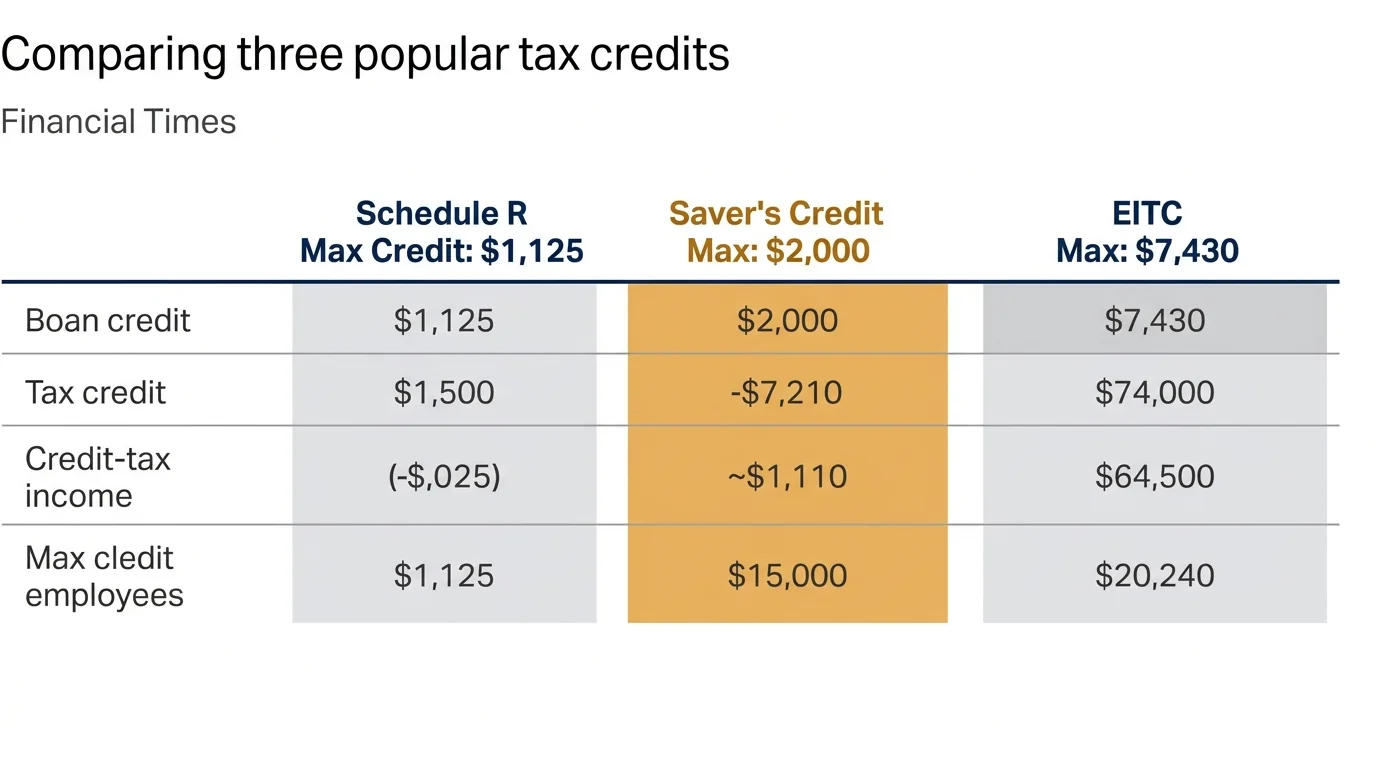
Comparing the 9 Overlooked Tax Credits
To help you determine which tax credits fit your financial profile, review this summary comparing credit caps, refundability, and key eligibility limits:
| Tax Credit Name | Maximum Credit Value | Refundable? | Primary Eligibility Hurdle | Required IRS Form |
|---|---|---|---|---|
| Credit for the Elderly or Disabled | $750 – $1,125 | No | Low AGI cap ($17.5k single / $25k MFJ) and age 65+ | Schedule R |
| Saver’s Credit | $1,000 ($2,000 MFJ) | No | Must have earned income and contribute to an IRA/plan | Form 8880 |
| Earned Income Tax Credit (EITC) | $632+ (childless) | Yes | Earned income under caps; investment income under $11,600 | Schedule EIC / 1040 |
| Credit for Other Dependents | $500 per dependent | No | Provide >50% support; dependent gross income under $5,050 | Form 1040 |
| Child & Dependent Care Credit | $600 – $2,100 | No | Incapacitated spouse/dependent care needed to work | Form 2441 |
| Premium Tax Credit | Varies (thousands) | Yes | Ages 55–64 enrolled in ACA plan; income 100%–400%+ FPL | Form 8962 |
| Energy Efficient Home Upgrades | $1,200 – $3,200 / yr | No | Installing certified heat pumps, windows, doors, insulation | Form 5695 |
| Used Clean Vehicle Credit | Up to $4,000 | No (Point-of-sale) | Used EV/PHEV under $25k; AGI under $75k single / $150k MFJ | Form 8936 |
| State Property Tax Circuit-Breaker | Varies by State | Often Yes | State resident; high local tax burden relative to income | State Tax Forms |
Tax Credits vs. Tax Deductions: Why the Difference Matters in Retirement
Understanding the fundamental distinction between a tax deduction and a tax credit helps you structure your retirement withdrawals more effectively.
A tax deduction reduces your taxable income before the tax brackets are applied. For example, if you are in the 12% marginal tax bracket, a $1,000 tax deduction saves you $120 in federal taxes ($1,000 × 0.12). Retirees aged 65 and older benefit from the Additional Standard Deduction under Internal Revenue Code Section 63(f). For tax year 2025, this provision adds an extra $2,000 to the basic standard deduction for single or head-of-household filers, and $1,600 per qualifying spouse for married couples filing jointly.
In contrast, a tax credit provides a direct, dollar-for-dollar reduction of your calculated tax bill. A $1,000 tax credit wipes out $1,000 in taxes owed, making credits significantly more powerful than deductions of the same face value.
Additionally, retirees over age 70½ can use Qualified Charitable Distributions (QCDs) to manage their taxable baseline. Direct transfers from your traditional IRA to a qualified 501(c)(3) charity (up to $108,000 in 2025; $111,000 in 2026) satisfy your annual Required Minimum Distribution (RMD) without increasing your Adjusted Gross Income. Keeping your AGI low preserves your eligibility for income-sensitive tax credits like the Saver’s Credit, EITC, and healthcare premium subsidies.
What Can Go Wrong
Attempting to claim tax credits without reviewing specific IRS constraints can lead to rejected filings, delayed refunds, or unexpected tax adjustments. Watch out for these four common pitfalls:
- Misunderstanding Nonrefundable vs. Refundable Credits: If your total tax liability on Form 1040 is $400, a nonrefundable credit worth $1,000 (such as the Credit for Other Dependents or Schedule R) will only reduce your tax liability to $0; you forfeit the remaining $600. Only refundable credits (like the childless EITC or Premium Tax Credit) pay out the excess as a cash refund check.
- Crossing the ACA Subsidy Cliff or Phaseout Ceilings: Taking an unplanned retirement account withdrawal or realizing large capital gains in December can suddenly push your Modified AGI above subsidy thresholds. This can trigger an obligation to repay thousands of dollars in advance Premium Tax Credits when filing Form 8962.
- Overlooking Gross Income Tests for Adult Dependents: If you claim an aging parent for the $500 Credit for Other Dependents, ensure their taxable income (excluding Social Security) remains below the annual limit ($5,050 for 2025). Earning even one dollar over the threshold disqualifies them as a dependent on your return.
- Failing to Secure Manufacturer Certification Statements: To claim residential energy efficiency credits on Form 5695, you must retain the manufacturer’s PIN or certified efficiency rating statement for installed heat pumps, windows, and doors in your tax records. The IRS routinely disallows energy credits when homeowners lack proper documentation during an audit.

Where Outside Advice Pays Off
While many tax credits can be claimed using standard tax preparation software, certain retirement scenarios warrant professional consultation with a certified public accountant (CPA) or an Enrolled Agent (EA):
- Multi-Generational Care Coordination: When multiple siblings share financial support for an elderly parent, an accountant can help you draft a Form 2120 (Multiple Support Declaration). This allows one designated sibling to claim the dependency tax benefits each year.
- Early Retirement Income Engineering: If you retire between ages 55 and 64, a fee-only financial planner can structure an exact annual withdrawal sequence across your taxable, tax-deferred, and Roth accounts to keep your MAGI optimized for maximum ACA Premium Tax Credits.
- Complex Estate and RMD Timing: Coordinating large Required Minimum Distributions, Qualified Charitable Distributions, and Roth conversions requires careful planning to prevent accidental phaseouts of medical deductions and senior tax credits.
Frequently Asked Questions
Can I claim tax credits if my only income is Social Security?
If your sole source of income consists of nontaxable Social Security benefits, your federal income tax liability is generally zero, meaning you are not legally required to file a federal return. However, if you are eligible for fully refundable credits—such as state-level property tax circuit breakers or the childless Earned Income Tax Credit—you must file a tax return to receive your cash refund.
Can I claim the Saver’s Credit if I am retired and work a part-time seasonal job?
Yes. As long as you receive taxable earned income (reported on Form W-2 or 1099-NEC), make an eligible contribution to a traditional or Roth IRA, and keep your Adjusted Gross Income below the annual limits ($39,500 single / $79,000 MFJ for 2025), you can claim the Saver’s Credit on IRS Form 8880.
Does claiming an elderly parent as a dependent impact their Medicare or Medicaid eligibility?
Claiming a parent for the $500 Credit for Other Dependents does not affect their Medicare coverage, which is an earned entitlement. However, Medicaid eligibility is tied strictly to household income and asset thresholds. In some states, claiming a parent on your tax return may pull them into your tax household, potentially complicating their Medicaid or Supplemental Security Income (SSI) calculations. Review your state’s Medicaid guidelines before claiming an adult family member.
Can I claim energy improvement tax credits if I rent my retirement home?
Under IRC Section 25C, renters can occasionally claim credits for certain portable energy-efficient upgrades they personally purchase and install, provided the equipment meets statutory standards. However, structural improvements to the building envelope (such as windows, exterior doors, and central heat pumps) generally require the claimant to own and reside in the property as their principal residence.
Maximizing your annual tax savings is an ongoing discipline that requires reviewing your credits, deductions, and income distributions every filing season. Take time to audit your eligibility for these nine credits before submitting your return, or share this checklist with your tax preparer to guarantee you keep more of your hard-earned nest egg.
This article provides general information only. Every reader’s situation is different—what works for others may not be the right fit for you. For personalized guidance on health, legal, or financial matters, consult a qualified professional.
Last updated: May 2026. Rules, prices, and details change—verify current information with official sources before acting on it.









Leave a Reply