

Your career shapes your daily schedule, stress levels, and take-home pay, but it also wields a profound influence on your marriage. U.S. Census Bureau data shows divorce rates vary dramatically across different career paths.
While roughly 35% of married American workers experience a split, certain high-stress jobs push marital failure rates beyond 50%. That volatility can easily jeopardize your long-term personal finances.
Exploring the professions with highest divorce rates highlights the critical connection between your work life and your financial security.
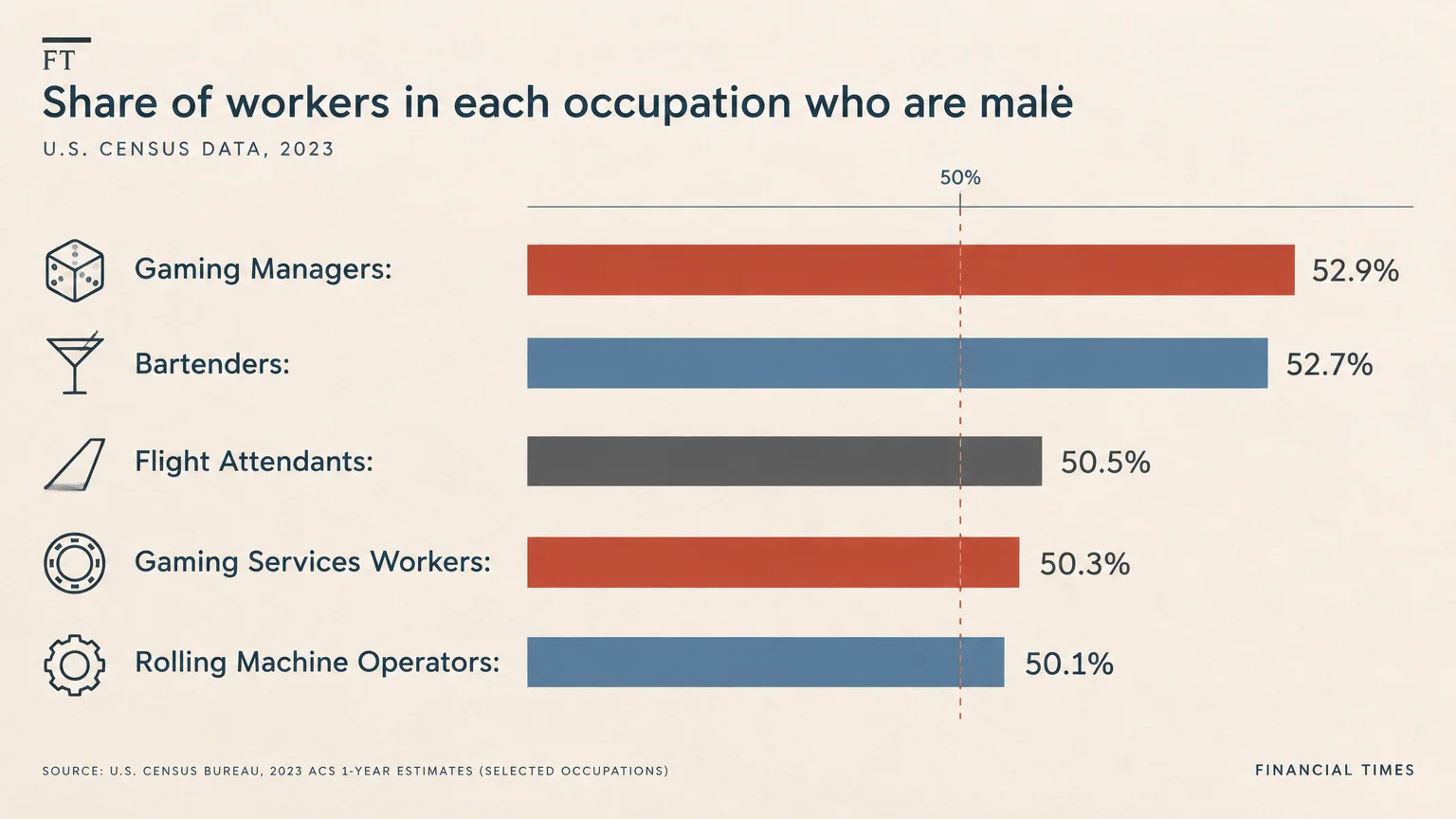
The Occupations with the Highest Divorce Rates
Data compiled from the U.S. Census Bureau American Community Survey reveals startling disparities among American workers. Several occupations see more than half of ever-married workers undergo a divorce or legal separation.
Casino gaming managers claim the top spot with a staggering 52.9% cumulative divorce rate. Irregular shift hours, round-the-clock operations, and high-stress environments place relentless pressure on personal relationships.
Bartenders follow right behind with a 52.7% cumulative divorce rate. In fact, research indicates bartenders experience an annual new-divorce rate of 4.34%, the highest among common trades.
Flight attendants experience an estimated divorce rate of 50.5%. Constant travel, frequent nights away from home, and irregular sleep patterns make sustaining day-to-day marital routines exceedingly difficult.
Gaming services workers, who staff casino floors alongside managers, post a 50.3% divorce rate. Like their supervisors, these employees face late-night shifts, volatile tip income, and emotionally charged workplaces.
Rolling machine setters and operators in manufacturing round out the top tier at 50.1%. Intense physical labor and fluctuating plant production schedules create severe chronic stress at home.
Several transit and customer service roles also hover near the 48% mark. These occupations include municipal bus drivers, telemarketers, massage therapists, and licensed practical nurses (LPNs).
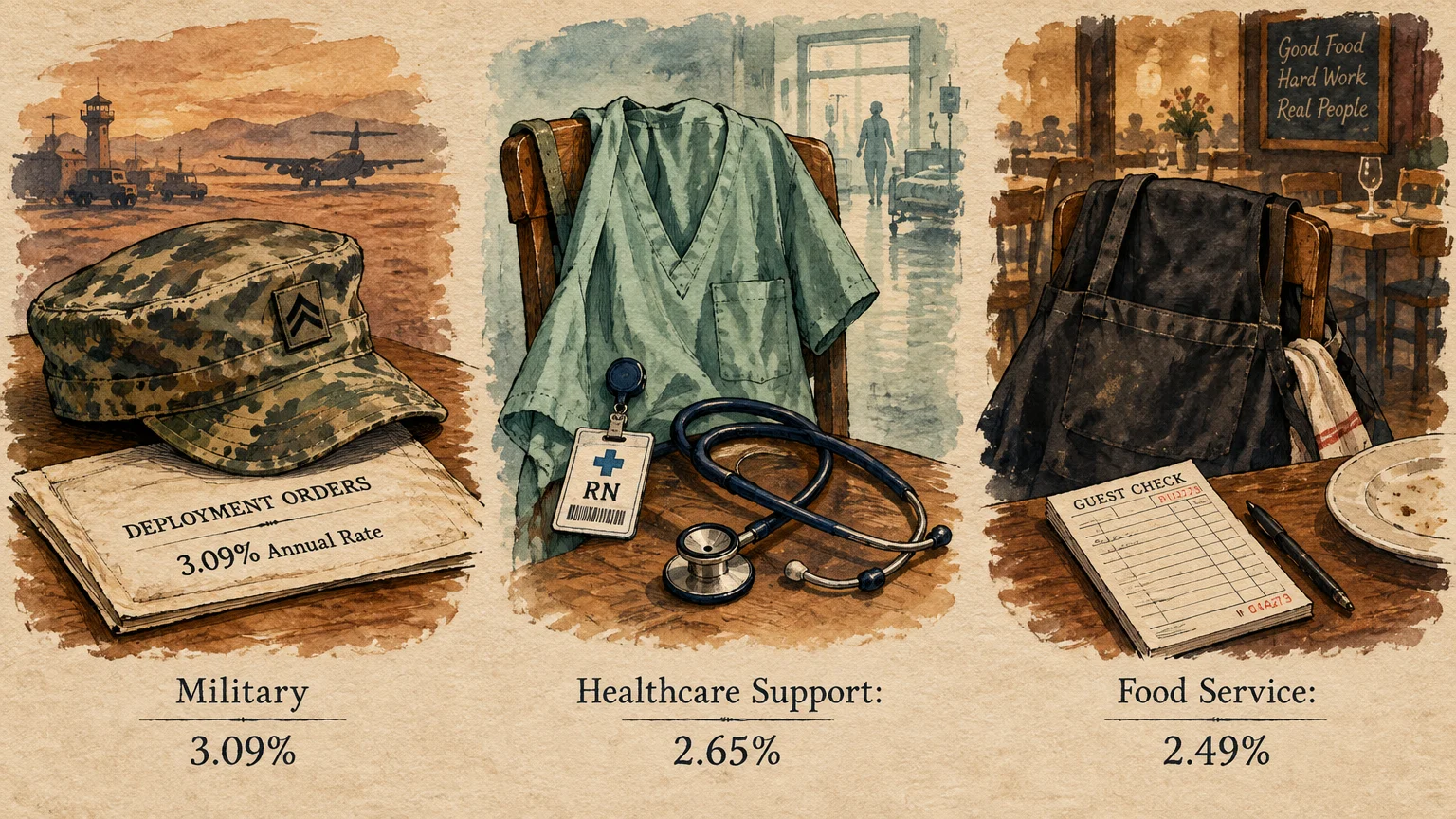
High-Risk Industries: Military, Healthcare, and Hospitality
While individual occupations provide clear data points, examining broad industrial sectors reveals deeper systemic pressures. Specific work environments consistently generate higher relationship instability across the board.
Active-duty military personnel face substantial relationship strain, recording an annual divorce rate of 3.09%. According to data gathered through the U.S. Census Bureau, this rate nearly doubles the national annual average of 1.6%.
Military families endure extended deployments, frequent relocations, and the psychological weight of combat trauma. These intense disruptions complicate partner communication and frequently derail spousal career prospects.
Healthcare support roles rank as another highly vulnerable category, averaging a 2.65% annual divorce rate. Home health aides, psychiatric technicians, and nursing assistants shoulder heavy physical demands for modest wages.
Food preparation and hospitality workers log a 2.49% annual divorce rate. Unstable weekly scheduling, frequent weekend commitments, and lack of paid leave leave little room for family life.
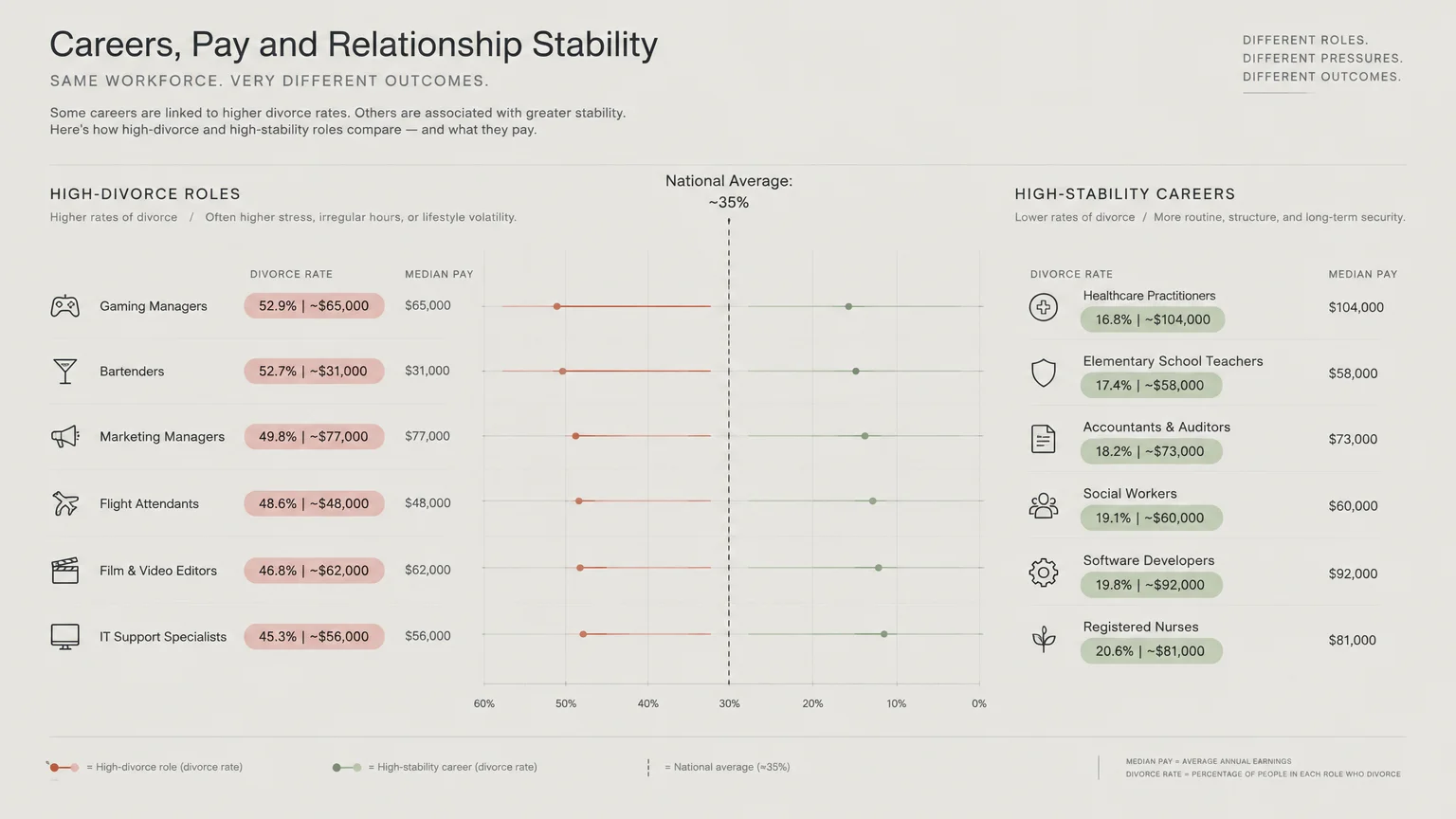
Comparing Divorce Rates Across Prominent U.S. Professions
Career and marriage stability often mirror the economic stability of a field. Comparing the highest-divorce jobs to the lowest-divorce positions highlights clear operational and financial differences.
| Occupation | Divorce or Separation Rate | Median Annual Pay | Primary Marital Stressors |
|---|---|---|---|
| Gaming Managers | 52.9% | ~$65,000 | Night shifts, casino environment, irregular hours |
| Bartenders | 52.7% | ~$31,000 | Late hours, alcohol exposure, volatile tip income |
| Flight Attendants | 50.5% | ~$68,000 | Frequent travel, time zone fatigue, physical distance |
| Active-Duty Military | 3.09% (Annual) | Varies by rank | Combat stress, prolonged deployments, relocation |
| Home Health Aides | ~47.0% | ~$33,000 | Physical burnout, emotional fatigue, low wages |
| Physicians & Surgeons | 20.1% | $239,000+ | Demanding shifts counterbalanced by high income |
| Software Developers | 18.9% | $130,000+ | Predictable schedule, remote flexibility, high pay |
| Actuaries | 14.2% | $120,000+ | Low physical stress, predictable hours, strong stability |
Actuaries hold the lowest divorce rate in the nation at just 14.2%. Their predictable working hours, strong mathematical problem-solving skills, and high salaries foster domestic stability.
Contrast that with frontline service trades where wages fluctuate wildly. Financial strain amplifies whatever relationship friction already exists.

Why Certain Jobs Fuel Relationship Friction
Jobs linked to divorce share specific workplace conditions that grind down personal connections over time. Marital therapists and labor economists point to several primary drivers.
Nonstandard shift work disrupts the basic rhythm of family life. When one partner works overnight while the other works daytime hours, spouses rarely share meals or meaningful conversation.
Chronically low compensation constitutes another severe hazard. According to research from the U.S. Bureau of Labor Statistics, careers in the highest divorce bracket frequently offer median wages below $40,000.
Constant financial scarcity forces couples to make grueling trade-offs between groceries, healthcare, and utility bills. Money arguments remain one of the most reliable predictors of divorce.
Emotional exhaustion and occupational trauma also spill into home life. First responders, healthcare aides, and correctional officers absorb heavy emotional burdens that can lead to domestic withdrawal.
Frequent social exposure in nightlife or hospitality roles creates unique vulnerabilities. Working around alcohol and casual social interactions can weaken interpersonal boundaries if boundaries are already fragile.
You can gauge your own career vulnerability by evaluating these common workplace risk factors:
- Irregular weekend, evening, or rotating night shifts that prevent shared downtime.
- Volatile, commission-based, or tip-dependent income that complicates household budgeting.
- Extended periods of physical separation or travel away from home.
- High exposure to secondary traumatic stress without workplace mental health support.
- Low workplace autonomy combined with heavy physical fatigue.

Careers with the Lowest Divorce Rates
Examining the opposite end of the spectrum reveals what factors foster domestic stability. The careers with the lowest divorce rates almost universally offer high salaries and predictable hours.
Actuaries lead the country with a tiny 14.2% divorce rate. Their work emphasizes risk assessment, data analysis, and long-term planning, habits that often translate into personal life.
Physical and medical scientists record divorce rates between 17.2% and 19.6%. These roles provide steady corporate or academic funding and regular daytime schedules.
Software developers experience a divorce rate of roughly 18.9%. Generous tech salaries and widespread remote-work flexibility give developers more control over their daily schedules.
Physicians and surgeons post a 20.1% divorce rate despite grueling residency training. While medical hours are demanding, median earnings exceeding $239,000 eliminate chronic poverty stressors.
Clergy members report a 20.2% divorce rate. Shared religious commitments, strong community support systems, and institutional marital counseling contribute to their stability.
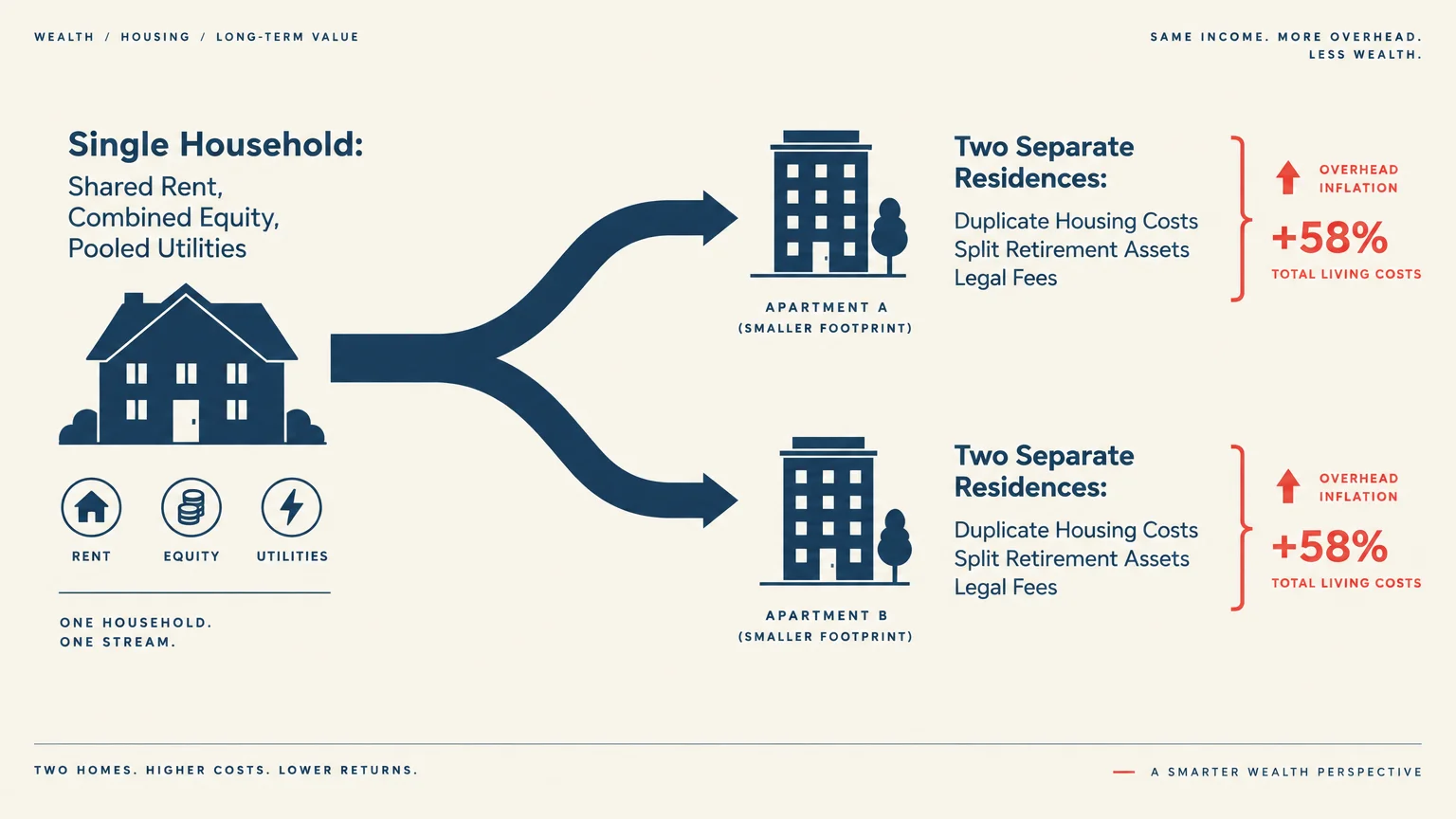
The Financial Reality: How Divorce Destroys Household Wealth
Understanding divorce rate by profession is not just an academic exercise; it is an urgent personal finance issue. Ending a marriage is often the single most expensive financial event of an adult life.
Legal fees alone consume substantial savings. Industry data from Martindale-Nolo indicates the average divorce involving attorneys costs approximately $11,300, with a median cost of $7,000.
Family law attorneys charge an average of $270 per hour nationwide. In metropolitan regions, hourly rates routinely surpass $350 to $500.
When spouses negotiate an uncontested settlement outside court, legal costs drop significantly. Filing and administrative fees for a simple dissolution typically total between $200 and $500.
Highly contested divorces involving child custody disputes, business valuations, or disputed retirement accounts tell a different story. These battles frequently climb to $15,000 or $27,000 per spouse.
Beyond direct legal expenses, divorce fractures household economies of scale. Maintaining two separate rents or mortgages instantly increases living costs by 30% to 50%.
Dividing 401(k) plans, pensions, and home equity can set your retirement timeline back by a decade. Both partners end up with smaller nest eggs and higher individual living expenses.

What Can Go Wrong: Costly Financial Pitfalls During a Separation
When marital conflict peaks, emotion often overpowers financial prudence. Recognizing common missteps helps you protect your net worth during stressful periods.
Liquidating retirement accounts prematurely: Cashing out a 401(k) or IRA to pay immediate legal retainer fees triggers ordinary income taxes and a 10% penalty if you are under age 59½.
Using a Qualified Domestic Relations Order (QDRO) allows tax-free retirement transfers between spouses during divorce. Skipping this legal tool results in devastating unnecessary tax bills.
Accumulating joint credit card debt: Spouses often run up shared credit balances during bitter marital separations. Creditors hold both parties liable regardless of what a divorce decree later dictates.
The Consumer Financial Protection Bureau warns that joint account obligations do not disappear simply because a judge assigns the debt to your ex-partner.
Fighting costly legal battles over low-value personal property: Spending $300 an hour on attorney fees to argue over used furniture or depreciated vehicles quickly drains liquid savings.
Spouses frequently spend thousands in legal fees litigating items worth only a few hundred dollars. Keeping emotions detached from property division preserves your cash.
Overlooking tax withholding adjustments: Failing to change your W-4 form from married to single after separation leads to a surprise tax shortfall next spring.

Where Outside Advice Pays Off
Navigating occupations with relationship struggles requires objective professional guidance before financial damage becomes permanent. Targeted expertise saves thousands of dollars over time.
Hiring a Certified Divorce Financial Analyst (CDFA): A CDFA specializes in evaluating the long-term tax consequences of asset splits, pension valuations, and real estate buyouts.
They ensure you do not trade liquid cash savings for illiquid, tax-burdened retirement accounts of equal face value. Their analysis provides critical leverage during financial negotiations.
Engaging a neutral family mediator: Mediation resolves disputes over parenting schedules and asset divisions without courtroom litigation. A mediator usually costs a fraction of two competing trial attorneys.
Mediators guide both spouses toward mutual compromise in neutral settings. This approach preserves financial resources for your children rather than legal retainers.
Consulting an Enrolled Agent or CPA: Professional tax preparers help you navigate filing statuses, dependency exemptions, and the tax implications of alimony payments.
Under current tax laws, alimony is neither deductible by the payer nor taxable to the recipient for divorces finalized after 2018. Clear tax advice prevents costly filing errors.
Drafting postnuptial or prenuptial agreements: If you work in an occupation with high financial volatility, establishing clear marital property boundaries protects both partners.
A family law attorney ensures marital contracts adhere strictly to state statutes. These agreements clarify expectations and remove financial uncertainty from the marriage.

Proactive Steps to Protect Your Marriage and Your Pocketbook
If your job features irregular shifts, travel, or chronic stress, you can take deliberate steps to insulate your marriage. Prevention is infinitely cheaper than divorce litigation.
Build mandatory shared downtime into your weekly calendar. Treat dinner dates or weekend mornings together with the same non-negotiable priority as your professional shifts.
Maintain an independent emergency fund alongside joint household accounts. Having three to six months of living expenses reduces everyday friction caused by sudden car repairs or medical bills.
Practice open financial transparency by holding monthly money meetings. Reviewing bank statements and shared goals together eliminates financial secrets that destroy relationship trust.
Establish strict emotional and professional boundaries if you work in nightlife, hospitality, or travel. Keeping clear delineations between work socialization and private life protects marital fidelity.
Frequently Asked Questions
Which single profession has the highest divorce rate in America?
Casino gaming managers currently report the highest cumulative divorce rate at roughly 52.9%, closely followed by bartenders at 52.7%, according to Census microdata.
Why do actuaries have the lowest divorce rate?
Actuaries report a 14.2% divorce rate due to high median salaries, standard predictable work hours, low physical strain, and strong analytical problem-solving skills.
Does working opposite shifts increase your risk of divorce?
Yes, research demonstrates that nonstandard night or rotating shifts significantly increase marital instability by limiting shared time, disrupting sleep, and impairing partner communication.
How much does a typical uncontested divorce cost compared to a contested one?
An uncontested divorce resolved through court filings typically costs $200 to $500, whereas contested divorces involving attorneys average $11,300 and can easily exceed $25,000.
Your profession may bring unique operational challenges, but career statistics do not dictate your marital fate. Clear communication, shared budgeting, and proactive boundary setting keep both your relationship and your savings intact.
The information here is meant for educational purposes. Specific circumstances—including health conditions, finances, location, and goals—may require different approaches. When in doubt, consult a licensed professional or check official sources directly.
Last updated: May 2026. Rules, prices, and details change—verify current information with official sources before acting on it.









Leave a Reply