

Millions of Americans leave thousands of dollars on the table each year simply because they do not realize their marital status unlocks distinct financial rights. You can claim major healthcare, retirement, and survivor resources based entirely on your partner’s work history.
Government agencies and private administrators rarely notify you when these funds become available. If you do not actively submit paperwork, your household misses out on vital cash reserves and health protections.
Whether you are currently married, divorced, or widowed, knowing which spousal benefit claims to trigger makes an immediate difference to your bottom line.
1. Social Security Spousal and Divorced-Spouse Benefits
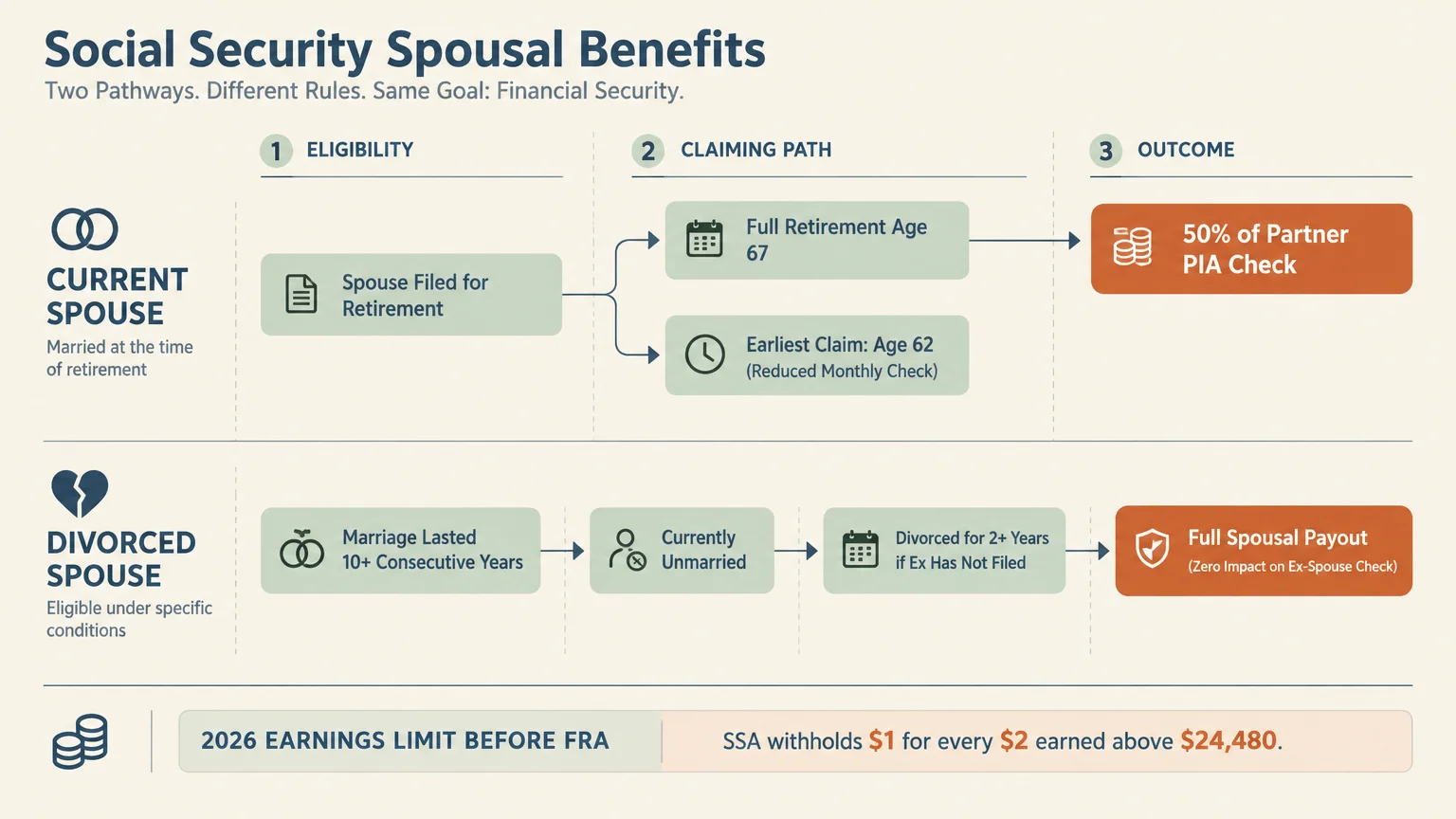
Many married individuals assume they may only collect Social Security based on their own earnings record. In reality, you can claim spousal benefits worth up to 50% of your partner’s Primary Insurance Amount.
To receive the full 50% payout, you must wait until your own Full Retirement Age. For anyone born in 1960 or later, Full Retirement Age is 67.
You can start claiming as early as age 62; however, filing early permanently reduces your monthly payout. Your spouse must also have filed for their own retirement benefits before you can draw against their record.
Divorced individuals frequently overlook these same protections. If your prior marriage lasted at least 10 consecutive years, you can claim benefits based on your ex-spouse’s earnings record.
To qualify on an ex-partner’s record, you must currently remain unmarried. Additionally, if your ex-spouse has not yet filed for retirement, you must have been divorced for at least 2 continuous years.
Claiming benefits on an ex-spouse does not reduce their monthly payout in any way. Furthermore, your claim remains completely confidential, and your former partner will never receive a notification from the government.
According to the Social Security Administration, you should evaluate both your own benefit record and your spousal entitlement before submitting your initial application. The agency automatically awards whichever amount yields the larger monthly check.
If you choose to work while receiving benefits before Full Retirement Age, remember the annual earnings test rules. Exceeding those thresholds triggers temporary benefit withholding.
In 2026, the SSA withholds $1 for every $2 you earn above $24,480. That threshold increases to $25,560 in 2027, giving working spouses extra room to earn without penalty.
During the specific calendar year you reach Full Retirement Age, the rule becomes much more generous. The agency withholds $1 for every $3 you earn above $65,160 ($67,920 in 2027) prior to your birthday month.

2. Restored Benefits Under the Social Security Fairness Act
Public sector workers and their families endured decades of reduced Social Security payouts due to two controversial statutory offsets. Those punitive reductions have officially come to an end.
The Social Security Fairness Act, signed into law on January 5, 2025, permanently repealed both the Windfall Elimination Provision and the Government Pension Offset. This landmark legislation took effect retroactively to January 2024.
Under the former Government Pension Offset, the government reduced spousal and survivor Social Security benefits by two-thirds of the claimant’s public pension. This formula routinely wiped out spousal benefits for retired teachers, police officers, and municipal staff.
With the offset repealed, public servants can now collect their earned spousal or survivor benefits in full alongside their government pensions. You no longer forfeit the Social Security credit your spouse earned through decades of payroll taxes.
Crucially, these restored payments do not begin automatically if you never applied in the past. If you skipped filing because the old offset eliminated your check, you must actively submit an application.
Contact your local Social Security office to initiate your claim under the restored rules. Request back pay covering eligible retroactive periods dating back to the effective change in January 2024.
Gather your marriage certificate, your partner’s Social Security information, and documentation verifying your public pension. Presenting complete records ensures the claims representative calculates your restored entitlement without administrative delays.

3. Social Security Survivor Benefits and the Lump-Sum Death Payment
Losing a spouse brings profound emotional grief alongside severe financial disruption. Survivor benefits provide vital stability, yet many widows and widowers delay or mismanage their filings.
You can claim survivor benefits as early as age 60, or as early as age 50 if you have a qualifying disability. Claiming prior to your Full Retirement Age results in a reduced monthly percentage.
Unlike standard spousal benefits, survivor benefits allow unique claiming flexibility. You can claim a survivor benefit first, allow your own retirement benefit to grow until age 70, and then switch.
Remarriage rules also trip up many surviving spouses. If you remarry at age 60 or older (or age 50 if disabled), your remarriage will not affect your eligibility for survivor benefits.
Surviving divorced spouses can also claim survivor benefits if the original marriage lasted at least 10 years. Just like current spouses, divorced survivors can claim starting at age 60 without notifying the ex-spouse’s family.
Be aware that you cannot apply for survivor benefits through online web forms. You must schedule an appointment by calling the Social Security Administration or by visiting a local field office in person.
Additionally, surviving spouses frequently forget to claim the statutory Lump-Sum Death Payment. This one-time payment delivers $255 to the surviving spouse who lived in the same household as the deceased worker.
The government does not disburse this payment automatically upon receiving a death certificate from a funeral director. You must formally request it, and a strict 2-year application deadline applies from the date of death.
4. Premium-Free Medicare Part A on a Spouse’s Record
Healthcare expenses represent one of the largest budget categories in retirement. Qualifying for premium-free Medicare Part A can save your household thousands of dollars each year.
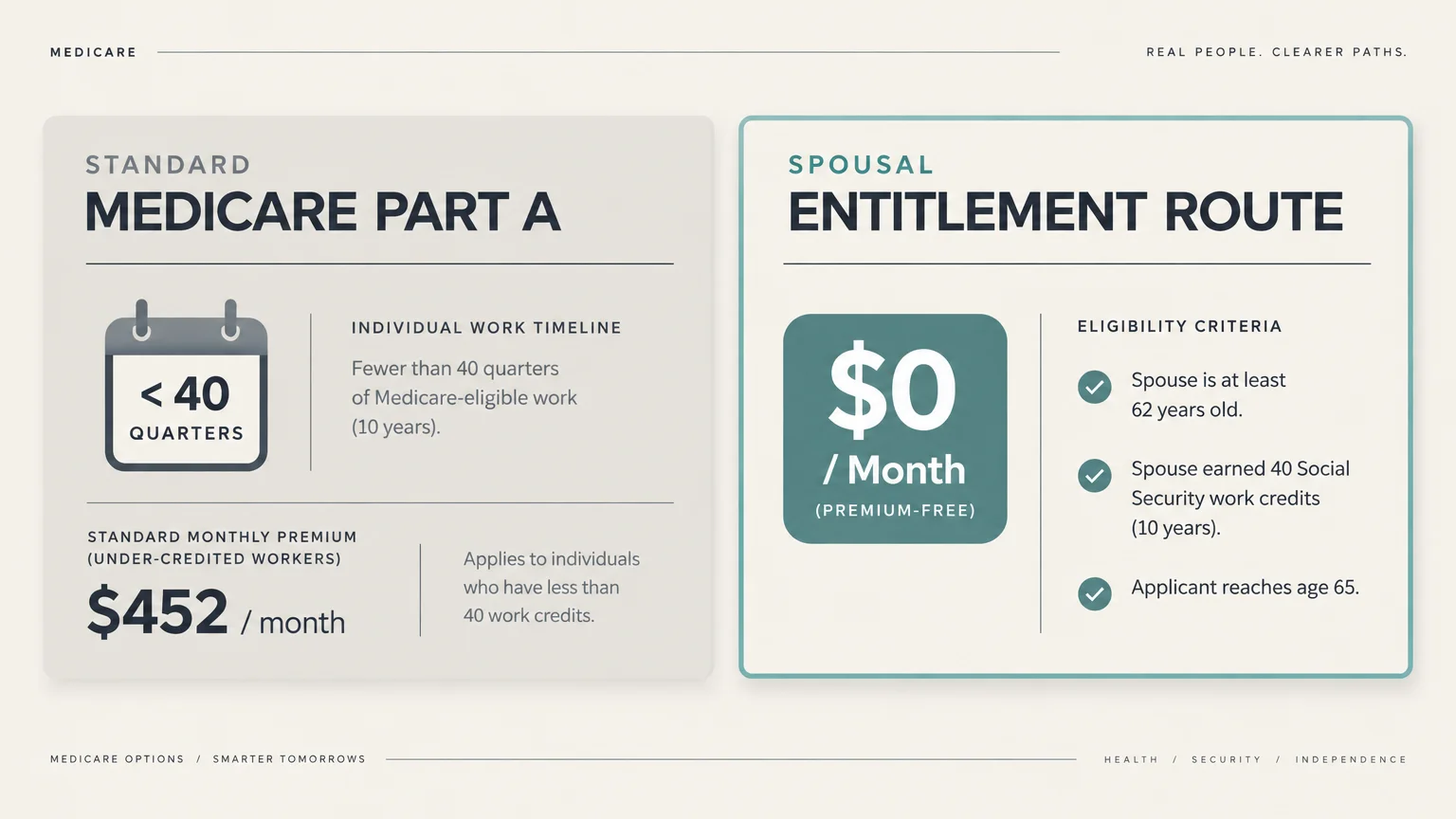
Medicare Part A covers inpatient hospital stays, skilled nursing care, and hospice services. While most Americans pay no premium for Part A, eligibility hinges on accumulating sufficient work credits.
If you spent years outside the paid workforce raising children or managing a home, you might lack the required credits. Fortunately, the official Medicare program allows you to qualify using your spouse’s employment history.
To qualify for premium-free Part A on your spouse’s record, you must be at least 65 years old. Your spouse must be at least 62 years old and have earned at least 40 Social Security work credits.
In 2026, a worker earns one credit for every $1,890 in covered wages, up to a maximum of four credits per year. Reaching 40 credits requires approximately 10 years of covered employment.
Marriage duration rules dictate your eligibility. Current spouses must have been married for at least 1 continuous year before applying for spousal Part A coverage.
Divorced individuals can also qualify using an ex-spouse’s work record if the marriage lasted at least 10 years. Widowed individuals qualify if they were married for at least 9 months prior to their partner’s death.
Missing this spousal option carries a severe financial penalty. Without spousal eligibility or sufficient personal credits, an individual could pay up to $565 per month for Part A in 2026.
Even those with 30 to 39 personal work credits face a mandatory premium of $311 per month. Claiming on your spouse eliminates this cost entirely, leaving you responsible only for standard Part B premiums ($202.90 per month).

5. VA Dependency and Indemnity Compensation and Survivors Pension
Families of military veterans often miss out on substantial monthly cash stipends provided by the federal government. Surviving spouses frequently assume benefits end the moment the veteran passes away.
The U.S. Department of Veterans Affairs administers two major monthly benefit programs for surviving spouses: Dependency and Indemnity Compensation and the VA Survivors Pension.
Dependency and Indemnity Compensation delivers a tax-free monthly payment to eligible survivors of service members who died in the line of duty. It also covers survivors of veterans whose death resulted from a service-connected disability.
The base monthly rate for VA Dependency and Indemnity Compensation is $1,699.36. Surviving spouses with dependent children or those requiring daily medical assistance receive additional monthly allowances.
If the veteran did not pass away from a service-connected cause, you may still qualify for the VA Survivors Pension. This needs-based benefit supports low-income surviving spouses of wartime veterans.
For a surviving spouse qualified for Aid and Attendance assistance, the Survivors Pension pays up to $1,558.08 per month. This supplemental income helps offset the rising costs of in-home care or assisted living facilities.
Neither veteran survivor benefit activates on its own. You must formally submit VA Form 21P-534EZ alongside military discharge paperwork (DD-214) and relevant medical death certificates.

6. Spousal IRA Contributions (Kay Bailey Hutchison Rule)
Traditional retirement savings vehicles generally demand earned income from a job. Non-working spouses or stay-at-home parents often assume they cannot build retirement wealth in their own name.
Under tax law, the Kay Bailey Hutchison Spousal IRA provision allows an income-earning spouse to fund a separate retirement account for a non-working partner. This strategy effectively doubles a couple’s annual tax-advantaged savings capacity.
According to guidelines from the Internal Revenue Service, you can fund a Spousal Traditional IRA or a Spousal Roth IRA provided you file a joint federal tax return. The working partner must generate sufficient earned income to cover both contributions.
For 2026, the annual IRA contribution limit is $7,500 per person. If the non-working spouse is age 50 or older, you can add an extra $1,100 catch-up contribution, raising the annual limit to $8,600.
Funding a spousal IRA creates substantial long-term wealth while granting the non-earning spouse independent legal ownership of retirement assets. The account remains solely in that spouse’s name, regardless of future marital changes.
If you choose a Roth IRA, keep the household income phaseout ranges in mind. For married couples filing jointly in 2026, direct Roth contributions phase out between a Modified Adjusted Gross Income of $242,000 and $252,000.
Couples earning above that phaseout limit can still utilize backdoor Roth conversion strategies. Funding these accounts annually shields your investments from ongoing dividend and capital gains taxes.
7. Extended 36-Month Spousal COBRA Health Coverage
Employer-sponsored health insurance frequently covers the entire household under a single worker’s plan. When major family transitions occur, spouses often assume their health coverage vanishes almost immediately.
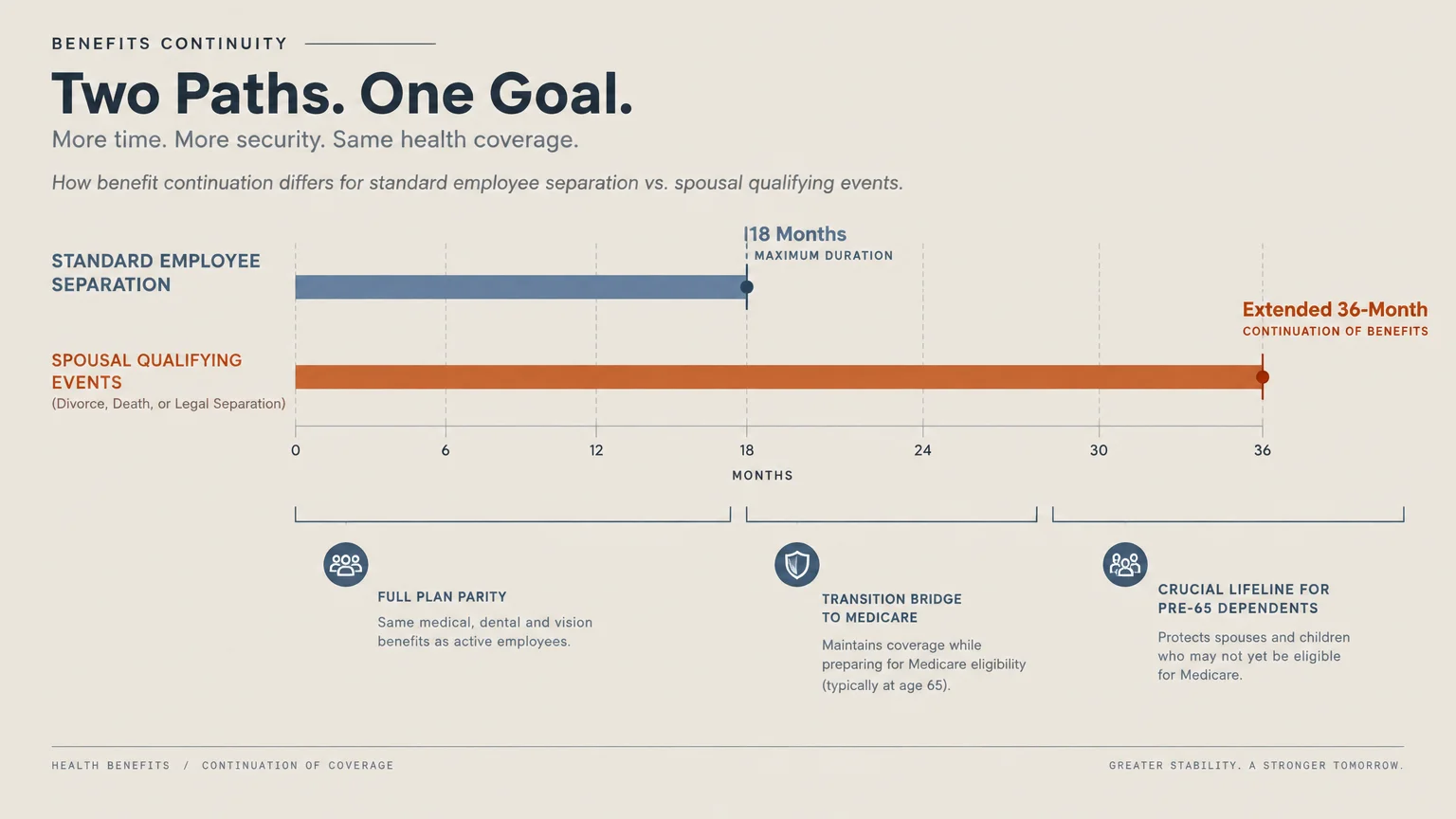
The Consolidated Omnibus Budget Reconciliation Act guarantees temporary continuation of group health benefits. While standard job termination entitles workers to 18 months of COBRA, spouses can access up to 36 months of extended coverage.
You can claim this 36-month continuation period following specific qualifying events that cause you to lose group coverage. These qualifying events include divorce, legal separation, the covered employee’s death, or the employee enrolling in Medicare.
This multi-year extension provides critical stability if you have ongoing medical treatments or pre-existing conditions. It guarantees continuous access to your established provider networks and specialized medical teams.
Under COBRA rules, you must pay the full group premium out of pocket, plus a 2% administrative fee (totaling up to 102% of plan costs). While costly, it prevents sudden coverage gaps while you transition to independent health coverage.
Action is strictly time-sensitive. In cases of divorce or legal separation, you must notify the employer’s plan administrator in writing within 60 days of the qualifying event.
If you fail to issue notification within that 60-day window, you forfeit your right to elect extended COBRA coverage. Always send your election notice using certified mail with return receipt requested.

Comparing Major Spousal Benefit Claims
Review the primary eligibility triggers, maximum payouts, and filing rules across these programs to ensure your household submits claims correctly and on schedule.
| Benefit Program | Primary Eligibility Trigger | Maximum Payout / Savings | Filing Deadline or Restriction |
|---|---|---|---|
| Social Security Spousal | Spouse filed; claimant age 62+ (10-yr marriage if divorced) | Up to 50% of worker’s Primary Insurance Amount | No deadline; benefits not retroactive before Full Retirement Age |
| Restored Fairness Act (WEP/GPO) | Public pension offset eliminated for spouses/survivors | 100% of standard spousal/survivor benefit | Retroactive to Jan 2024; active claim submission required |
| Social Security Survivor | Worker’s death; surviving spouse age 60+ (50+ if disabled) | Up to 100% of deceased worker’s benefit | Must apply by phone or in person; cannot file online |
| Lump-Sum Death Payment | Surviving spouse cohabiting with deceased worker | $255 one-time payment | Strict 2-year deadline from date of death |
| Spousal Medicare Part A | Claimant age 65; spouse age 62 with 40 work credits | Saves up to $565 per month in Part A premiums | Initial Enrollment Period around 65th birthday |
| VA DIC / Survivors Pension | Veteran death (service-connected or wartime service) | $1,699.36/mo (DIC) or $1,558.08/mo (Pension with Aid) | Must file VA Form 21P-534EZ; awards date to claim filing |
| Spousal IRA Contribution | Married filing jointly; one spouse has earned income | $7,500/yr ($8,600 if age 50+) tax-advantaged savings | Annual tax filing deadline (typically April 15) |
| Extended Spousal COBRA | Divorce, separation, spouse death, or Medicare enrollment | Up to 36 months continuous employer group health coverage | Must notify plan administrator within 60 days of event |

Worth Keeping in Mind
While these benefit programs offer substantial financial relief, complex administrative traps can derail your claims if you do not plan ahead.
Earning too much income before reaching Full Retirement Age can trigger painful Social Security withholding. Always account for the annual earnings limits ($24,480 in 2026 and $25,560 in 2027) if you plan to work while claiming spousal payments.
Missing administrative deadlines permanently forfeits valuable funds. The Social Security Lump-Sum Death Payment strictly enforces its 2-year cutoff, leaving no room for late appeals.
Similarly, missing the 60-day notification window for extended spousal COBRA permanently closes the door on maintaining employer group coverage. Mark these critical dates on your calendar immediately following any family transition.
Assuming government systems automatically coordinate is another widespread error. The Social Security Administration does not automatically restore spousal benefits following the WEP and GPO repeal unless you request a formal review.
Finally, gather vital paper documents long before you need to file. Locating certified marriage licenses, divorce decrees, military records, and death certificates ahead of time prevents painful processing delays.

When to Get Professional Help
Navigating multi-layered government claims often requires professional advice to maximize your household’s lifetime wealth.
Consult a certified financial planner if you are coordinating spousal Social Security with non-covered public pensions. Ensuring your claims take full advantage of the Social Security Fairness Act requires precise timing.
Work with an accredited Veterans Service Officer when applying for VA benefits. These specialists assist with VA Form 21P-534EZ without charging service fees, significantly increasing approval odds.
Engage a qualified family law attorney during divorce proceedings to protect your long-term benefit rights. Your legal team must ensure the final decree preserves your access to pension divisions and medical COBRA notifications.
Finally, consult a certified public accountant if your household approaches Roth IRA income phaseout limits. A tax professional can establish compliant backdoor conversion procedures while preventing unnecessary tax liabilities.
Frequently Asked Questions
Can I claim spousal Social Security if my spouse has not yet filed?
If you are currently married, your spouse must file for their own retirement benefits before you can receive spousal benefits on their record.
However, if you are divorced and were married for at least 10 years, you can claim benefits even if your ex-spouse has not yet filed, provided you have been divorced for at least 2 years.
What happens to my spousal Medicare Part A if I get divorced?
You can retain premium-free Medicare Part A based on your former spouse’s work record as long as your marriage lasted at least 10 continuous years.
You must also be at least 65 years old and your ex-spouse must be at least 62 years old with 40 work credits.
How does remarriage affect Social Security survivor benefits?
If you remarry after reaching age 60 (or age 50 if you have a disability), your remarriage has no impact on your survivor benefit eligibility.
You will continue to receive your survivor benefit or claim on your new spouse’s record, whichever generates the higher monthly amount.
Do public sector retirees receive retroactive payments under the Social Security Fairness Act?
Yes, the legislation repealing the Government Pension Offset and Windfall Elimination Provision took effect retroactively to January 2024.
Eligible spouses and survivors who submit their applications can claim retroactive benefit payments covering the months between January 2024 and their filing date.
Taking time to audit your marital benefits can uncover thousands of dollars in hidden household capital. Whether claiming restored Social Security payments, establishing a Spousal IRA, or protecting your healthcare through Medicare and COBRA, filing accurate paperwork secures the resources you rightfully earned.
This is general informational content based on widely accepted guidance. Individual results vary. Verify current details—rules, prices, eligibility, regulations—with official sources before making important decisions.
Last updated: October 2026. Rules, prices, and details change—verify current information with official sources before acting on it.









Leave a Reply