

Filing taxes in retirement often feels deceptively simple once wage statements and employer benefits disappear, yet thousands of seniors hand back hard-earned money to the IRS every spring by overlooking critical deductions and credits. Transitioning into retirement alters your income streams, unlocking specialized retirement tax savings designed to protect your nest egg. By mastering key tax filing tips for retirees—from extra standard deductions to strategic charitable distributions—you can lower your taxable income and retain more wealth. Taking advantage of overlooked tax breaks retirees frequently miss keeps your lifetime savings working for you rather than funding unnecessary tax bills.
1. The Expanded Standard Deduction for Seniors
Reaching age 65 triggers an immediate opportunity to lower your taxable income, even if you do not itemize your deductions. The IRS offers an additional standard deduction amount specifically for older taxpayers and individuals who are blind. To claim this extra deduction, you must reach age 65 by the last day of the tax year—notably, the IRS considers you to be 65 on the day before your 65th birthday.
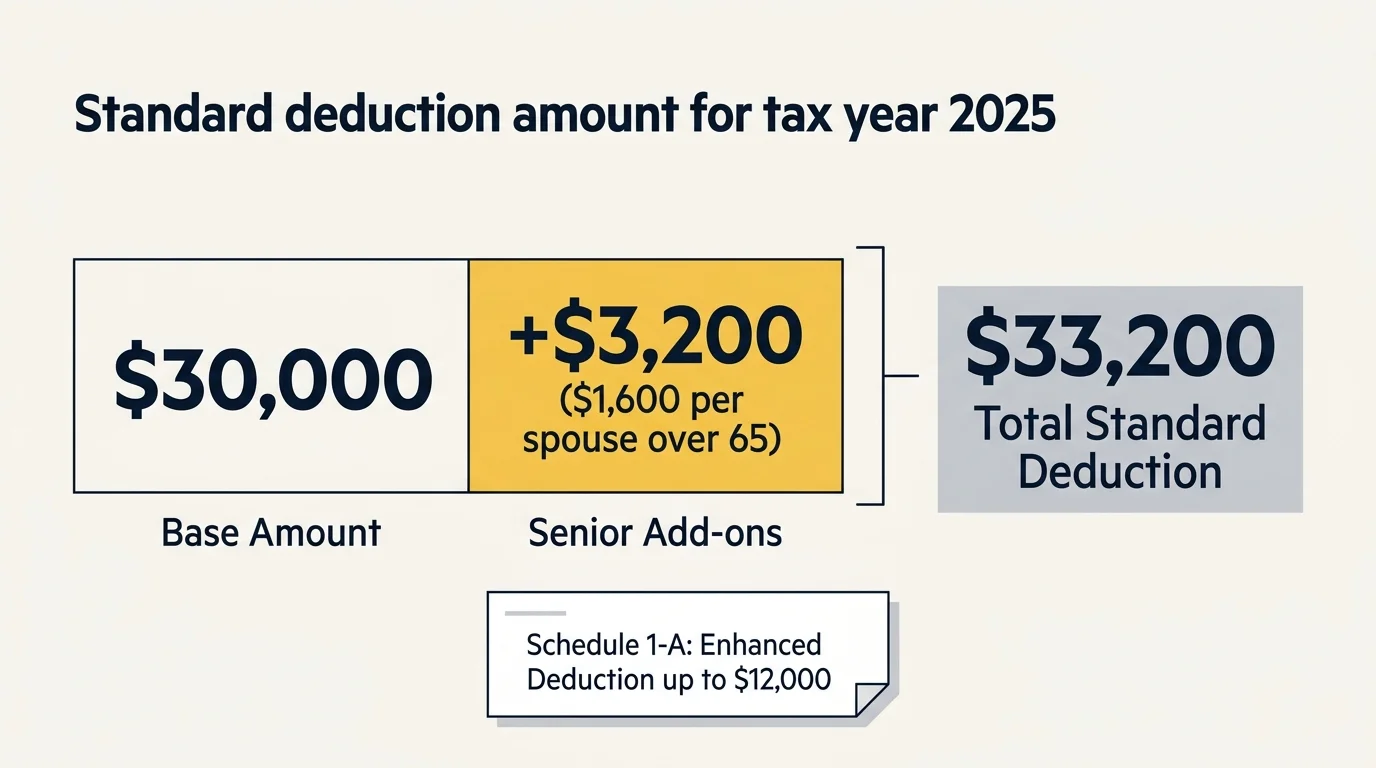
For tax year 2025, single filers and heads of household who are 65 or older receive an extra $2,000 standard deduction on top of the standard base amount. If you are married and filing jointly, the extra deduction is $1,600 per qualifying spouse. That means if both you and your spouse are 65 or older, you add $3,200 to your standard deduction. A married couple both aged 65 or older filing jointly in 2025 can claim a total standard deduction of $33,200—combining the $30,000 base amount with $3,200 in senior add-ons.
Beyond the traditional additional standard deduction, temporary federal provisions establish an Enhanced Senior Deduction on Schedule 1-A. Under this provision, eligible taxpayers aged 65 and older can claim an additional “below-the-line” deduction of up to $6,000 per person ($12,000 for qualifying married couples filing jointly). Unlike standard itemized choices, this enhanced deduction applies to both standard deduction takers and itemizers alike. The benefit phases out for taxpayers with modified adjusted gross income (MAGI) exceeding $75,000 for single filers and $150,000 for joint filers.
When preparing your return, consider using IRS Form 1040-SR, designated specifically for taxpayers aged 65 and older. Form 1040-SR uses larger print and includes a dedicated chart at the bottom to help you calculate your total standard deduction, ensuring you do not leave these elevated deduction limits on the table.
2. Qualified Charitable Distributions (QCDs): Bypassing Income Altogether
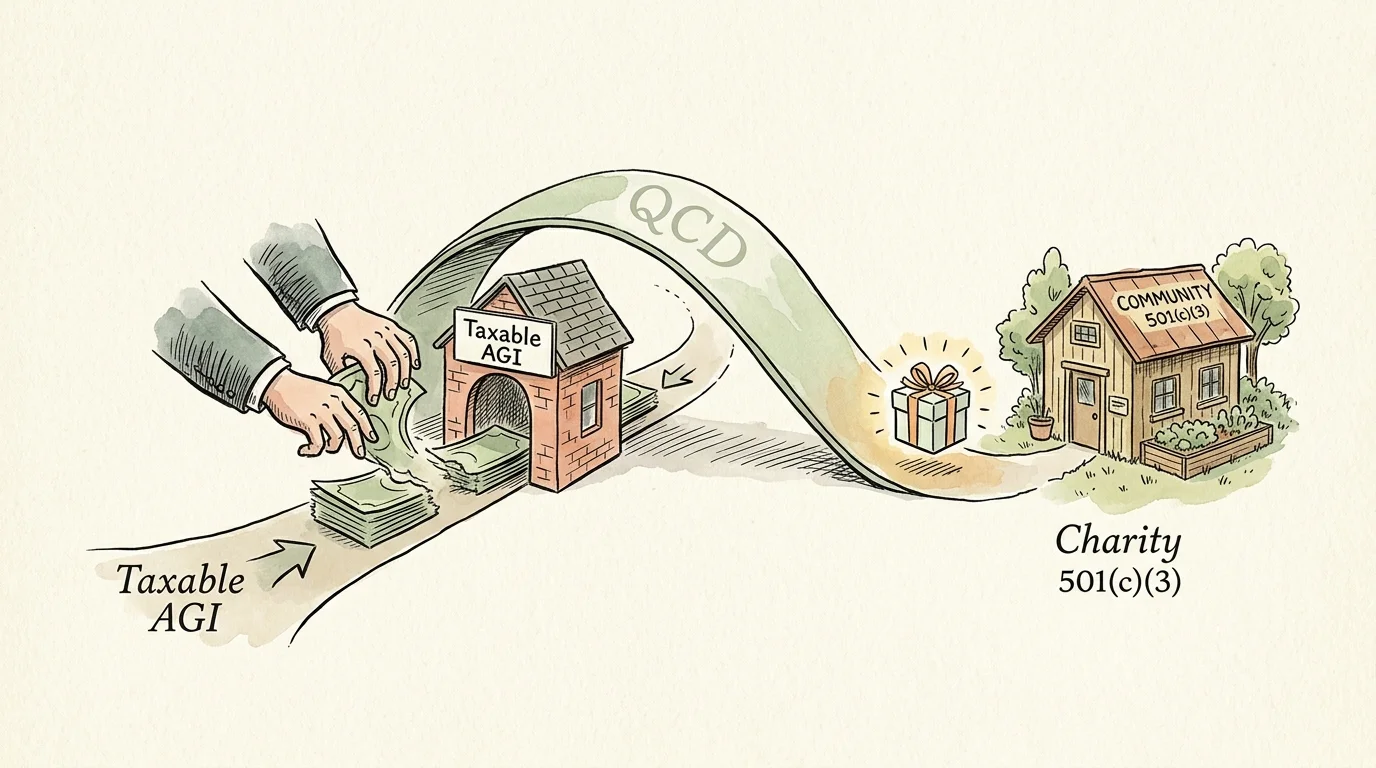
If you give money to charitable organizations and hold traditional IRA accounts, standard charitable deductions might not deliver any tax savings—especially if you claim the standard deduction. Qualified Charitable Distributions (QCDs) bypass this hurdle by letting you transfer funds directly from your traditional IRA to a qualified 501(c)(3) nonprofit organization without counting the withdrawal as taxable income.
Because the distribution goes straight from your IRA custodian to the charity, the money never enters your Adjusted Gross Income (AGI). Keeping your AGI lower helps preserve your eligibility for other income-based tax credits, prevents spikes in your income tax bracket, and protects you from Medicare premium surcharges. For tax year 2025, individual retirees aged 70½ or older can transfer up to $108,000 per year via QCDs; this limit rises to $111,000 for tax year 2026.
The strategic power of a QCD increases dramatically once you reach the age for Required Minimum Distributions (RMDs). Under current law, your QCD counts directly toward satisfying your annual RMD for the year. For example, if your required minimum distribution for the year is $15,000 and you execute a $10,000 QCD to your favorite charity, you only need to withdraw the remaining $5,000 as taxable income to meet your obligation.
Retirees also have access to a specialized, one-time QCD election. You can make a single lifetime transfer of up to $55,000 to fund a split-interest entity, such as a Charitable Remainder Unitrust (CRUT), Charitable Remainder Annuity Trust (CRAT), or Charitable Gift Annuity (CGA). According to IRS rules, executing a QCD requires direct distribution processing from the custodian—you cannot withdraw the cash into your personal bank account and subsequently write a personal check to the charity.

3. Navigating the Social Security “Tax Torpedo”
Many retirees assume that Social Security benefits are entirely tax-free. In reality, up to 85% of your Social Security benefits can become subject to federal income tax depending on your “provisional income.” Provisional income equals your Adjusted Gross Income (excluding Social Security), plus any tax-exempt interest income, plus exactly 50% of your annual Social Security benefits.
The tax thresholds for Social Security benefits are fixed by federal law and are notably not indexed for inflation, meaning wage growth and cost-of-living adjustments push more retirees over these income limits each year:
- Single Filers:
- Provisional income below $25,000: 0% of Social Security benefits are taxable.
- Provisional income between $25,000 and $34,000: Up to 50% of benefits are taxable.
- Provisional income above $34,000: Up to 85% of benefits are taxable.
- Married Filing Jointly:
- Provisional income below $32,000: 0% of Social Security benefits are taxable.
- Provisional income between $32,000 and $44,000: Up to 50% of benefits are taxable.
- Provisional income above $44,000: Up to 85% of benefits are taxable.
Understanding these thresholds allows you to execute smart retirement tax savings strategies. For example, taking distributions from a Roth IRA does not increase your AGI or provisional income. If you need extra cash to pay for a home renovation or a new car, withdrawing funds from a Roth account rather than a traditional IRA keeps your provisional income below the threshold that triggers taxation on your Social Security benefits. You can learn more about how benefits interact with overall income at the Social Security Administration guidelines page.

4. Deducting Out-of-Pocket Medical and Dental Expenses
Healthcare expenses often consume a sizable portion of a retiree’s monthly budget. The IRS allows you to deduct unreimbursed medical and dental expenses on Schedule A if you itemize deductions, provided those expenses exceed 7.5% of your Adjusted Gross Income. The portion of total qualifying medical costs that surpasses this 7.5% floor becomes fully deductible.
Imagine your Adjusted Gross Income is $40,000 for the year. Your 7.5% threshold sits at $3,000. If you accumulated $7,500 in qualified out-of-pocket medical, dental, and vision expenses during that same year, you can deduct $4,500 ($7,500 total costs minus the $3,000 threshold) on Schedule A.
Retirees frequently overlook many items that qualify as medical expenses. Eligible expenses include:
- Medicare Part B medical insurance premiums (if paid with after-tax dollars).
- Medicare Part D prescription drug coverage premiums.
- Medicare Advantage (Part C) monthly premiums.
- Medigap (Medicare Supplement) policy premiums.
- Qualified long-term care insurance premiums (subject to IRS age-based annual caps).
- Out-of-pocket costs for prescription drugs, insulin, eyeglasses, hearing aids, and dental care (including implants and dentures).
- Transportation expenses incurred for medical care, including actual gas costs or standard medical mileage rates, parking fees, and tolls.
- Home capital modifications undertaken primarily for medical safety, such as installing wheelchair ramps, grab bars, or widening doorways.

5. State-Level Retirement Income Exclusions and Property Exemptions
Focusing exclusively on federal income taxes causes many retirees to miss valuable senior tax credits and exclusions available at the state level. State tax codes vary widely, but most states offer specific relief programs for older residents.
A majority of states fully exempt Social Security benefits from state income taxes. Furthermore, several states provide income exclusions for pension payments, traditional IRA withdrawals, and 401(k) distributions up to specified monetary limits. For instance, certain states allow retirees aged 62 or 65 to exclude anywhere from $10,000 to over $60,000 of retirement income from state taxation entirely.
Local property tax relief programs represent another area of substantial savings. Many counties and municipalities offer senior homestead exemptions, property tax freezes, or property tax deferral programs for homeowners aged 65 and older. These programs either cap your property’s assessed value, lower the taxable evaluation, or provide direct property tax rebates based on your age and income level.

6. Strategic Utilization of Health Savings Accounts (HSAs) After 65
If you contributed to a Health Savings Account (HSA) during your working years, that account becomes a flexible financial tool once you reach age 65. Although enrolling in any part of Medicare stops you from making new contributions to an HSA, you can keep and invest existing funds indefinitely.
Prior to age 65, taking an HSA distribution for non-medical expenses incurs a harsh 20% penalty plus ordinary income tax. However, once you turn 65, the 20% penalty permanently disappears. You can withdraw money from your HSA for any reason—qualifying medical or non-medical—without penalty. Non-medical withdrawals are simply taxed as ordinary income, mirroring the tax treatment of a traditional IRA.
More importantly, withdrawals used for qualified medical expenses remain 100% tax-free. In retirement, you can use tax-free HSA funds to pay premiums for Medicare Part B, Medicare Part D, and Medicare Advantage plans. Note, however, that IRS regulations explicitly prohibit using HSA funds to pay Medigap premiums tax-free.
7. Side-by-Side Comparison of Senior Tax Strategies
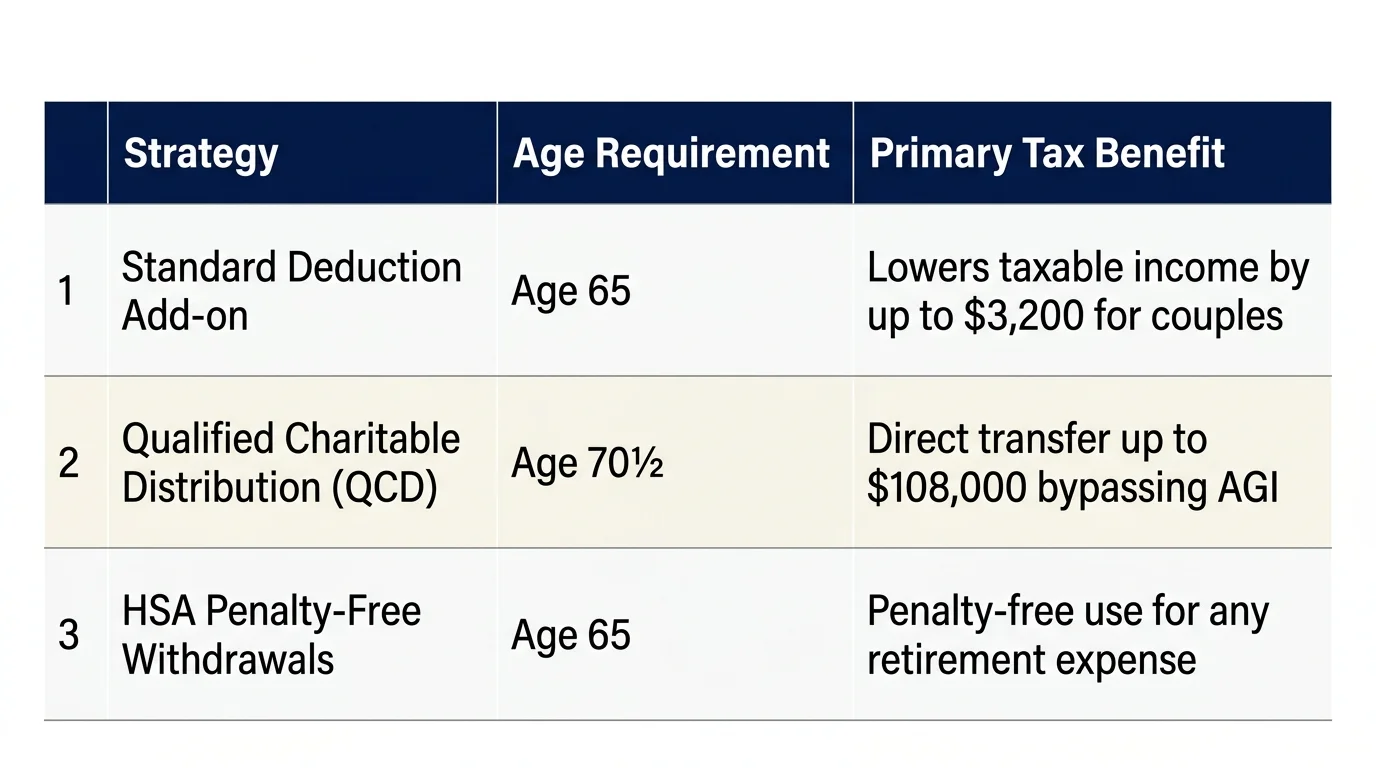
Choosing the right tax management strategy depends on your primary income sources, health expenses, and charitable goals. The table below compares common retirement tax tactics to help you identify which options best fit your financial picture.
| Tax Strategy | Primary Tax Advantage | Key Eligibility Requirements | Best Suited For |
|---|---|---|---|
| Additional Standard Deduction | Adds $1,600 to $2,000 per person to base standard deduction. | Age 65+ by end of tax year; claim standard deduction. | Retirees who do not have enough expenses to itemize. |
| Enhanced Senior Deduction (Sched. 1-A) | Up to $6,000 ($12,000 joint) temporary below-the-line deduction. | Age 65+; MAGI under $75k (single) or $150k (joint). | Low-to-middle-income seniors using standard or itemized options. |
| Qualified Charitable Distribution (QCD) | Excludes up to $108k (2025) from AGI; satisfies RMD requirements. | Age 70½+; traditional IRA funds transferred directly to charity. | Charitably inclined retirees with taxable traditional IRAs. |
| Itemized Medical Expense Deduction | Deducts unreimbursed health costs exceeding 7.5% of AGI. | Must itemize on Schedule A; costs must exceed 7.5% floor. | Retirees with significant out-of-pocket medical or care bills. |
| HSA Premium Payment Strategy | Tax-free withdrawals for Medicare Part B, Part D, and Advantage premiums. | Age 65+ with existing HSA balance; enrolled in Medicare. | Retirees paying Medicare premiums out of pocket. |
Things to Watch Out For
Tax management in retirement requires careful planning because an unexpected jump in income can trigger unwanted secondary costs. Watch out for these four common traps during tax season:
- The IRMAA Premium Surcharge Cliff: Medicare Income-Related Monthly Adjustment Amounts (IRMAA) place surcharges on Medicare Part B and Part D premiums based on your Modified AGI from two years prior. Crossing an IRMAA income threshold by even one dollar can cost you hundreds or thousands of dollars in higher Medicare premiums across the entire year. Check detailed rates and income brackets on Medicare.gov before taking large optional IRA withdrawals.
- Required Minimum Distribution (RMD) Penalties: If you fail to take your full RMD by the deadline (typically December 31 each year), the IRS imposes an excise tax penalty of 25% on the amount not withdrawn. This penalty drops to 10% if you correct the error and submit an updated return within a two-year correction window.
- Double-Dipping Health Expenses: You cannot claim an itemized deduction on Schedule A for medical expenses paid using tax-free dollars from an HSA or Flexible Spending Account (FSA). Doing so violates IRS regulations against double tax benefits for the same expenditure.
- State Tax Exemption Claim Errors: Many states do not automatically apply senior tax exemptions on pension or property taxes. You often must file a specific state form or county application to claim your senior homestead exemption or income exclusion.

When DIY Isn’t Enough
While software makes routine filing straightforward, personal finance in retirement frequently involves complex trade-offs. Seeking professional guidance from a CPA or Certified Financial Planner (CFP) becomes essential under specific circumstances:
- Relocating to a New State: Moving across state lines during retirement triggers partial-year tax returns and requires navigating different state tax treatments for pensions, capital gains, and real estate.
- Planning Multi-Year Roth Conversions: Converting funds from a traditional IRA to a Roth IRA requires deliberate pacing to optimize tax brackets while avoiding steep IRMAA Medicare surcharges and Social Security tax triggers.
- Managing Inherited Accounts: Non-spouse beneficiaries inheriting traditional IRAs under current SECURE Act rules must balance complex 10-year distribution schedules to minimize cumulative tax liability.
- Liquidating Significant Real Estate or Assets: Selling a longtime primary residence, vacation home, or taxable investment portfolio requires careful coordination to maximize capital gains exclusions and prevent unexpected taxable income spikes.
Frequently Asked Questions
Is Social Security completely tax-free once I reach full retirement age?
No. Reaching full retirement age does not eliminate federal income taxes on Social Security. Taxation depends entirely on your provisional income. If your provisional income exceeds $25,000 for single filers or $32,000 for married couples filing jointly, up to 50% or 85% of your benefits become subject to federal income tax.
Can both spouses claim the additional senior standard deduction?
Yes. If you file a joint return and both you and your spouse are age 65 or older by the end of the tax year, each spouse qualifies for the additional standard deduction amount ($1,600 per person for tax year 2025, totaling $3,200 combined).
Does a Qualified Charitable Distribution (QCD) count toward my RMD?
Yes. A QCD counts directly toward meeting your Required Minimum Distribution for the tax year, provided the transfer originates from your IRA and moves directly to an eligible 501(c)(3) charity without passing through your hands.
Can I deduct Medicare supplemental insurance (Medigap) premiums?
Yes. Premiums paid for Medigap insurance count toward qualified medical expenses. If you itemize deductions on Schedule A, you can include Medigap premiums alongside other medical expenses when calculating the amount that exceeds 7.5% of your AGI.
Lowering Your Retirement Tax Bill
Navigating taxes in retirement requires moving beyond habit and taking advantage of age-specific rules. Tax filing tips for retirees, such as using Qualified Charitable Distributions, tracking medical expenses, and applying extra senior deductions, can meaningfully reduce your taxable income. Review your expected income sources early each year so you can organize your tax strategies well before filing deadlines arrive.
This article provides general information only. Every reader’s situation is different—what works for others may not be the right fit for you. For personalized guidance on health, legal, or financial matters, consult a qualified professional.
Last updated: May 2026. Rules, prices, and details change—verify current information with official sources before acting on it.








Leave a Reply