
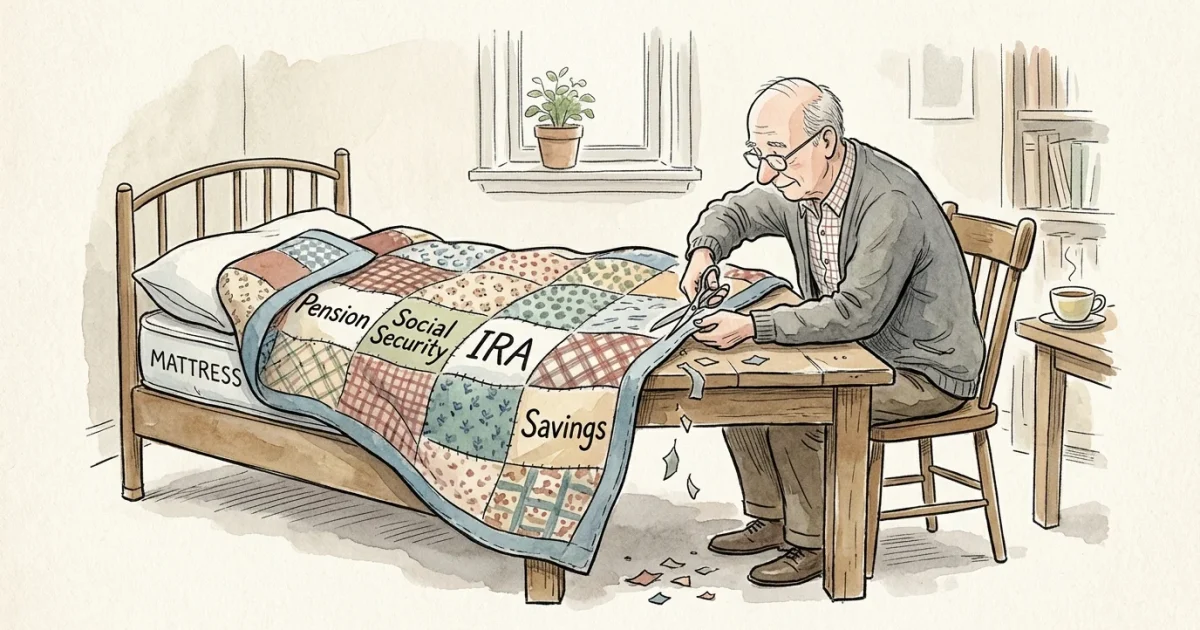
Leaving the workforce replaces a single, predictable paycheck with a patchwork of income streams, each governed by separate tax withholding rules. If you do not calibrate these distributions correctly, you risk facing a hefty tax bill or triggering IRS underpayment penalties next spring. Your tax bracket, deductions, and taxable income shift significantly across retirement as you claim Social Security, tap pre-tax accounts, or reach mandatory distribution milestones. Reviewing your withholding regularly preserves your monthly cash flow and keeps your nest egg secure. Here are seven distinct signs that you need to reassess your retirement tax withholding immediately.
1. You Started Claiming Social Security Benefits
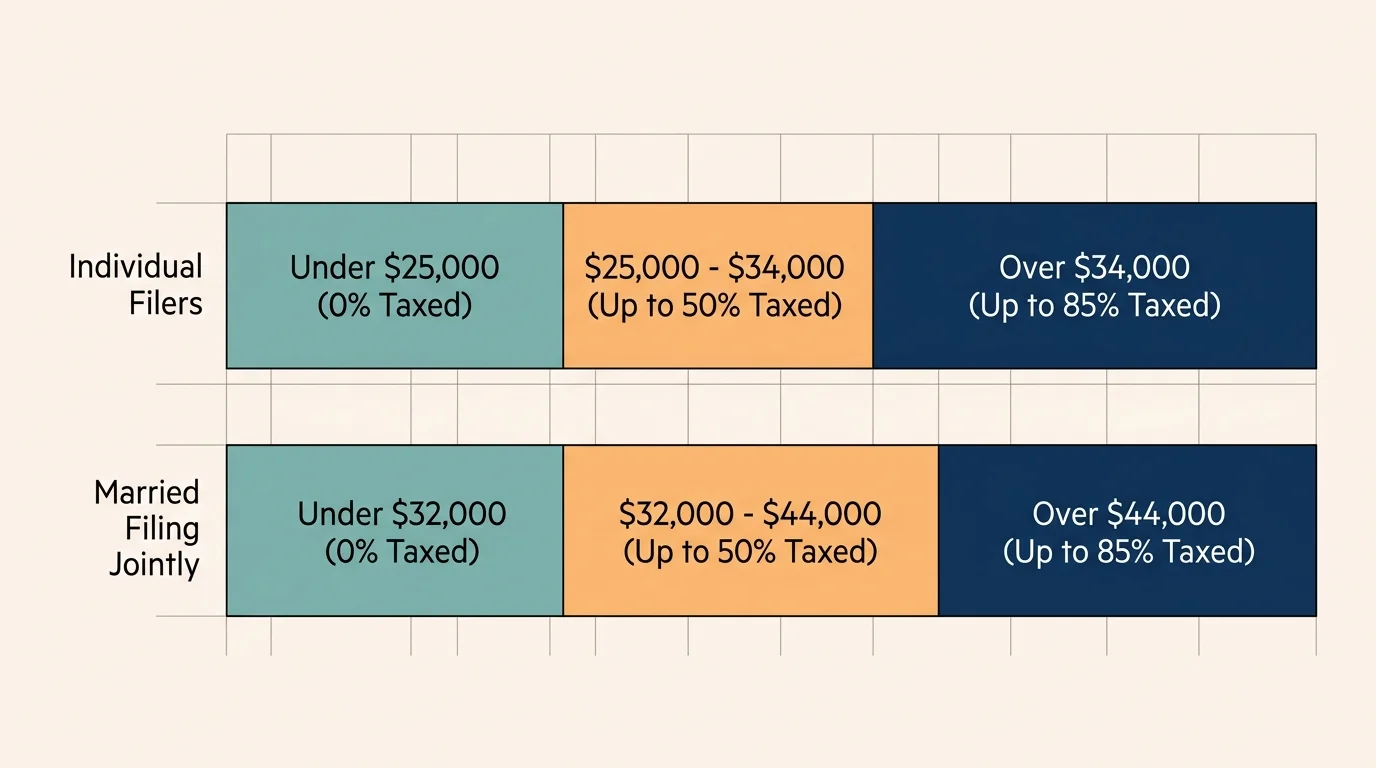
Many retirees assume Social Security benefits are entirely tax-free. However, the federal government taxes up to 85% of your benefits once your total earnings cross statutory thresholds that have remained unchanged for decades. To determine your tax liability, the IRS calculates your “combined income,” which equals your adjusted gross income (AGI) plus nontaxable interest and 50% of your annual Social Security benefits.
The taxation thresholds depend on your filing status:
- Individual Filers: Combined income between $25,000 and $34,000 makes up to 50% of benefits taxable; combined income over $34,000 makes up to 85% of benefits taxable.
- Married Filing Jointly: Combined income between $32,000 and $44,000 makes up to 50% of benefits taxable; combined income over $44,000 makes up to 85% of benefits taxable.
The Social Security Administration does not withhold federal taxes from your monthly benefit automatically. If you draw income from pensions, part-time work, or traditional retirement accounts alongside your benefits, you will likely exceed these modest income limits. To prevent a sudden shortfall at tax filing time, Social Security recommends submitting Form W-4V to request voluntary withholding at a flat rate of 7%, 10%, 12%, or 22%.

2. You Reached Age 73 and Began Required Minimum Distributions (RMDs)
Under the SECURE 2.0 Act, individuals must begin taking Required Minimum Distributions (RMDs) from traditional IRAs, 401(k)s, and 403(b) plans starting at age 73 (rising to age 75 in 2033). These mandatory withdrawals are treated as ordinary taxable income. Adding a significant annual distribution to your existing cash flow can push you into a higher marginal tax bracket.
When you take a nonperiodic distribution or an RMD from an IRA, plan custodians automatically apply a default federal withholding rate of 10% under IRS rules, unless you instruct them otherwise. If your combined retirement income places you in the 22%, 24%, or 32% federal tax bracket, relying on that flat 10% default guarantees a substantial tax underpayment at year-end. You can customize your withholding percentage on traditional accounts by submitting IRS Form W-4R to your financial custodian.
3. You Draw Income From Multiple Uncoordinated Sources
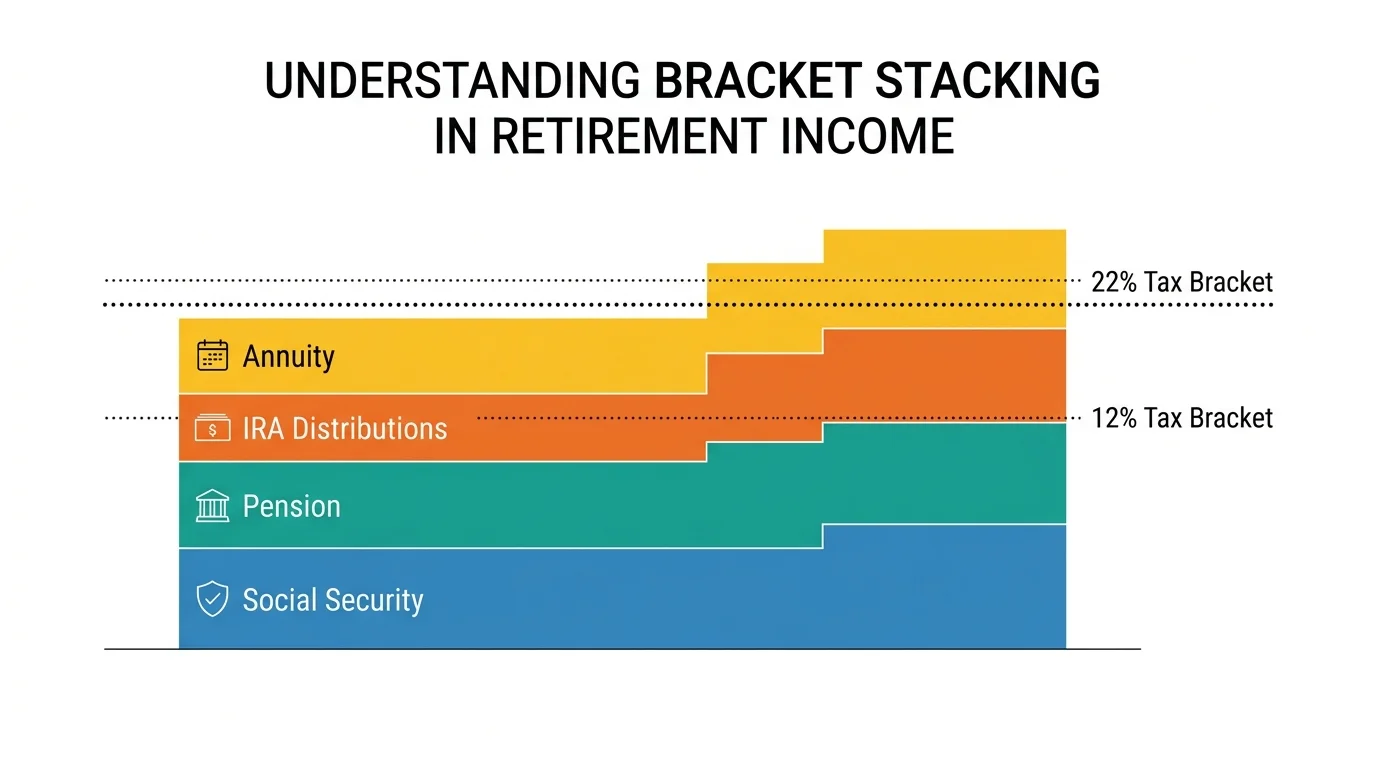
During your working years, your primary employer used your Form W-4 to withhold taxes across your entire salary. In retirement, you might collect income from a corporate pension, an annuity, Social Security, a traditional IRA, and a taxable brokerage account simultaneously. This fragmentation creates a major blind spot known as the “bracket stacking” problem.
Every payor calculates withholding in complete isolation, treating their distribution as if it were your sole source of income for the year:
- Pension Administrators: If you do not make an explicit election on Form W-4P, administrators apply default withholding based on a single filer with zero adjustments, which may not align with your true total income.
- IRA Custodians: Apply a standard 10% default withholding on ad-hoc distributions via Form W-4R.
- Social Security: Defaults to 0% withholding unless you file Form W-4V.
Because each payor applies lower marginal tax brackets and standard deductions to their individual payout, your aggregate tax withheld will fall far short of your actual cumulative liability. Consolidating your withholding strategy across all income streams eliminates this compounding deficit.

4. You Incurred an IRS Underpayment Penalty on Your Prior Return
If you owed more than $1,000 when filing your last tax return, the IRS likely assessed an underpayment penalty using Form 2210. The federal tax system operates on a “pay-as-you-go” structure, requiring taxpayers to remit payments throughout the year rather than in one lump sum in April.
According to IRS guidelines on underpayment penalties, you can satisfy safe harbor rules and avoid penalties if your total annual withholding and timely estimated payments equal at least:
- 90% of your total tax liability for the current tax year; or
- 100% of the total tax shown on your prior year’s return (this threshold rises to 110% if your prior-year adjusted gross income exceeded $150,000, or $75,000 for married individuals filing separately).
If you retired recently, note that the IRS offers a special statutory penalty waiver under Internal Revenue Code Section 6654(e)(3)(B). The agency may waive underpayment penalties if you retired after reaching age 62 in the current or preceding tax year and your underpayment resulted from reasonable cause rather than willful neglect. However, you should treat this waiver as a one-time transitional buffer and adjust your withholding immediately for subsequent tax years.

5. You Relocated or Split Time Between Multiple States
Retirement often prompts relocations to states with lower costs of living or warmer climates. Moving across state lines, purchasing a vacation home, or living as a seasonal resident fundamentally changes your state tax liabilities. State taxation on retirement income varies widely across the country:
- Some states exempt all retirement income, including pensions and Social Security, or collect no state income tax at all.
- Other states tax traditional retirement distributions fully while offering partial exemptions for military or public pensions.
- Certain states require you to pay tax if you maintain a permanent place of abode and spend more than 183 days within their borders during the tax year.
Federal withholding updates do not automatically transfer to state revenue agencies. If you move from an income-tax-free state to a state with personal income taxes, or vice versa, you must file specific state withholding certificates with your pension administrators and IRA custodians to match your new domicile requirements.

6. Your Filing Status or Household Deductions Changed
A change in household structure dramatically shifts your tax baseline. The most severe example is the loss of a spouse—often called the “widow’s tax penalty.” In the year following a spouse’s death, a surviving spouse shifts from the Married Filing Jointly tax brackets to the Single filer schedule. This transition cuts the standard deduction roughly in half and compresses tax brackets, subjecting identical income levels to higher marginal rates.
Conversely, aging brings deduction enhancements. Once you turn 65, the IRS grants an additional standard deduction amount above the basic standard deduction for each qualifying taxpayer. Furthermore, many retirees discover that their itemized deductions decrease once they pay off a primary mortgage, shifting them back to the standard deduction. If you experience any change in filing status, marital status, or itemized deduction eligibility, recalculate your withholding to reflect your updated bracket profile.
7. You Received an Unusually Large Tax Refund
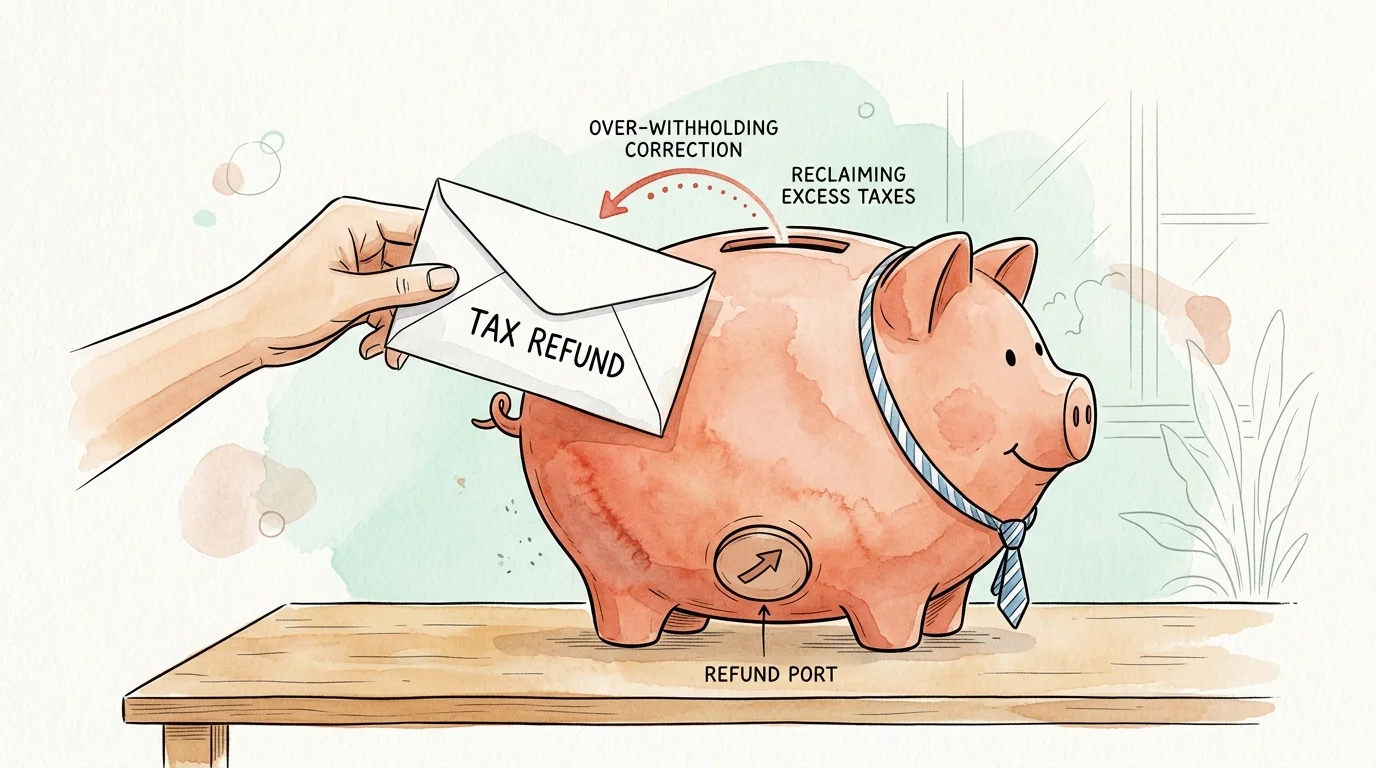
While receiving a sizable refund check feels rewarding, an oversized refund in retirement indicates that you gave the federal government an interest-free loan throughout the year. When you live on a fixed income or rely on investment portfolio returns, surrender of your liquid cash reduces your monthly budget flexibility and prevents you from earning interest in high-yield cash accounts.
A tax refund exceeding $1,500 signals an opportunity to adjust your withholding downward. By reducing your withholding on Form W-4P or Form W-4R, you redirect that money back into your monthly budget immediately, matching your incoming cash flow to your true living expenses.
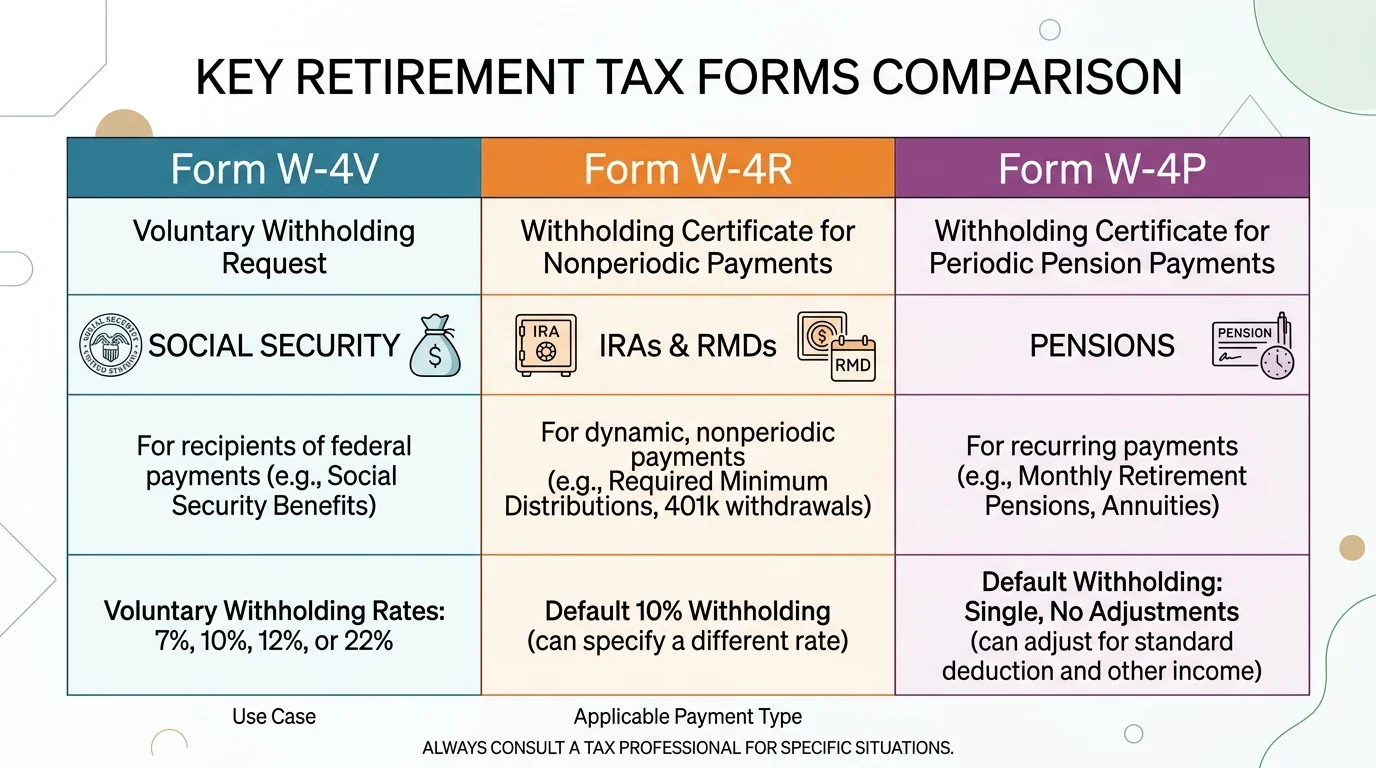
Key Retirement Tax Withholding Forms and Default Rules
Understanding which IRS form controls each specific income stream allows you to customize your withholding accurately. The following table summarizes the primary retirement withholding mechanisms and their default settings:
| Tax Form | Income Source | Default Withholding Rule | Customization Options |
|---|---|---|---|
| Form W-4P | Periodic payments (pensions, lifetime annuities) | Treated as Single filer with zero adjustments if no form is submitted | Allows specific marital status, deductions, other income, and extra withholding amounts |
| Form W-4R | Nonperiodic distributions (IRA withdrawals, RMDs, lump sums) | Flat 10% default withholding rate (eligible rollover distributions default to 20%) | Elect any rate from 0% up to 100% on the distribution amount |
| Form W-4V | Social Security benefit payments | 0% default withholding (no automatic tax deducted) | Elect a flat withholding rate of 7%, 10%, 12%, or 22% |
| Form 1040-ES | Investments, rental income, self-employment, consulting | No withholding (taxpayer calculates and remits quarterly) | Payments due four times per year (April 15, June 15, Sept 15, Jan 15) |
The Year-End Withholding Advantage for Retirees
Retirees possess a distinct procedural advantage over wage earners when fixing an estimated tax shortfall. Under federal tax law (Internal Revenue Code Section 3402), tax withheld from a retirement account distribution is treated as having been paid evenly throughout the tax year, regardless of the calendar date the distribution occurred.
In contrast, if you make a late estimated tax payment via Form 1040-ES in the fourth quarter, the IRS still assesses underpayment penalties for the preceding quarters. However, if you discover a projected tax deficit in November or December, you can take a traditional IRA distribution or adjust an RMD to withhold up to 100% of the distribution for federal taxes. The IRS treats that late-year withholding as if you remitted it in four equal installments across the entire year, instantly eliminating prior-quarter underpayment penalties.

What Can Go Wrong
Failing to monitor your retirement tax withholding can create compounding financial problems. Consider these common retirement tax pitfalls:
- The Social Security Tax Torpedo: Taking an unexpected taxable withdrawal from a traditional IRA can push your combined income over the $34,000 or $44,000 threshold. This triggers taxation on up to 85% of your Social Security benefits, pushing your effective marginal tax rate significantly higher than your stated tax bracket.
- Medicare IRMAA Surcharges: An uncalculated increase in modified adjusted gross income (MAGI) due to large RMDs or Roth conversions can trigger Medicare Part B and Part D Income-Related Monthly Adjustment Amount (IRMAA) surcharges two years later.
- Passive Underwithholding from 10% Defaults: Relying on the 10% default rate on Form W-4R for a $50,000 IRA distribution leaves a $6,000 tax deficit if you sit in the 22% federal bracket, creating a surprise tax bill in April.
- Neglecting Dual-State Residency Rules: Failing to submit state-specific tax withholding forms after moving can cause dual-state tax claims and delay state tax refunds for months.

Where Outside Advice Pays Off
While online calculators such as the IRS Tax Withholding Estimator help resolve basic withholding questions, several complex retirement scenarios warrant direct consultation with a certified public accountant (CPA) or fee-only financial planner:
- Executing Multi-Year Roth Conversion Ladders: Strategic conversions from traditional IRAs to Roth IRAs generate immediate ordinary taxable income. A financial professional can calculate precise quarterly withholding from taxable accounts to prevent underpayment penalties while maximizing tax-free growth.
- Navigating the Post-Spousal Transition: Re-evaluating withholding immediately after the death of a spouse ensures the surviving partner avoids dramatic bracket shocks caused by the single filer status.
- Coordinating Qualified Charitable Distributions (QCDs): Retirees age 70½ and older can transfer up to $105,000 annually directly from an IRA to an eligible charity. Because QCDs satisfy RMD requirements without increasing AGI, an advisor can recalibrate your Form W-4R withholding downward.
- Managing Multi-State Domicile Transitions: A tax advisor specializing in multi-state taxation can structure your income streams and statutory residency days to prevent double taxation on pension and investment payouts.
Frequently Asked Questions
Can I change my Social Security tax withholding at any time?
Yes. You can adjust or cancel your voluntary Social Security withholding at any time during the year. Download and complete Form W-4V, select your preferred withholding rate (7%, 10%, 12%, or 22%), and mail or deliver the physical form to your local Social Security Administration office.
Why is withholding from an IRA often preferable to paying quarterly estimated taxes?
Withholding from an IRA offers greater flexibility because the IRS treats withholding as paid evenly throughout the year, even if taken in December. Quarterly estimated tax payments (Form 1040-ES) must be paid on strict quarterly deadlines; missing an earlier deadline results in an underpayment penalty even if you overpay in the fourth quarter.
How do I claim the IRS retirement underpayment penalty waiver?
If you retired after reaching age 62 and incurred an underpayment penalty due to reasonable cause, file IRS Form 2210 (Underpayment of Estimated Tax by Individuals, Estates, and Trusts) with your tax return. Check the penalty waiver box in Part II and attach a written statement explaining your retirement date and why the underpayment occurred.
What happens if I submit no withholding form for my pension?
If you do not submit Form W-4P to your pension administrator, the default federal withholding rule treats you as a single filer with no other adjustments. This may result in excessive withholding if you are married, or insufficient withholding if you have multiple significant income sources.
Managing your tax withholding in retirement requires ongoing attention rather than a one-time setup. Review your pay stubs, distribution statements, and overall tax liability annually or whenever your household income changes to keep your retirement finances smooth, predictable, and fully compliant.
The information here is meant for educational purposes. Specific circumstances—including health conditions, finances, location, and goals—may require different approaches. When in doubt, consult a licensed professional or check official sources directly.
Last updated: May 2026. Rules, prices, and details change—verify current information with official sources before acting on it.









Leave a Reply