

If you opened your loan servicer portal and found an IDR removal notice, you face an immediate decision. Federal loan servicers are transitioning millions of borrowers away from invalid repayment schedules.
Missing your deadline pushes your account directly into a fixed Standard repayment schedule. That sudden shift can double or triple your monthly loan payment without warning.
You can protect your budget and stay on income-driven repayment by acting before your deadline expires. Here is how to navigate the notices and select the right replacement plan.
Why You Received an IDR Removal Notice
Receiving an IDR removal notice does not mean the government revoked your eligibility for income-driven relief. Instead, federal directives recently invalidated specific repayment tiers across major servicers.
A March 10, 2026 court order formally ended the Saving on a Valuable Education (SAVE) Plan. As a result, loan servicers began issuing rolling 90-day transition notices to affected borrowers starting July 1, 2026.
A separate clerical error triggered a second wave of letters in late November 2026. The Department of Education directed MOHELA to notify fewer than 0.1% of borrowers who were mistakenly enrolled in the post-2014 Income-Based Repayment (IBR) tier.
Borrowers with older loans disbursed before July 1, 2014, only qualify for the pre-2014 IBR plan. If you received this specific notice, you must select an eligible alternative within 90 days.

The Cost of Ignoring Your Servicer Notice
Ignoring a removal letter triggers automatic re-enrollment into a standard repayment track. Servicers will assign you to either the traditional 10-year Standard Plan or the new Tiered Standard Plan.
The Tiered Standard Plan imposes fixed repayment terms ranging from 10 to 25 years based on your total balance. However, it does not offer loan forgiveness and requires a minimum payment of $50 per month.
According to consumer guidance from the Consumer Financial Protection Bureau, default schedules often cause immediate payment spikes. Servicers must send your official billing statement at least 21 days before your first payment comes due.
Eligible Replacement Plans to Keep Payments Affordable
Borrowers holding federal loans disbursed prior to July 1, 2026, retain access to several legacy IDR programs. You can choose the older IBR tier, Pay As You Earn (PAYE), or Income-Contingent Repayment (ICR).
Both PAYE and ICR will permanently close to all borrowers no later than July 1, 2028. After that sunset date, IBR and the new Repayment Assistance Plan (RAP) will serve as the primary options.
Created under the One Big Beautiful Bill Act (OBBBA), RAP launched on July 1, 2026. It calculates your monthly loan payment at 1% to 10% of your adjusted gross income (AGI).
RAP waives unpaid monthly interest as long as you pay on time, and it forgives remaining debt after 30 years. It also subtracts $50 per month for every dependent you claim on your taxes.
| Repayment Plan | Monthly Payment Formula | Forgiveness Timeline | Key Limitation |
|---|---|---|---|
| Pre-2014 IBR | 15% of discretionary income | 25 years (300 payments) | Higher payment rate than newer plans |
| Post-2014 IBR | 10% of discretionary income | 20 years (240 payments) | Only for new borrowers as of July 1, 2014 |
| PAYE / ICR | 10% to 20% of discretionary income | 20 to 25 years | Permanently sunsets by July 1, 2028 |
| Repayment Assistance Plan (RAP) | 1% to 10% of AGI (minus $50/dependent) | 30 years (360 payments) | Longer forgiveness timeline |
| Tiered Standard Plan | Fixed payment ($50/month minimum) | None | No forgiveness; balance dictates term |
How to Select a Plan and Avoid Payment Spikes
You can manage your repayment strategy directly through your federal dashboard. Visit StudentAid.gov/idr to submit a new income-driven application or request an immediate recalculation.
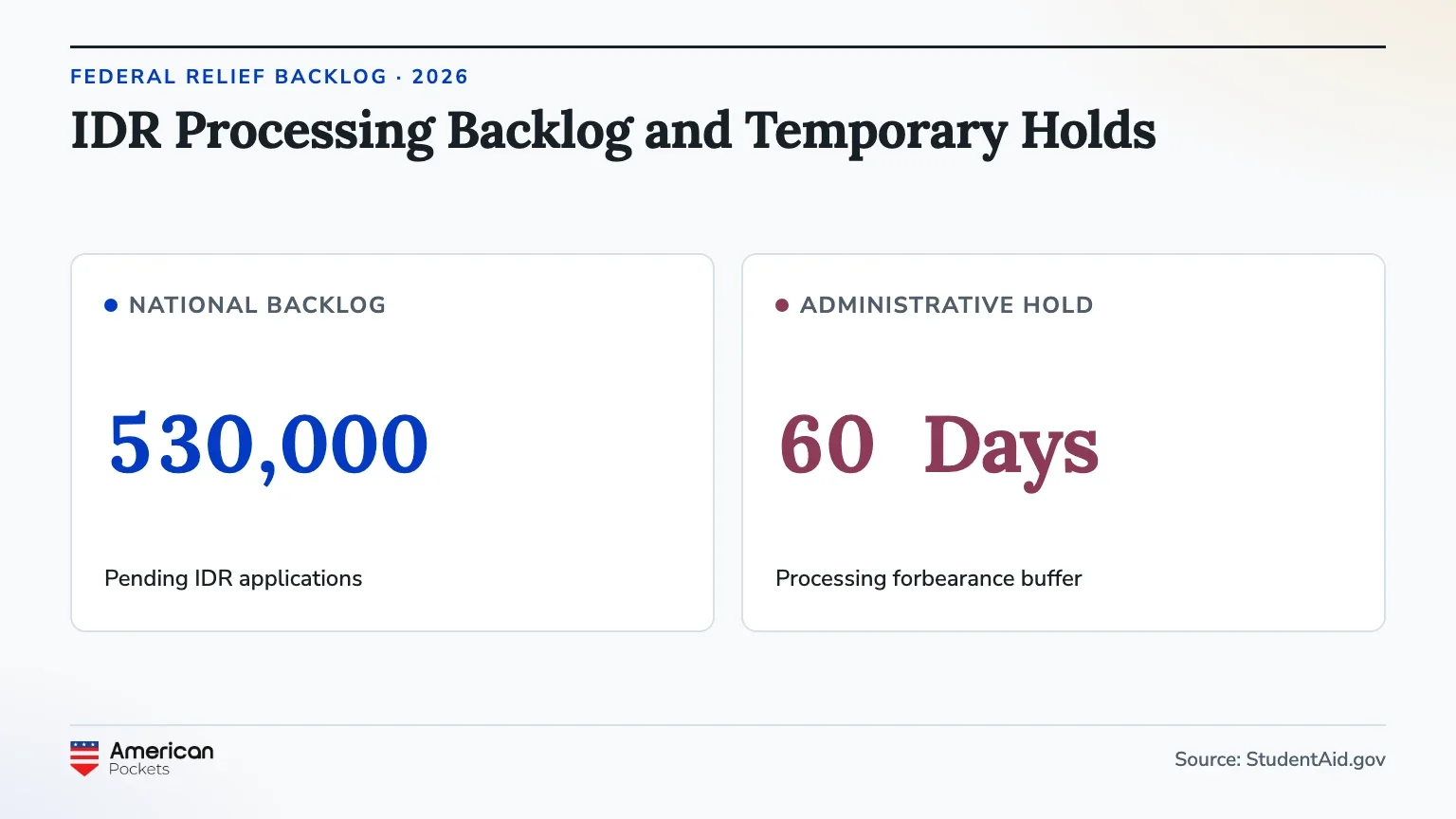
If your servicer faces a processing delay, request a 60-day administrative processing forbearance. With more than 530,000 IDR applications backlogged nationally, this administrative hold prevents servicers from demanding unaffordable standard payments.
You can also use the official calculator at StudentAid.gov/repayment-calculator to compare monthly estimates. This tool reveals whether IBR or RAP delivers the lowest monthly loan payment for your earnings.

What Can Go Wrong
Consolidating your loans after July 1, 2026, carries a permanent drawback. Any consolidation loan disbursed after this date permanently locks your debt into either RAP or Tiered Standard, stripping away IBR eligibility.
Tax rules surrounding debt cancellation have changed significantly. The federal tax exemption established under the American Rescue Plan expired on December 31, 2025, meaning IDR forgiveness in 2026 or later could generate taxable income.
Missing your auto-pay enrollment deadline leaves guaranteed savings on the table. Federal borrowers can secure an elevated 1% auto-debit interest rate discount by enrolling before 11:59 p.m. ET on December 31, 2026.
Frequently Asked Questions
Will switching repayment plans reset my Public Service Loan Forgiveness count?
No, switching plans does not erase your accumulated PSLF credit. However, months spent in non-qualifying forbearance or standard tiered plans will not advance your progress toward forgiveness.
What happens if my income dropped since my last tax return?
You do not have to rely on prior-year tax returns if you experienced a pay cut. You can submit recent paystubs on StudentAid.gov to request an immediate payment recalculation.
Can Parent PLUS borrowers enroll in the new RAP option?
Parent PLUS loans disbursed or consolidated on or after July 1, 2026, cannot access RAP or any IDR plan. Only Parent PLUS debt consolidated before July 1, 2026, maintains access to legacy income plans.
Protecting Your Student Loan Repayment Strategy
Navigating loan servicer transitions requires timely paperwork and close attention to federal deadlines. Log into your servicer account today to confirm your current plan and submit any necessary adjustments.
This article provides general information only. Every reader’s situation is different—what works for others may not be the right fit for you. For personalized guidance on health, legal, or financial matters, consult a qualified professional.
Last updated: November 2026. Rules, prices, and details change—verify current information with official sources before acting on it.









Leave a Reply