

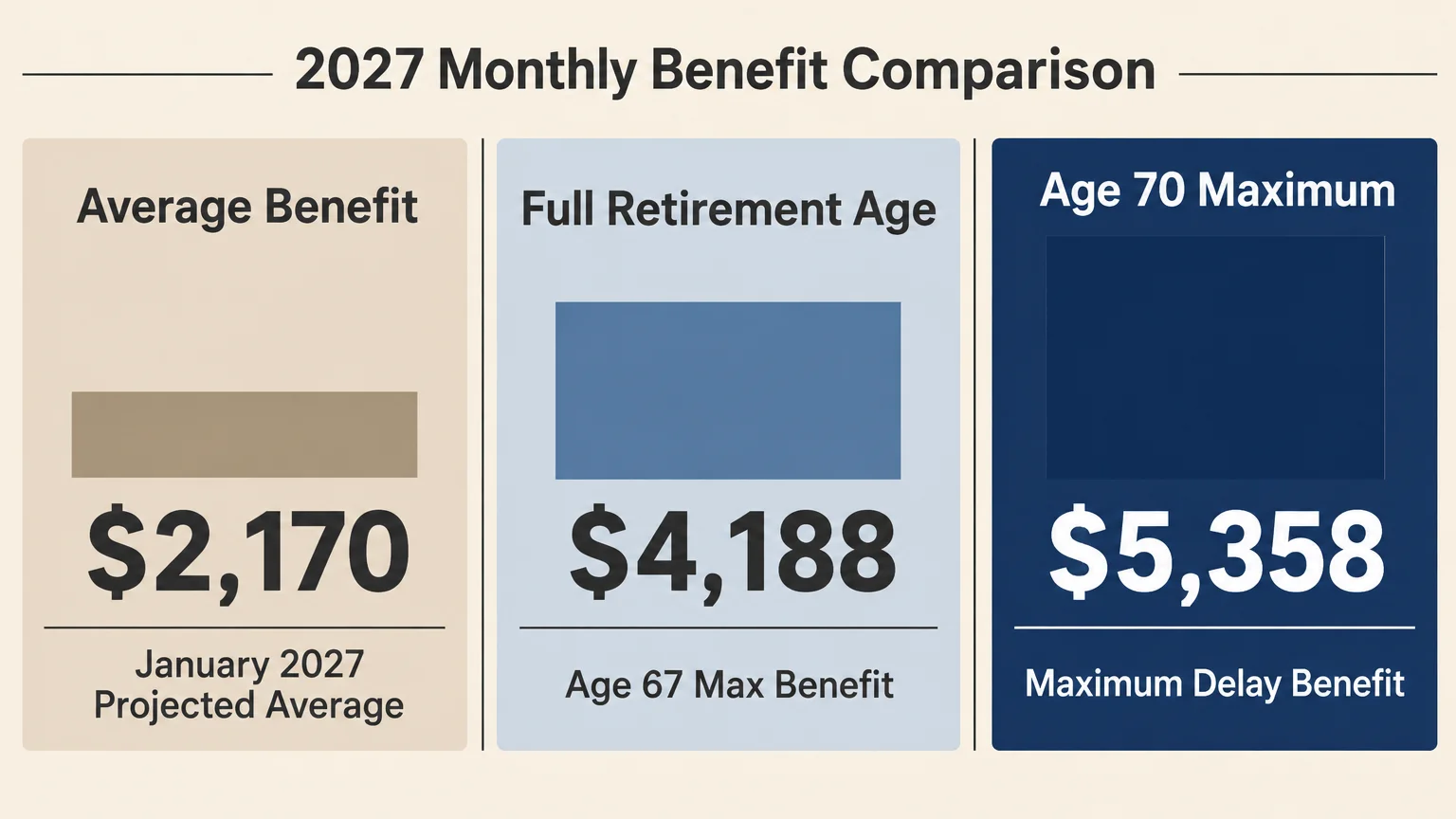
In 2027, the maximum Social Security benefit reaches $4,188 a month at full retirement age and $5,358 a month at age 70. Most retired workers receive less than half of that.
Crossing that threshold requires earning at or above the taxable wage cap for 35 straight years and delaying your claim until 70. Almost nobody checks both boxes.
Understanding why those limits lock out most workers helps you stop chasing an unrealistic ceiling and focus on the levers that actually raise your check.
Why People Are Talking About This
Every October, new benefit figures trigger a wave of headlines about the highest social security check available in the coming year. On October 14, 2026, the Social Security Administration (SSA) announced a 3.6% cost-of-living adjustment (COLA) for 2027.
That 3.6% increase takes effect with January 2027 payments, up from a 2.8% COLA in 2026. It affects nearly 72 million Social Security beneficiaries and roughly 7.3 million Supplemental Security Income recipients.
Along with the COLA, the SSA set the 4188 social security benchmark for workers retiring at full retirement age in 2027. That $4,188 monthly figure equals $50,256 a year, up from $4,152 a month in 2026.
Workers who wait until age 70 see an even bigger headline number. For 2027, the maximum monthly benefit at age 70 climbs to $5,358, or $64,296 a year, compared with $5,181 in 2026.
Meanwhile, real-world checks look very different. According to the SSA Monthly Statistical Snapshot, the actual average monthly benefit across all 55.2 million retired workers in October 2026 was $2,092.17.
On its 2027 COLA Fact Sheet, the SSA projects the average retired-worker benefit will rise by about $75 a month, from $2,095 to $2,170, in January 2027. That leaves the typical retiree with roughly half of the $4,188 full retirement age benefit and about 40% of the age-70 ceiling.
The Two Rules That Gatekeep the Highest Check
Landing the social security max 2027 payout is not a matter of luck or savvy paperwork at age 65. Two rigid mathematical requirements shut out almost every worker before retirement even begins.
First, you must earn at or above the annual Social Security taxable maximum for at least 35 years of your working life. For the absolute highest age-70 check, the SSA schedule assumes maximum-taxable earnings every year starting at age 22.
Second, you must wait until age 70 to start collecting benefits. Claiming even a few months earlier permanently locks you below the top tier.
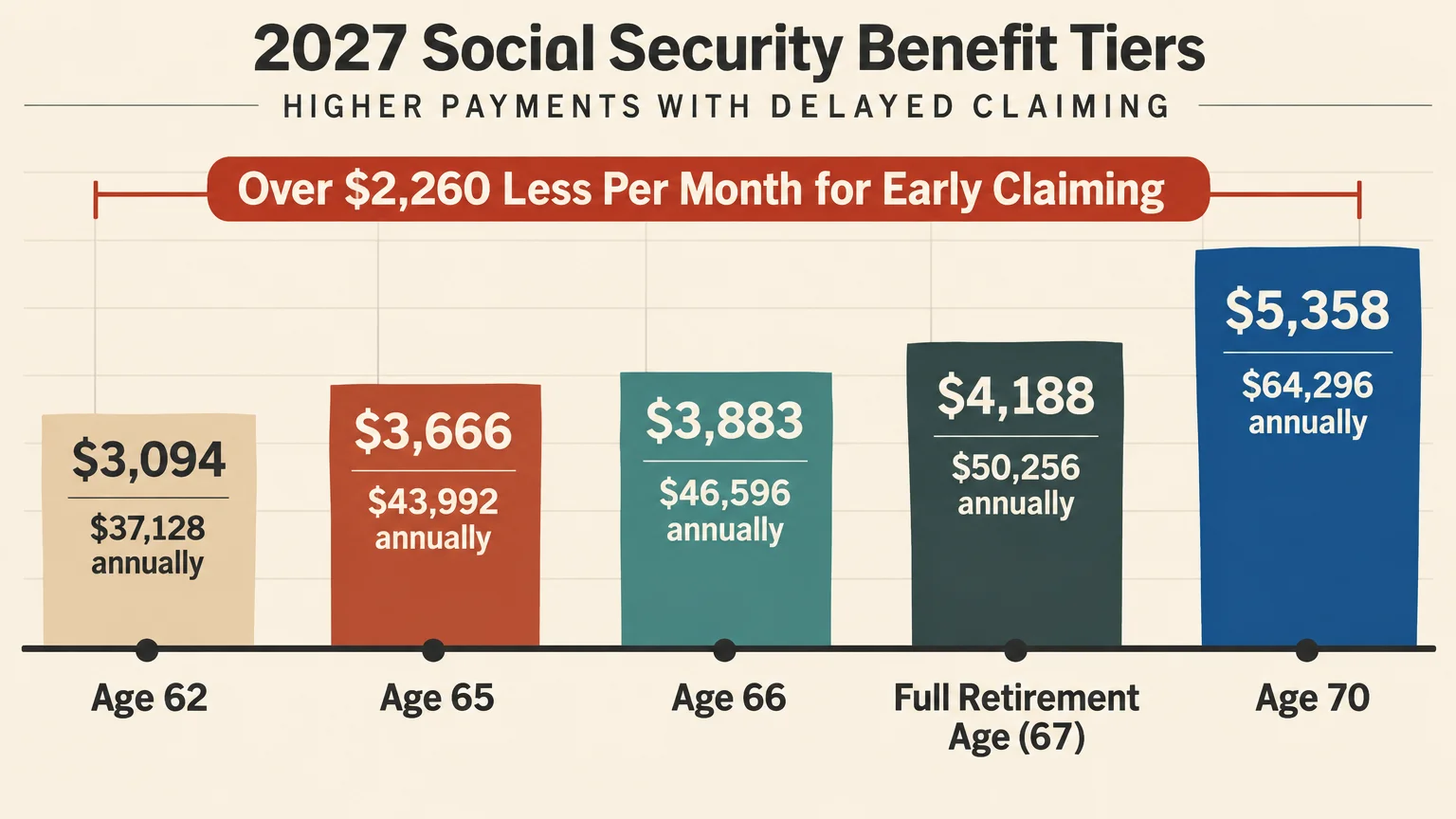
The table below compares maximum monthly benefits in 2026 and 2027 across different claiming ages, based on the SSA Workers with Maximum-Taxable Earnings schedule.
| Claiming Age | 2026 Maximum Monthly Benefit | 2027 Maximum Monthly Benefit | 2027 Annual Maximum |
|---|---|---|---|
| Age 62 (and 1 month) | $2,969 | $3,094 | $37,128 |
| Age 65 | Not listed in 2027 comparison baseline | $3,666 | $43,992 |
| Age 66 | Not listed in 2027 comparison baseline | $3,883 | $46,596 |
| Full Retirement Age (67 in 2027) | $4,152 | $4,188 | $50,256 |
| Age 70 | $5,181 | $5,358 | $64,296 |
Notice how steep the penalty is for claiming early even if you earned the maximum salary every single year. A top earner who files at 62 in 2027 gets $3,094 a month—over $2,260 less per month than waiting until 70.

Why the 35-Year Earnings Cap Eliminates Nearly Everyone
To calculate your benefit, the SSA looks at your 35 highest-earning years, adjusted for wage inflation. Each past year gets indexed to the national Average Wage Index (AWI) so older paychecks reflect modern wage levels.
For workers turning 62 in 2027, the 2025 AWI used for indexing is $72,800.33, compared with $69,846.57 for 2024. After indexing, the SSA averages your top 35 years to produce your Average Indexed Monthly Earnings (AIME).
If you worked fewer than 35 years in Social Security-covered jobs, the formula fills each missing year with a zero. Even one zero—or several low-earning years in your twenties—pulls your 35-year average below the ceiling.
At the other end, hitting the ceiling each year gets harder as wages grow. In 2027, the Social Security taxable maximum rises to $192,300, up from $184,500 in 2026 and $176,100 in 2025.
Any income you earn above $192,300 in 2027 is exempt from the 6.2% employee Social Security payroll tax, or 12.4% if you are self-employed. Those extra dollars do not increase your future retirement check either.
An employee earning $192,300 or more in 2027 pays the maximum $11,922.60 in Social Security payroll taxes. Doing that once is tough enough for most budgets; doing it for 35 separate years is extraordinarily rare.
Data from SSA Population Profile: Taxable Maximum Earners and Fast Facts 2026 underscores how few workers clear that bar:
- Single-year earners: Roughly 6% of covered workers earn above the taxable maximum in any given year, including 6.2% in 2025.
- Historical consistency: Since 1983, the share of covered workers topping the cap in a single year has stayed between 5.4% and 6.6%.
- Lifetime odds: Nearly 20% of covered workers are projected to exceed the taxable cap in at least one year, yet sustaining it across all 35 calculation years eliminates almost everyone.
Career realities work against a spotless 35-year streak at the cap. Graduate school, layoffs, startups, caregiving breaks, or public-sector jobs outside Social Security all create lower-earning years that cannot be erased unless you replace them later.
Remember also that earnings above the cap in your peak forties or fifties cannot compensate for lower pay in your twenties. Because every year is capped individually before the 35-year average is computed, extra income in one year never spills over into another.
How Claiming Age Shrinks or Stretches Your Full Retirement Age Benefit
Even among the tiny group of workers who max out their 35-year earnings record, most forfeit the highest check because of when they file. Your claiming age acts as a permanent multiplier on your full retirement age benefit.
Under SSA retirement rules, full retirement age (FRA) reaches 67 in 2027 for everyone born in 1960 or later. Those born in 1959 had an FRA of 66 and 10 months.
If your FRA is 67 and you claim as early as age 62, Social Security permanently cuts your check by 30%. That leaves you with 70% of your Primary Insurance Amount for life.
Delaying past FRA works in the opposite direction. You earn 8% per year in delayed retirement credits up to age 70, boosting your check to 124% of your FRA amount before credits stop accruing.
On paper, waiting until 70 looks like an obvious win, especially if you are healthy. In practice, real retirees overwhelmingly claim much sooner.
Tabulations from the SSA Annual Statistical Supplement 2026 show how new retirees actually behaved in 2024 and 2025:
- Early filers dominate: Among retired workers whose benefits began in 2024, 50.9% started before FRA, or 58.1% when excluding automatic disability conversions.
- Age 62 leads all ages: Exactly 22.5% of 2024 new claimants filed at age 62, making it the single most common claiming age.
- Waiting to 70 is rare: Only 9.3%—about 347,000 retirees—waited until age 70 or later in 2024, while the average claiming age sat at 65.3.
- Continuing trend in 2025: Out of 3.92 million retired-worker awards in 2025, 53.2% carried an early-retirement reduction.
People claim early for practical reasons, not poor math. Health issues, physically demanding jobs, unexpected layoffs in your early sixties, or the immediate need to cover groceries and housing often outweigh waiting for a bigger check at 70.
Career gaps also drive a persistent gender gap in monthly benefits. According to SSA Fast Facts and Figures About Social Security, 2026, retired men averaged $2,282 a month compared with $1,872 a month for retired women.
Why the Formula Favors Modest Earners Over Top Earners
Social Security was never designed to replace a six-figure salary dollar for dollar. Its progressive benefit formula intentionally gives lower and middle earners a higher return on every taxed dollar than high earners receive.
The SSA calculates your Primary Insurance Amount using three income brackets separated by dollar thresholds called bend points. For workers first eligible in 2026, the formula replaces 90% of the first $1,286 of your AIME.
Between $1,286 and $7,749 of AIME, the replacement rate drops sharply to 32%. Above $7,749 of AIME, the formula replaces just 15% of your average monthly covered earnings.
Because of those steep drop-offs, chasing the maximum social security benefit yields diminishing returns as your income rises. According to the SSA publication Understanding the Benefits, claiming at FRA in 2026 replaces very different shares of pre-retirement pay:
- Very low earners: Social Security replaces roughly 79% of pre-retirement earnings.
- Medium earners: Benefits replace about 43% of pre-retirement earnings.
- Maximum earners: Even at the top, Social Security replaces only around 28% of pre-retirement earnings.
That 28% replacement rate explains why high earners rarely rely on Social Security as their primary retirement engine. Personal savings, 401(k) plans, IRAs, and taxable brokerage accounts must do most of the heavy lifting.
For lower- and middle-income households, the reliance flips completely. Congressional Research Service analysis of Health and Retirement Study data shows Social Security supplies 83% of total income for adults 65 and older in the lowest income quintile.
It also provides 64% of total income in the second quintile and 46% in the middle quintile. For most Americans, squeezing another $200 or $400 a month out of the system matters far more than hitting $4,188 or $5,358.
Practical Steps to Maximize Your Own Benefit
You probably cannot go back to age 22 and earn $192,300 every year. Still, you have meaningful control over your final check if you are in your forties, fifties, or early sixties.
Focus on concrete steps that improve your own 35-year average and claiming multiplier:
- Audit your earnings record now: Create or log in to your my Social Security account and verify every single year of posted wages against old W-2s or tax returns. Catching an unrecorded year early is far easier than fixing a 20-year-old payroll error right before retirement.
- Replace zero or low-wage years: If your record shows gaps or low-paying jobs from your twenties, working even two or three extra years at your current peak salary directly bumps those weak years out of your top 35.
- Delay claiming when cash flow allows: Each year you wait between age 62 and 67 avoids early reductions, and each year between 67 and 70 adds 8% in guaranteed credits. Using savings or part-time work to bridge even one or two years can permanently raise your inflation-adjusted income floor.
- Coordinate spousal timing: If you are married, the higher earner delaying toward 70 locks in both a larger lifetime check and a larger survivor benefit for whichever spouse lives longer.
- Review annual COLA updates: Check official adjustments on the SSA COLA page each October so your household budget reflects real benefit changes rather than rumors.
You do not need the highest check in the country to secure a stable retirement. Adding two solid late-career years and waiting past 62 can still boost your lifetime household payout by tens of thousands of dollars.

Things to Watch Out For
As you plan around the 2027 numbers, several common misunderstandings can quietly shrink your check or derail your retirement budget. Watch closely for these four pitfalls.
1. Working while claiming before full retirement age. If you claim early and keep earning a paycheck, the SSA Retirement Earnings Test temporarily withholds part of your benefit above annual limits. In 2027, $1 is withheld for every $2 you earn above $25,560 a year ($24,480 in 2026) if you remain under FRA all year.
During the calendar year you reach FRA, the threshold is higher and softer. In 2027, $1 is withheld for every $3 earned above $67,920 ($65,160 in 2026) in the months before your FRA birthday, and the limit disappears completely once you hit FRA.
2. Assuming a few high-earning years erase early gaps. Earning $200,000 a year for your last five years will help your average, but payroll taxes stop counting once you pass the annual cap ($192,300 in 2027). Those five peak years only fill five slots out of 35, leaving 30 other slots intact.
3. Mixing up the $4,188 FRA cap and the $5,358 age-70 ceiling. Many financial articles cite $4,188 as the maximum Social Security benefit in 2027, while others cite $5,358. Both numbers are real, but $4,188 applies strictly at full retirement age (67), whereas $5,358 requires waiting until age 70.
4. Ignoring long-term trust fund projections in your budget. According to the 2025 Social Security Trustees Report, the retirement (OASI) trust fund is projected to be depleted in 2033, with combined trust funds depleted in 2034. Without Congressional action, ongoing payroll tax revenue would still cover about 77% of OASI benefits or 81% of combined scheduled benefits.
That does not mean Social Security is disappearing, since payroll taxes keep flowing in every paycheck. Still, stress-testing your retirement budget for a modest benefit haircut or tax change keeps you protected if lawmakers wait until the last minute.
When DIY Isn’t Enough
Basic claiming calculators work well for single workers with straightforward pensions or 401(k) balances. However, guessing on your own can cost you real money in several complex situations.
- Coordinating dual-earner spousal and survivor benefits: Choosing who claims first—and whether the higher earner delays to 70—affects both monthly cash flow now and the surviving spouse’s income decades later.
- Building a retirement bridge account: Drawing down traditional IRAs or brokerage accounts between ages 62 and 70 to delay Social Security can trigger higher Medicare premiums or push you into steeper tax brackets without careful tax modeling.
- Managing self-employment income near the cap: Self-employed workers pay both halves of the 12.4% Social Security tax up to $192,300 in 2027, so entity structure and retirement contributions require coordination with a CPA.
- Balancing trust fund risk against private savings: If Social Security provides most of your projected retirement income, a fee-only financial planner can help you build a cash buffer or part-time income plan ahead of 2033.
Meeting once with a qualified fiduciary planner or tax professional before filing is far cheaper than locking in a reduced monthly benefit for the next 25 years.
Frequently Asked Questions
What is the maximum Social Security benefit at 67 in 2027?
The maximum Social Security benefit for a worker retiring at full retirement age (67 for those born in 1960 or later) in 2027 is $4,188 a month, or $50,256 a year. That is up from $4,152 a month in 2026.
How much do you have to make to get the maximum Social Security check in 2027?
In 2027, you must earn at least $192,300 to hit the annual Social Security taxable wage cap. To get the true maximum check, you also need to have earned at or above each prior year’s wage cap for 35 years and delay claiming until age 70.
What is the average Social Security check compared to the maximum in 2027?
Following the 3.6% COLA for 2027, the SSA projects the average retired-worker benefit will rise from $2,095 to $2,170 a month in January 2027. That average is roughly half of the $4,188 FRA maximum and about 40% of the $5,358 age-70 ceiling.
Can you still increase your Social Security benefit after age 62?
Yes, you can raise your future check in two ways after turning 62. Delaying your claim adds value up to age 70, and continuing to work can replace earlier zero or low-earning years inside your top 35 years.

What to Do With These Numbers Today
Treat the $4,188 and $5,358 maximums as mathematical curiosities rather than personal benchmarks. Log into your SSA account this week, check your 35-year earnings history, and run projections at ages 62, 67, and 70 based on your actual budget.
This is general informational content based on widely accepted guidance. Individual results vary. Verify current details—rules, prices, eligibility, regulations—with official sources before making important decisions.
Last updated: November 2026. Rules, prices, and details change—verify current information with official sources before acting on it.








Leave a Reply