
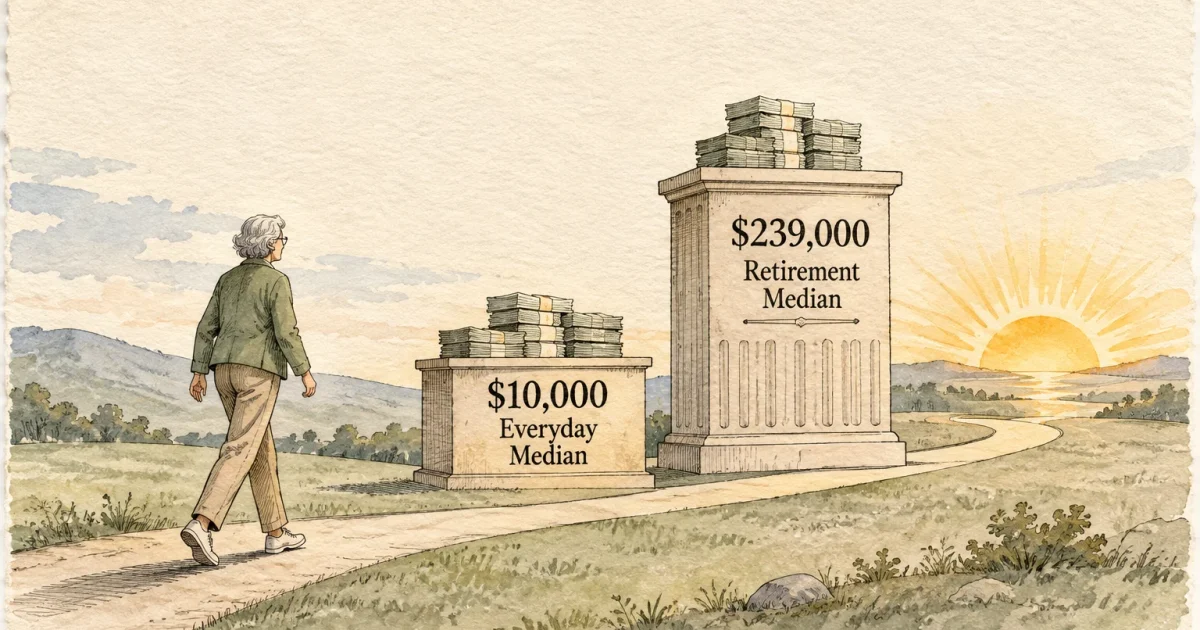
Checking your savings against national benchmarks in your 60s can feel confusing when headlines cite wildly different numbers. Households aged 55 to 74 hold a median of $10,000 in everyday bank accounts, plus larger sums in CDs and retirement plans.
Looking at bank cash, workplace 401(k) balances, and net worth separately shows where you actually stand. Comparing median figures rather than skewed averages gives you a clearer baseline for retirement readiness.
Below, you can review the latest 2026 federal and industry data alongside updated IRS catch-up rules. You will also find concrete ways to put idle cash to work as you approach or enter retirement.
At a Glance
Recent federal and brokerage reports show a wide gap between what Americans in their 60s hold in everyday cash and what they keep in long-term accounts. Keep these core benchmarks in mind as you review your own statements.
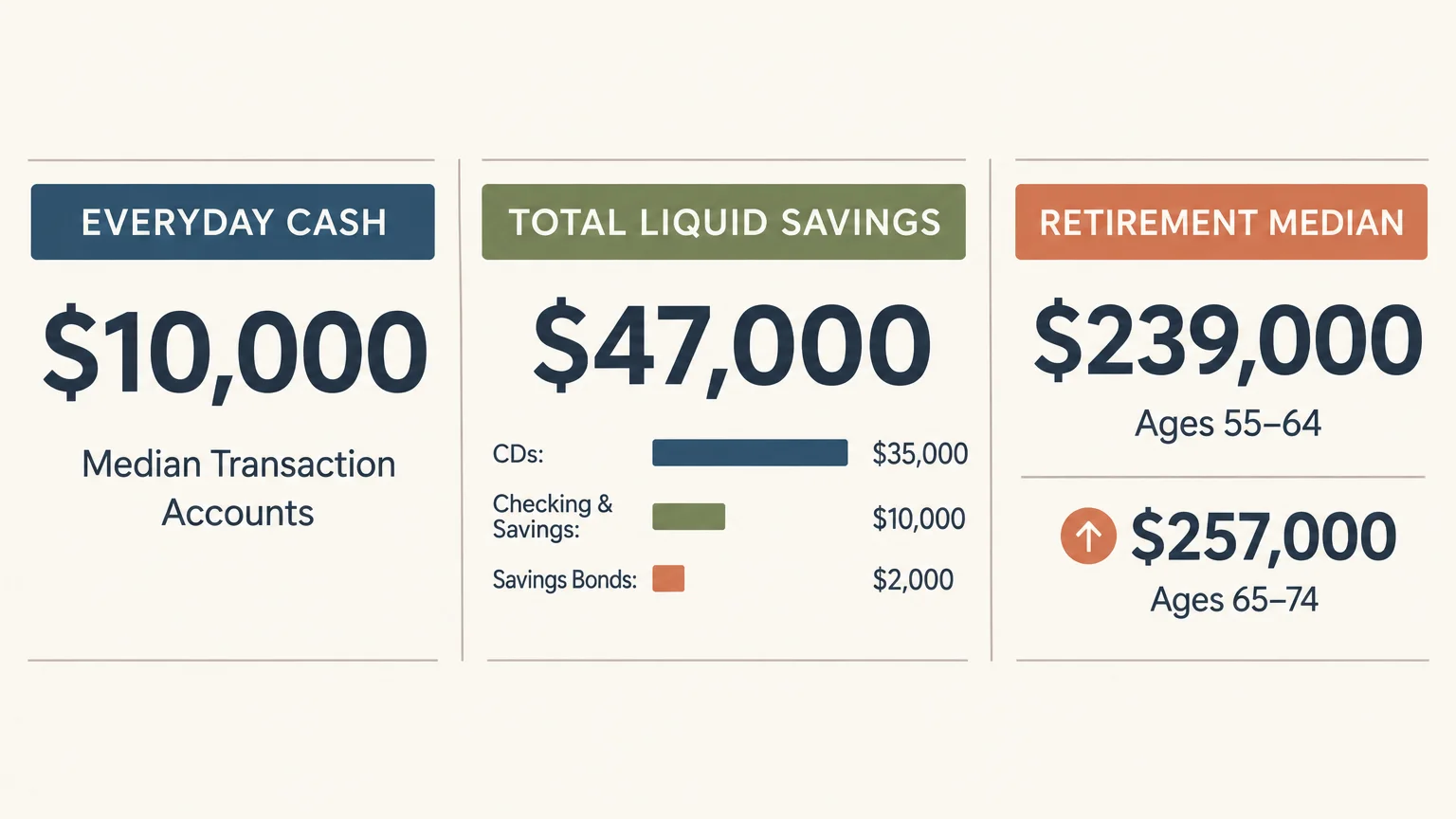
- Liquid bank balances: Households aged 55–64 hold a combined median of $47,000 across transaction accounts, certificates of deposit (CDs), and savings bonds, while those aged 65–74 hold $57,000.
- Retirement account medians: Among account holders, median balances reach $239,000 for ages 55–64 and $257,000 for ages 65–74, though many families have no retirement plan at all.
- Target savings benchmarks: Fidelity Investments recommends saving 8 times your annual salary by age 60 and 10 times your salary by age 67.
- Higher catch-up limits: Workers aged 60 to 63 can contribute up to $11,250 in extra 401(k) catch-up funds in 2026 and $11,750 in 2027 when their employer plan allows it.
American Savings Statistics: What People in Their 60s Keep in the Bank
When people ask about the average bank balance 60s households carry, they usually mean liquid cash you can access quickly without selling stocks. That includes checking accounts, traditional or high-yield savings accounts, money market accounts, CDs, and savings bonds.
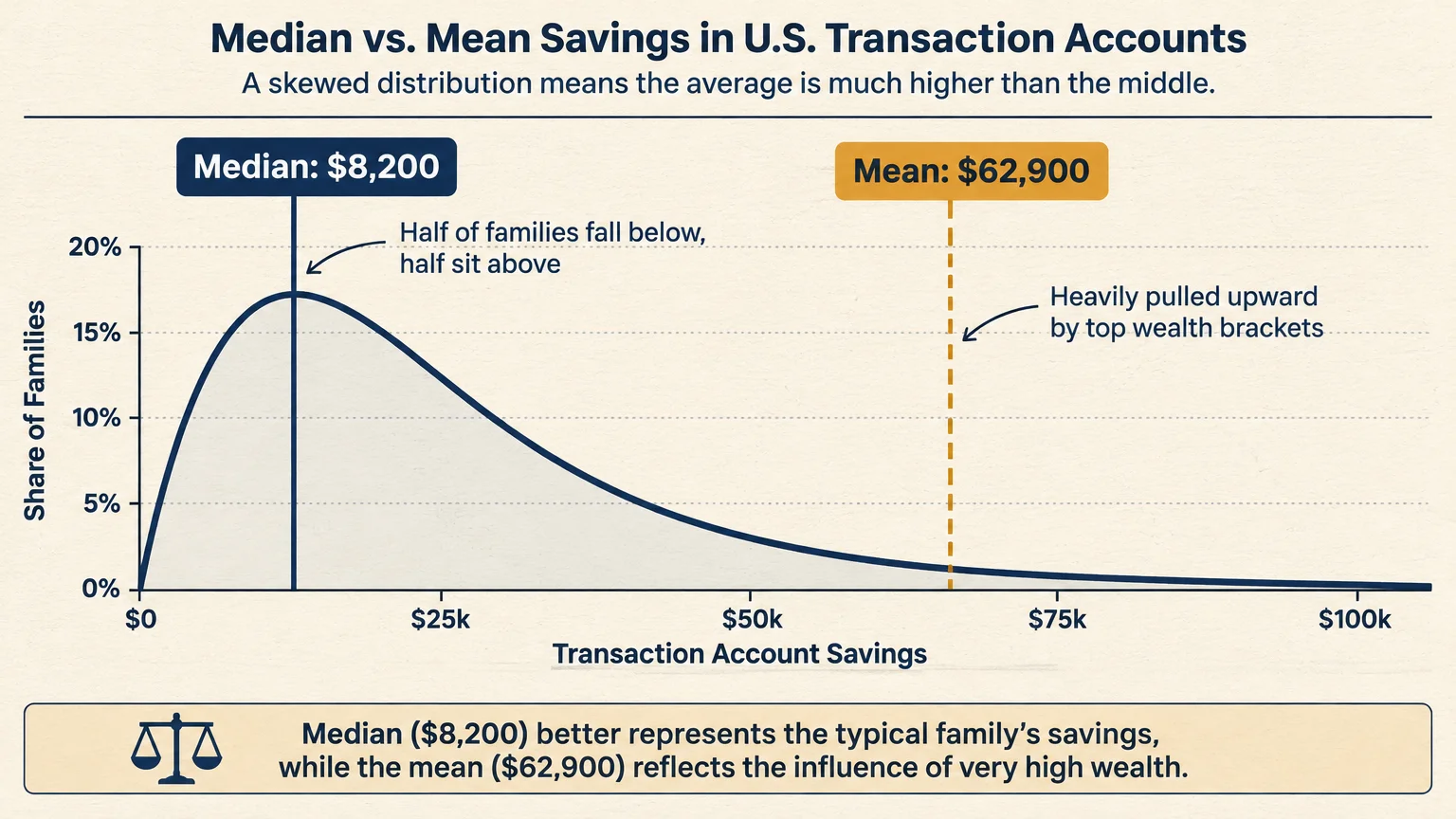
Across all U.S. families, the Federal Reserve Board reports in its 2025 Survey of Consumer Finances (released October 9, 2026) that 98.7% hold transaction accounts. Measured in 2025 dollars, the median balance across all age groups is $8,200, down 6% from 2022.
Meanwhile, the national mean transaction account balance sits at $62,900, down 8% from 2022. That massive gap between $8,200 and $62,900 illustrates why averages mislead you when measuring typical American savings statistics.
A small slice of wealthy households holding hundreds of thousands of dollars in cash pulls the average sharply upward. Because half of families fall below the median and half sit above it, the median gives you a much fairer comparison.
Breaking liquid savings down by age bracket reveals how cash habits shift as retirement arrives. According to a November 3, 2026 analysis of the 2025 Survey of Consumer Finances by The Independent, households aged 55 to 64 hold a combined median liquid balance of $47,000.
That $47,000 total breaks down into three specific buckets:
- Transaction accounts (checking, savings, and money market): $10,000 median balance.
- Certificates of deposit (CDs): $35,000 median balance.
- Savings bonds: $2,000 median balance.
Overall, liquid savings for the 55–64 group fell by nearly $14,000 compared with 2022 levels. Higher everyday living costs and inflation pressures forced many pre-retirees to dip into cash reserves or hold less idle money in bank accounts.
For households aged 65 to 74, the combined median liquid balance rises slightly to $57,000. That figure includes a $10,000 median in transaction accounts, $45,000 in CDs, and $2,000 in savings bonds.
Even so, the 65–74 cohort experienced a $26,000 drop in combined liquid savings compared with 2022 as retirees drew down cash for daily expenses. Notice that everyday checking and savings medians stay right around $10,000 across both brackets, while CDs hold most of the liquid cushion.

Retirement Savings Comparison: 401(k)s, IRAs, and Net Worth
Comparing your checking account alone misses the bigger picture of financial security in your 60s. Most Americans who build substantial wealth keep the bulk of their money in tax-advantaged retirement accounts and home equity rather than bank deposits.
Federal Reserve data from the 2025 Survey of Consumer Finances shows that 54.9% of all U.S. families own a retirement account such as a 401(k), 403(b), IRA, Keogh, or thrift plan. Among those account holders, the overall median balance is $106,000 and the average is $451,100.
These figures exclude traditional defined-benefit pensions and future Social Security checks. Looking closely at older age brackets highlights both meaningful savings growth and deep inequality across households:
- Ages 55–64: About 63.1% of families own a retirement account, with a median balance of $239,000 and an average of $670,300 among holders; across all families including non-holders, the median drops to $45,000.
- Ages 65–74: Only 49% of families hold a retirement account, carrying a median of $257,000 and an average of $767,500 among holders; across all families in this bracket, the median is $0, partly reflecting retirees who rely on pensions instead.
Workplace plan data from major recordkeepers offers another lens for your retirement savings comparison. In its How America Saves 2026 report covering roughly 4.6 million participants as of December 31, 2025, Vanguard lists an overall average 401(k) balance of $167,970 and a median of $44,115.
Among Vanguard participants aged 55 to 64, the average 401(k) balance reaches $305,006 and the median sits at $107,269. For participants aged 65 and older, the average climbs to $330,186 while the median holds at $103,202.
Fidelity Investments reports narrower five-year age snapshots in its Q2 2026 defined-contribution analysis covering 25.6 million participants as of March 31, 2026. Overall, Fidelity recorded an average 401(k) balance of $155,800 as of June 30, 2026.
Within specific age bands, Fidelity average 401(k) balances show remarkable consistency through the 60s: $260,800 for ages 55–59, $257,400 for ages 60–64, $258,800 for ages 65–69, and $264,500 for ages 70 and older. Because Fidelity figures only reflect current workplace plans, workers often hold additional money in rolled-over IRAs or old employer accounts.
Net worth—everything you own minus everything you owe—captures your total financial footing. In the 2025 Survey of Consumer Finances, median family net worth reaches $411,900 for ages 55–64 and $431,300 for ages 65–74, compared with $215,900 across all U.S. families.
For the 65–74 group, mean net worth hits $1,897,600, while families aged 75 and older post the highest median net worth at $504,900. Home equity drives much of that wealth: the U.S. homeownership rate stands at 66%, with a median net housing value of $230,000.
| Financial Benchmark (2025 SCF) | Ages 55–64 | Ages 65–74 | All U.S. Families |
|---|---|---|---|
| Transaction accounts (median) | $10,000 | $10,000 | $8,200 |
| CDs (median) | $35,000 | $45,000 | Not reported |
| Savings bonds (median) | $2,000 | $2,000 | Not reported |
| Combined liquid savings (median) | $47,000 | $57,000 | Not reported |
| Retirement account ownership | 63.1% | 49.0% | 54.9% |
| Retirement balance (median among holders) | $239,000 | $257,000 | $106,000 |
| Retirement balance (average among holders) | $670,300 | $767,500 | $451,100 |
| Family net worth (median) | $411,900 | $431,300 | $215,900 |
How Much Should You Have Saved by Age 60 and Age 67?
Knowing what peers hold in their accounts answers half the question, yet you still need to know if your savings will pay your future bills. Financial institutions translate retirement expenses into straightforward salary multipliers so you can measure savings by age 60 against your own lifestyle.
Fidelity Investments recommends having 8 times your annual salary saved by age 60 and 10 times your annual salary by age 67. Those targets assume you save 15% of pre-tax pay annually including employer matches, retire at 67, and replace 45% of pre-retirement income from savings.
Under that framework, you also plan to withdraw 4% to 5% of your nest egg each year in retirement, adjusted for inflation. Social Security and any pension income are expected to cover the remaining gap in your monthly budget.
You can test this formula against the real median pre-tax U.S. family income of $82,200 reported for 2024 in the 2025 Survey of Consumer Finances. Multiplying $82,200 by 8 produces a target of $657,600 at age 60, while multiplying by 10 equals $822,000 by age 67.
Comparing $657,600 against the real-world median retirement balance of $239,000 for account holders aged 55 to 64 shows why many households feel stretched. Still, your personal answer to how much should I have saved depends heavily on your fixed expenses and debt load.
Paying off your mortgage before retirement dramatically lowers the income you need to replace each month. Similarly, living in a lower-cost area or holding a government or union pension reduces the pressure on your personal 401(k) and bank balances.
Vanguard suggests saving 12% to 15% of annual pay including employer contributions throughout your career. In practice, Vanguard participants averaged a 12.1% total saving rate in 2025 with an 11.6% median, while Fidelity participants averaged a 14.4% total savings rate in Q2 2026.
When savings fall short of those targets, confidence drops quickly. In the Federal Reserve Report on the Economic Well-Being of U.S. Households in 2025 (published May 2026 from an October 2025 survey), only 35% of non-retirees considered their retirement savings on track.
That confidence figure fell from 40% in 2021. The same survey found that 94% of U.S. adults had a bank account, yet only 63% could cover an unexpected $400 expense using cash or its equivalent.
Furthermore, 14% of non-retirees borrowed from, cashed out, or reduced contributions to a retirement account over the prior 12 months. Protecting your emergency fund in cash helps prevent you from raiding retirement accounts when car repairs or medical bills hit.

The Bigger Picture: Social Security, Medicare, and Working Longer
Bank balances and 401(k) statements do not exist in a vacuum during your 60s. Guaranteed monthly benefits and rising health care costs shape how fast you spend your cash and how long your savings must last.
For anyone born in 1960 or later—the generation turning 66 in 2026—Full Retirement Age (FRA) for Social Security is 67. Claiming benefits earlier permanently reduces your monthly check, while waiting until FRA or later preserves a larger guaranteed income stream.
Following a 2.8% cost-of-living adjustment (COLA) in 2026, the Social Security Administration announced on October 14, 2026 a 3.6% COLA for 2027. A typical retired worker received $2,092 per month in October 2026, with 2026 COLA benchmarks averaging about $2,095 per month.
Starting in January 2027, that typical monthly check will rise by an average of $75 to roughly $2,170 per month. Meanwhile, the maximum monthly benefit for someone retiring at Full Retirement Age increases from $4,152 in 2026 to $4,188 in 2027.
That $2,170 average monthly check provides about $26,040 a year in inflation-adjusted income. Factoring that steady payout into your budget often makes a modest $200,000 to $300,000 portfolio far more workable than raw multiplier charts suggest.
At the same time, you must budget for rising out-of-pocket medical expenses as you reach age 65 and enroll in Medicare. The Centers for Medicare & Medicaid Services (CMS) set the standard Medicare Part B monthly premium at $202.90 in 2026, increasing by $6.50 to $209.40 in 2027.
If you experience an inpatient hospital stay, the Medicare Part A deductible rises from $1,736 in 2026 to $1,776 in 2027. Keeping enough liquid cash in a high-yield savings account or HSA helps you absorb those deductibles without touching long-term investments during a market dip.
Actionable Ways to Grow Your Bank and Retirement Balances in Your 60s
Even if your accounts sit below national medians or institutional salary targets, your 60s remain prime years to optimize what you have. Small shifts in where you park cash and how you use updated IRS rules can add thousands of dollars before retirement.
Consider putting these practical steps in motion over the next few months:
- Move idle cash out of low-interest checking and savings accounts. As of November 18, 2026, Fortune reports top high-yield savings accounts paying up to 4.70% APY, more than 10 times the FDIC national savings average of 0.39% APY. On a $10,000 transaction balance, earning 4.70% instead of 0.39% generates $470 in annual interest rather than $39.
- Shop aggressively for competitive CD rates. According to CBS News on November 3, 2026, top 12-month, 18-month, and 5-year CDs pay up to 5.00% APY versus a 1.41% national average. On the $35,000 median CD balance held by ages 55–64, 5.00% yields $1,750 a year compared with $493.50 at the national average.
- Maximize workplace 401(k), 403(b), 457(b), or TSP deferrals. Under IRS Notice 2026-66 (IR-2026-136, issued November 12, 2026), the standard employee deferral limit is $24,500 in 2026 and rises to $25,500 in 2027. Combined employee and employer limits climb from $72,000 in 2026 to $75,000 in 2027.
- Use the SECURE 2.0 super catch-up if you are 60 to 63. While standard age 50-and-older catch-up contributions are $8,000 in 2026 ($32,500 total) and $8,500 in 2027 ($34,000 total), workers turning 60, 61, 62, or 63 get a bigger window. You can contribute up to $11,250 in catch-up funds in 2026 ($35,750 total) and $11,750 in 2027 ($37,250 total), provided your employer plan offers the option.
- Add IRA and HSA contributions while you still qualify. Traditional and Roth IRA annual limits stand at $7,500 in both 2026 and 2027, plus a $1,100 age 50-and-older catch-up for an $8,600 total. Health Savings Account (HSA) limits rise from $4,400 individual and $8,750 family in 2026 to $4,500 and $9,000 in 2027, giving you a tax-free medical cushion before Medicare enrollment.
| IRS Account / Rule (Notice 2026-66) | 2026 Limit | 2027 Limit |
|---|---|---|
| 401(k) / 403(b) / 457(b) / TSP employee deferral | $24,500 | $25,500 |
| Combined employee + employer workplace limit | $72,000 | $75,000 |
| Standard age 50+ workplace catch-up | $8,000 ($32,500 total) | $8,500 ($34,000 total) |
| Ages 60–63 super catch-up (if plan permits) | $11,250 ($35,750 total) | $11,750 ($37,250 total) |
| Mandatory Roth catch-up prior-year wage threshold | Above $150,000 | Above $155,000 |
| Traditional & Roth IRA base limit | $7,500 | $7,500 |
| IRA age 50+ catch-up limit | $1,100 ($8,600 total) | $1,100 ($8,600 total) |
| HSA contribution limit (individual / family) | $4,400 / $8,750 | $4,500 / $9,000 |
If your budget cannot stretch to max out every retirement account, focus first on capturing your full employer 401(k) match. Pair that with a three-to-six-month cash buffer in a high-yield savings account or staggered CD ladder so you never pay credit card interest on surprise repairs.
Worth Keeping in Mind
Chasing higher yields and larger catch-up contributions works best when you avoid costly regulatory traps in your 60s. Watch out for four common pitfalls that catch late-career savers and early retirees off guard:
- High earners face mandatory Roth catch-up rules. Starting in 2026, employees whose prior-year wages with their plan sponsor exceeded $150,000—rising to $155,000 for 2027—must direct workplace catch-up dollars into a Roth account using after-tax money rather than taking an upfront tax deduction.
- Single-bank cash balances can exceed federal insurance caps. The FDIC insures member banks—and the NCUA insures credit unions—up to $250,000 per depositor, per insured institution, per ownership category. Two-owner joint accounts cover $500,000 at one bank, while trust or payable-on-death accounts cover $250,000 per beneficiary up to $1,250,000 per owner per bank under rules effective April 1, 2024.
- Claiming Social Security while working triggers benefit withholding. If you claim benefits before Full Retirement Age (67), the SSA withholds $1 for every $2 earned above $24,480 in 2026 ($25,560 in 2027). During the calendar year you reach FRA, $1 is withheld per $3 earned above $65,160 in 2026 ($67,920 in 2027).
- Overspending liquid cash early in retirement strains your cushion. Seeing median liquid savings for ages 65–74 drop $26,000 between 2022 and 2025 shows how fast living expenses drain bank accounts when inflation spikes or you pull cash without a clear withdrawal plan.
When to Get Professional Help
Online averages and rules of thumb give you a solid starting line, yet personalized math matters most as paychecks turn into withdrawals. Consider meeting with a fee-only certified financial planner, enrolled agent, or CPA in these situations:
- Coordinating Social Security and part-time work: A planner can model whether delaying benefits past age 62 or working below the annual earnings limit saves you more over a 25-year retirement.
- Managing mandatory Roth catch-ups and tax brackets: A tax professional helps you balance pre-tax savings, Roth conversions, and Medicare premium surcharges as your income changes.
- Insuring large cash reserves across banks: If you sell a home or receive a lump-sum payout exceeding $250,000, an advisor can structure joint, CD, or payable-on-death accounts to keep every dollar federally insured.
- Building a retirement paycheck from multiple accounts: Turning 401(k)s, IRAs, CDs, and Social Security into predictable monthly income requires a sequence that limits taxes and preserves principal.
Frequently Asked Questions
What is the average bank balance for someone in their 60s?
In the 2025 Survey of Consumer Finances, households aged 55–64 and 65–74 both carry a median transaction account balance of $10,000 across checking, savings, and money market accounts. When adding CDs and savings bonds, combined median liquid savings reach $47,000 for ages 55–64 and $57,000 for ages 65–74.
Across all U.S. households, the mean transaction account balance is $62,900 compared with an $8,200 median. Because very wealthy savers skew average figures higher, median numbers offer a far more accurate reflection of typical bank balances.
How much should I have saved for retirement by age 60?
Fidelity Investments recommends having 8 times your annual salary saved by age 60 and 10 times your salary by age 67. On the median pre-tax family income of $82,200, that target equals $657,600 by age 60.
In reality, 2025 Federal Reserve data shows a median retirement balance of $239,000 among account holders aged 55–64 and $257,000 among holders aged 65–74. Your personal target can be lower if you have a paid-off home, a pension, or modest living costs.
Can I contribute extra money to my 401(k) between ages 60 and 63?
Yes, workers turning 60, 61, 62, or 63 during the calendar year qualify for the SECURE 2.0 super catch-up if their employer plan allows it. This provision lets you contribute up to $11,250 in catch-up funds in 2026 ($35,750 total) and $11,750 in 2027 ($37,250 total).
Keep in mind that employees whose prior-year wages with their plan sponsor exceeded $150,000 for 2026 ($155,000 for 2027) must make catch-up contributions on an after-tax Roth basis. Confirm with your HR department or plan administrator before adjusting payroll deductions.
Are CDs and high-yield savings accounts insured up to the same limit?
Yes, FDIC insurance at member banks and NCUA insurance at credit unions cover checking accounts, high-yield savings accounts, money market deposit accounts, and CDs under the same umbrella. Standard coverage protects up to $250,000 per depositor, per insured institution, per ownership category.
You can expand protection at a single bank by using joint ownership ($500,000 for two owners) or naming beneficiaries on trust and payable-on-death accounts ($250,000 per beneficiary, capped at $1,250,000 per owner). Spreading excess funds across multiple federally insured institutions also keeps every dollar covered.

Moving Forward With Your Numbers
Rather than stressing over skewed national averages, compare your cash and retirement balances against median figures and your actual monthly budget. Moving idle checking dollars into a top-yielding savings account or CD and capturing 2026–2027 catch-up limits can strengthen your position starting today.
The information here is meant for educational purposes. Specific circumstances—including health conditions, finances, location, and goals—may require different approaches. When in doubt, consult a licensed professional or check official sources directly.
Last updated: November 2026. Rules, prices, and details change—verify current information with official sources before acting on it.









Leave a Reply