

Headline unemployment numbers look calm on the surface, yet landing a new offer can feel surprisingly tough next year. Forecasters expect a slow-moving job market in 2027 where companies rarely lay people off—and rarely hire new ones.
That hiring freeze hits some household budgets much harder than others. Workers in shrinking fields, older applicants, recent graduates, and remote-only seekers face steeper competition and longer waits between paychecks.
Knowing where your unemployment risk sits helps you protect your savings before a search stretches out. Use these hiring trends for 2027 to spot your weak points and adjust your budget early.
Why the 2027 Job Market Feels Harder Than Headline Numbers Suggest
On paper, the U.S. labor market appears steady heading into the new year. According to the U.S. Bureau of Labor Statistics, the unemployment rate stood at 4.1% in October 2026—roughly 7.1 million people—after hovering between 4.1% and 4.3% since March 2026.
Payroll growth also held positive, adding 165,000 jobs in October after a revised 60,000 gain in September. Underneath those headline totals, however, worker turnover has slowed to a crawl.
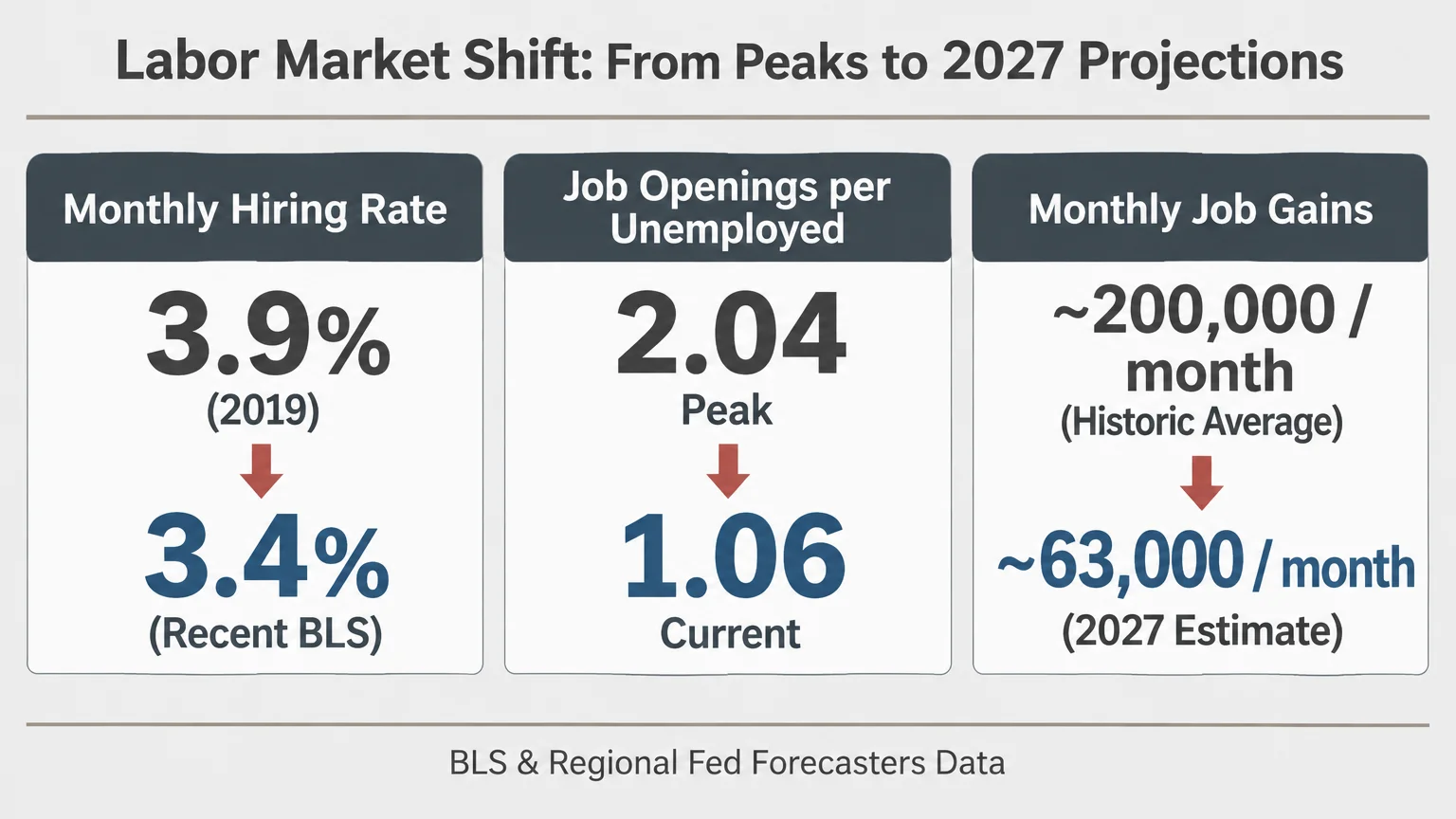
BLS JOLTS data cited by MASEconomics in November 2026 shows employers hired at just a 3.4% monthly rate in September, down from roughly 3.9% in 2019. Layoffs and discharges stayed low at 1.0%, creating a stagnant low-hire, low-fire cycle.
Meanwhile, job openings dropped to 1.06 per unemployed person, down from a March 2022 peak of 2.04 and below the 2019 average of 1.19. Another 4.8 million Americans worked part-time for economic reasons in October while labor force participation stayed at 61.9%.
For your personal finances, this dynamic creates a deceptive trap. Keeping your current job looks relatively safe, yet replacing a lost paycheck takes far more time and patience than it did a few years ago.
| Forecaster | Release Date | 2027 Unemployment Projection | Key Hiring Context |
|---|---|---|---|
| Federal Reserve (FOMC) | September 2026 | 4.1% median (4.0%–4.5% full range) | Central tendency sits at 4.0%–4.2% for 2027 |
| Philadelphia Fed Forecasters | November 2026 | 4.2%–4.3% through Q3 2027 | Cut 2027 job-gain estimate from 75,400 to ~63,000 per month |
| Congressional Budget Office | February 2026 | 4.5% in Q4 2027 | From the Budget and Economic Outlook: 2026 to 2036 |
Even if unemployment stays near 4.1% to 4.5%, monthly job creation is cooling. When employers add closer to 63,000 positions a month instead of double that pace, specific groups bear the brunt of the slowdown.
1. Long-Term Unemployed Workers and Workforce Re-Entrants
Once a job search passes the six-month mark, momentum often works against you. In October 2026, BLS Table A-12 data showed 27.6% of all unemployed Americans—roughly 2.0 million people—had been out of work for 27 weeks or longer.
That long-term share rose 4.0 percentage points from a year earlier and ranks higher than in 90% of months since 1948. While the median unemployment spell reached 11.9 weeks, the average wait stretched past 27.1 weeks—nearly seven months.
People returning after caregiving breaks or starting fresh face similar friction. First-time job seekers (778,000, up roughly 28% from October 2019) and workforce re-entrants (2.30 million, up roughly 35%) made up about 3.1 million of all unemployed workers in October 2026.
That timeline creates an immediate cash crunch because state benefits rarely last seven months. Regular state unemployment insurance pays up to 26 weeks in most states, while several states cap payouts at 12 to 20 weeks.
Only Massachusetts at 30 weeks and Montana at 28 weeks offer longer regular state coverage. Furthermore, the U.S. Department of Labor reported that no state had federal-state Extended Benefits triggered on as of late August 2026.
To prepare your budget, measure your burn rate against essential bills before benefits run out. BLS Consumer Expenditure Survey data from 2024 shows average U.S. household spending on housing, transportation, food, and healthcare reached $55,950 per year—about 54% of average pre-tax income.
Personal finance planners generally advise keeping three to six months of essential expenses in liquid savings. If your search nears week 12, take fast steps to preserve cash and restart momentum:
- Audit recurring bills immediately: Pause nonessential subscriptions, switch mobile or internet tiers, and call lenders about hardship forbearance before missing any payment.
- Pick up bridge income early: Part-time retail, seasonal work, or freelance projects extend your savings runway—just check how earned wages affect your state unemployment benefit calculation first.
- Frame career gaps around outcomes: List recent certifications, volunteer leadership, or contract projects prominently at the top of your resume so recruiters see active skills.
- Apply within 48 hours of posting: Early applicants get reviewed before hiring managers drown in automated submissions.

2. Older Workers Facing Subtle Age Bias and AI Screening
Workers age 50 and older often bring steady judgment and lower turnover, yet an older workers job search frequently drags on longer than peers expect. In October 2026, workers age 55 and older posted a low 2.8% unemployment rate, up slightly from 2.6% in September.
However, AARP analysis of October 2026 BLS numbers revealed a hidden warning beneath that low rate. Fully 32% of unemployed workers age 55 and older were long-term unemployed for 27 weeks or more, outpacing the 27.6% national share.
Survey data helps explain why experienced professionals struggle to get callbacks once displaced. In a 2026 AARP survey of 1,656 workers age 50 and older, 64% reported seeing or experiencing age discrimination at work, and 22% felt pushed out because of age.
Job hunting itself has grown tougher for older applicants. Roughly 37% reported subtle age bias during job searches in 2026, up from 30% in 2024.
Overall, 60% of workers age 50 and older encountered subtle bias fueled by unfair stereotypes. The top assumptions were that older employees are less tech-savvy (33%) and resistant to change (24%).
Automated hiring software adds another layer of risk before a human ever reads your resume. The federal Age Discrimination in Employment Act (ADEA) protects workers age 40 and older at employers with at least 20 staff members.
Ongoing 2026 litigation—specifically Mobley v. Workday, highlighted by AARP Foundation—puts new legal scrutiny on whether algorithmic screening tools filter out older applicants automatically. Still, waiting on a lawsuit will not pay your mortgage next month.
Protect both your career odds and your retirement nest egg with targeted adjustments:
- Focus your resume on the past 10 to 15 years: Drop graduation years and early-career roles that invite automated date filtering without adding current value.
- Prove modern tool fluency: Name the specific cloud suites, project dashboards, and AI workflows you use today so employers cannot assume you lag behind.
- Guard your retirement accounts: Tapping a 401(k) early triggers income taxes and potential penalties, while claiming Social Security early locks in permanently reduced monthly checks.
- Document suspicious patterns: Save job postings, rejection timestamps, and interview notes in case you need to consult the U.S. Equal Employment Opportunity Commission.
3. Routine Office, Administrative, and Support Staff
If your daily work centers on data entry, scheduling, basic record-keeping, or cashiering, long-term headwinds are accelerating. In its August 2026 Employment Projections for 2025 through 2035, the BLS forecast office and administrative support roles to post the steepest drop of any major job group.
That category alone is projected to shrink by 4.0%, wiping out 752,100 jobs over the decade. Automation, self-service software, and consolidated back-office operations steadily chip away at headcount.
Individual job titles face much sharper contractions over that 2025 to 2035 span. BLS projects steep losses for Data Entry Clerks (-25.5%), Telemarketers (-21.4%), Bank Tellers (-13.2%), Retail Cashiers (-6.5%), and Office Clerks (-6.0%).
Secretaries and Administrative Assistants face projected drops ranging from 2% to 6% depending on specialty. Meanwhile, physical consumer sectors are trimming staff right now—food companies announced 39,370 job cuts through October 2026, up 43% year-over-year per Challenger, Gray & Christmas.
Waiting until your department downsizes leaves you competing against thousands of peers for fewer open seats. Instead, use your current paycheck to fund an orderly pivot into adjacent work that resists full automation.
Employers still need people who manage exceptions, handle upset clients, coordinate compliance, or oversee vendor budgets. Look for internal lateral moves or employer-paid training credits while you still have income:
- Claim unused tuition benefits: Many mid-size and large companies reimburse $2,000 to $5,250 a year tax-free for approved coursework—use it for bookkeeping, operations, or project coordination certificates.
- Shift from processing to oversight: Volunteer to test new scheduling or billing software on your team so you become the person managing the tool rather than the clerk replaced by it.
- Track cross-departmental budgets: Moving toward payroll, procurement, healthcare billing, or facilities coordination uses your existing organizational skills in steadier niches.
4. Tech Workers and Programmers Hit by Restructuring
A tech resume no longer guarantees quick offers or generous exit packages. According to Challenger, Gray & Christmas data from November 2026, total announced U.S. job cuts fell 44% year-over-year to 617,189 through October—yet technology led every industry with 171,501 cuts, up 21%.
Artificial intelligence is playing a growing role in those restructuring decisions. Employers cited AI in 121,401 announced cuts through October 2026—roughly 19.7% of all layoffs and 2.2 times the 54,836 AI-cited cuts recorded in all of 2025.
Long-range BLS projections for 2025 through 2035 reinforce the shift away from routine coding and basic infrastructure maintenance. Computer Programmers face a projected 7.3% decline, followed by Network and Computer Systems Administrators (-4%) and Computer Support Specialists (-3%).
Executive surveys point to continued tightening in 2027 alongside slimmer safety nets. A November 2026 LHH survey of 600 U.S. leaders found 66% of HR leaders and 80% of CEOs expect workforce reductions over the next 12 months.
Even worse for household cash flow, 38% of surveyed employers have cut severance packages, up sharply from just 9% in 2024. Relying on a fat severance check to bridge a six-month search is no longer realistic.
There is an important financial bright spot for workers willing to adapt. Job postings requiring AI skills carry an estimated 28% wage premium—roughly $18,000 per year—according to Lightcast, and up to 62% in PwC 2026 research.
Furthermore, Gartner predicted in October 2026 that 30% of AI-driven layoffs will require rehiring by 2029. Position yourself for higher-value work while tightening your household fixed costs:
- Right-size lifestyle creep now: High tech salaries often hide steep auto payments or housing costs; trimming fixed bills cuts the emergency reserve you need if a layoff hits.
- Add applied AI and security depth: Pair legacy coding or IT support skills with AI integration, model governance, data privacy, or cloud cost auditing.
- Negotiate severance terms carefully: Ask about extended COBRA health subsidies, prorated bonuses, or outplacement stipends—these items sometimes move even when cash weeks are capped.
5. Recent Graduates Without Demonstrated Practical Skills
Leaving school with a fresh diploma in 2027 could feel disorienting if you lack internships or tangible project proof. In October 2026, BLS Table A-10 showed elevated unemployment of 13.9% for ages 16 to 19 and 7.5% for ages 20 to 24.
College degrees help, yet they do not eliminate early-career friction. Federal Reserve Bank of New York data for Q3 2026 placed recent college graduate unemployment at 5.2%, while underemployment—working jobs not typically requiring a degree—ticked up to 42.5%.
Early-career workers also face disproportionate pressure from automation in entry-level tasks. Research from the Stanford Digital Economy Lab in 2026 found employment for ages 22 to 25 in the most AI-exposed occupations measured 19% below peers.
Hiring plans for the Class of 2027 remain selective despite slightly better headline numbers. Only 43% of Class of 2026 seniors held at least one job offer before graduation according to NACE.
For the Class of 2027, NACE Job Outlook 2027 data projects a 14% median hiring increase and 4.2% higher starting pay. Still, 56% of surveyed employers plan to keep entry-level hiring flat and 10% plan cuts.
The biggest trap is misunderstanding how companies screen junior talent today. Roughly 70% of employers use skills-based hiring for entry-level roles—valuing proven output over GPA or school name—yet fewer than 40% of graduating seniors know the term.
Encourageingly, only 1% of employers in NACE November 2026 polling are considering replacing entry-level hires with AI, down from 11% the year prior. Instead, 79% rank knowing when AI should and shouldn’t be used as the top competency in new graduates.
Keep your budget lean as you build proof of work:
- Build a public proof portfolio: Publish three concise work samples—code repositories, financial models, marketing audits, or lab summaries—and explain what you verified by hand rather than blindly generating.
- Keep post-grad housing flexible: Living with family or roommates during your first year out prevents locking into an expensive lease while waiting for a career-track offer.
- Map student loan grace periods: Know when interest accrues and check income-driven repayment options before signing up for high fixed monthly payments.

6. Job Seekers Holding Out for Fully Remote Roles
Insisting on a 100% remote job in 2027 narrows your search to a tiny, overcrowded slice of the market. According to Robert Half data from November 2026, fully in-office job postings surged from 65% in Q4 2025 to 85% in Q3 2026.
A closer look at Q2 2026 listings revealed 87% were onsite, 10% were hybrid, and just 3% were fully remote. At the same time, 36% of employers increased mandatory on-site days over the prior 12 months.
Worker preferences have moved in the opposite direction, creating a brutal supply-demand mismatch. Roughly 39% of active or planned job seekers in the second half of 2026 cited more remote flexibility as a top motivator.
Competition on remaining remote listings has exploded as supply dries up. Jobgether reported in October 2026 that new remote postings fell 15.8% per day in September, while location-flexible roles dropped to 4.0% of remote listings and drew 8.8 times the average applications.
Experience barriers squeeze applicants even harder. FlexJobs reported in October 2026 that nearly two-thirds of all remote postings in Q3 2026 required experienced-level candidates.
Holding out exclusively for remote work can drain months of savings over a preference that hybrid pay might easily offset. Do the math on total compensation rather than rejecting onsite or hybrid roles automatically:
- Calculate true commuting costs: Compare gas, transit passes, parking, and extra childcare against what each month of continued unemployment costs your savings.
- Target hybrid roles first: A three-day onsite schedule gives you dramatically less applicant competition while still cutting commuting expenses by 40% compared with five days in an office.
- Earn remote leverage later: Once hired locally, strong six-month performance reviews give you real bargaining power to request an extra remote day.
Comparing the 6 High-Risk Groups at a Glance
Every group above faces a distinct mix of employer bias, structural shifts, or sheer applicant volume. Use this summary table to match your situation with the highest-impact defensive move for your wallet.
| Job Seeker Group | Key 2026–2027 Data Signal | Biggest Budget Risk | Best First Defensive Step |
|---|---|---|---|
| Long-Term Unemployed & Re-Entrants | 27.6% jobless 27+ weeks; mean duration >27.1 weeks | Exhausting 12–26 week state UI with no Extended Benefits | Cut fixed monthly bills early and take bridge income |
| Older Workers (50–55+) | 32% of unemployed 55+ are long-term; 37% report search bias | Early retirement withdrawals or discounted Social Security | Trim old resume dates and showcase current software fluency |
| Routine Office & Support Staff | Office/admin jobs projected down 4.0% (-752,100) by 2035 | Permanent pay drop if forced into lower-wage work | Use employer tuition stipends to pivot into oversight roles |
| Tech Workers in Restructuring | 171,501 tech cuts through Oct 2026; 38% cut severance | High fixed living costs outlasting slimmer exit payouts | Slash lifestyle creep and add AI governance or cloud skills |
| Recent Grads Without Proven Skills | 42.5% underemployment; 70% of firms use skills-based hiring | Student loan payments starting before career-track pay | Build verifiable work samples and keep housing costs low |
| Remote-Only Job Seekers | 85% of Q3 2026 postings onsite; 8.8x competition on flexible roles | Burning savings waiting on the rarest 3%–4% of listings | Price out hybrid schedules against extra months unemployed |
Common Mistakes to Avoid in a Slow Hiring Market
Even sharp job seekers make costly financial mistakes when panic sets in during a long search. Avoiding a few predictable traps protects years of hard-won savings.
- Waiting until unemployment checks stop to cut spending: Most state programs cover only a fraction of prior pay and cap at 26 weeks or less, so slash discretionary bills during week one rather than month five.
- Draining retirement accounts prematurely: Pulling money out of a traditional 401(k) or IRA adds taxable income in the year you withdraw and may trigger early-withdrawal penalties, shrinking future compounding permanently.
- Ignoring health insurance deadlines: Missing COBRA election windows or Affordable Care Act special enrollment periods can leave your household exposed to catastrophic medical bills during a transition.
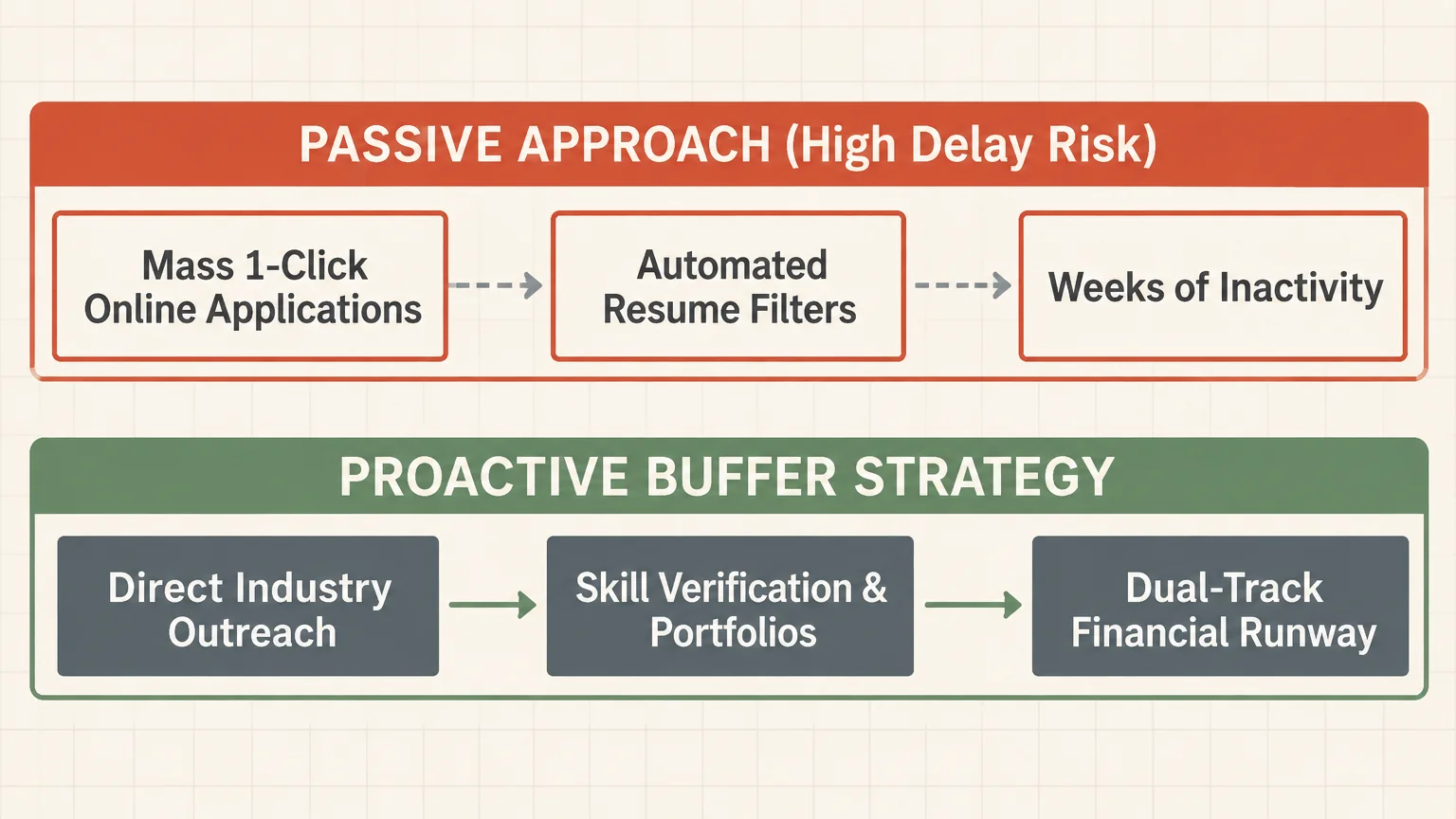
- Relying only on one-click job boards: Sending hundreds of identical applications feeds automated rejection filters; direct referrals, local networking, and tailored proof of work convert at far higher rates.
- Skipping contract or hybrid offers out of pride: A temporary bridge paycheck slows savings burn and keeps your resume current while you continue interviewing for your ideal full-time seat.
Getting Expert Input
General budgeting rules help you prepare, yet certain layoffs and career transitions involve complex tax, legal, and retirement tradeoffs. Consulting a qualified professional can easily save more than the fee.
- Reviewing a severance package or tax hit: A Certified Public Accountant (CPA) or fee-only Certified Financial Planner (CFP) can help you time lump-sum payouts, manage tax withholding, and decide whether COBRA or marketplace coverage fits your household.
- Suspecting age discrimination or unfair release terms: An employment attorney can review severance waivers—especially releases under the ADEA—before you sign away legal rights on a tight deadline.
- Reshaping a stalled mid-career resume: A certified career coach familiar with your industry can translate outdated titles into skills-based accomplishments that pass modern applicant tracking systems.
- Managing debt or mortgage strain during long unemployment: A nonprofit HUD-approved housing counselor or accredited credit counselor—found through resources at the Consumer Financial Protection Bureau—can walk through formal hardship plans before late marks hit your credit report.
Frequently Asked Questions
Will it really be hard to get a job in 2027 if unemployment stays around 4.1% to 4.5%?
Yes, because low unemployment in a low-hire, low-fire economy mostly reflects fewer layoffs rather than brisk hiring. When monthly job growth cools toward 63,000 positions, open seats take longer to land once you are out of work.
How much cash should I keep in an emergency fund for the 2027 job market?
Aim for three to six months of essential expenses such as housing, food, utilities, transportation, and healthcare. If you work in tech, administrative support, or seek fully remote roles, leaning toward six months provides stronger protection.
What happens if my state unemployment insurance runs out before I find work?
Once regular state weeks end—typically 12 to 26 weeks depending on your state—payouts stop unless federal-state Extended Benefits trigger on during severe recessions. You will need cash savings, household budget cuts, or bridge income to cover bills.
Is it better to accept a hybrid or lower-paying role while keeping my search alive?
Often yes, especially if your emergency fund is shrinking or state benefits are nearing expiration. Earning a steady bridge paycheck preserves retirement savings, avoids high-interest credit card debt, and strengthens your leverage while you interview selectively.

Moving Forward With a Clear Plan
A slower hiring market in 2027 rewards preparation far more than panic. Whether you are protecting an established career, refreshing older skills, or launching right out of school, strengthening your cash buffer and adapting how you prove your value puts control back in your hands.
The information here is meant for educational purposes. Specific circumstances—including health conditions, finances, location, and goals—may require different approaches. When in doubt, consult a licensed professional or check official sources directly.
Last updated: November 2026. Rules, prices, and details change—verify current information with official sources before acting on it.









Leave a Reply