When you compare median household incomes across the country, a nearly $55,000 gap separates the wealthiest Americans from those living in the poorest US states. Based on the latest US Census Bureau data, the national median household income sits at roughly $83,730, but several states fall more than $20,000 short of that mark. If you are considering relocating for a lower cost of living or just trying to understand broader economic trends, knowing where these financial disparities exist helps you make more informed decisions. The states ranking lowest for income often feature drastically cheaper housing and everyday expenses, but they also face distinct challenges regarding poverty rates, infrastructure, and local job markets.
At a Glance: How Income and Poverty Are Measured
Before diving into the state-by-state breakdown, it helps to understand exactly how economists and government agencies measure wealth and poverty. The most common metric used to determine the financial health of a state is the median household income. This number represents the exact midpoint of all households in a specific region; half of the households earn more than this amount, and half earn less. Because it avoids being heavily skewed by a small number of billionaires at the very top, the median household income provides a highly accurate picture of what a typical family actually brings home in a year.
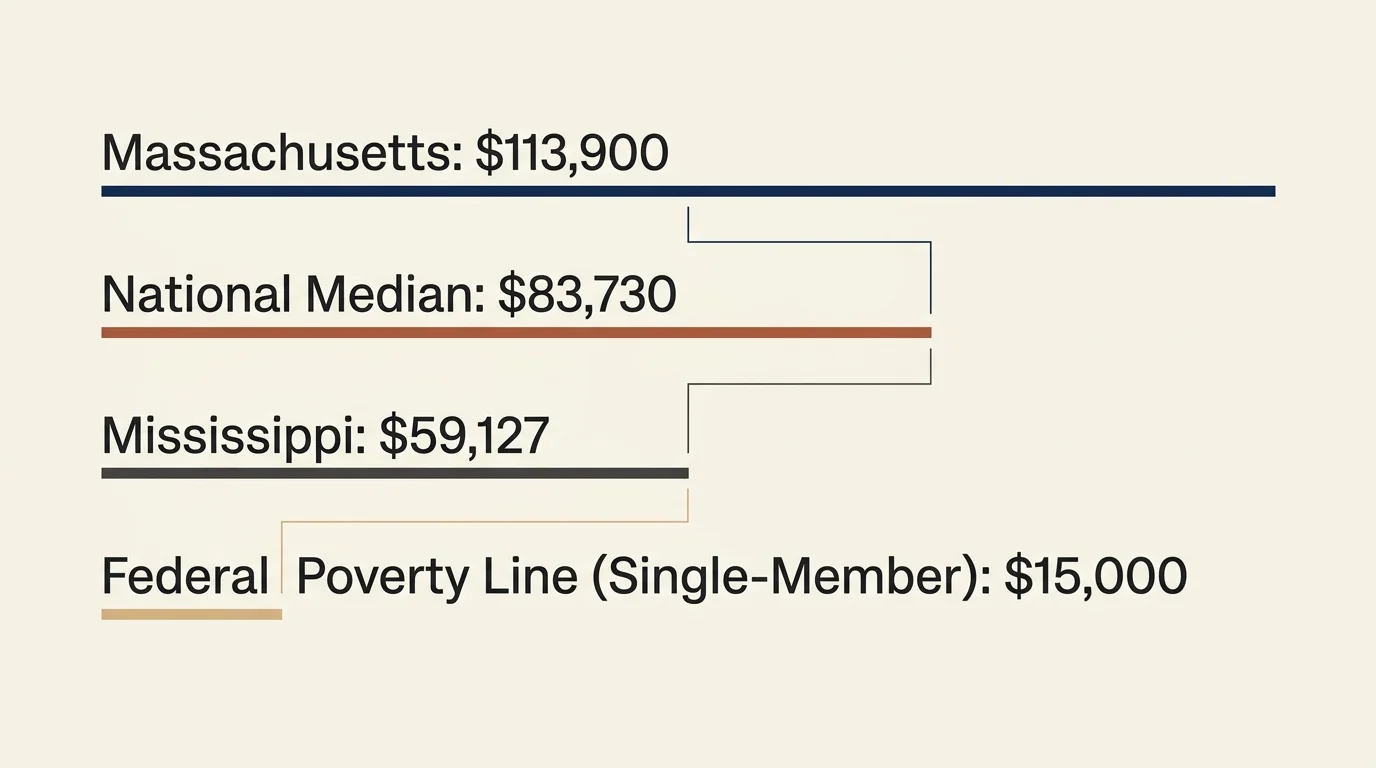
In addition to median income, states are frequently evaluated by their poverty rate. The federal poverty threshold is calculated annually to reflect the absolute minimum income required to cover basic life necessities like food, clothing, and shelter. Currently, the federal poverty guideline for a single-member household sits around $15,000 a year, scaling upward for each additional family member. When a state has a low median income, it almost always carries a higher percentage of residents living below this federal poverty line.
The US Census Bureau tracks these figures meticulously through the American Community Survey (ACS) and the Current Population Survey (CPS). The data reveals sharp regional divides, with Northeastern and West Coast states generally reporting the highest incomes, while Southern and Appalachian states frequently report the lowest. To put this in perspective, Massachusetts currently boasts a median household income of roughly $113,900, while the poorest state in the nation sits closer to $59,000.
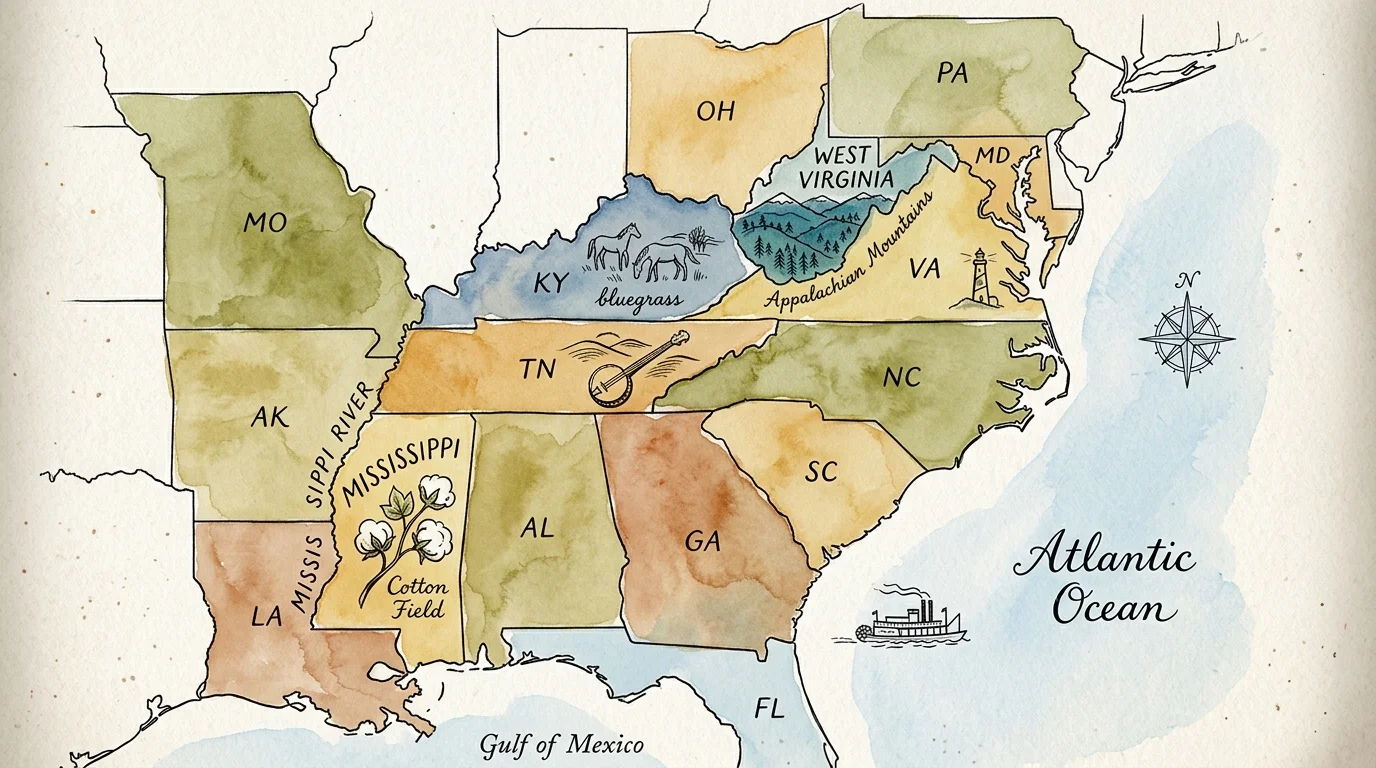
The 5 Poorest States in the US
Based on the latest Census Bureau median household income data and statewide poverty rates, the following five states rank at the bottom of the national economic ladder. While these areas face structural economic challenges, they also offer some of the most affordable living conditions in the entire country.
1. Mississippi
Mississippi consistently ranks as the poorest state in the nation. With a median household income hovering around $59,127, the typical household here earns significantly less than the national average. Consequently, the state struggles with a high poverty rate; roughly 18 percent of Mississippi residents live below the federal poverty line.
The state’s economy is heavily anchored in agriculture, with over one-third of its land dedicated to farming. While agriculture, manufacturing, and fishing provide a steady baseline of employment, these industries generally do not support the rapid wage growth seen in the technology or financial sectors of wealthier states. This lack of economic diversification makes the local job market particularly vulnerable to severe weather events and broader economic downturns. However, the tradeoff for residents is an extraordinarily low cost of living. Housing, groceries, and utilities in Mississippi cost a fraction of what they do in the national metro areas.
2. West Virginia
West Virginia follows closely behind Mississippi, reporting a median household income of approximately $57,900 to $58,000, depending on the specific Census survey metric used. The state has an enduring legacy tied to coal mining and heavy manufacturing. As the national energy sector has aggressively shifted away from coal over the past few decades, West Virginia has faced immense difficulty transitioning its workforce into new, high-paying industries.
Beyond the shift in the energy sector, West Virginia grapples with demographic challenges. The state has an aging population, and a significant portion of its younger, educated workforce often leaves for neighboring states in search of better career opportunities—a phenomenon economists refer to as “brain drain.” Despite these hurdles, West Virginia boasts strong community networks, stunning natural landscapes, and housing prices that make homeownership highly accessible for workers earning the median wage.
3. Louisiana
Louisiana is a state of stark economic contrasts. While cities like New Orleans drive significant tourism revenue and the state holds massive oil and natural gas infrastructure, the median household income remains heavily depressed, frequently landing between $52,000 and $58,000 in recent federal estimates. Around 18 percent of Louisiana’s population lives in poverty.
The state’s reliance on the energy sector means that global fluctuations in oil prices have an immediate, outsized impact on local employment and state tax revenues. Furthermore, Louisiana’s geographic location leaves it highly exposed to devastating hurricanes. Rebuilding infrastructure and homes after severe storms places a recurring financial burden on both the state government and individual households. Insurance premiums for homeowners and drivers in Louisiana are among the highest in the nation, which actively eats into the disposable income of its residents.
4. Arkansas
Arkansas reports a median household income of roughly $58,700, placing it firmly in the bottom tier of US states. Much like Mississippi, Arkansas has a heavily rural population and an economy deeply rooted in agriculture and traditional manufacturing. While the state is famously home to the corporate headquarters of retail giant Walmart, the broader statewide economy struggles to generate high-wage professional jobs outside of its specific corporate hubs.
Educational attainment plays a massive role in the state’s economic standing. A lower percentage of Arkansas residents hold bachelor’s or advanced degrees compared to the national average, which limits the state’s ability to attract lucrative technology and biomedical companies. That said, Arkansas offers immense financial relief when it comes to daily expenses, featuring some of the cheapest real estate and lowest property tax rates in the entire country.
5. New Mexico
New Mexico stands out on this list because its economy differs significantly from the agricultural and manufacturing bases of the South and Appalachia. With a median household income floating between $54,000 and $62,000 depending on the survey year, New Mexico pairs high poverty rates with a heavy reliance on federal government spending. The state is home to major military bases and national research laboratories, which provide high-paying scientific and defense jobs.
The core issue in New Mexico is the sharp divide between its specialized government workforce and the broader civilian population. Outside of these federal hubs, the state is vastly rural, and many communities lack access to robust private-sector employment. Additionally, rural parts of New Mexico face ongoing struggles with infrastructure development, water scarcity, and access to advanced healthcare facilities.
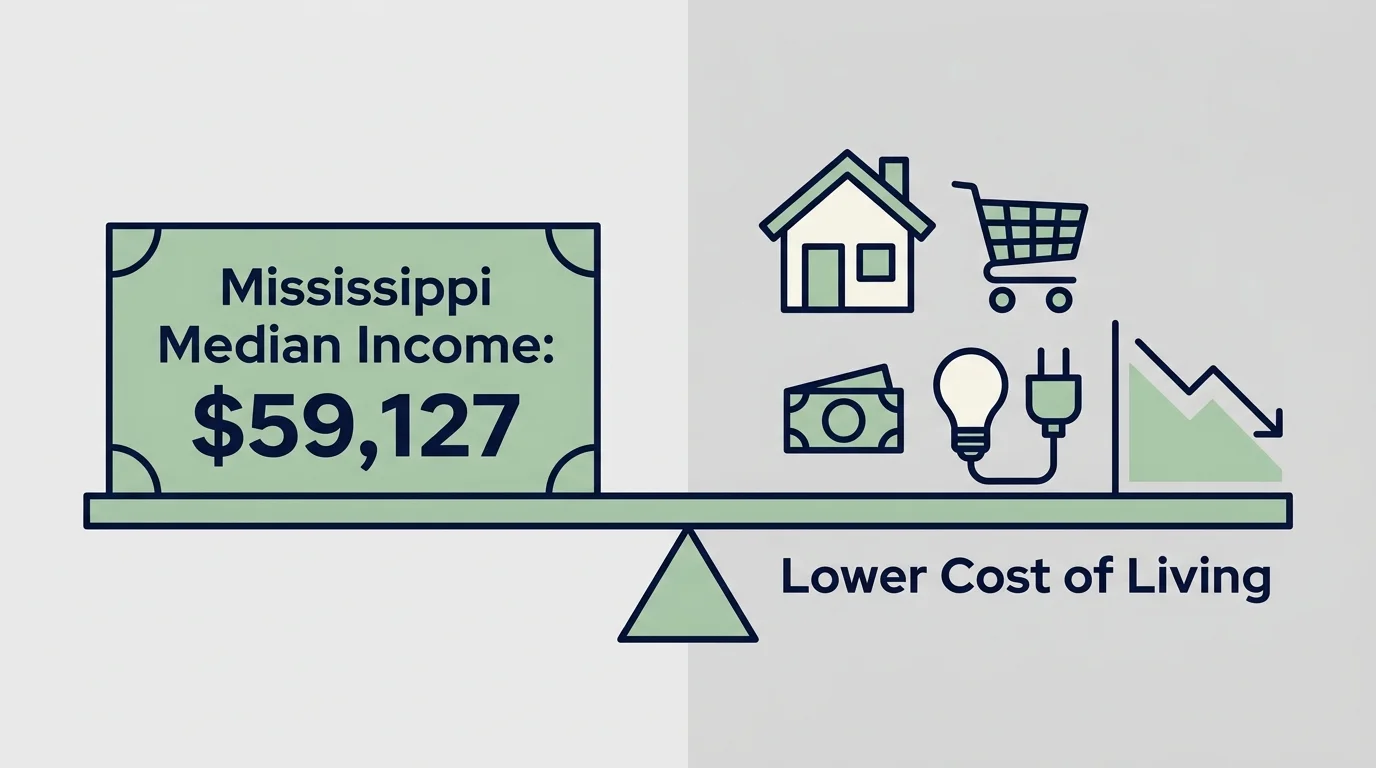
The Bigger Picture: Cost of Living vs. Income
Looking strictly at income only tells half the story. To understand what a household’s finances actually look like on a day-to-day basis, you must weigh income against the local cost of living. The Bureau of Economic Analysis calculates Regional Price Parities (RPPs), which measure how much goods and services cost in each state compared to the national average.
When you apply this lens, the math changes significantly. For example, Arkansas and Mississippi consistently record the lowest Regional Price Parities in the nation, hovering around 87.0. This means that everyday expenses—rent, groceries, utilities, and healthcare—cost roughly 13 percent less than the national average. By contrast, states with massive median incomes like California and Hawaii have RPPs exceeding 110, meaning everything is substantially more expensive.
While a lower median income indicates regional economic challenges, it frequently goes hand-in-hand with drastically reduced housing and daily living costs, completely changing the math for retirees and remote workers.
If you work remotely and retain a salary pegged to a national or coastal standard, moving to a state like West Virginia or Arkansas effectively acts as a massive raise. Your housing costs will plummet, leaving a much larger percentage of your income available for investing, saving for retirement, or discretionary spending. However, if you are relying on the local job market, your lower living expenses will likely be entirely offset by a correspondingly lower salary.
| State | Median Household Income (Approx.) | Estimated Poverty Rate | Cost of Living (National = 100) |
|---|---|---|---|
| Mississippi | $59,127 | 18% | 87.0 |
| West Virginia | $57,917 | 17% | 88.3 |
| Louisiana | $58,229 | 18% | 89.0 |
| Arkansas | $58,773 | 16% | 86.9 |
| New Mexico | $62,468 | 17% | 90.0 |

Worth Keeping in Mind
If you are looking at the poorest states as potential relocation targets to stretch your budget, there are several hidden financial and lifestyle factors you must weigh before calling a moving company.
- Property Taxes vs. Income Taxes: A low cost of living does not always mean a low tax burden. Some states compensate for a lack of income tax by levying high sales taxes or property taxes. Conversely, states like Mississippi and Arkansas do charge state income tax, which you must factor into your monthly budget.
- Salary Adjustments for Remote Workers: If you plan to bring your high-paying remote job to a state with a low cost of living, verify your employer’s compensation policies first. Many large companies adjust salaries based on the employee’s physical zip code; moving to Louisiana could trigger a downward adjustment in your pay.
- Healthcare Access and Quality: States with lower median incomes frequently struggle with medical provider shortages, particularly in rural counties. If you have a chronic medical condition that requires access to specialized care, you must ensure that top-tier facilities are within a reasonable driving distance before relocating.
- Insurance Premiums: Housing might be cheap, but home insurance might not be. States vulnerable to specific natural disasters—such as hurricanes in Louisiana or tornadoes in Arkansas—often saddle homeowners with exorbitant insurance premiums that can quietly ruin an otherwise affordable mortgage payment.

When to Get Professional Help
Navigating significant financial moves, especially those involving relocating across state lines to optimize your budget, rarely goes smoothly without expert guidance. Consider securing professional help in these specific scenarios:
- Moving Across State Lines: Hire a certified tax professional or CPA. Establishing residency in a new state while maintaining ties or business interests in your old one can create complex dual-state tax liabilities. A professional ensures you do not inadvertently owe income tax to two different states in the same year.
- Adjusting Your Retirement Strategy: Consult a fiduciary financial planner if you are retiring to a lower-income state to stretch your savings. Because your local cost of living will drop, your planner can help you safely lower your portfolio withdrawal rate, potentially adding years of longevity to your retirement funds.
- Buying Out-of-State Property: Work with a heavily vetted, locally based real estate agent and a rigorous home inspector. Lower-income areas can sometimes feature aging local infrastructure, varying municipal zoning laws, or specific environmental hazards (like flood zones) that an out-of-state buyer would not naturally recognize.
Frequently Asked Questions
What is the national median household income in the US?
According to recent US Census Bureau data, the national median household income is approximately $83,730. This figure serves as the baseline for comparing the economic health of individual states.
Why is housing so much cheaper in poorer states?
Housing costs are largely driven by local demand, land availability, and local wage rates. In states with lower median incomes and slower population growth, there is less intense competition for housing. Additionally, the cost of labor to build homes is cheaper, keeping overall property values highly affordable compared to dense coastal cities.
Does a low median income guarantee a poor quality of life?
Not necessarily. Quality of life is highly subjective and depends on your personal financial situation. If you have a stable, adequate income, living in a statistically poorer state can actually elevate your standard of living because your housing, grocery, and entertainment dollars go much further. However, residents relying on the local economy may face challenges with infrastructure and upward career mobility.
Are wages keeping up with inflation in these states?
Nationally, wages have seen sharp increases, but inflation has historically outpaced real income growth for many middle- and lower-income families. In the poorest states, wage growth tends to be slower, meaning residents feel the squeeze of rising grocery and utility prices more acutely than those in high-income regions.
Last updated: July 2026. This is general informational content based on widely accepted guidance. Individual results vary. Verify current details—rules, prices, eligibility, regulations—with official sources before making important decisions.