
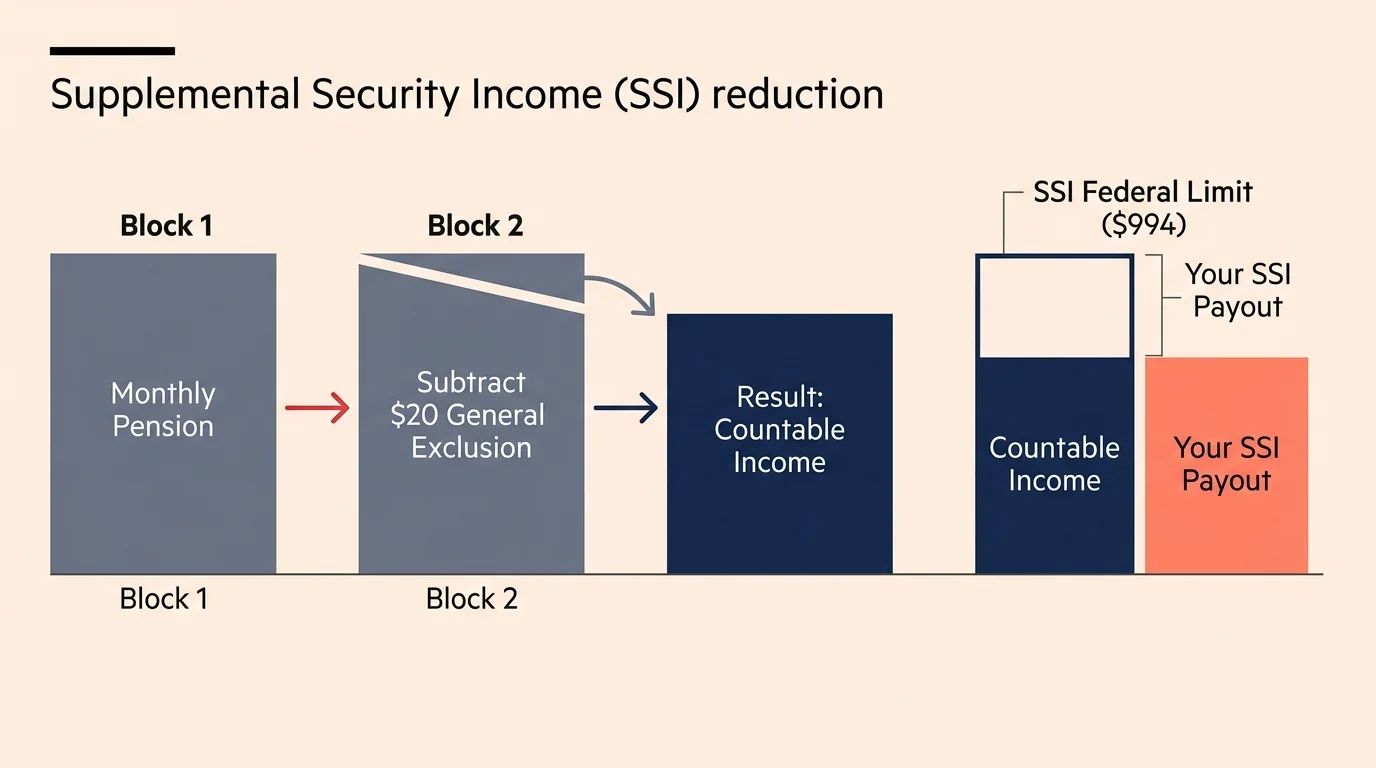
How Your Pension Affects Your SSI Calculation
To understand exactly how much money you will take home, you have to look at how the SSA categorizes your pension. SSI rules divide all income into two categories: earned and unearned. Earned income comes from wages or self-employment. Unearned income includes almost everything else, such as unemployment benefits, cash gifts, and pensions.
The SSA applies a strict offset to unearned income. First, they apply a $20 general income exclusion. This means they ignore the first $20 of your pension. After that, every single dollar you receive from your pension reduces your SSI payment by exactly one dollar.
For 2026, the maximum Federal Benefit Rate for an individual on SSI is $994 a month. If you are married and both spouses qualify, the couple’s rate is $1,491. Let us look at exactly how a pension alters your final deposit amount using the 2026 individual rate.
| Income Source | Scenario A: No Pension | Scenario B: $600 Pension | Scenario C: $800 Pension |
|---|---|---|---|
| Gross Pension Amount | $0 | $600 | $800 |
| Minus $20 Exclusion | $0 | -$20 | -$20 |
| Countable Income | $0 | $580 | $780 |
| 2026 Maximum SSI Base | $994 | $994 | $994 |
| Minus Countable Income | $0 | -$580 | -$780 |
| Final SSI Payment | $994 | $414 | $214 |
| Total Monthly Income (Pension + SSI) | $994 | $1,014 | $1,014 |
As you can see in the table, having a pension leaves you with a slightly higher total monthly income than someone who relies on SSI alone, thanks entirely to the $20 general income exclusion. You get to keep exactly $20 more each month than the base SSI rate. The rest is perfectly balanced out by the SSI reduction.
The Payment Schedule: When Does the Money Arrive?
Even though the SSA calculates your pension and your SSI as a single financial equation, the money usually hits your bank account in two separate transactions. This is a common source of confusion for new retirees who expect a single, unified deposit.
If you receive concurrent benefits—meaning you get both Social Security retirement (or SSDI) and SSI—the government staggers your payment dates.
- SSI is paid on the 1st of the month. Because it is a needs-based program designed to help you pay rent and buy groceries, the SSA prioritizes getting this money to you on the very first day of the month.
- Social Security is paid on the 3rd of the month. If you receive both benefits, your earned Social Security benefit defaults to the third day of the month, bypassing the standard Wednesday-based payment schedule used for standard retirees.
There is a notable exception to this rule. If the 1st or the 3rd falls on a weekend or a federal holiday, the SSA moves your payment forward to the nearest preceding business day. For example, if the 1st falls on a Sunday, your SSI check will arrive on Friday, the 29th or 30th of the previous month. This quirk can occasionally result in receiving two SSI payments in one calendar month and zero payments in the following month, requiring careful budgeting.
Furthermore, federal law now mandates electronic payments. You must elect to receive your funds via direct deposit into a traditional bank account or onto a government-issued Direct Express debit card. Paper checks have been aggressively phased out, minimizing the risk of mail theft and processing delays.







Good to receive assistance to receive from SSI $900.00
Good to receive assistance to receive from SSI $900.00 every month