

Most budgeting errors do not look like reckless splurges; they hide inside routine financial habits you rarely question. Spotting these silent cash drains lets you keep hundreds or thousands of dollars a year without cutting what you enjoy.
Common money mistakes often grow out of outdated assumptions about bank rates, credit rules, and workplace benefits. Even small blind spots compound quickly when borrowing costs stay high and everyday prices keep climbing.
Below are eight overlooked personal finance mistakes backed by current data. Each section breaks down what the habit costs you and the exact steps to fix it.
1. Leaving Cash in a Low-Interest Savings Account
Parking your emergency fund or short-term cash in a traditional brick-and-mortar savings account feels safe, yet it quietly erodes your purchasing power. You still see the same dollar balance, while inflation shrinks what those dollars actually buy.
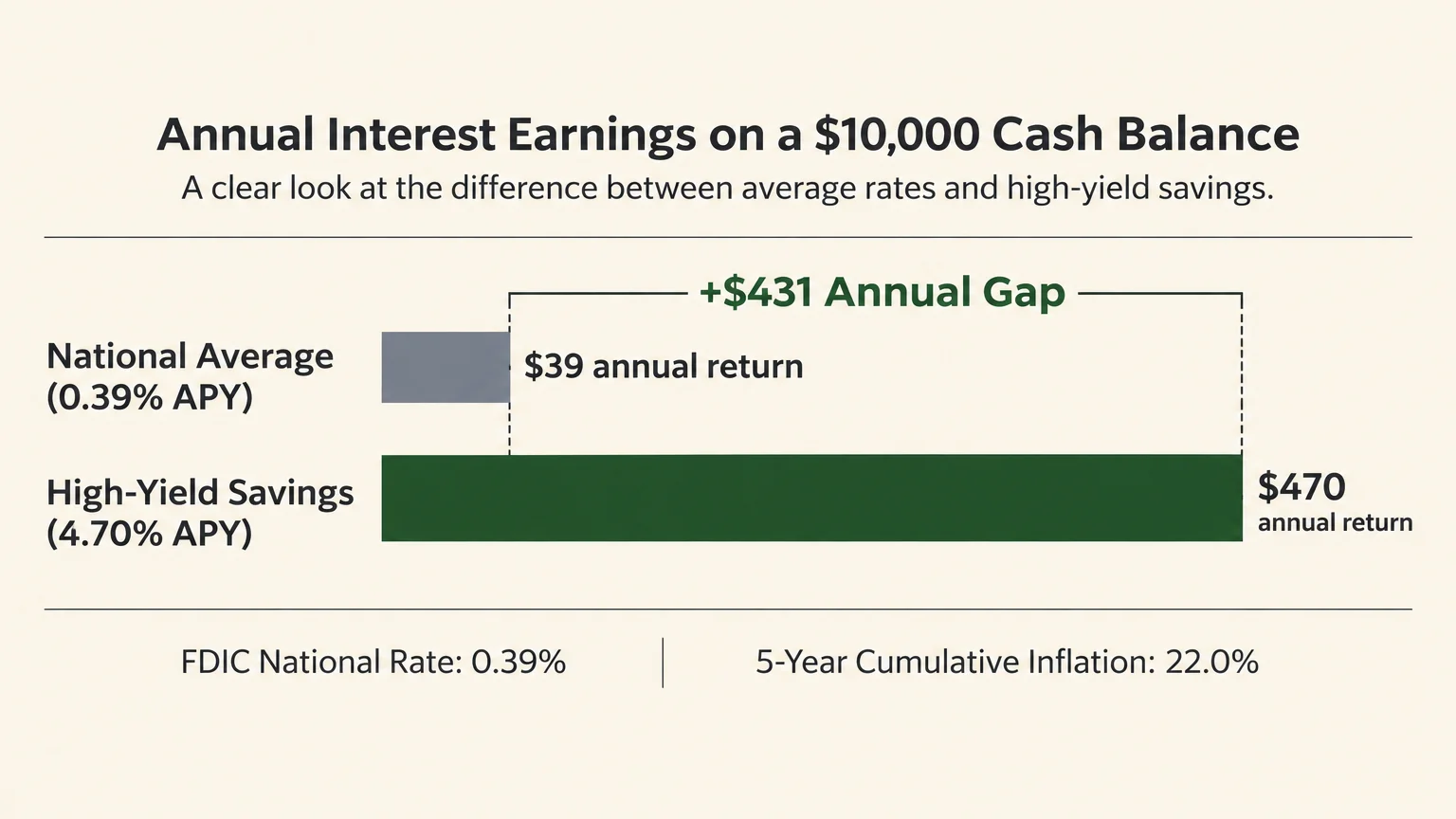
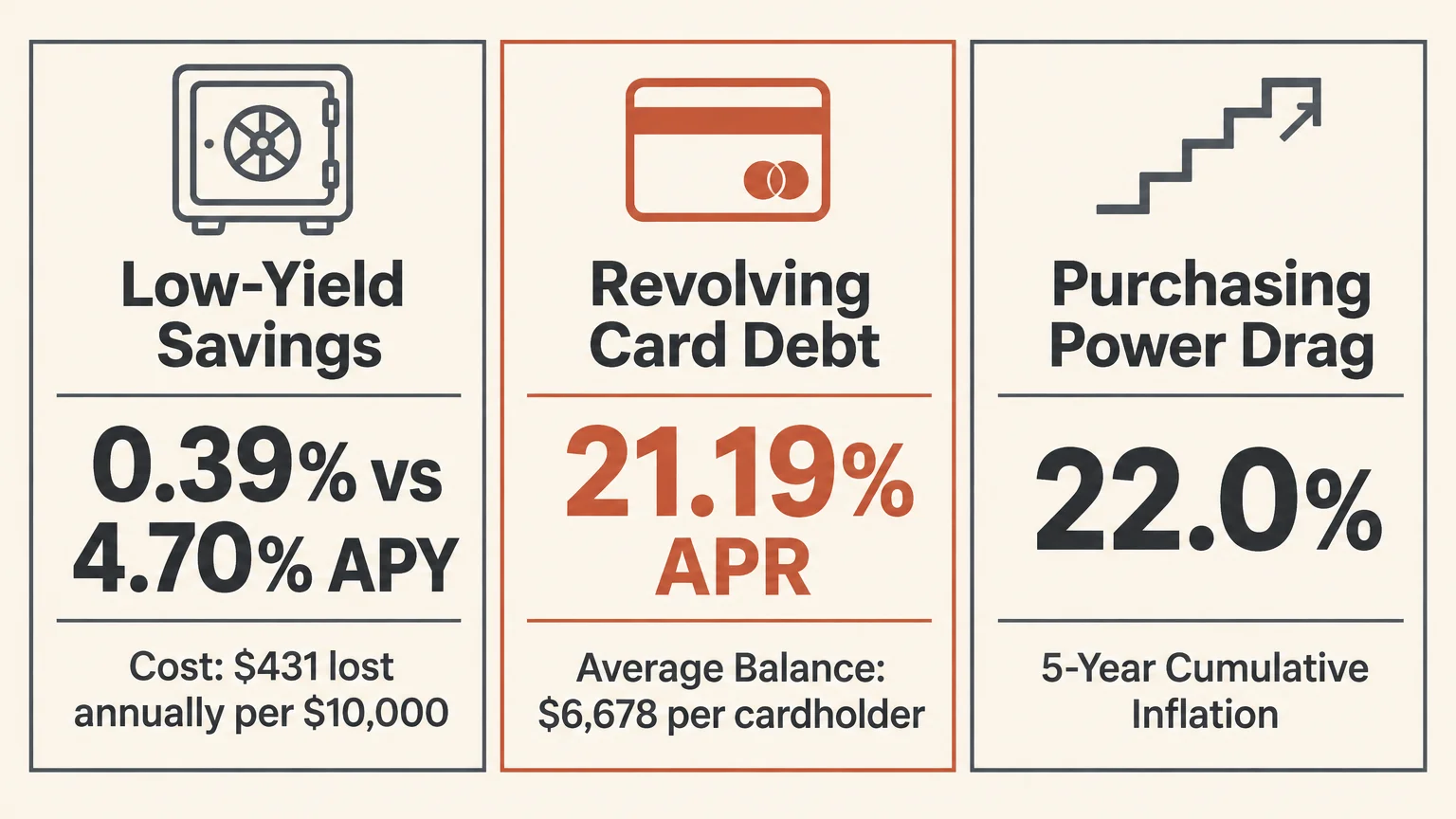
As of November 16, 2026, the U.S. national average savings account rate sits at just 0.39% APY according to the Federal Deposit Insurance Corporation (FDIC). Meanwhile, top high-yield savings accounts offer up to 4.70% APY as of November 24, 2026, per Fortune, with promotional offers reaching 5.00% APY for six months with linked checking per NerdWallet.
That rate gap costs real money every single month. On a $10,000 balance, earning 0.39% APY brings in roughly $39 a year, whereas earning 4.70% APY generates about $470 before taxes.
Inflation widens that divide even further. According to the U.S. Bureau of Labor Statistics, the Consumer Price Index rose 0.4% in October 2026 after climbing 0.6% in September, pushing cumulative five-year inflation to 22.0%.
Separate figures from the U.S. Bureau of Economic Analysis show the PCE price index climbed 3.6% year-over-year in September 2026, or 3.1% excluding food and energy. Cash earning under half a percent loses ground every day prices rise faster than your interest rate.
Switching accounts takes less than twenty minutes and requires zero change to your daily spending. Follow these saving money tips to put idle cash to work safely:
- Verify federal deposit insurance: Confirm the online bank carries FDIC coverage—or NCUA coverage for a credit union—up to standard legal limits.
- Skip accounts with monthly hurdles: Look for high-yield accounts with no monthly maintenance fees and no strict minimum balance penalties.
- Keep checking separate if needed: Link your new high-yield savings account to your existing checking account so transfers settle within one to three business days.
- Review rates twice a year: Savings yields shift when broader interest rates move, so check your APY every six months to ensure it stays competitive.
2. Carrying Credit Card Debt and Paying Only the Minimum
Making the minimum payment on time protects your credit history from late marks, which tricks many cardholders into thinking their debt is under control. In reality, minimum formulas are built to keep you paying interest for years.
Total U.S. credit card balances hit a record $1.285 trillion at the end of the third quarter of 2026, per the Federal Reserve Bank of New York. That milestone pushed total American household debt to $19.1 trillion.
At the individual level, average credit card debt per American stood at $6,678 in November 2026 according to TransUnion. Meanwhile, Federal Reserve and LendingTree data show average card APRs at 21.19% overall, 22.36% on interest-bearing accounts, and 24.00% on new card offers.
Those rates punish anyone who revolves a balance, and 45% of adult cardholders carried debt at least once over the past year per the Federal Reserve. Issuers frequently calculate minimum payments at roughly 1% of your balance plus new interest and fees.
Because credit card interest compounds daily, tiny minimum payments barely dent what you owe. Paying $150 per month on a $6,678 balance at 22.36% APR takes 98 billing cycles and costs nearly $8,000 in interest, according to Washington Post and Forbes calculations.
Breaking out of the minimum-payment loop requires a deliberate payoff plan rather than extra willpower. Use these steps to cut interest charges fast:
- Stop adding new charges: Switch daily purchases to cash or a debit card while paying down existing balances so new purchases do not accrue immediate interest.
- Pick avalanche or snowball: Direct every extra dollar toward the card with the highest APR first to save the most money, or clear the smallest balance first for quick momentum.
- Call your card issuer: Ask the retention department for a lower APR or a temporary hardship rate, especially if you have a clean payment record.
- Evaluate a balance transfer carefully: Moving debt to a 0% introductory APR card can pause interest, provided you factor in the upfront transfer fee and pay off the balance before the promo window ends.

3. Underfunding Your Emergency Cash Buffer
Treating an emergency fund as optional works fine until a blown transmission, medical copay, or sudden layoff arrives. Without dedicated cash on hand, one unexpected bill instantly turns into high-interest credit card debt.
Financial planners generally recommend holding three to six months of essential living expenses in accessible savings. Yet most households remain far below even a modest starter cushion.
According to Bankrate’s 2026 Annual Emergency Savings Report, only 30% of U.S. adults say they would cover an unexpected $1,000 expense from savings. Another 17% would pull from regular income, while 33% say they would go into debt to handle it.
That same Bankrate report found 29% of Americans carry more credit card debt than emergency savings, and 54% say inflation is forcing them to save less. Smaller surprises strain budgets too: a Federal Reserve survey found 63% of adults could cover a $400 emergency in cash or cash equivalents.
More recently, a November 2026 Credit One Bank survey reported that 53% of consumers live paycheck to paycheck and 41% could not cover a $250 emergency without borrowing or missing a bill. Meanwhile, the U.S. personal saving rate dipped to 3.8% in September 2026 per the Bureau of Economic Analysis.
Building three to six months of expenses overnight feels intimidating when budgets are tight, so shrink the initial target. Start by protecting yourself from small shocks first:
- Aim for a $1,000 starter cushion: Covering minor car repairs or co-pays in cash stops the debt cycle before it begins.
- Automate payday transfers: Route $25 or $50 per paycheck straight into your high-yield savings account via split direct deposit so you never rely on leftover money.
- Bank half of every windfall: Put at least 50% of tax refunds, work bonuses, and cash rebates directly into your emergency reserve.
- Calculate true bare-bones costs: Base your three-to-six-month goal on essential housing, food, utilities, insurance, and minimum debt payments rather than your full discretionary lifestyle.
4. Leaving 401(k) Match Money Behind and Missing Tax-Advantaged Limits
Skipping or underfunding a workplace retirement plan is one of the costliest personal finance mistakes because you forfeit both an instant return and years of tax-advantaged compounding. If your employer offers a match, failing to capture all of it means declining part of your total compensation.
In early 2026, Fidelity reported an average total 401(k) savings rate of 14.4%, combining 9.6% from employees and 4.8% from employers—just shy of Fidelity’s 15% benchmark. About 81.2% of participants contributed enough to earn their full match, leaving nearly 19% walking away from free employer dollars.
On Fidelity’s platform, the most common matching formula requires at least a 5% employee contribution. Even a 1% or 2% shortfall adds up to tens of thousands of dollars lost over a career.
Contribution limits also rise periodically, so stale payroll percentages can quietly hold back your retirement savings. Under IRS Notice 2026-66 issued in November 2026, the annual employee 401(k), 403(b), and 457 limit is $24,500 for 2026 and increases to $25,500 for 2027.
Workers age 50 and older can add an $8,000 catch-up contribution in 2026, rising to $8,500 in 2027, while workers ages 60 to 63 qualify for a $11,250 catch-up in 2026 and $11,750 in 2027 under SECURE 2.0 rules. Combined employee-plus-employer caps move from $72,000 to $75,000.
Outside work plans, Traditional and Roth IRA annual limits stand at $7,500 for both 2026 and 2027, plus a $1,100 catch-up if you are 50 or older, per the Internal Revenue Service (IRS). Yet Vanguard’s How America Saves 2026 report shows a median 401(k) balance of $44,115 alongside an average of $167,970, and only 35% of non-retired adults feel on track per the Federal Reserve.
Take ten minutes this week to audit your workplace and individual retirement settings:
- Confirm your match threshold: Check your benefits portal or HR summary to verify the exact percentage required for the full employer match.
- Turn on annual auto-escalation: Set your 401(k) contribution to bump up by 1% each year, ideally timed with annual raises so your take-home pay barely notices.
- Check investment allocation: Ensure contributions are actually invested—such as in a diversified index fund or target-date fund—rather than sitting uninvested in a money market sweep.
- Verify eligibility for IRAs: Review current IRS income phase-outs before contributing to a Roth IRA or deducting a Traditional IRA contribution.
5. Letting Subscription Creep Drain Monthly Cash Flow
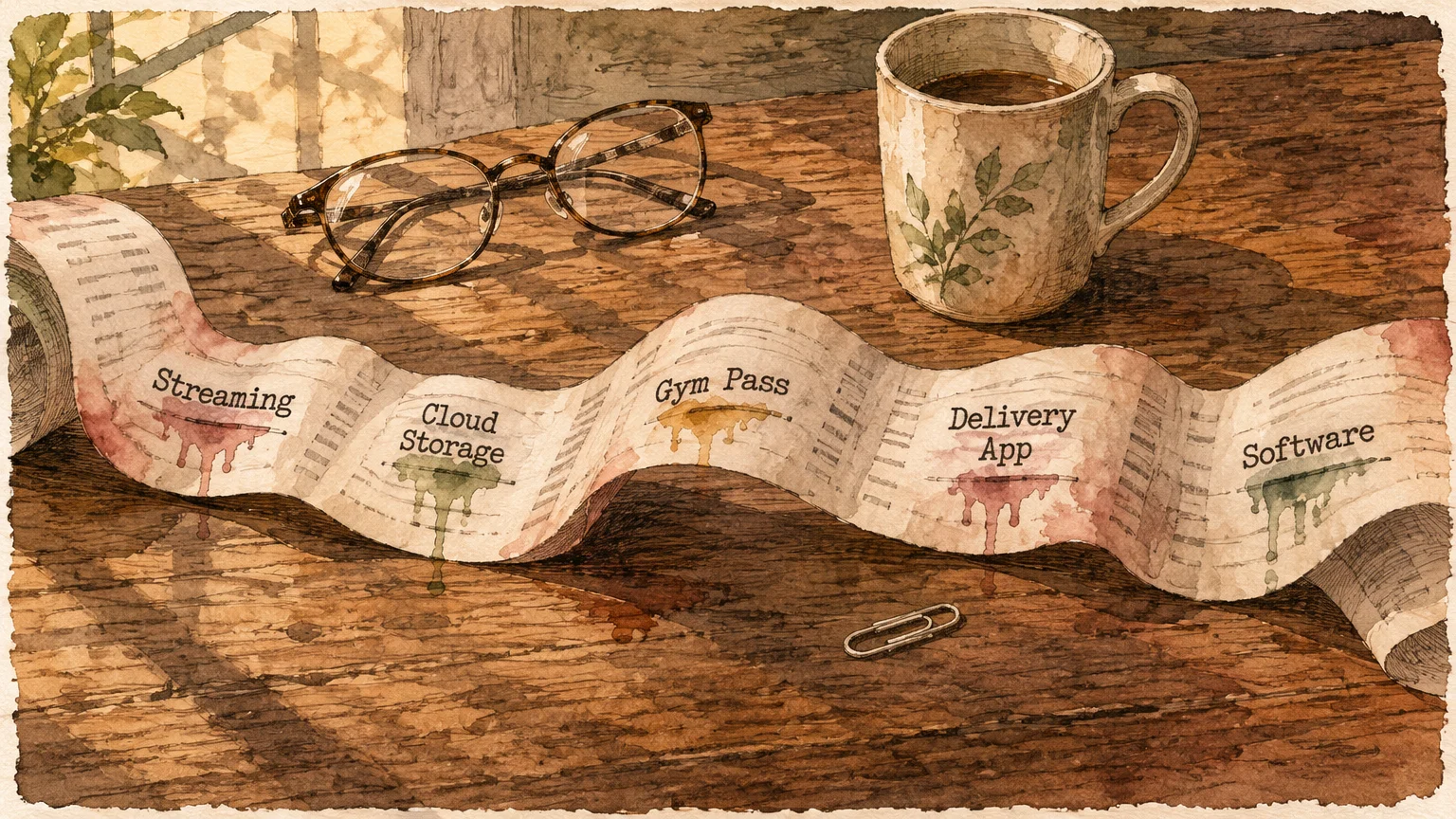
Individual monthly memberships rarely trigger alarm bells because each charge looks harmless on its own. Ten dollars for cloud storage, fifteen for ad-free streaming, and twenty for a fitness app feel trivial until they pile together on auto-pay.
According to CNET’s July 2026 State of Subscriptions survey, U.S. adults spend an average of $111 per month—or $1,332 per year—on subscriptions, up from $90 per month in 2025. Respondents also reported wasting an average of $21 per month, or $252 annually, on services they do not use.
Other data suggest waste may run even higher when households overlook overlapping bundles. A 2026 Self Financial survey found 59.9% of respondents carry at least one unused paid subscription each month, averaging 2.6 unused services worth $26.79 monthly.
Streaming video drives much of that creep. Deloitte’s March 2026 Digital Media Trends report noted that 90% of U.S. households pay for streaming video, spending an average of $69 per month—$828 a year—across roughly four platforms.
Worse, almost everyone underestimates their recurring bill load because auto-renewals vanish from active memory. In a Chargeback survey, respondents guessed they spent $87 per month on subscriptions while their itemized bank statements averaged $219 per month.
Fixing subscription creep takes one focused audit rather than permanent deprivation. Run through this quarterly cleanup checklist:
- Pull ninety days of statements: Scan your checking account and every credit card for recurring charges, including annual memberships billed once a year.
- Rotate streaming services: Keep one or two platforms active each month, cancel the rest, and rotate back when a favorite new season drops.
- Audit mobile app stores: Check Apple App Store and Google Play subscription tabs, where forgotten free trials often convert into quiet renewals.
- Set calendar alerts before renewals: Whenever you sign up for a promotional rate or free trial, add a phone reminder three days before billing starts.
6. Paying Avoidable Checking, Overdraft, and ATM Fees
Routine banking fees punish people who miss small balance rules or grab quick cash at the wrong machine. Because many consumers assume every bank charges the same penalties, they stay with costly accounts out of pure habit.
You may have heard about federal efforts to cap large-bank overdraft fees at $5, which the Consumer Financial Protection Bureau finalized in late 2024. However, Congress overturned that rule on May 9, 2025 under the Congressional Review Act, leaving no federal overdraft fee cap in 2026.
As a result, banks and credit unions still collect massive penalty revenue—over $12 billion in overdraft and nonsufficient funds fees in 2025, per National Consumer Law Center data from June 2026. Federal Reserve data show 12% of Americans paid at least one overdraft fee during 2025.
Those individual penalties add up fast. Bankrate reports an average overdraft fee of $26.77 across checking accounts, with major banks such as Chase charging $34 and the Consumer Financial Protection Bureau (CFPB) citing $35 as typical at large institutions.
Everyday access costs can sting too. Out-of-network ATM withdrawals hit a record average of $4.86 per transaction—combining a $3.22 machine surcharge and a $1.64 own-bank fee—per Bankrate, while average monthly checking maintenance fees sit at $13.95, or $15.65 for interest checking, per MoneyRates.
Yet over 37% of checking accounts charge no monthly maintenance fee at all according to Bankrate, and many institutions now eliminate overdraft fees entirely. Protect your checking balance with four straightforward adjustments:
- Turn off overdraft coverage for debit purchases: Opting out of debit-card overdraft means a transaction simply declines if funds run short instead of triggering a $34 or $35 fee.
- Switch to a no-overdraft or fee-free account: Online banks, credit unions, and select national banks offer free checking with no minimum balance rules and no overdraft penalties.
- Enable low-balance text alerts: Set an automatic alert whenever your checking balance dips below $200 so you can transfer funds before bills clear.
- Use cash-back at checkout: Request $20 or $40 cash back with a grocery debit purchase instead of paying nearly $5 at an out-of-network ATM.

7. Ignoring Credit Reports and Falling for Credit Score Myths
Waiting until you apply for a mortgage or auto loan to look at your credit file leaves you zero runway to fix errors or adjust utilization. Even worse, widespread myths about how scores work cause many borrowers to make moves that backfire.
A permanent policy from Equifax, Experian, and TransUnion allows every American to pull free credit reports from all three bureaus once a week exclusively at AnnualCreditReport.com, per the FTC and CFPB. Checking your own report regularly is the fastest way to catch duplicate accounts, wrong balances, or identity theft.
Your score shapes far more than loan approvals, often influencing auto insurance premiums in most states, apartment applications, and utility deposits. FICO Scores are used by 90% of top U.S. lenders, and the national average FICO Score held at 714 with a median of 744 in August 2026.
Understanding what drives that number clears up costly confusion. According to myFICO, payment history accounts for 35% of your score and amounts owed—including credit utilization—accounts for 30%.
That utilization rule hides a subtle trap: even if you pay your credit card in full every month, your credit report usually captures your last statement closing balance. Running high charges before the statement closes can temporarily spike your reported utilization and dip your score right before a loan application.
Other myths persist too: a 2026 FICO and Harris Poll survey found 65% of Americans wrongly believe or are unsure whether income affects a FICO Score, and one in four mistakenly think checking their own score lowers it. Keep your credit profile sharp with these habits:
- Review one report every four months—or weekly if needed: Pull your free reports at AnnualCreditReport.com and dispute inaccurate late payments, unfamiliar inquiries, or wrong balances immediately.
- Pay down balances before the statement date: If you plan to apply for a mortgage or car loan soon, make a mid-cycle payment a few days before your card’s statement closes to keep reported utilization low.
- Ignore soft-inquiry anxiety: Checking your own credit score or report counts as a soft pull and never lowers your score by a single point.
- Keep old no-fee cards open: Closing a paid-off, zero-annual-fee card shrinks your total available credit and can raise your utilization ratio overnight.
8. Stacking Buy Now, Pay Later Plans Without Tracking Cash Flow
Splitting a $120 jacket or a $300 electronics purchase into four interest-free installments feels easier on your budget than putting it on a credit card. The problem arises when several harmless-looking plans overlap on different biweekly schedules.
Buy Now, Pay Later adoption has climbed steadily, with 16% of U.S. adults using BNPL in the prior 12 months per the Federal Reserve’s May 2026 report—up from 10% in 2021. However, 26% of users paid late at least once, and 17% were charged extra fees for paying late.
Because most providers require automatic debit payments from your checking account or debit card, stacked installments create surprise cash crunches. Federal Reserve research from late 2026 found that 11% of BNPL users had an installment payment trigger a bank overdraft or nonsufficient funds fee in the prior year.
That overdraft rate jumped to 18% among BNPL users who could cover less than $100 from savings. A single $35 bank penalty can wipe out every penny of interest you thought you saved by choosing four installments.
Standard pay-in-four BNPL loans also operate in a reporting blind spot. As the Federal Reserve Bank of Richmond notes, these plans generally avoid hard credit inquiries and are typically not reported to major credit bureaus, making it easy to pile up multiple obligations undetected.
If you use short-term installment plans, treat them like real debt inside your monthly budget:
- Cap active plans at one: Never open a second pay-in-four plan until the first one is completely paid off.
- Log every auto-debit date: Write each installment amount and withdrawal date directly into your monthly budget calendar alongside rent and utilities.
- Never use BNPL for recurring essentials: Relying on installment loans for groceries, gas, or utility bills signals an underlying cash-flow shortfall that needs budget relief rather than split payments.
Quick Comparison: Where These Mistakes Hit Your Wallet Hardest
Seeing these eight budgeting errors side by side makes it easier to prioritize what deserves your attention first. Use this snapshot to match the biggest leak in your finances with an immediate fix.
| Money Mistake | Current Cost or Benchmark | Fastest Action to Take |
|---|---|---|
| Low-yield savings account | 0.39% avg APY vs. up to 4.70% HYSA | Move cash reserve to an FDIC-insured HYSA |
| Paying only card minimums | 22.36% avg interest APR; $6,678 avg debt | Pick avalanche or snowball and pay above minimum |
| Thin emergency fund | Only 30% cover $1,000 from savings | Automate $25–$50 per paycheck into savings |
| Missing 401(k) match | Nearly 19% miss full match; $24,500 limit (2026) | Raise payroll deferral to capture 100% of match |
| Subscription creep | $111/mo avg spend; $21/mo wasted | Audit 90 days of statements and cut unused apps |
| Checking and ATM fees | $26.77 avg overdraft; $4.86 avg ATM fee | Opt out of debit overdraft; switch to fee-free bank |
| Ignoring credit reports | Amounts owed (incl. utilization) = 30% of FICO Score | Pull free weekly reports at AnnualCreditReport.com |
| Unmonitored BNPL plans | 26% pay late; 11% hit overdraft fees | Limit to one active plan and track auto-debit dates |
Getting Expert Input
Most day-to-day financial habits respond well to a simple checklist, yet certain turning points benefit from a qualified second pair of eyes. Consider speaking with a fee-only Certified Financial Planner, Certified Public Accountant, or accredited nonprofit credit counselor in these situations:
- Multiple high-interest debts feel unmanageable: If minimum payments consume your take-home pay, a nonprofit credit counselor affiliated with the NFCC can review structured debt management options without predatory fees.
- You are juggling retirement rollovers or tax brackets: A CPA or fee-only planner can help you coordinate 401(k) rollovers, Roth conversions, and IRS catch-up contributions without triggering avoidable tax penalties.
- You face a major life transition: Marriage, divorce, buying a home, welcoming a child, or receiving an inheritance shifts insurance, tax filing, and beneficiary needs all at once.
- You earn self-employment or gig income: Quarterly estimated taxes, retirement options like Solo 401(k)s, and business deductions have strict IRS rules where tailored advice often pays for itself.
Frequently Asked Questions
Which of these common money mistakes should I fix first?
Start by capturing your full employer 401(k) match if one is available, since it delivers an immediate return, while building a small $500 to $1,000 cash buffer. Once that safety net stops new borrowing, attack high-interest credit card debt aggressively.
Does checking my own credit report or score hurt my credit?
No—pulling your own credit report at AnnualCreditReport.com or viewing your score through a bank app counts as a soft inquiry and does not lower your score. Despite that, one in four Americans still mistakenly believe checking hurts their credit.
How much should I keep in a high-yield savings account versus investing?
Keep three to six months of essential living expenses plus any money you plan to spend within the next three to five years—like a car purchase or home down payment—inside a safe, liquid high-yield savings account. Money earmarked for retirement five or more years away generally belongs in diversified investments.
Are Buy Now, Pay Later loans reported to credit bureaus?
Standard four-payment BNPL plans typically skip hard credit inquiries and are usually not reported to the major credit bureaus, though longer-term financed plans may be. Even without bureau reporting, missed payments still trigger late fees, account freezes, or bank overdrafts.
Take One Practical Step Today
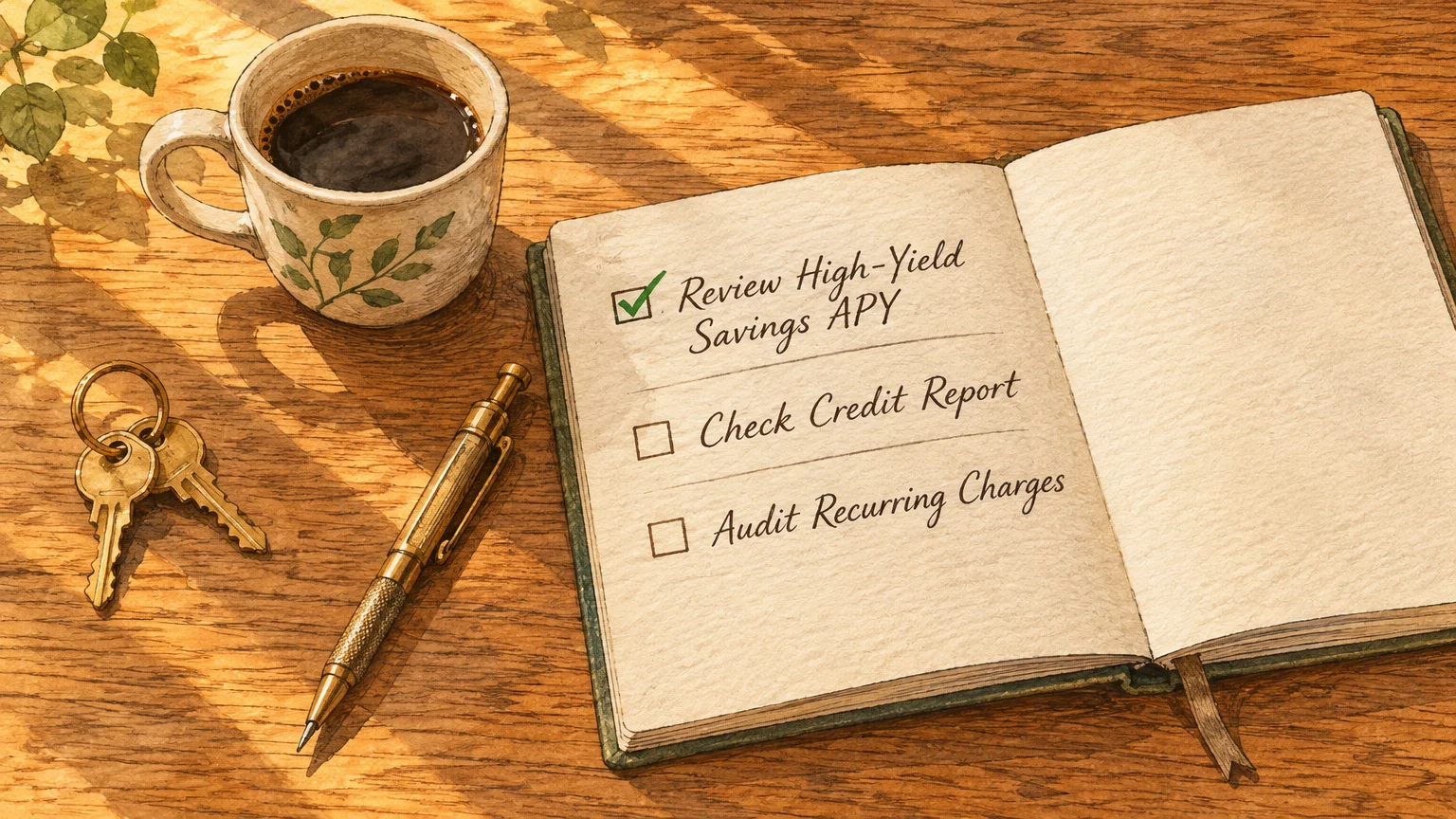
Trying to overhaul your entire budget in a single weekend usually leads to burnout by Tuesday. Instead, pick the single mistake from this list that hits your wallet hardest—whether that means capturing a missed 401(k) match, canceling three forgotten apps, or moving your emergency cash to a higher-yielding account—and fix it in the next thirty minutes.
Once that quick win runs on autopilot, come back next month and tackle the next item on your list. This is general informational content based on widely accepted guidance. Individual results vary. Verify current details—rules, prices, eligibility, regulations—with official sources before making important decisions.
Last updated: November 2026. Rules, prices, and details change—verify current information with official sources before acting on it.









Leave a Reply