

Handing over a guaranteed monthly check for a single six-figure payout permanently changes your retirement trajectory. A lump sum gives you immediate control, but it also transfers every ounce of investment risk onto your shoulders.
When your employer offers a pension buyout, you must choose between guaranteed lifetime income and personal asset management. Making the wrong choice can trigger unexpected tax bills or leave you short of funds in old age.
Before signing any paperwork, evaluate how interest rates, taxes, and longevity impact your bottom line. These seven critical factors will help you make a confident, well-informed choice.
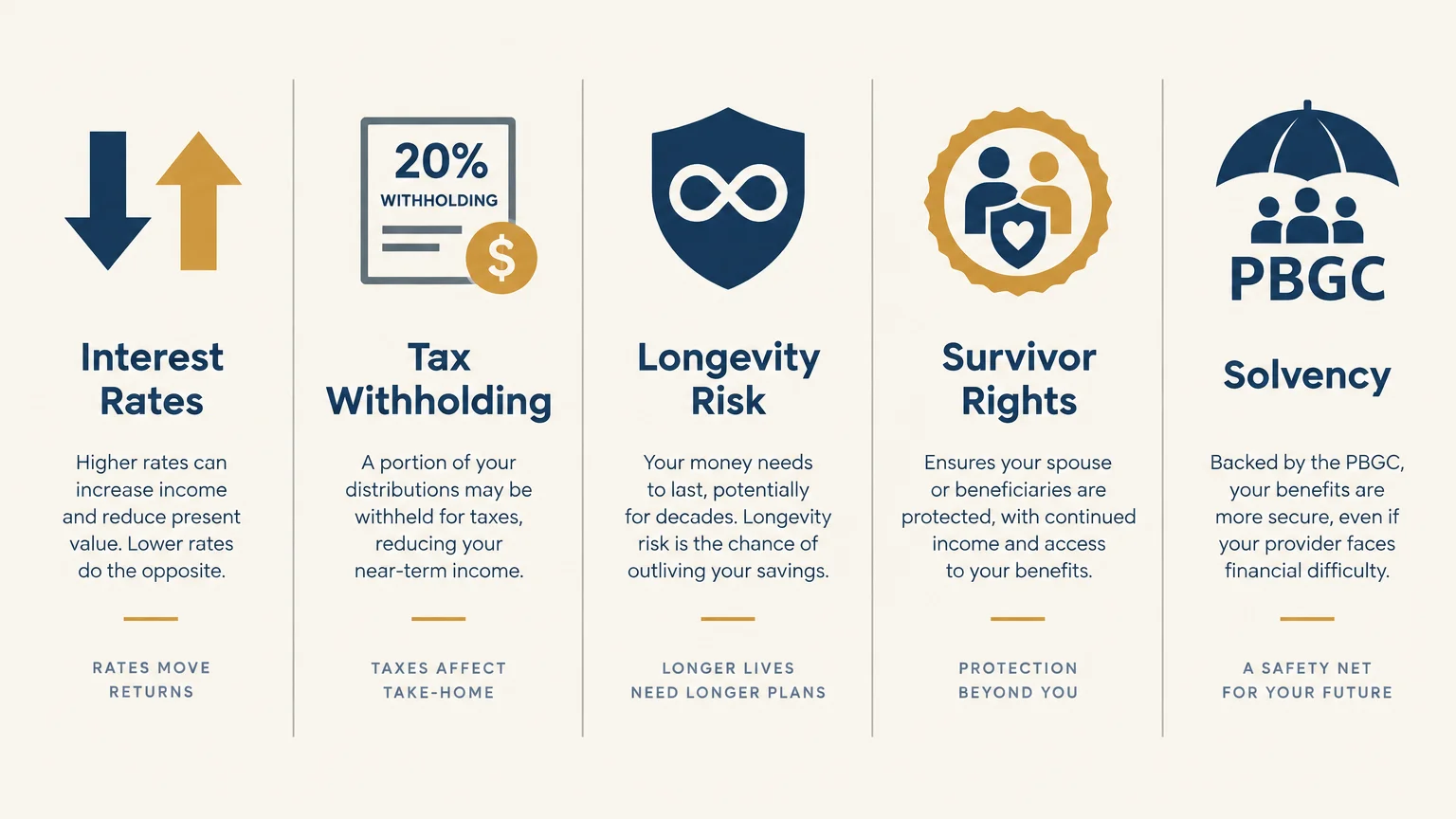
The Essentials at a Glance
Deciding between an ongoing annuity and a single cash payout requires balancing guaranteed security against personal flexibility. Neither option works best for every household.
- Interest Rate Impact: Higher corporate bond segment rates shrink lump-sum payouts; lower rates inflate them.
- Tax Hazards: Cash distributions face a mandatory 20% federal tax withholding unless you execute a direct rollover.
- Longevity Protection: An annuity guarantees you will never outlive your money, regardless of market downturns.
- Survivor Security: Federal law protects spousal rights, requiring notarized consent before you can waive monthly survivor benefits.
- Employer Risk: Private pensions have safety nets through federal insurance caps, but corporate distress still matters.
1. Interest Rates and the Discount Rate Math
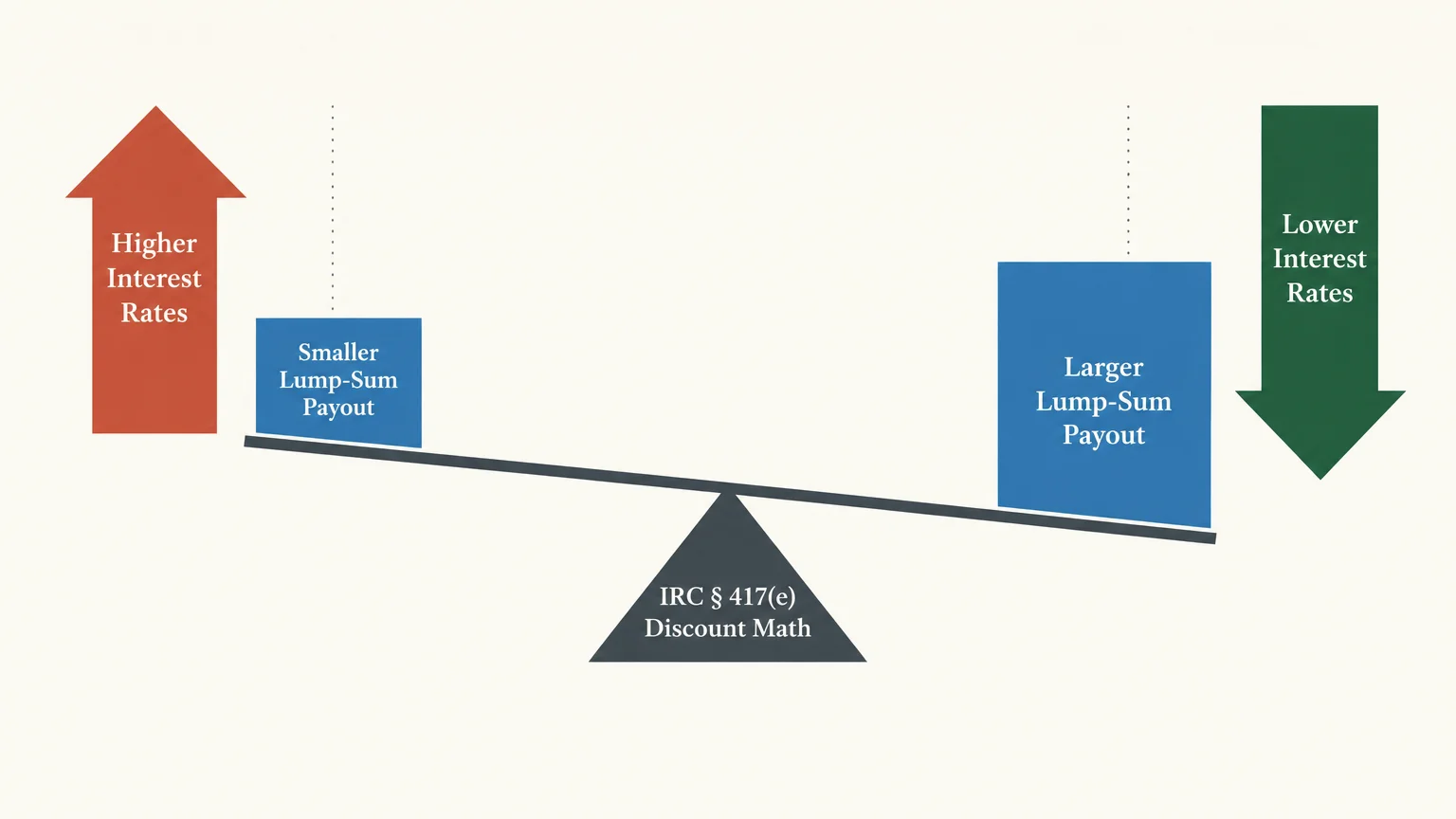
Federal law dictates how plan administrators calculate your lump-sum offer from your monthly benefit. Employers must use corporate bond segment rates established under Internal Revenue Code § 417(e).
These benchmark interest rates create an inverse relationship with your payout amount. When interest rates climb, the present value of your future pension drops, resulting in a smaller lump-sum check.
Conversely, when benchmark rates decline, your employer must offer a substantially larger lump sum to equal those lifetime payments. A shift of just one percentage point can swing a payout offer by tens of thousands of dollars.
Defined benefit plans calculate these values using specific lookback months defined in their plan documents. A plan might determine calendar-year payouts using corporate bond rates from the prior August or November.
Because of these timing rules, retiring in December versus January can produce drastically different payout totals. Always ask your benefits administrator which lookback month governs your calculation before picking an exit date.
2. Tax Pitfalls, Mandatory Withholding, and Rollover Rules
Taxes can quickly devour a significant portion of your payout if you fail to follow strict distribution procedures. The IRS treats un-rolled pension distributions as ordinary income in the year you receive them.
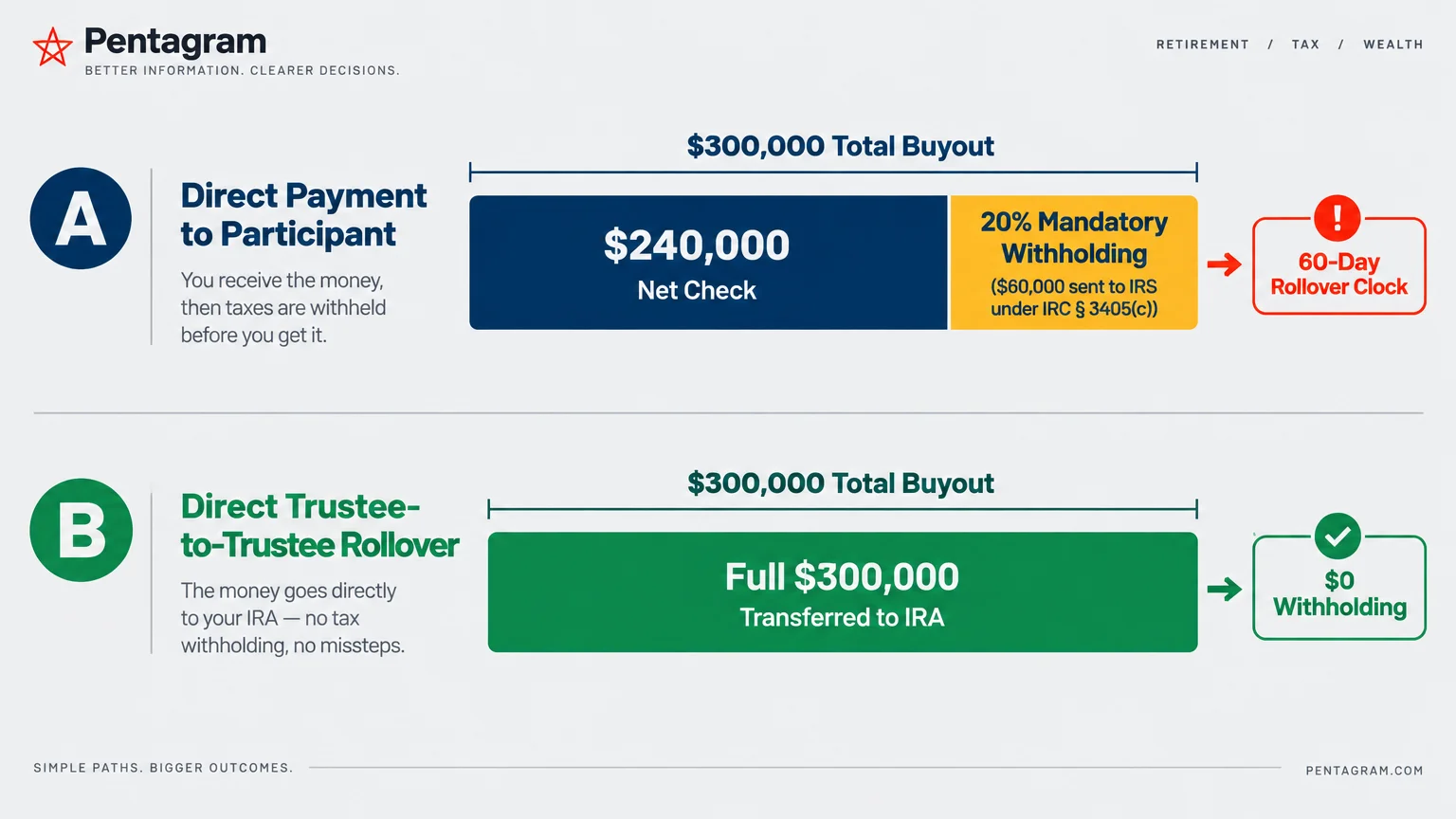
If you take your payout as a direct check payable to yourself, federal law mandates an immediate 20% tax withholding under IRC § 3405(c). On a $300,000 buyout, the plan administrator automatically sends $60,000 directly to the IRS.
You then have 60 calendar days from receipt to deposit that full distribution into an eligible traditional IRA. To roll over the entire $300,000, you must come up with the withheld $60,000 from personal savings.
If you fail to replace that withheld money, the IRS considers that $60,000 a permanent distribution. You will owe regular income taxes on it, plus potential early withdrawal penalties.
According to the Internal Revenue Service, you can eliminate this withholding trap by requesting a direct trustee-to-trustee rollover. The funds move directly between financial institutions without triggering mandatory withholding or immediate income tax.
Age also introduces substantial penalties for early departures. If you take a taxable distribution before age 59½, you generally owe an extra 10% early withdrawal tax.
An exception exists under the IRS Rule of 55 for workers leaving their employer during or after the year they turn 55. However, this exception applies only to workplace plans, not to funds rolled into traditional IRAs.

3. Longevity Risk and the Reality of Managing Investments
Longevity risk represents the mathematical danger of living longer than your accumulated retirement assets last. A monthly pension annuity absorbs this risk entirely by paying a reliable check until your death.
When you accept a lump sum, you assume the full burden of outliving your money. You must manage investment allocations, track fees, and establish a disciplined withdrawal schedule year after year.
Market timing creates additional hurdles through sequence-of-returns risk. A major market downturn during the first three years of your retirement can permanently impair a self-managed portfolio.
Withdrawing living expenses from depressed stock holdings locks in portfolio losses and speeds up capital depletion. A steady monthly pension check arrives regardless of whether Wall Street enters a bull market or a severe bear market.
Managing a complex portfolio also becomes harder as retirees grow older. Cognitive decline can make managing asset withdrawals, required distributions, and rebalancing stressful or vulnerable to financial exploitation.
An ongoing monthly annuity removes day-to-day money management stress from your 80s and 90s. If you prefer financial simplicity over portfolio maintenance, guaranteed monthly income offers peace of mind.

4. Spousal Rights and Survivor Income Guarantees
Taking a lump sum is rarely an individual decision if you are legally married. Federal legislation actively protects non-employee spouses from losing access to essential retirement income.
Under the Employee Retirement Income Security Act (ERISA), married participants must receive a Qualified Joint and Survivor Annuity (QJSA) by default. This structure guarantees that a surviving spouse continues receiving monthly payments after the pensioner dies.
You cannot elect a single lump sum or a single-life annuity without your spouse’s explicit written approval. The law requires your spouse to sign a formal waiver witnessed by a notary public or an authorized plan representative.
This protection prevents a worker from spending down retirement wealth and leaving a surviving partner without support. Couples must weigh the survival benefits of an ongoing annuity against an inherited lump-sum balance.
A properly invested lump sum rolled into an IRA can pass directly to a surviving spouse without interruption. However, that survivor assumes full responsibility for managing the remaining assets and stretching them over their remaining lifespan.
A monthly joint-and-survivor annuity guarantees your spouse receives predictable income without touching investment markets. For couples with unequal life expectancies or different financial skills, this safety net provides invaluable security.

5. Employer Solvency and PBGC Benefit Limits
Company-sponsored pensions are only as stable as the corporations funding them and the federal backstops backing them up. If your employer enters bankruptcy or defaults on its obligations, your pension plan could face termination.
When private single-employer defined benefit plans fail, the Pension Benefit Guaranty Corporation takes over administration to pay promised benefits. However, federal law caps the maximum amount the agency can legally distribute to participants.
For plans terminating in 2026, the PBGC maximum annual guarantee for a 65-year-old receiving a straight-life annuity is $93,477.24. That cap equals a monthly payout of $7,789.77.
If your promised lifetime benefit stays comfortably below this statutory cap, federal insurance guarantees your income against company insolvency. Workers with modest pensions face little personal financial risk from a corporate bankruptcy.
However, high-earning executives and long-tenured professionals promised monthly sums above that limit face real haircuts in bankruptcy. If your promised pension exceeds statutory limits, taking a lump sum removes your exposure to employer credit risk.
Public-sector municipal and state pensions do not carry PBGC insurance coverage. If you participate in an underfunded government plan with weak legal protections, evaluate your state’s constitutional pension safeguards carefully.
6. Inflation Protection Versus Stock Market Potential
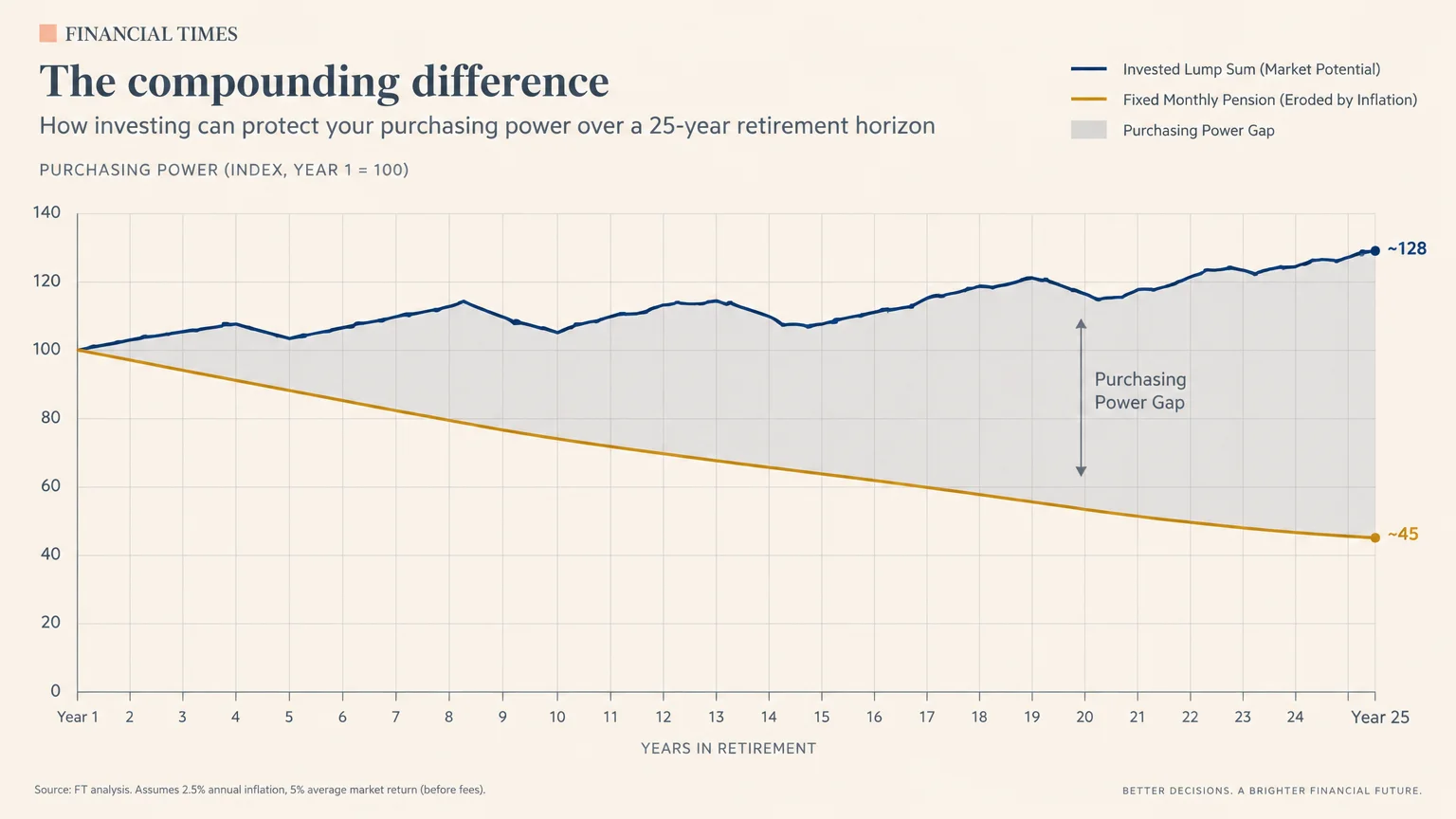
Fixed monthly payouts carry a quiet, persistent danger: the loss of purchasing power over decades. Most private corporate pensions do not include an annual Cost-of-Living Adjustment (COLA).
A monthly check of $2,500 may cover your living expenses comfortably when you retire at age 62. Yet over 20 years, an average annual inflation rate of 3% cuts the real purchasing power of that check nearly in half.
By age 82, that fixed payment buys only what $1,384 bought on the day you retired. Unless you have other inflation-indexed income, like Social Security, inflation can slowly compress your standard of living.
Taking a lump sum allows you to invest in equities, real estate funds, and inflation-protected bonds. A diversified investment portfolio rolled into an IRA offers the potential to grow faster than consumer prices.
Historically, broad equity markets have outpaced inflation over extended rolling 20-year horizons. This potential for capital appreciation helps preserve your household’s purchasing power well into your final decades.
However, investment growth is never guaranteed. Seeking higher returns means accepting volatility, and aggressive investing can backfire if major economic contractions hit your portfolio early in retirement.

7. Personal Health, Life Expectancy, and Legacy Objectives
Your current medical reality and family medical history must anchor your payout choice. Pension annuities use population averages to price lifetime monthly payments, but you are not a statistical average.
If you face serious health complications or come from a family with short lifespans, taking monthly payments often leaves money on the table. A worker who collects an annuity for only four years forfeits the vast majority of their accrued retirement equity.
In this scenario, taking a lump sum preserves capital for your surviving family members. The remaining IRA balance passes directly to your designated beneficiaries rather than reverting to the employer’s pension trust.
Conversely, if you enjoy vigorous health and your parents lived into their late nineties, the annuity becomes mathematically superior. You can collect payments for 35 or 40 years, extracting far more value than the original lump-sum buyout offered.
Legacy planning introduces another major decision point for budget-conscious families. Single-life pension annuities vanish completely when you pass away, providing zero inheritance to children or charitable causes.
A lump-sum rollover creates an inheritable asset that can support grandchildren, fund family trusts, or support causes you care about. If passing wealth down to the next generation matters deeply, the lump sum aligns best with your estate goals.
“Taking a lump sum means you take on the responsibility of investing the money and making sure it lasts your entire lifetime. Once you choose a lump sum, you cannot change your mind later.”
Comparing Your Payout Options Side by Side
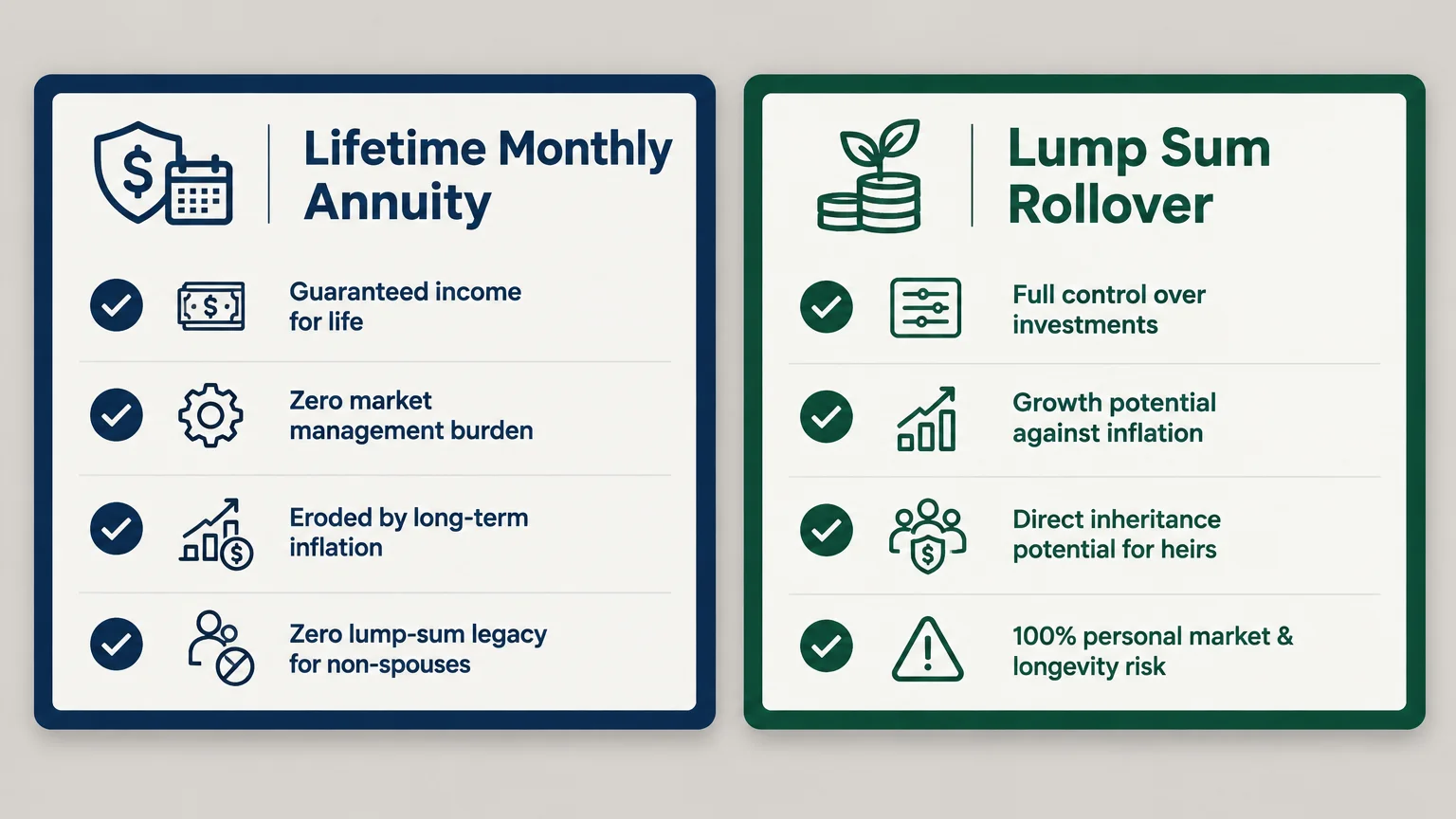
Weighing these trade-offs requires comparing features across key personal finance categories. Review this side-by-side comparison to see where your personal priorities align.
| Decision Factor | Monthly Pension Annuity | Lump-Sum Buyout |
|---|---|---|
| Guaranteed Income | Predictable monthly checks for life; never runs out. | No income guarantee; depends on withdrawal rates and market performance. |
| Investment Risk | Zero market risk for the retiree; employer bears all risk. | Full market risk; bad market timing can deplete principal. |
| Inflation Response | Rarely adjusted for inflation in private-sector plans. | Can invest in growth assets to outpace consumer inflation. |
| Spousal Security | Protected via QJSA survivor annuity options. | Requires spouse to manage or draw down inherited funds. |
| Insolvency Protection | Backed by PBGC up to statutory annual caps ($93,477.24 at age 65 for 2026). | Completely insulated from future employer bankruptcy. |
| Heirs and Legacy | Payments terminate at death; leaves nothing to children. | Remaining balance transfers to designated IRA beneficiaries. |
| Flexibility & Access | Rigid payment schedule; cannot accelerate funds for emergencies. | Complete liquidity; can withdraw custom amounts as needed. |
How to Calculate Your Pension Break-Even Age
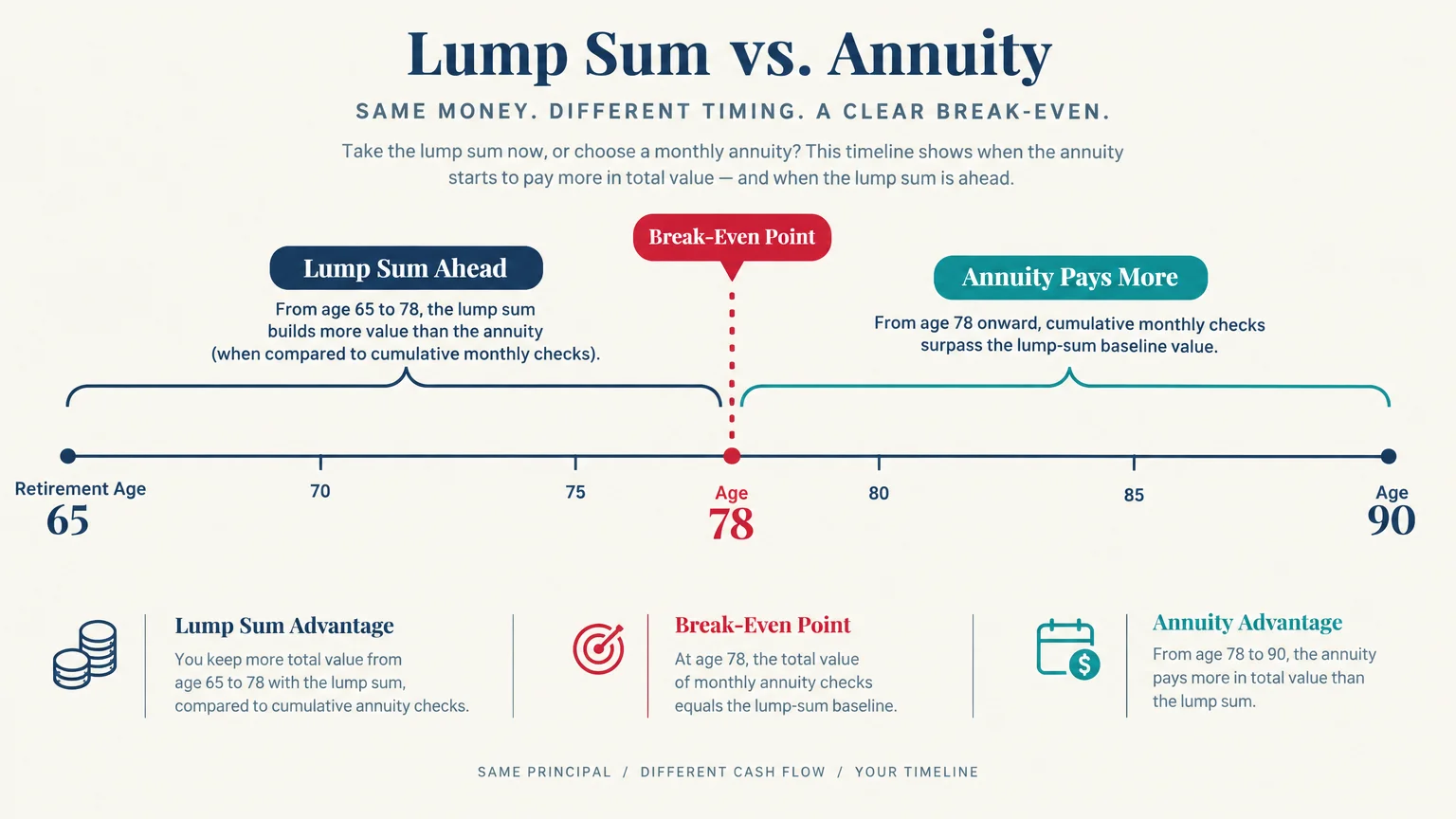
You can run a straightforward mathematical comparison to find your personal break-even age. This calculation estimates how long you must live for monthly annuity checks to surpass the initial lump sum.
Start with a simple comparison that sets aside investment growth to establish a baseline. Divide the total lump-sum offer by the gross annual pension payments promised by your employer.
For example, assume your plan offers a choice between a $360,000 lump sum or $2,250 per month ($27,000 annually) at age 65. Dividing $360,000 by $27,000 equals 13.3 years.
Adding 13.3 years to your retirement age of 65 establishes a simple break-even age of roughly 78. If you live past age 78, collecting the monthly annuity generates more cumulative gross cash than the original buyout.
Next, factor in reasonable investment growth on that lump sum inside a tax-deferred IRA. If that $360,000 earns a conservative 4% net return while you withdraw $2,250 monthly, the money lasts approximately 18 years.
In that scenario, your break-even age shifts out to age 83. If you expect to live past 83, the guaranteed annuity remains the mathematically superior choice.
The Bigger Picture: Fitting the Payout into Your Overall Plan
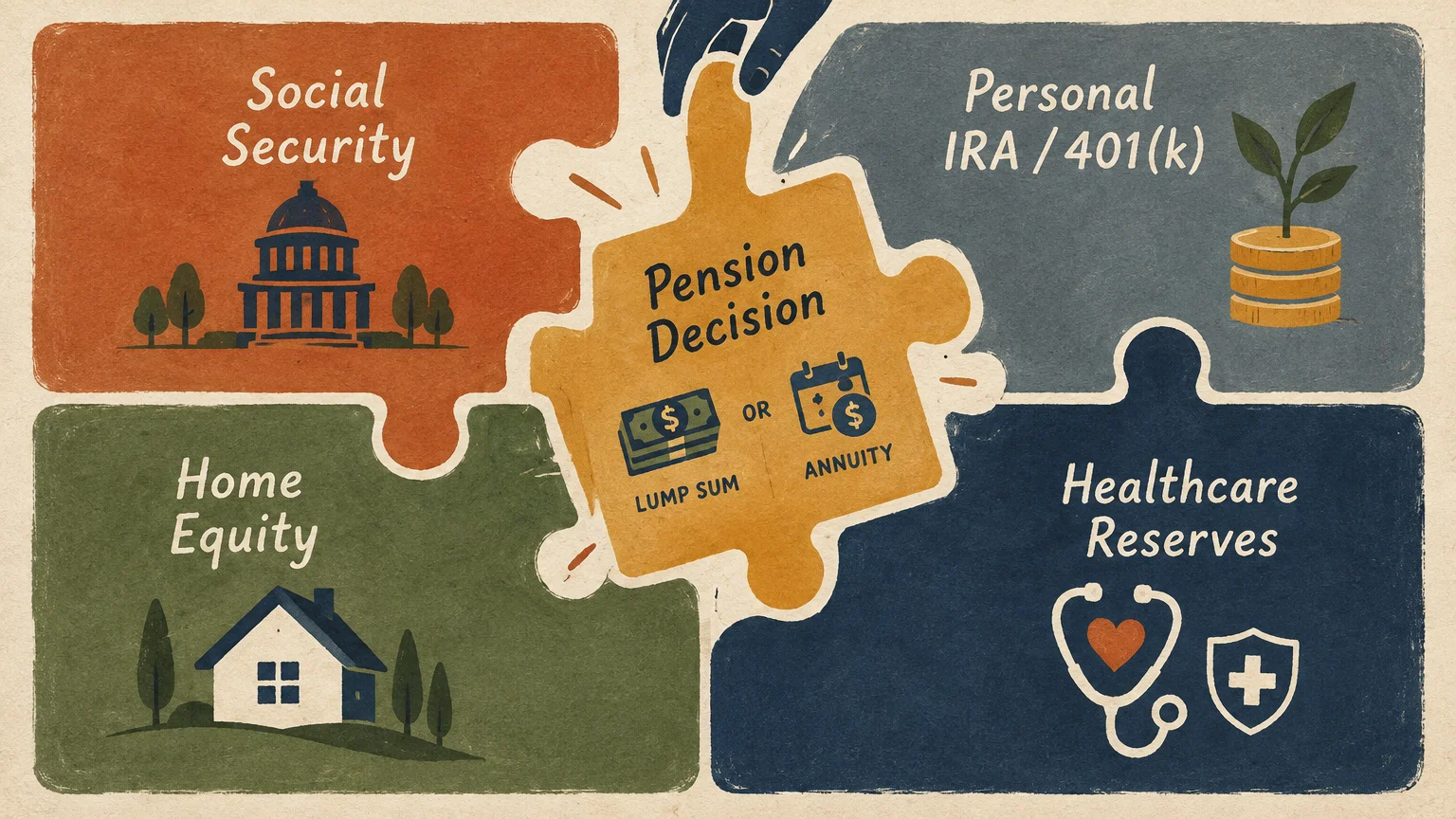
Your pension does not operate in isolation from the rest of your household finances. You must analyze how each payout option integrates with Social Security, existing 401(k) balances, and healthcare costs.
If you already have significant retirement assets in a 401(k) or brokerage account, you may not need another volatile asset. In that case, keeping the monthly pension creates a rock-solid income floor alongside Social Security.
This reliable baseline covers your recurring, non-negotiable living costs, including housing, food, and Medicare premiums. You can then invest your separate 401(k) more aggressively for growth, knowing your basic lifestyle is insulated from market crashes.
Conversely, if you carry substantial high-interest debt or have minimal liquid cash, a lump sum can eliminate financial emergencies. Wiping out a high-interest balance immediately can save thousands of dollars in compounding interest charges.
Healthcare expenses also influence this broader dynamic. Retirees facing steep out-of-pocket medical bills before Medicare eligibility at age 65 sometimes need the capital accessibility that a lump sum provides.

Worth Keeping in Mind
Specific life situations and administrative rules can complicate your pension decision. Keep these realistic scenarios in mind as you review your paperwork.
- Involuntary Plan Cash-Outs: Under Section 304 of the SECURE 2.0 Act, employers can involuntarily cash out vested balances up to $7,000. If your balance sits between $1,000 and $7,000, plans will automatically roll it into a Safe Harbor IRA unless you select an alternative.
- Rate-Lock Timing Delays: Taking months to decide during an era of changing interest rates can cause your payout calculation to expire. A fresh calculation performed under updated segment rates could yield a significantly smaller sum.
- Blended Family Complications: Electing a lump sum can create friction if you want to balance support for a second spouse against inheritances for children from a first marriage. Annuities with survivor benefits lock in spousal income, while lump sums require detailed beneficiary designations or trusts.
- Varying Creditor Protections: Traditional defined benefit plans receive unlimited federal protection from commercial creditors and bankruptcy under ERISA. Once you roll funds into a traditional IRA, creditor protection falls under state laws, which vary widely in their coverage limits.
- Required Minimum Distribution Cliffs: Rolling a massive lump sum into a traditional IRA defers taxes today, but inflates your account balance. Under current rules, you must begin taking Required Minimum Distributions at age 73, which could push you into a higher tax bracket and spike your Medicare IRMAA surcharges.

When to Get Professional Help
While basic calculations help clarify your choices, certain financial circumstances require specialized, credentialed guidance. Consult a fee-only fiduciary financial advisor or a CPA in the following situations:
- Your Annuity Exceeds PBGC Limits: If your monthly promised annuity exceeds the 2026 PBGC cap of $7,789.77 and your company exhibits credit weakness, hire a professional to evaluate corporate solvency risk.
- You Face Complex Multi-Year Tax Brackets: An advisor can run multi-year tax projections to model whether taking an annuity or executing partial Roth conversions from a lump-sum rollover minimizes your lifetime tax bill.
- You Are Navigating a Divorce or QDRO: Dividing retirement assets through a Qualified Domestic Relations Order requires specialized legal and financial analysis to prevent unintended tax triggers.
- You Suffer from Chronic Illness: A professional can help model healthcare longevity costs, long-term care needs, and estate preservation strategies tailored to your medical outlook.
Frequently Asked Questions
Can I change my mind after choosing a pension lump sum?
No, choosing a pension lump sum is an irrevocable decision. Once the distribution processes and the check clears or transfers to your IRA, you cannot convert that money back into an employer annuity.
What happens if I roll my lump sum into an IRA and retire before age 59½?
If you roll your payout into an IRA, subsequent withdrawals before age 59½ generally trigger a 10% IRS early distribution penalty alongside regular income taxes. You lose access to the workplace Rule of 55 once funds move into an IRA.
How does taking a lump sum impact my Social Security benefits?
A direct rollover of a pension lump sum into a traditional IRA has zero impact on your Social Security benefits. However, taking a cash distribution increases your provisional income for that tax year, which can cause up to 85% of your Social Security benefits to become taxable.
Are lump-sum pension rollovers subject to Required Minimum Distributions?
Yes, once your lump sum sits inside a traditional IRA, it becomes subject to IRS Required Minimum Distribution rules. Under current SECURE 2.0 legislation, you must begin mandatory taxable withdrawals starting at age 73.
Take the time to verify your plan lookback dates, run personal break-even timelines, and involve your spouse in every calculation. Choosing the right payout structure safeguards your financial independence throughout your retirement years.
This is general informational content based on widely accepted guidance. Individual results vary. Verify current details—rules, prices, eligibility, regulations—with official sources before making important decisions.
Last updated: May 2026. Rules, prices, and details change—verify current information with official sources before acting on it.









Leave a Reply