
At first glance, $100 doesn’t seem important enough to analyze. It’s not rent money. It’s not a car payment. It’s not something most people sit down and plan for. For many households, $100 falls into a mental category of “normal spending” — money that comes in and goes out without much thought.
But this is exactly why $100 matters.
Small, repeatable decisions shape financial outcomes far more than rare, dramatic ones. A single large expense may sting, but it’s the everyday handling of smaller amounts that quietly determines whether someone builds momentum or stays stuck in financial stress.
How someone treats $100 reveals how they think about money itself — whether money is seen as something to consume, something to cope with, or something to position for the future. And that difference compounds over years, not weeks.

How Most People Spend $100
For most people, $100 is viewed as usable money — something meant to solve an immediate problem, provide relief, or deliver a short burst of comfort in an otherwise demanding life.
This approach is understandable. Modern life is expensive, exhausting, and time-starved. When money feels tight and energy feels limited, spending decisions naturally prioritize the present moment over distant outcomes.
The issue isn’t irresponsibility. It’s reactivity.
Convenience & Comfort
One of the most common ways people spend $100 is on convenience. This includes takeout meals, food delivery fees, rideshares, last-minute purchases, or choosing the fastest option rather than the most cost-efficient one.
These decisions usually happen when people are tired, overwhelmed, or stretched thin. After a long workday, cooking feels like effort. Planning ahead feels like work. Convenience spending becomes a way to buy back a little energy or sanity.
In the moment, it feels justified — and often necessary.
But convenience spending has a hidden cost: it solves today’s discomfort while quietly increasing tomorrow’s expenses. Delivery fees don’t reduce future workload. Fast purchases don’t create systems. They simply keep life moving without improving it.
Over time, this creates a higher baseline cost of living without increasing income or flexibility.
Small Emotional Rewards
Another common use of $100 is emotional spending. This isn’t about indulgence in a negative sense — it’s about relief, reward, and self-expression.
People spend $100 on clothes that make them feel refreshed, beauty products that boost confidence, home items that add comfort, or entertainment that provides an escape. These purchases often follow stress, disappointment, or emotional fatigue.
In many cases, they serve a psychological function. They restore a sense of control or pleasure when other areas of life feel constrained.
The problem isn’t emotion — it’s expectation.
Most emotional purchases are not expected to create long-term value. Once the feeling fades, the money’s role is finished. There’s no return, no leverage, and no future benefit attached to it.
Short-Term Thinking
For most people, spending $100 marks the end of the money’s journey. The transaction is complete. The money is gone.
There’s rarely an expectation that the $100 should:
-
Reduce future expenses
-
Improve earning ability
-
Save time long-term
-
Create additional opportunities
This isn’t because people lack intelligence or discipline. It’s because financial pressure forces focus onto the short term. When monthly bills, unpredictable costs, and limited savings dominate mental space, thinking long-term feels abstract or unrealistic.
As a result, money becomes something to use up, not something to position strategically. Survival mode prioritizes relief over leverage.
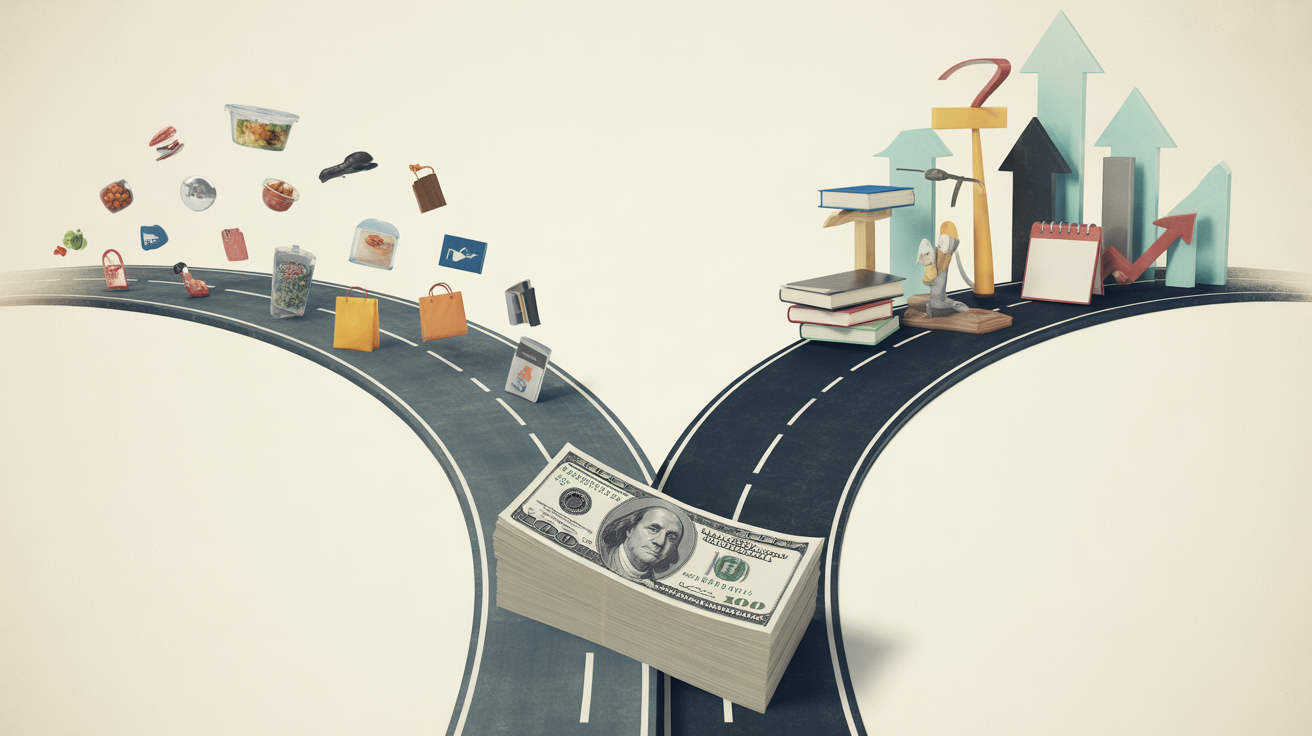
How the Rich Spend $100
Wealthy individuals don’t obsess over $100 — but they don’t dismiss it either. They see it as a small but meaningful unit of decision-making inside a much larger financial system.
The difference lies in expectation. Even modest spending is expected to slightly improve future conditions.
They Spend It to Save Future Money
One of the most consistent habits among wealthy individuals is evaluating total cost over time, rather than upfront price.
A $100 purchase might go toward higher-quality items that last longer, bulk purchases that lower per-unit cost, or upfront payments that eliminate recurring fees. These decisions may not feel exciting, but they quietly reduce future spending.
The question isn’t “Is this cheap?”
It’s “Does this lower my long-term expenses?”
This mindset transforms spending into prevention. Every dollar spent today is weighed against what it prevents tomorrow — replacements, repairs, upgrades, or inefficiencies.
They Spend It on Access, Not Objects
Wealthy people tend to prioritize access over ownership.
Instead of accumulating things, they spend on knowledge, tools, systems, and networks. A $100 purchase might grant access to information, improve productivity, or open doors to future opportunities.
Objects tend to depreciate.
Access often compounds.
Even small investments in learning or tools are expected to slightly expand capacity — making decisions faster, output higher, or opportunities more visible.
They don’t ask whether something feels good in the moment.
They ask whether it changes what they can do next.
They Turn $100 Into Information
Another subtle but powerful habit is using money to reduce uncertainty.
Wealthy individuals often spend small amounts to test ideas, experiment with tools, or validate assumptions. If the test fails, the money wasn’t wasted — it bought clarity.
Information lowers risk. Knowing what doesn’t work is just as valuable as knowing what does, especially when it prevents much larger losses later.
To them, $100 is inexpensive tuition if it avoids a $10,000 mistake.
This willingness to pay for insight creates faster learning curves and better decisions over time.
They Use $100 to Buy Time
Time is treated as a limited resource, not an infinite one.
Wealthy people regularly spend money to remove friction from their lives — outsourcing small tasks, automating repetitive work, or simplifying routines. The goal isn’t laziness. It’s focus.
By protecting time and mental energy, they preserve their ability to make higher-value decisions elsewhere. They understand that energy, not money, is often the real bottleneck.
Buying time today creates space for better thinking tomorrow.

The Core Difference Isn’t Lifestyle — It’s Expectation
The most important difference between how the rich and most people spend $100 has nothing to do with luxury or restraint.
It’s about expectation.
Most people treat $100 as a finish line.
The rich treat it as a starting point.
One asks: “What can this get me right now?”
The other asks: “What will this do for me next?”
One approach ends in consumption.
The other extends into momentum.
Neither is morally superior — but they lead to very different long-term outcomes.
Why This Gap Keeps Growing Over Time
A single $100 decision doesn’t change a life.
But repeated decisions do.
Over years, convenience spending raises baseline costs. Emotional spending increases reliance on money for relief. Short-term thinking reduces flexibility.
Meanwhile, future-focused spending quietly builds systems, buffers, and options.
This is why wealth gaps widen even among people with similar incomes. The difference isn’t willpower or intelligence. It’s orientation — whether money is aimed at relief or at leverage.
What This Means for Everyday People
Thinking like the rich doesn’t require deprivation or perfection. It requires awareness.
Before spending $100, pausing to ask a few questions can shift outcomes dramatically:
-
Will this reduce a future expense?
-
Will this improve my skills or earning potential?
-
Will this save time or mental energy later?
-
Will this still matter in six months?
Sometimes the answer will still be no — and the purchase will still be worth it. That’s not failure. That’s conscious choice.
Awareness transforms spending from habit into strategy.
$100 Is Never Just $100
Money doesn’t shout. It whispers through patterns.
Every $100 either disappears quietly or subtly reshapes future options. Wealth isn’t built through extreme sacrifice or sudden windfalls. It’s built through small expectations applied consistently.
And very often, it starts with how seriously someone treats a single $100 decision.









Leave a Reply