

You can boost your monthly cash flow without forfeiting a single dollar of your Social Security retirement check. The Social Security Administration (SSA) applies its strict Retirement Earnings Test solely to earned wages and net active self-employment profits, leaving unearned and passive income streams entirely untouched. If you claim benefits before your Full Retirement Age (FRA)—which is age 67 for anyone born in 1960 or later—earning too much from a traditional job triggers benefit withholdings. By focusing instead on passive income, asset liquidation, and investment returns, you can build substantial side income that keeps your full government benefit check arriving on schedule every month.

How the Social Security Earnings Limit Really Works
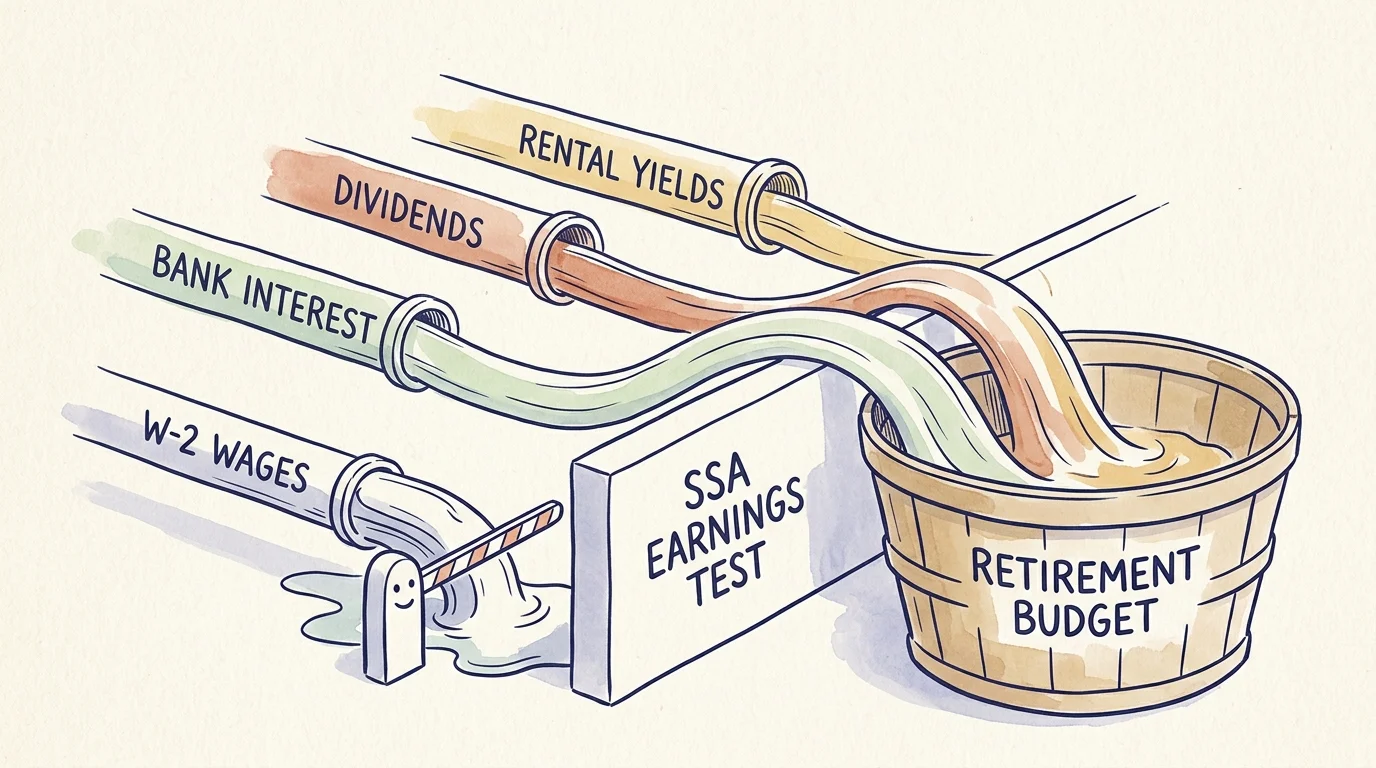
To protect your monthly benefit check, you must first understand the legal distinction between earned income and unearned income. The Social Security Administration enforces a statutory Retirement Earnings Test (RET) on anyone receiving early retirement benefits before reaching Full Retirement Age. Under SSA earnings guidelines, the agency only counts gross wages from an employer (W-2 income) and net earnings from active self-employment (Schedule C profit).
If you claim benefits early and continue working a standard job or active freelance gig, the following annual earnings caps dictate how much benefit money the SSA temporarily holds back:
- Under Full Retirement Age for the entire year: In 2025, you can earn up to $23,400 ($24,480 in 2026). Once you exceed this threshold, the SSA withholds $1 from your benefits for every $2 you earn above the limit.
- The year you reach Full Retirement Age: In 2025, the earnings cap rises to $62,160 ($65,160 in 2026). During the months leading up to your birthday month, the agency withholds $1 for every $3 you earn above the limit.
- Month of Full Retirement Age and beyond: The earnings limit disappears entirely. You can earn unlimited wages through active employment or business ownership without losing a penny of your Social Security check.
Under federal regulation 20 CFR 404.429, unearned income does not count toward these limits. Capital gains, rental yields, investment interest, and asset sales never trigger retirement benefit withholdings, no matter how much revenue they generate.
9 Side Income Ideas That Keep Your Benefits Intact
Generating supplemental cash without running afoul of the Retirement Earnings Test requires picking side ventures that generate non-work revenue or fall outside the IRS definition of earned wages. The following nine side income opportunities allow early retirees to pad their budgets safely.
1. High-Yield Cash Accounts and Certificates of Deposit (CDs)
Earning yield on cash balances represents one of the simplest, lowest-maintenance forms of unearned income available. Returns from high-yield savings accounts (HYSAs), certificates of deposit, and money market funds qualify as interest income, which the SSA completely excludes from the earnings test.
If you park $50,000 in emergency reserves across a ladder of top-tier CDs or an FDIC-insured HYSA yielding between 4.00% and 5.00%, you can generate $2,000 to $2,500 in annual passive cash flow. You report this income on IRS Form 1040 via Schedule B. Because interest reflects return on capital rather than physical or mental labor, you can collect unlimited bank interest while drawing early Social Security benefits.
2. Dividend-Paying Stocks, Bond Funds, and Real Estate Investment Trusts (REITs)
Building a diversified portfolio of income-generating securities turns your investment capital into a dependable quarterly paycheck. Dividend distributions, municipal bond interest, and Real Estate Investment Trust payouts do not represent wages or self-employment income.
A $100,000 portfolio invested across low-cost dividend exchange-traded funds (ETFs) or dividend aristocrat equities with an average yield of 3.5% produces $3,500 per year in hands-off cash flow. You can direct these dividends to pay into your checking account automatically to cover monthly utilities, groceries, or travel expenses. Capital gains realized when you sell shares at a profit also bypass the Retirement Earnings Test entirely.
3. Renting Out Storage Space, Garages, or Land
If you own residential or rural property with unused space, you can monetize that footprint without performing active physical services. Renting out an empty garage, a secure driveway spot for RV parking, an empty basement corner, or a pole barn generates purely passive rental income.
Neighborhood storage platforms let homeowners list their extra space for local residents seeking vehicle parking or household storage. A dry, secure two-car garage can easily bring in $150 to $350 per month depending on your local real estate market. The SSA classifies real estate rental income as unearned as long as you do not operate as a licensed commercial real estate dealer or provide substantial hotel-style personal services.
4. Decluttering and Liquidating Personal Possessions
Selling used household goods, hobby gear, furniture, and vintage collections converts clutter into immediate spending money. When you sell personal property online through marketplaces like eBay, Poshmark, or Facebook Marketplace—or at an in-person yard sale—the transaction represents an asset conversion rather than earned income.
Because you generally sell personal items for less than their original purchase price, the revenue does not produce a taxable capital gain, nor does it create Schedule C self-employment profit. If you downsize a lifetime of tools, musical instruments, jewelry, or sporting equipment, you can generate thousands of dollars in spendable liquidity. This holds true as long as you do not buy or manufacture inventory with the specific intent of flipping it for ongoing business profit.
5. Credit Card Cash-Back Programs and Shopping Rebates
Strategic spending using cash-back credit cards and retail rebate portals generates non-taxable, non-earned income on money you already plan to spend. According to established tax rulings, the IRS treats consumer credit card cash back, rewards points, and retail shopping rebates as post-purchase purchase discounts rather than taxable income.
By routing routine expenses—such as groceries, gasoline, utilities, and insurance premiums—through a no-annual-fee credit card offering 2% flat cash back across all purchases, a household spending $3,000 monthly earns $720 per year in pure tax-free cash. Stacking this strategy with digital shopping rebate platforms adds another $100 to $300 annually. Since the SSA does not track purchase rebates, your benefits remain completely protected.
6. Royalties from Work Created Before Retirement
If you wrote a book, recorded music, developed software, created online training modules, or registered a patent prior to claiming retirement benefits, ongoing residual checks will not reduce your monthly benefit. Under SSA Program Operations Manual System (POMS) guidelines, royalties received from intellectual property created prior to the month you became entitled to Social Security do not count against the earnings test.
For example, if you published a non-fiction book five years ago that continues to generate $600 a month through online distribution platforms, that stream remains exempt. However, if you actively write and publish a new book after claiming early benefits, earnings derived from that new work constitute active self-employment income subject to the earnings cap.
7. Long-Term Residential Rental Income
Owning a traditional residential rental property—such as a duplex, single-family home, or condominium leased to long-term tenants—creates a steady monthly income stream reported on IRS Schedule E. Standard real estate lease income is considered passive under federal law.
A rental unit producing $1,500 per month generates $18,000 in gross annual rent. Even after property taxes, insurance, and maintenance reserves, the remaining net cash flow belongs entirely to you without triggering SSA benefit penalties. To maintain this passive classification, you must avoid providing hotel-style concierge services, daily linen changes, or catered meals, which can cause the IRS and SSA to reclassify the operation as an active business.
8. Private Annuity and Defined-Benefit Pension Distributions
Converting a portion of your liquid retirement savings into an immediate or fixed index annuity guarantees a predictable monthly check for life. Contractual distributions from commercial annuities, previous employer pensions, and traditional or Roth individual retirement accounts (IRAs) do not count as earned wages.
Purchasing a single-premium immediate annuity (SPIA) with cash outside your retirement accounts delivers steady monthly income split between a return of principal and unearned interest. You can collect a $500 to $1,500 monthly annuity check without worrying about SSA deduction thresholds, providing peace of mind while balancing your household budget.
9. Micro-Leasing Personal Equipment and Recreational Vehicles
If you own high-value leisure equipment that sits idle for months at a time—such as a travel trailer, camper van, utility trailer, or compact tractor—you can rent it out on a “dry lease” basis. Peer-to-peer equipment sharing platforms allow owners to rent assets directly to vetted users.
Renting out a travel trailer for six weekends every summer at $125 per night yields $1,500 in supplemental income. To ensure this income stays exempt from the Retirement Earnings Test, you must lease the equipment without providing accompanying personal labor, such as operating the machinery, serving as a tour guide, or providing daily chauffeuring services.

Side Income Comparison: Effort, Income Potential, and Tax Treatment
The table below summarizes how each side income stream operates, showing the typical initial effort, potential returns, and regulatory reporting category.
| Side Income Stream | Setup Effort | Typical Annual Potential | Tax Reporting Form | SSA Earned Income Impact |
|---|---|---|---|---|
| High-Yield Savings & CDs | Low | $500 – $5,000+ | 1040 (Schedule B) | Zero ($0 counted) |
| Dividend Portfolios & REITs | Medium | $1,000 – $10,000+ | 1040 (Schedule B / D) | Zero ($0 counted) |
| Storage Space & Parking Rental | Low | $1,200 – $4,500 | Schedule E | Zero ($0 counted) |
| Selling Personal Possessions | Medium | $500 – $5,000 | Non-taxable / Form 8949 | Zero ($0 counted) |
| Credit Card Cash Back & Rebates | Low | $300 – $1,200 | Non-taxable rebate | Zero ($0 counted) |
| Pre-Retirement Royalties | High (prior work) | $200 – $10,000+ | Schedule E | Zero ($0 counted) |
| Long-Term Residential Rental | High | $3,600 – $20,000+ | Schedule E | Zero ($0 counted) |
| Private Annuities & Pensions | Low | $2,400 – $25,000+ | 1099-R | Zero ($0 counted) |
| Equipment & RV Micro-Leasing | Medium | $1,000 – $6,000 | Schedule E / 1040 line 8 | Zero ($0 counted) |
The Hidden Catch: Provisional Income and Benefit Taxes
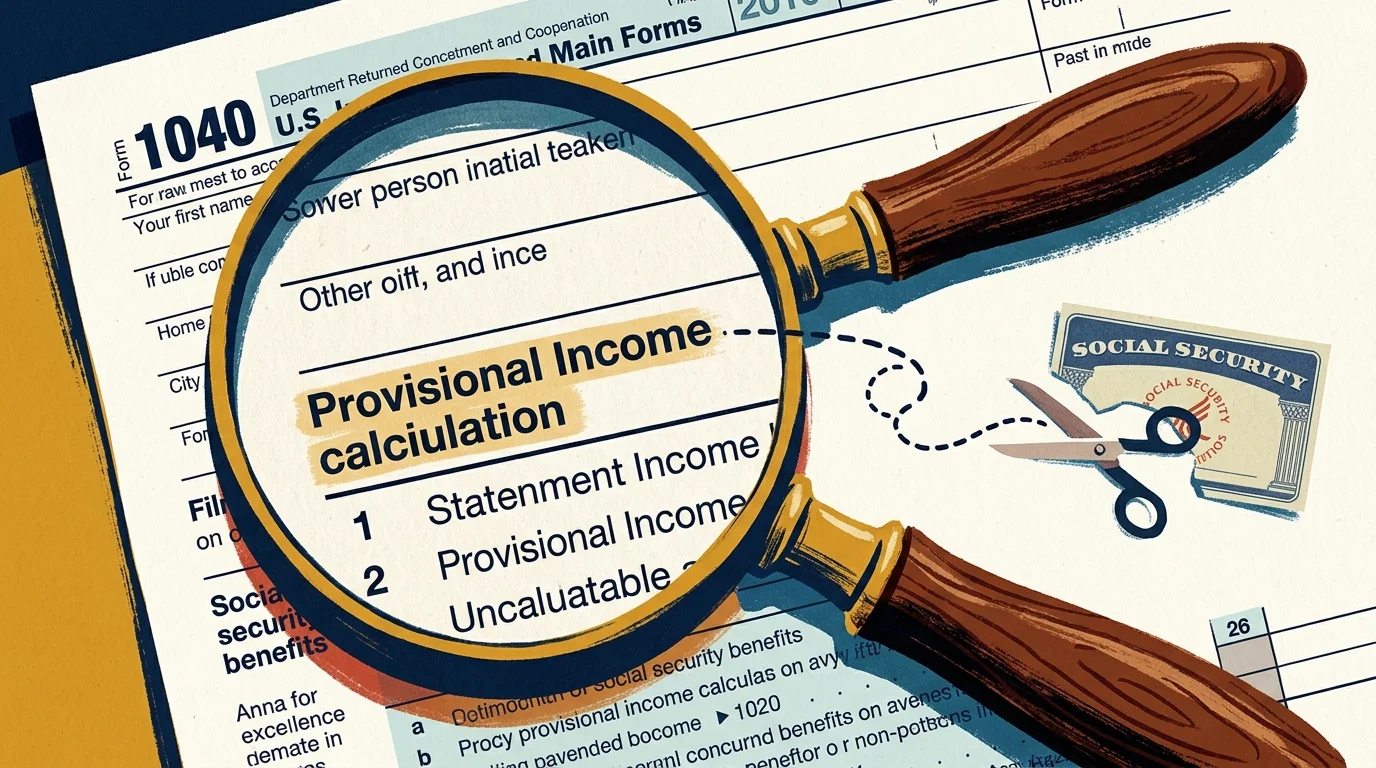
While unearned and passive income streams shield your Social Security check from the Retirement Earnings Test, they can still create an unexpected tax bill. The federal government uses a specific formula known as “Combined Income” (or provisional income) to determine whether a portion of your Social Security benefits is subject to ordinary federal income tax.
According to IRS provisional income rules, your Combined Income equals the sum of:
- Your Adjusted Gross Income (AGI) from all taxable sources (including CD interest, dividends, taxable pensions, and net rental profits);
- Any non-taxable interest you receive (such as municipal bond interest); and
- Exactly 50% of your total annual Social Security benefit amount.
If your Combined Income crosses specific statutory thresholds, you must pay income taxes on a portion of your monthly benefits:
- Single filers: If your Combined Income falls between $25,000 and $34,000, up to 50% of your Social Security benefits are subject to federal income tax. If your income exceeds $34,000, up to 85% of your benefits become taxable.
- Married filing jointly: If your combined total sits between $32,000 and $44,000, up to 50% of benefits face taxation. Above $44,000, up to 85% of benefits become taxable.
Generating $10,000 in rental income or CD interest will not reduce your gross monthly benefit check from the SSA, but it may push your total income into the bracket where Uncle Sam taxes your benefits at filing time. Factoring this calculation into your retirement plan prevents unwelcome surprises in April.
What Can Go Wrong
Even well-intentioned retirees can inadvertently trigger benefit clawbacks or unexpected tax penalties. Watch out for these four common pitfalls:
- Crossing into active business status on rental properties: If you list a spare room on a short-term vacation platform and provide daily cleanings, breakfast, or active hospitality services, the IRS may reclassify your revenue from passive Schedule E rental income to active Schedule C business profit. That reclassification subjects your earnings to self-employment tax and counts directly against the Social Security earnings cap.
- Turning a decluttering hobby into a retail business: Selling items you bought years ago for personal use is safe. However, if you begin visiting estate sales or thrift stores to purchase undervalued goods specifically to flip them for a markup, you are operating a merchandising business. The SSA views those net profits as earned income subject to the earnings test.
- Confusing SSDI and SSI rules with standard retirement: Social Security Disability Insurance (SSDI) restricts your ability to perform Substantial Gainful Activity ($1,620 per month in 2025; $1,680–$1,690 in 2026 for non-blind recipients). Meanwhile, Supplemental Security Income (SSI) is strictly needs-based; passive or unearned income reduces SSI checks dollar-for-dollar after a minor $20 monthly exclusion. Never apply standard retirement passive-income strategies to SSI recipients without verifying program rules.
- Failing to estimate quarterly income taxes: Passive earnings like rental profits, large stock dividends, and CD interest do not have automatic tax withholdings taken out at the source. If you collect substantial side revenue without making estimated quarterly payments to the IRS, you could face underpayment penalties at tax time.

Where Outside Advice Pays Off
Navigating the boundary between active work and passive income can involve gray areas. Consulting a certified financial planner (CFP) or certified public accountant (CPA) pays significant dividends in the following scenarios:
- Structuring real estate operations: If you own multiple rental units or commercial land, a CPA can help you structure ownership agreements and management contracts to ensure all net income remains cleanly categorized under Schedule E rather than self-employment.
- Managing large capital gains from asset liquidation: If you plan to sell high-value collectibles, real estate, or substantial stock positions, a tax professional can structure the sale across multiple tax years to prevent pushing your provisional income into the 85% Social Security taxation bracket.
- Coordinating Roth conversions with Social Security filing: Executing strategic Roth IRA conversions before or during early retirement can eliminate future taxable income, permanently reducing your provisional income exposure once you start collecting Social Security.
Frequently Asked Questions
Does passive income from an LLC reduce my Social Security benefits?
It depends on your role in the business. If you are a silent investor who contributes capital but performs no operational services or management labor, your share of LLC profits is generally treated as passive partnership income (reported on Schedule K-1), which does not count toward the earnings limit. However, if you actively manage operations, provide services, or work for the LLC, the SSA treats your share of net profits as earned self-employment income.
What happens if I accidentally exceed the Social Security earnings limit?
If you work an active job and earn more than the annual limit, the SSA temporarily withholds your monthly checks until the excess amount is recovered. However, these withheld funds are not lost forever. Once you reach your Full Retirement Age, the SSA automatically recalculates your benefit amount upward to credit back the withheld benefits gradually over your remaining lifetime.
Can I pet-sit or babysit casually without affecting my benefits?
Casual babysitting or pet-sitting for family and neighbors without running a formal business rarely causes issues if the earnings remain small. However, legally speaking, direct pay for physical services is considered earned income. As long as your total net earned income across the entire calendar year stays below the annual threshold ($23,400 in 2025; $24,480 in 2026), your benefits remain 100% intact.
Building supplemental income during retirement gives you breathing room in your monthly budget, helps absorb inflationary price increases, and funds personal lifestyle goals. By concentrating your efforts on unearned revenue streams—such as high-yield savings, long-term rentals, asset sales, and investment portfolios—you can enjoy extra income without losing a single dollar of your hard-earned Social Security benefits.
This article provides general information only. Every reader’s situation is different—what works for others may not be the right fit for you. For personalized guidance on health, legal, or financial matters, consult a qualified professional.
Last updated: May 2026. Rules, prices, and details change—verify current information with official sources before acting on it.









Leave a Reply