

Claiming spousal benefits through Social Security can provide up to 50 percent of your partner’s full retirement payout. This monthly income helps balance household retirement budgets, especially if you spent years out of the workforce or earned less.
Nearly 2.1 million Americans collect these monthly checks, averaging $986.68 per month according to official data. However, strict age requirements and filing rules determine how much money you actually receive.
Understanding how spousal benefits work ensures you do not inadvertently sacrifice lifetime retirement funds. Here is what every couple needs to know before submitting an application.
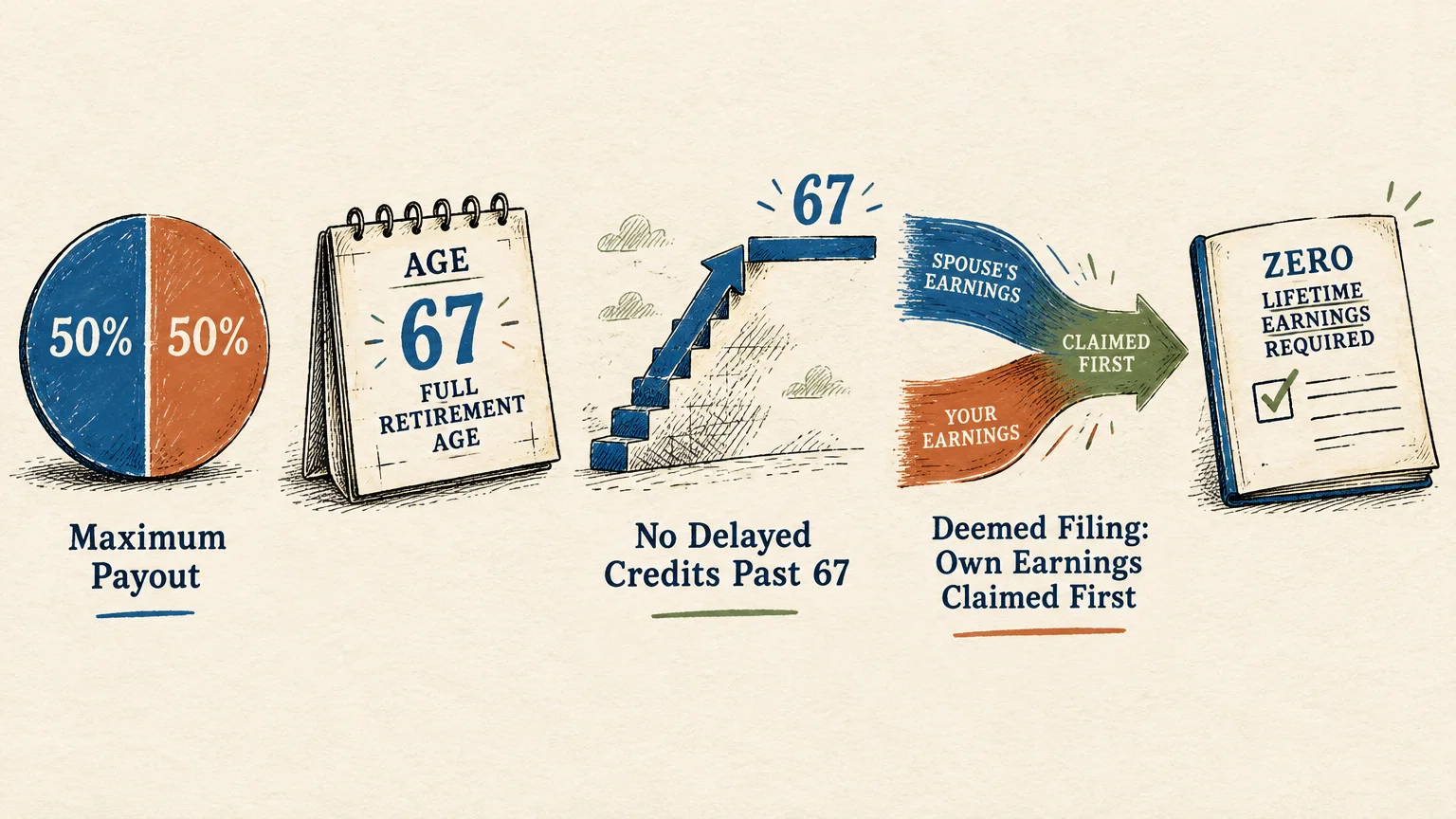
At a Glance: The Essentials
The rules governing spousal benefits differ significantly from regular retirement benefits. Keeping these core principles in mind helps you coordinate your household claiming strategy effectively:
- Maximum Payout: You can receive up to 50 percent of your spouse’s primary retirement benefit.
- Claiming Age: You must reach Full Retirement Age to get the full 50 percent share.
- No Delayed Credits: Unlike personal retirement benefits, spousal benefits do not increase after age 67.
- Deemed Filing: Applying for benefits triggers an automatic claim on your own earnings record first.
- Work History Not Required: You can qualify for spousal benefits even if you have zero lifetime earnings.
1. Your Maximum Spousal Benefit Caps at 50% of Your Partner’s Full Benefit
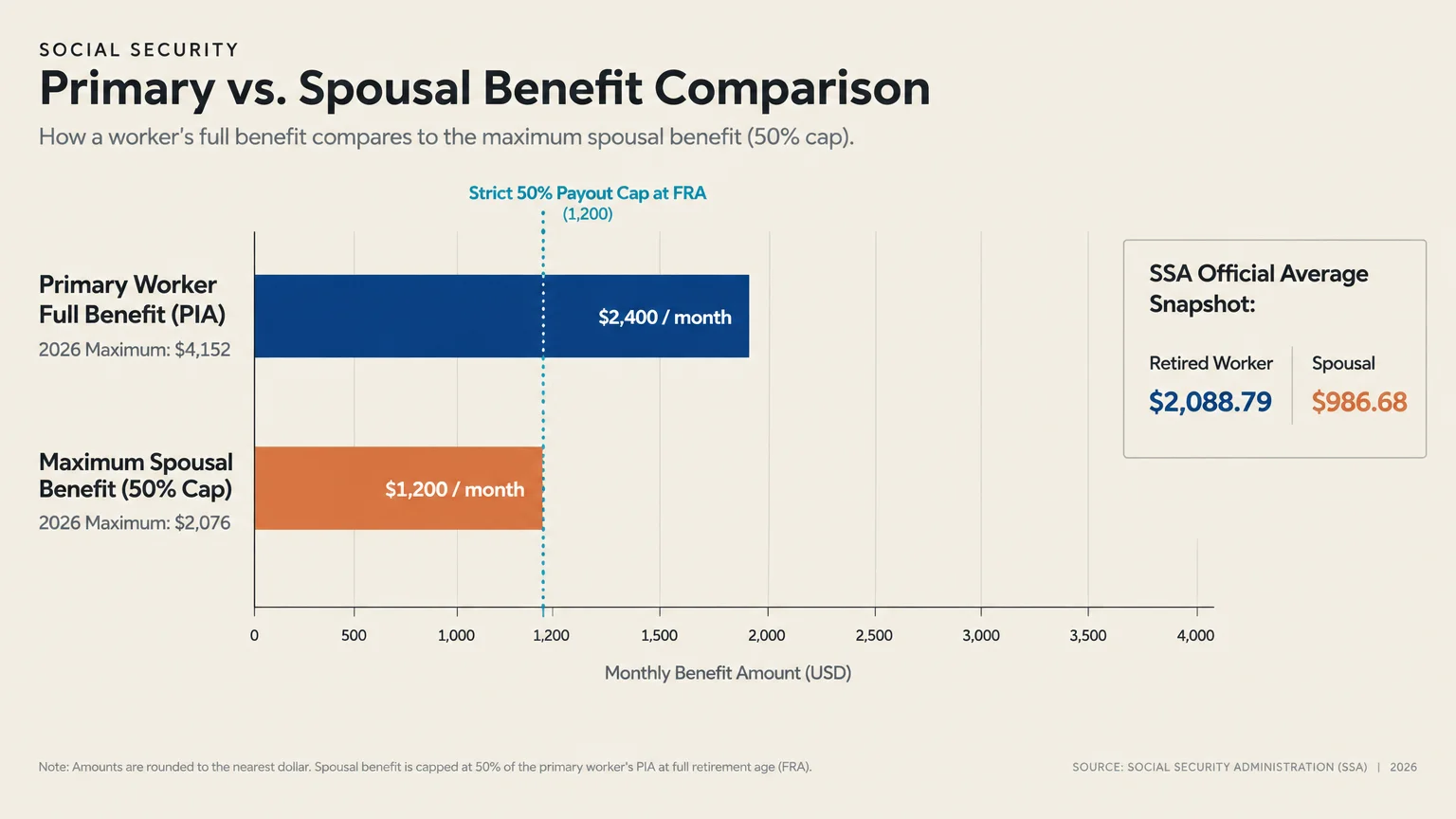
A Social Security spousal benefit provides monthly income based on your partner’s earnings record. The absolute maximum amount you can receive equals 50 percent of your partner’s Primary Insurance Amount (PIA).
The Primary Insurance Amount represents the monthly benefit your spouse earned at their Full Retirement Age (FRA). It does not reflect what your spouse currently collects if they claimed early or delayed.
For example, if your spouse’s PIA is $2,400 per month, your maximum spousal benefit is $1,200. You receive that maximum amount only if you claim at your own Full Retirement Age.
According to the Social Security Administration Monthly Statistical Snapshot, the average monthly spousal benefit sits at $986.68. For comparison, the average retired worker collects $2,088.79 per month.
For high earners retiring at Full Retirement Age in 2026, the maximum possible worker benefit is $4,152 per month. Consequently, the highest possible spousal benefit in 2026 is $2,076 per month.
Your spouse’s decision to delay claiming past their FRA does not increase your spousal benefit. Even if your spouse delays until age 70 to earn extra credits, your spousal calculation remains anchored to their baseline PIA.
2. Claiming Before Full Retirement Age Triggers a Permanent Cut
You can claim spousal benefits as early as age 62, provided your partner has already filed. However, claiming before your Full Retirement Age permanently slashes your monthly payout.
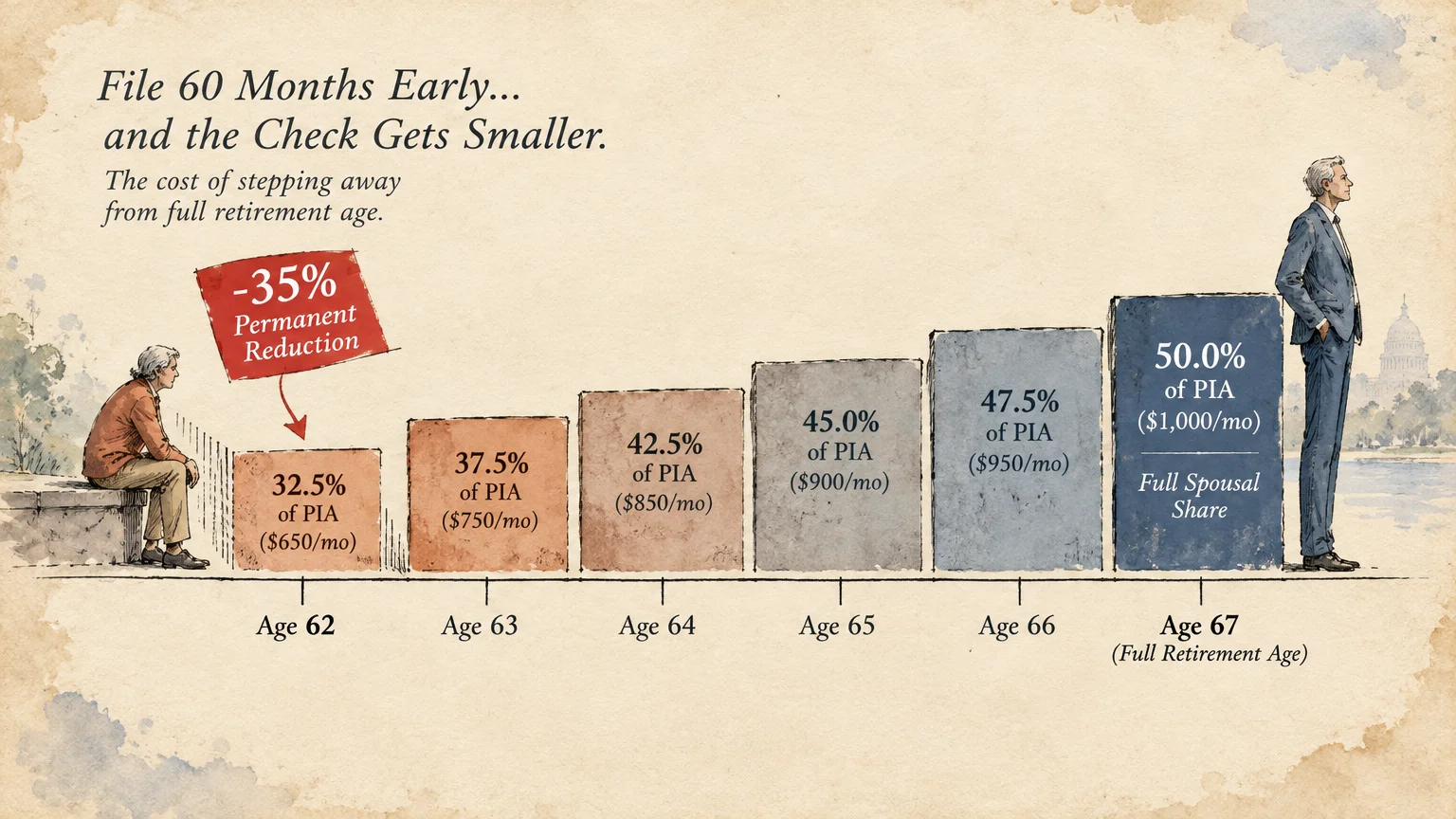
For anyone born in 1960 or later, Full Retirement Age is 67. If you file at age 62, your benefit drops from 50 percent to just 32.5 percent of your spouse’s PIA.
The reduction formula is exact and non-negotiable under federal law. The Social Security Administration reduces your benefit by 25/36 of 1 percent for each of the first 36 months before FRA.
For every additional month beyond 36 months, the agency deducts an additional 5/12 of 1 percent. If you file a full 60 months early at age 62, your reduction totals 35 percent of the spousal share.
The table below demonstrates how filing age impacts monthly income when the primary worker’s PIA is $2,000:
| Claiming Age | Percentage of Primary Worker’s PIA | Sample Monthly Benefit ($2,000 Worker PIA) | Lifetime Reduction vs. FRA |
|---|---|---|---|
| Age 62 | 32.50% | $650.00 | 35.0% reduction |
| Age 63 | 35.00% | $700.00 | 30.0% reduction |
| Age 64 | 37.50% | $750.00 | 25.0% reduction |
| Age 65 | 41.67% | $833.34 | 16.7% reduction |
| Age 66 | 45.83% | $916.67 | 8.3% reduction |
| Age 67 (FRA) | 50.00% | $1,000.00 | 0.0% reduction |
One critical exception exists for parents caring for a qualifying child. If you care for your spouse’s natural or adopted child who is under age 16 or disabled, age reductions do not apply.
In that scenario, you can receive benefits before age 62 without an early-claiming reduction penalty. However, your benefit terminates once the child turns 16 unless that child has a qualifying disability.
3. Delaying Past Full Retirement Age Earns Zero Delayed Credits
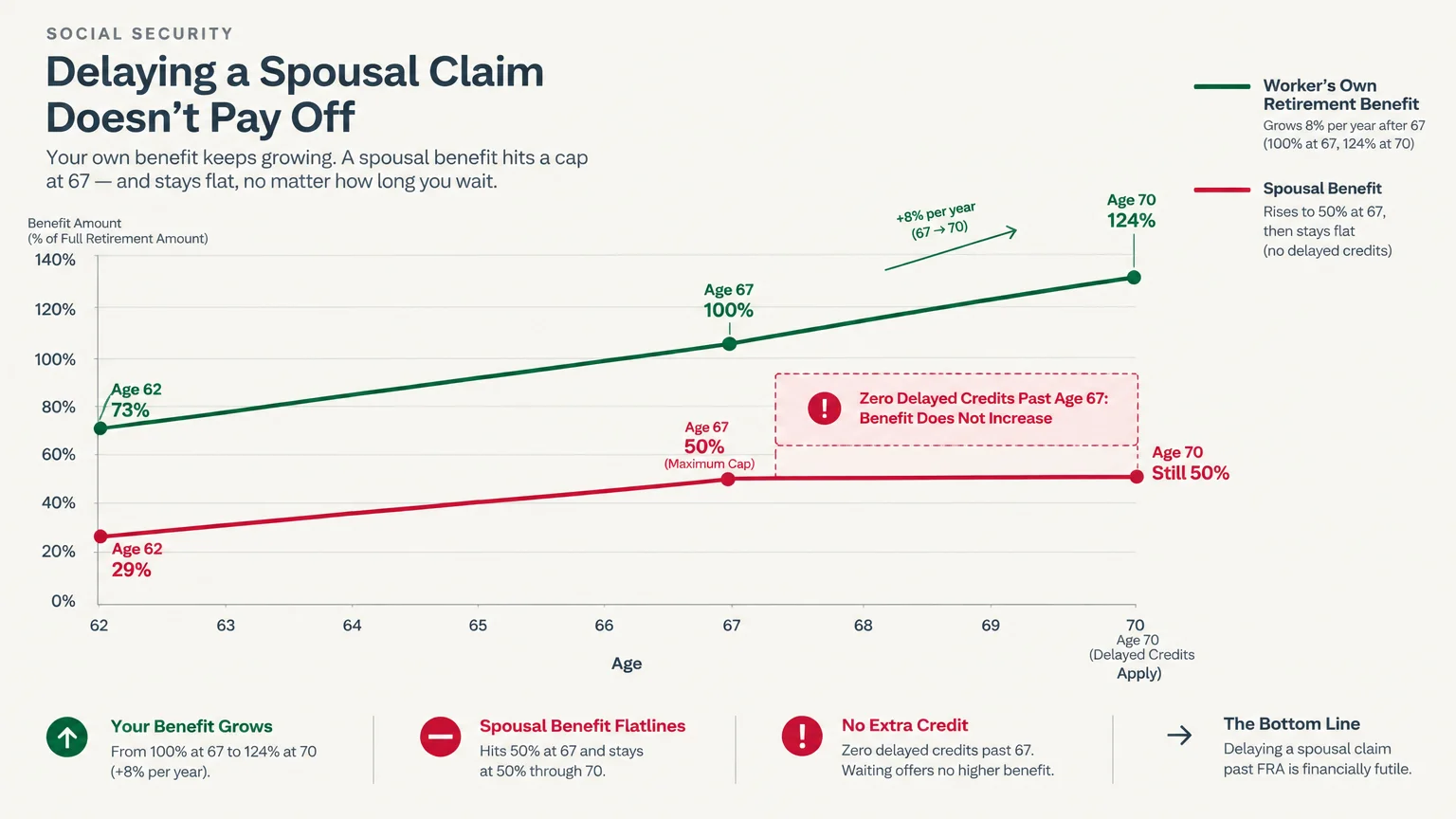
When you delay your own worker retirement benefit past Full Retirement Age, your payout grows by 8 percent per year until age 70. This powerful growth incentive does not apply to spousal benefits.
Spousal benefits reach their absolute peak at your Full Retirement Age. Waiting until age 68, 69, or 70 does not add a single cent to your monthly spousal payment.
If you plan to claim spousal benefits, delaying your application past age 67 simply surrenders money you could have collected. The Social Security Administration will not pay delayed retirement credits on a spousal claim.
Timing your filing requires clear communication between both partners. While the higher-earning spouse might delay to age 70 to maximize lifetime benefits, the lower-earning spouse should claim spousal benefits promptly upon hitting FRA.
4. “Deemed Filing” and Dual Entitlement Eliminate Double Dipping
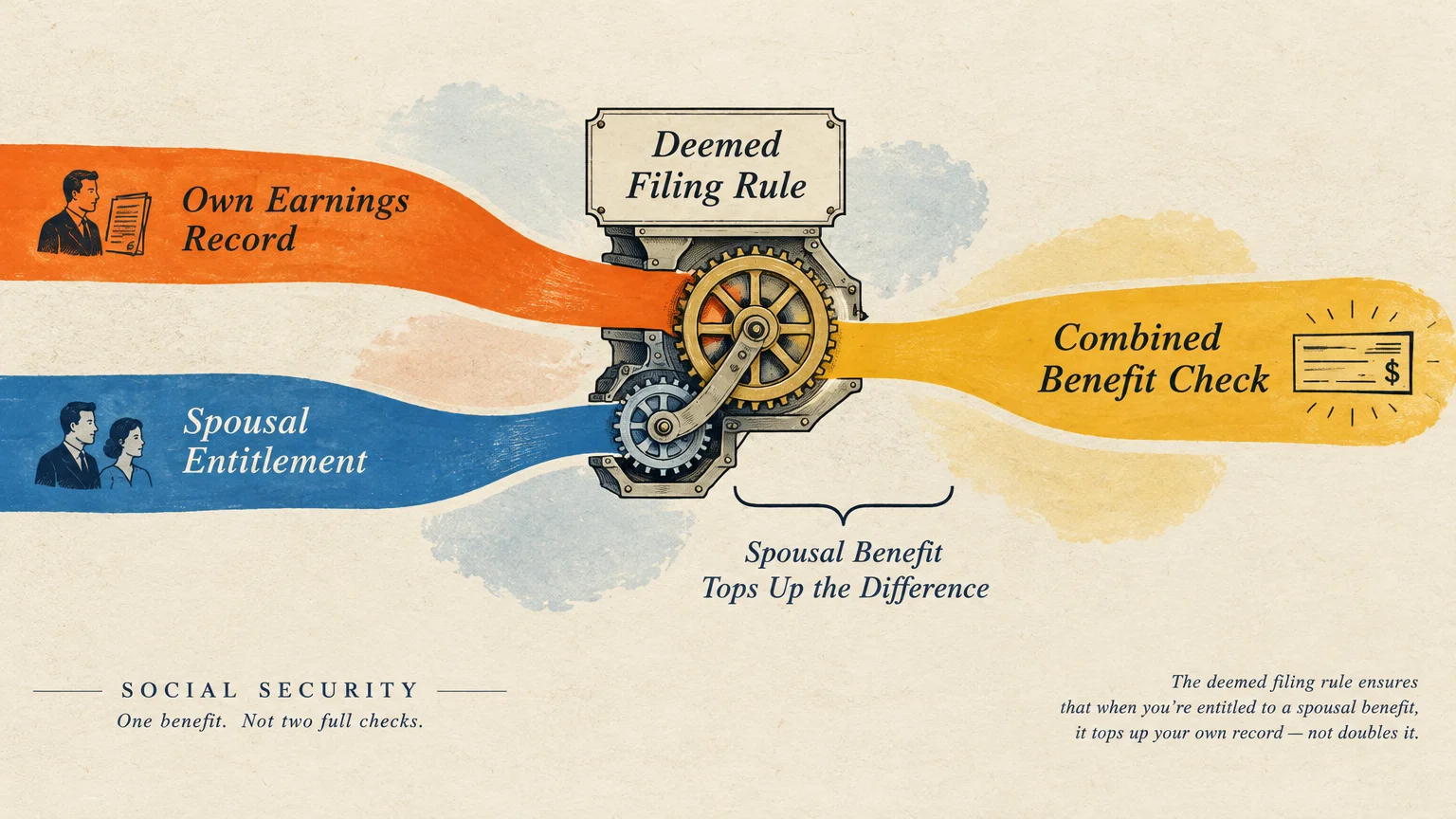
You cannot collect your own full retirement benefit alongside a full spousal benefit. Federal law enforces a policy known as “deemed filing” to prevent double dipping.
When you file for Social Security, the agency automatically treats your application as a claim for both your personal retirement benefit and any eligible spousal benefit. You cannot choose between them.
The agency calculates your payments through a process called dual entitlement. First, the agency calculates your personal retirement benefit based on your own lifetime earnings.
If your personal benefit exceeds 50 percent of your spouse’s PIA, you receive only your personal benefit. You receive nothing from the spousal benefit program because your own work record pays more.
If your personal benefit is less than the spousal benefit, the agency pays your worker benefit first. Then, it adds a supplementary “top-off” payment to equal the higher spousal amount.
Suppose your own work record qualifies you for $600 per month at FRA. If your spouse’s PIA is $2,000, your potential spousal benefit is $1,000.
The Social Security Administration will pay your $600 worker benefit plus a $400 spousal top-off. Your total monthly deposit equals $1,000, not $1,600.
In past decades, a loophole called the “restricted application” allowed filers to collect spousal checks while leaving their own benefits untouched to grow. Because anyone born before January 2, 1954, has passed age 70, that strategy is permanently closed for new applicants.

5. The Primary Worker Must Claim First (Unless You Are Divorced)
Under standard spousal benefit rules, you cannot collect on your current partner’s work record until they actively claim their own retirement benefits. Their application unlocks your eligibility.
Additionally, you must have been married for at least one continuous year before applying for spousal benefits. If your partner has not filed, you must wait, regardless of your personal age.
Divorced individuals operate under entirely different, more flexible guidelines. If you are divorced, you can claim benefits on your former spouse’s record without their permission or involvement.
To qualify for divorced spousal benefits, your marriage must have lasted for at least 10 consecutive years. Furthermore, you must currently remain unmarried and be at least 62 years old.
If you have been divorced for at least two continuous years, your ex-spouse does not need to be collecting benefits. As long as your ex is at least 62 and eligible, you can file independently.
Claiming benefits on an ex-spouse has zero impact on your ex-partner’s monthly check. It also does not reduce the benefits payable to your ex-spouse’s current partner or family.
If you remarry, your eligibility for divorced spousal benefits immediately ends. However, if your subsequent marriage ends due to divorce, annulment, or death, your eligibility on your first ex-spouse’s record revives.
6. Working While Receiving Early Benefits Triggers the Earnings Test
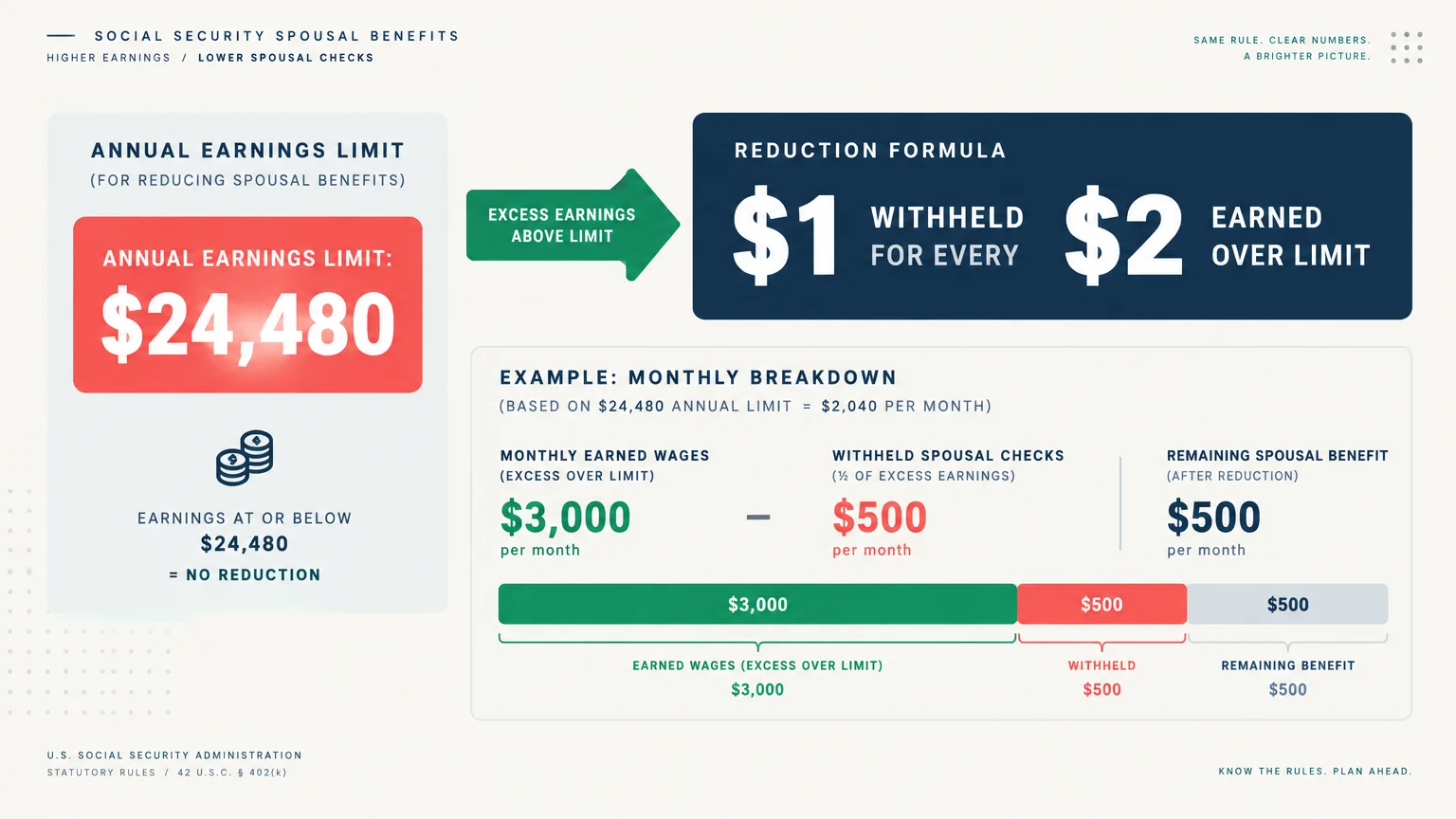
If you claim spousal benefits before reaching your Full Retirement Age and continue to work, your wages could trigger the Social Security Retirement Earnings Test. Earning too much money temporarily withholds your monthly payments.
For individuals who remain under Full Retirement Age for all of 2026, the annual earnings limit is $24,480 ($2,040 per month). In 2027, this threshold increases to $25,560 ($2,130 per month).
The Social Security Administration withholds $1 in benefits for every $2 you earn above the annual limit. These clawbacks apply whether you collect worker benefits or spousal benefits.
A higher limit applies during the calendar year you reach Full Retirement Age. In 2026, the earnings limit for the months leading up to your birthday month is $65,160 ($5,430 per month), rising to $67,920 ($5,660 per month) in 2027.
During that milestone year, the agency withholds $1 for every $3 you earn above the threshold. Once you reach your Full Retirement Age birthday month, the earnings test disappears entirely.
According to guidance from the Consumer Financial Protection Bureau, benefits withheld under the earnings test are not lost forever. When you reach FRA, the agency recalculates your monthly check upward to credit the withheld months.

7. The Social Security Fairness Act Eliminated the Pension Offset
For decades, public service employees faced severe penalties when trying to collect spousal Social Security benefits. A federal rule called the Government Pension Offset (GPO) drastically reduced or wiped out spousal benefits for public servants.
The GPO targeted retirees who received a government pension from non-Social Security-covered work. This affected hundreds of thousands of teachers, police officers, firefighters, and federal employees under older civil service retirement systems.
Under the old offset, the Social Security Administration reduced spousal benefits by two-thirds of the individual’s government pension amount. For many public servants, this reduction eliminated their spousal check completely.
That penalty is now history. On January 5, 2025, the Social Security Fairness Act was signed into law, permanently repealing the Government Pension Offset.
The repeal applies retroactively to January 2024. Public retirees can now collect the full spousal benefit they earned through their marriage, alongside their complete public pensions.
If a government pension previously blocked you from receiving spousal benefits, you should contact the Social Security Administration immediately. Eligible spouses can establish their monthly payments without the unfair two-thirds offset.
Spousal Benefits vs. Survivor Benefits: Key Differences
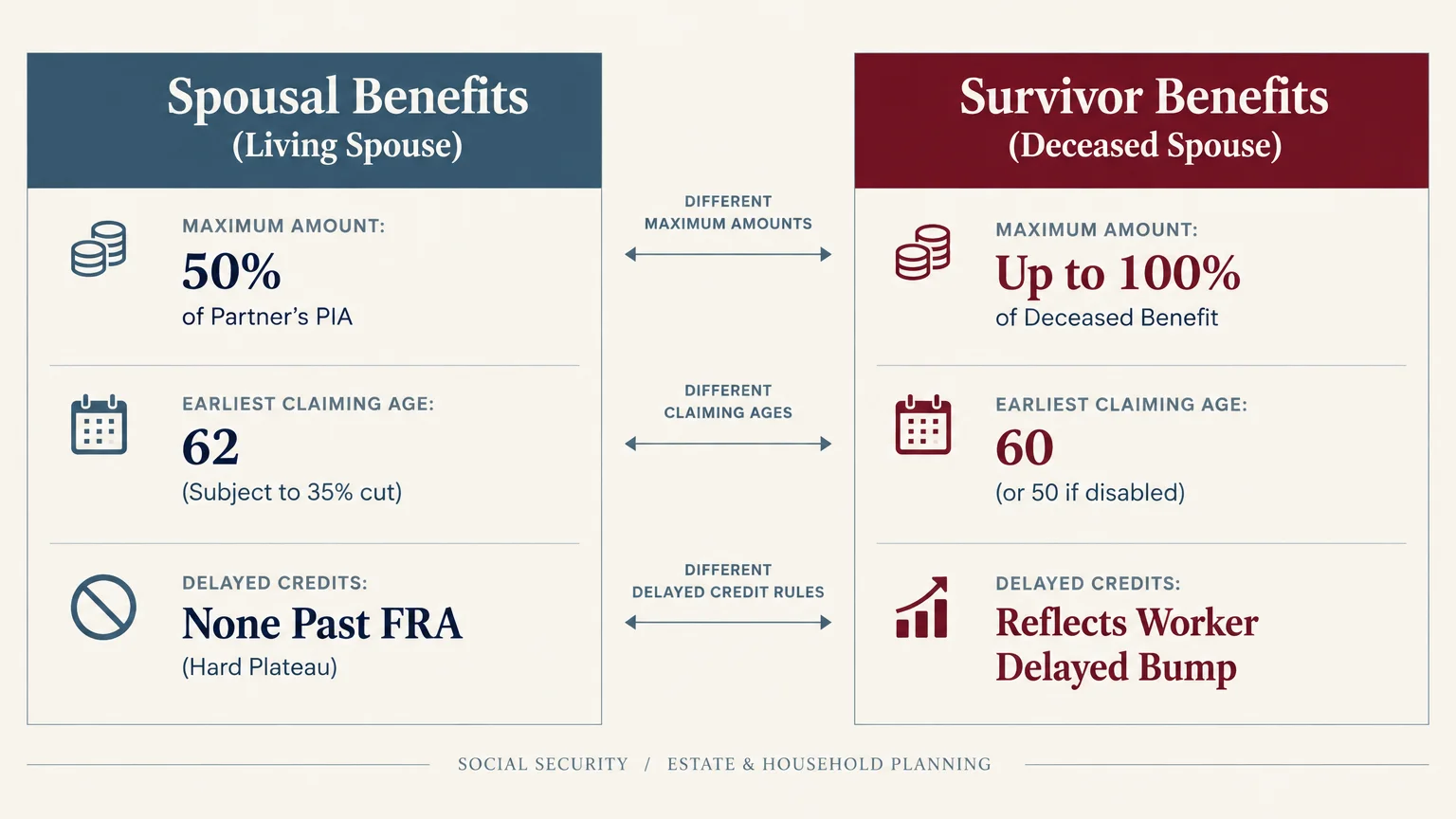
Many retirees confuse spousal benefits with survivor benefits, but the programs serve different purposes and follow distinct financial rules. Spousal benefits apply while both partners live; survivor benefits take effect when one spouse passes away.
When your spouse passes away, your spousal benefit terminates immediately. At that point, you transition to survivor benefits, which offer significantly larger monthly payouts.
While a spousal benefit caps at 50 percent of the worker’s PIA, a survivor benefit can reach 100 percent of what the deceased spouse collected. This includes any delayed retirement credits your spouse accumulated by waiting until age 70.
The rules governing claiming ages also differ. You can claim survivor benefits as early as age 60 (or age 50 if you have a qualifying disability), whereas spousal benefits require you to reach age 62.
Furthermore, deemed filing does not apply to survivor benefits. A surviving spouse can claim survivor benefits first while letting their own worker benefit grow, or claim their worker benefit first and switch to survivor benefits later.
Common Mistakes to Avoid When Claiming
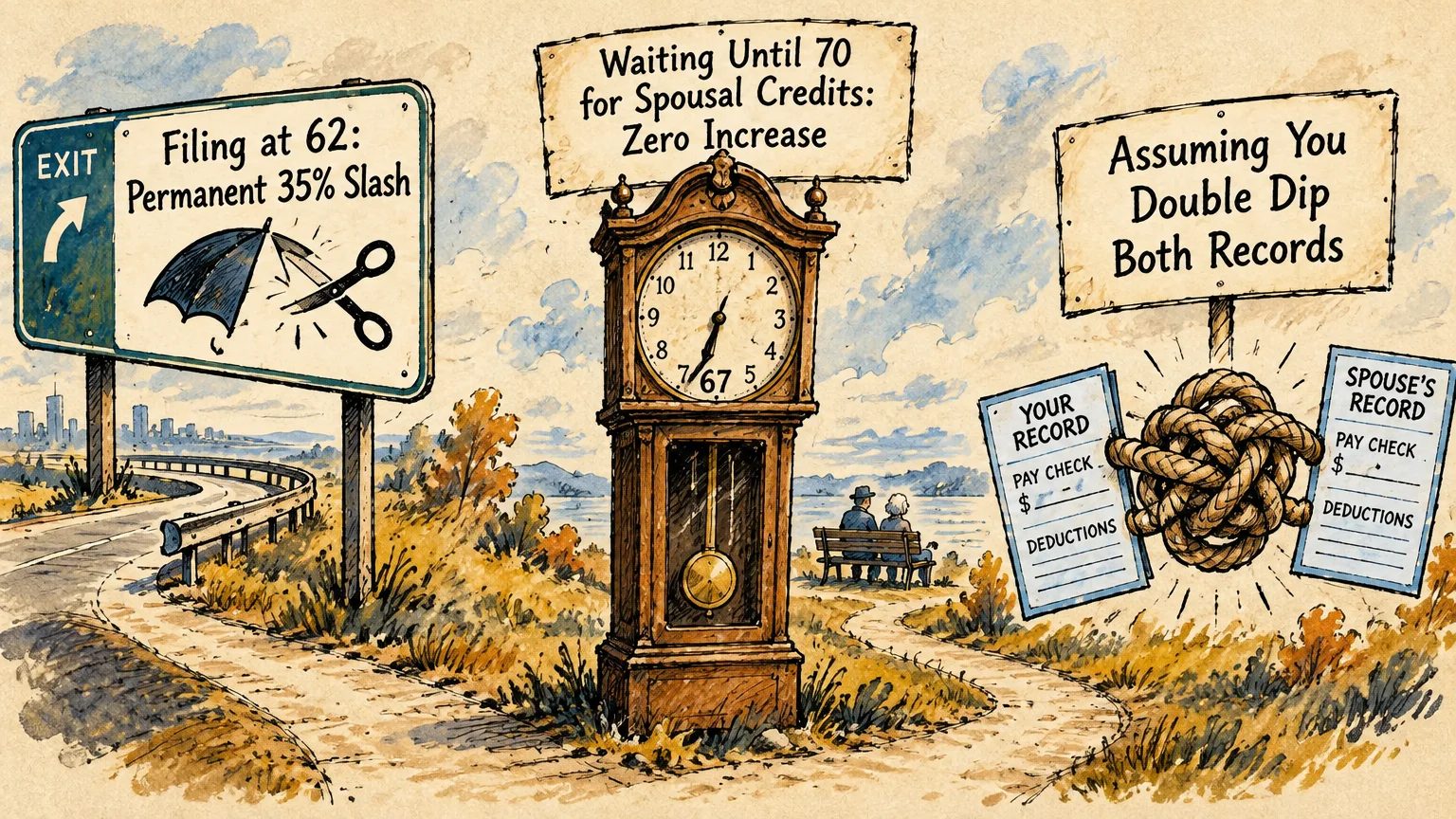
Navigating spousal benefits involves complex coordination. Avoiding these four common missteps protects your household cash flow throughout retirement:
Claiming at 62 Without Factoring in the Lifetime Cut: Filing the moment you turn 62 locks in a permanent 35 percent reduction to your spousal benefit. Unless you face urgent health or financial challenges, waiting until age 67 maximizes your monthly security.
Waiting Past Full Retirement Age to Claim: Unlike personal retirement benefits, spousal benefits do not accumulate delayed credits. Filing at age 70 instead of 67 results in three years of permanently lost household income.
Overlooking the Divorced Spouse Rule: Many divorcees assume they cannot touch an ex-partner’s benefits without their signature. If your marriage lasted 10 years and you remain unmarried, you can claim your share directly through the SSA without notifying your ex.
Ignoring the Retirement Earnings Test: If you claim spousal benefits early while earning a healthy wage, the earnings test will withhold substantial benefit checks. Keep your income below $24,480 in 2026 to avoid frustrating payment pauses.
Step-by-Step Guide: How to Claim Your Spousal Benefit
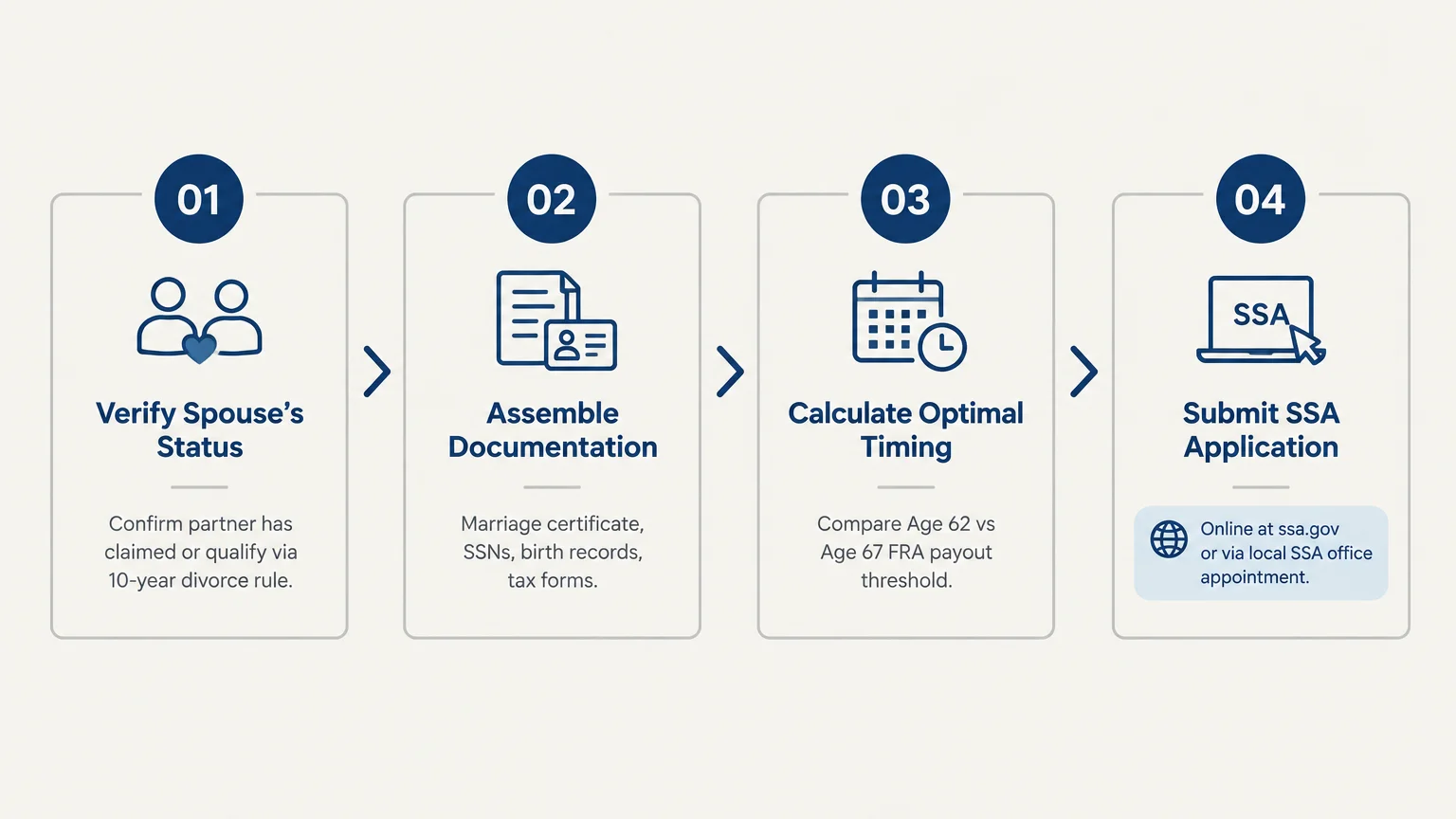
Applying for spousal benefits requires specific documentation and strategic timing. Following an organized roadmap ensures your application processes smoothly without costly delays.
First, verify your spouse’s filing status. In most cases, your partner must file for their own retirement benefits before the Social Security Administration accepts your spousal claim.
Second, gather all required legal documents. You need your birth certificate, your marriage certificate, and proof of U.S. citizenship or lawful residency status.
If you apply as a divorced spouse, you must provide your final divorce decree. The decree confirms your marriage lasted at least 10 consecutive years.
Third, decide on your claiming date. You can submit your application up to four months before you want your monthly benefits to begin.
Fourth, submit your application. You can complete the process online at SSA.gov, over the phone, or by scheduling an in-person meeting at your local Social Security field office.

Getting Expert Input
While the basic mechanics of spousal benefits appear straightforward, complex family dynamics and tax considerations often require personalized review. Consider professional guidance in these situations:
Significant Age Differences: If you and your spouse have a wide age gap, coordinating when each partner files impacts lifetime household income. A fee-only financial planner can model break-even scenarios for your exact ages.
Navigating Gray Divorce: If you are ending a long-term marriage late in life, consult a certified divorce financial analyst (CDFA). They will verify that your settlement preserves your access to spousal and survivor benefits.
Post-Fairness Act Pension Reviews: If you previously lost spousal benefits due to the Government Pension Offset, contact a Social Security claims specialist. They can help calculate retroactive back pay and restore proper monthly benefit amounts.
Frequently Asked Questions
Can a husband claim spousal benefits on his wife’s record?
Yes. Social Security spousal rules apply identically regardless of gender. A husband can receive up to 50 percent of his wife’s Full Retirement Age benefit if her record yields a higher payout than his own.
What happens to my spousal benefit if my partner dies?
Your spousal benefit ends, and you transition to a survivor benefit. If you have reached Full Retirement Age, your survivor benefit equals up to 100 percent of the monthly amount your partner was receiving.
Can I collect a spousal benefit if I never worked outside the home?
Yes. You do not need personal Social Security work credits to receive a spousal benefit. You qualify entirely based on your partner’s employment history and credit accumulation.
Will claiming on my ex-spouse notify them or reduce their check?
No. The Social Security Administration does not notify your former spouse when you file on their record. Furthermore, your claim will not reduce their monthly payment or the benefits of their current spouse.
Maximizing Social Security spousal benefits requires thoughtful timing and careful coordination between both partners. By understanding early-claiming penalties and earnings test thresholds, you can secure the highest possible guaranteed income for your household.
The information here is meant for educational purposes. Specific circumstances—including health conditions, finances, location, and goals—may require different approaches. When in doubt, consult a licensed professional or check official sources directly.
Last updated: October 2026. Rules, prices, and details change—verify current information with official sources before acting on it.









Leave a Reply