

You do not need an extravagant budget to turn grocery runs and electric bills into free flights. Travel rewards cards let you convert routine daily purchases into valuable airline miles and hotel stays.
The trick lies in finding a card that matches your spending patterns without trapping you in costly annual fees. A properly selected card can offset its own carrying cost several times over.
Whether you want simple cash-equivalent travel redemptions or premium airline transfer partners, the right account accelerates your goals. Here is how today’s top travel cards compare.
The Essentials: Choosing Your Travel Card Strategy
Every travel rewards card fits into one of three distinct categories. Picking the right tier depends directly on your spending habits and travel frequency.
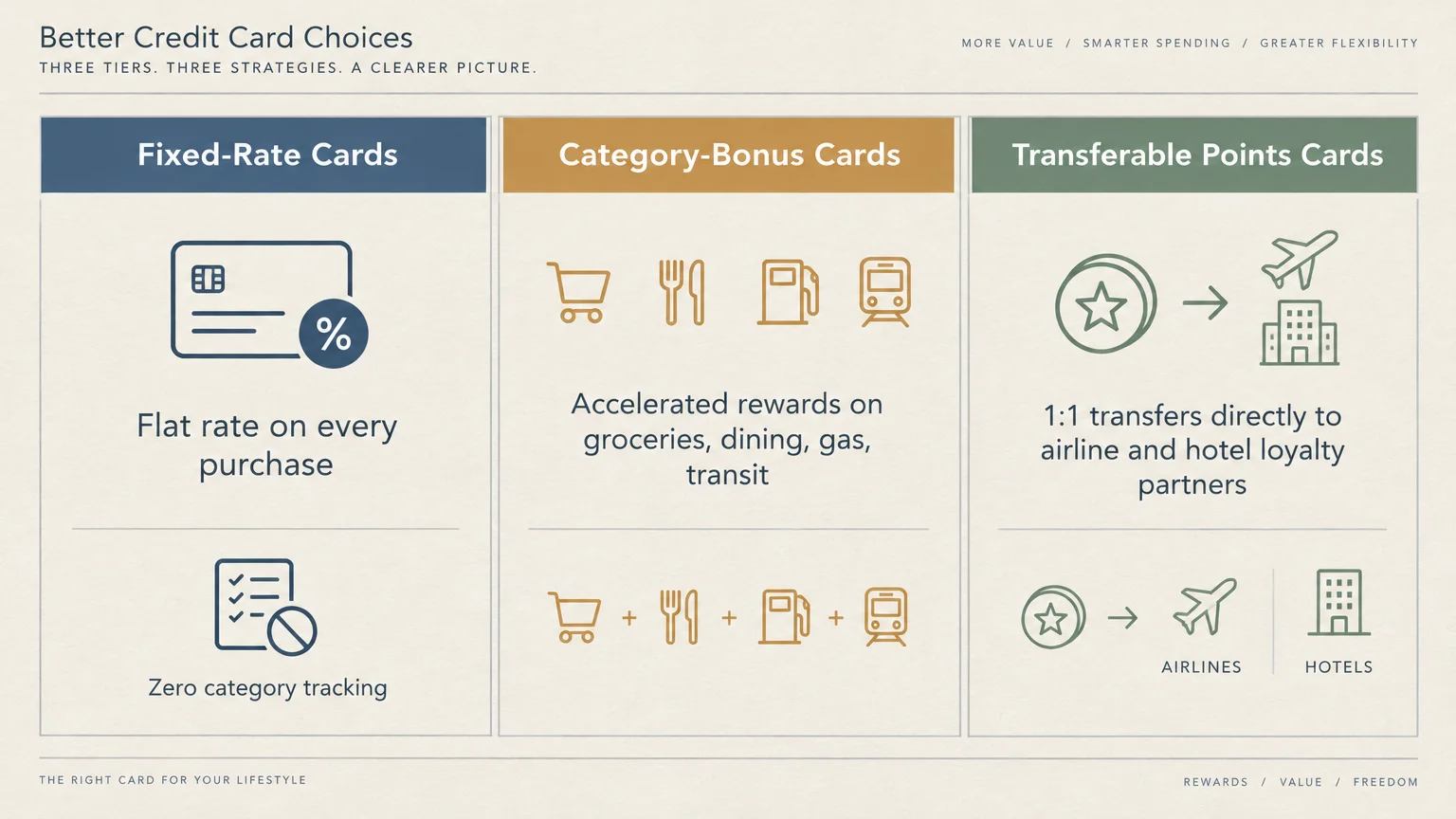
Budget-conscious travelers typically achieve the highest return on investment by focusing on three primary structures:
- Fixed-Rate Cards: Earn a flat rate on every dollar you spend, eliminating the need to track rotating categories.
- Category-Bonus Cards: Award accelerated points on everyday essentials like groceries, dining, gas, and transit.
- Transferable Points Cards: Allow you to move points directly to airline and hotel loyalty programs for maximum redemption value.
Before applying for any card, examine your monthly household expenses. A card offering massive rewards on flights does little good if most of your cash goes to utility bills and groceries.

The Best Mid-Tier Travel Cards for Everyday Spenders ($95 Annual Fee)
Mid-tier travel cards hit the sweet spot for most households. They offer robust rewards rates and useful travel protections while keeping yearly carrying costs under one hundred dollars.
Chase Sapphire Preferred® Card
The Chase Sapphire Preferred® Card underwent a significant refresh in June 2026 that substantially enhanced its baseline value. It remains an industry benchmark for mid-tier travel rewards.
Cardholders pay a $95 annual fee, which is easily offset by new and expanded statement credits. The card now includes an enhanced $100 annual Chase Travel hotel credit, up from the previous $50 credit.
It also provides an application statement credit of up to $120 for Global Entry, TSA PreCheck, or NEXUS every four years. That addition matches perks historically reserved for luxury products.
Chase expanded its bonus earning categories to match everyday spending realities. You earn 3x points on gas stations, electric vehicle (EV) charging, and vacation home rentals alongside existing bonus categories.
You continue to earn 5x points on travel booked through Chase Travel, 3x on dining, 3x on select streaming services, and 3x on online grocery purchases. All other eligible purchases earn 1x points.
Chase also added a complimentary one-year subscription to Apple TV, valued at $180, when activated by December 31, 2026. Points transfer at a 1:1 ratio to leading partners like World of Hyatt and United Airlines.
Capital One Venture Rewards Credit Card
The Capital One Venture Rewards Credit Card prioritizes simplicity. It charges a $95 annual fee and eliminates the mental overhead of tracking bonus categories.
You earn an unlimited flat 2x miles on every purchase you make, regardless of the merchant category. You also earn 5x miles on hotels and rental cars booked through Capital One Travel.
Miles can be redeemed at a flat rate of one cent each as a statement credit against recent travel purchases. Alternatively, you can transfer miles to over a dozen airline and hotel partners.
Citi Strata Premier℠ Card
The Citi Strata Premier℠ Card charges a $95 annual fee and acts as a workhorse for household budgets. It targets broad everyday spending categories rather than niche travel portals.
Cardholders earn 3x ThankYou® points per dollar on flights, hotels, restaurants, supermarkets, and gas stations. Earning triple points on both groceries and fuel makes points accumulation fast and consistent.
Points transfer directly to partner programs such as Avianca LifeMiles, Virgin Atlantic, and Choice Privileges. This flexibility makes it a powerful option for travelers seeking affordable redemption options.
Wells Fargo Autograph Journey℠ Card
The Wells Fargo Autograph Journey℠ Card charges a $95 annual fee while bypassing restrictive booking portal rules. You earn accelerated rewards on direct travel bookings.
You earn 5x points on hotels, 4x points on airline purchases, and 3x points on other travel and dining expenses. All other purchases earn 1x points per dollar.
Because you book directly with airlines and hotels, you still earn loyalty points within those individual hotel or airline loyalty programs. This double-dip potential provides significant long-term value.

Top No-Annual-Fee Options to Build Your Travel Fund
If you want to avoid annual fees entirely, several zero-fee cards offer respectable rewards. These cards let you build a travel nest egg without any recurring overhead.
Wells Fargo Autograph® Card
The standard Wells Fargo Autograph® Card carries a $0 annual fee and delivers exceptional category breadth. It serves as an ideal starter card for budget travelers.
You earn 3x points on dining, travel, gas stations, transit, select streaming services, and active phone plans. Points do not expire as long as your account remains open.
You can redeem points toward travel purchases or transfer them to select airline partners. The card also includes cell phone protection when you pay your monthly wireless bill with it.
Discover it® Miles
The Discover it® Miles card features a $0 annual fee and delivers straightforward rewards. You earn an unlimited flat 1.5x miles per dollar on every single purchase.
Discover matches all miles earned at the end of your first year on a 1:1 basis. That effectively yields an impressive 3% return on all spending during year one.
You can redeem your miles at one cent each as a direct cash deposit or as a travel statement credit. The card does not carry foreign transaction fees.
Bilt Blue Card
Housing costs often represent a household’s largest monthly outflow. The Bilt Rewards program allows renters and mortgage holders to earn points on housing payments without transaction fees.
Following the discontinuation of the original Wells Fargo-issued Bilt Mastercard on February 7, 2026, Cardless launched a revised lineup. The entry-level tier is the Bilt Blue Card, which charges a $0 annual fee.
The card enables you to earn rewards points on qualifying rent and mortgage payments. You can transfer those points directly to high-profile airline and hotel partners.
Premium Cards: Calculating Net Cost Against Heavy Travel Perks
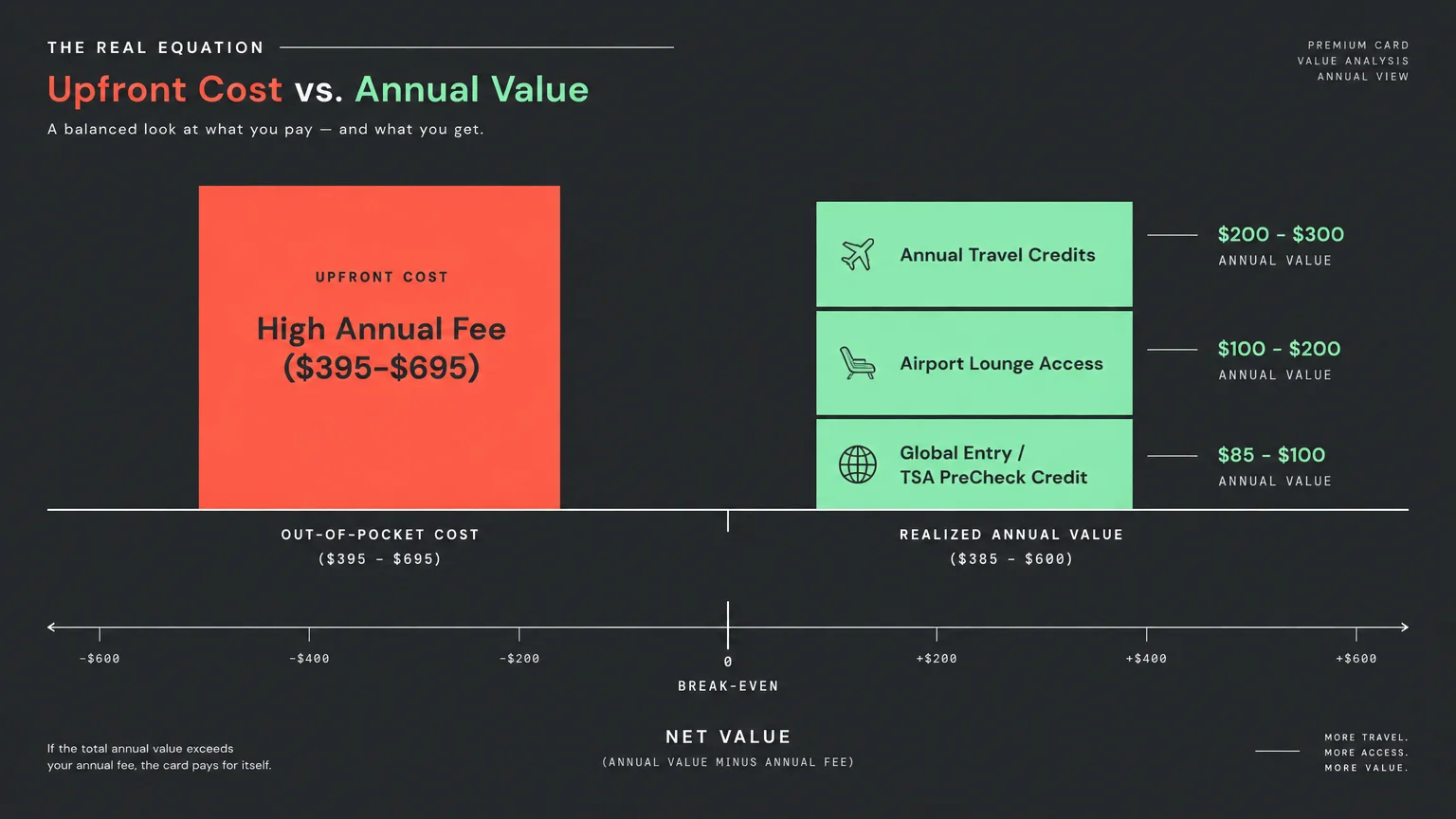
Premium cards feature steep upfront annual fees, but their travel credits can significantly lower the net cost. Frequent flyers often find these cards deliver hundreds of dollars in surplus value.
Capital One Venture X Rewards Credit Card
The Capital One Venture X Rewards Credit Card offers the most accessible pricing among luxury travel products. It carries a $395 annual fee, which sits well below competing premium cards.
Cardholders receive an annual $300 credit for bookings made through Capital One Travel. You also receive 10,000 bonus anniversary miles each year, worth at least $100 toward travel bookings.
These two perks effectively offset the entire $395 fee before accounting for other benefits. You also earn 10x miles on hotels and car rentals and 5x miles on flights via Capital One Travel.
Everyday spending earns a flat 2x miles per dollar. The card also provides complimentary access to Capital One Lounges and participating Priority Pass airport lounges worldwide.
American Express® Gold Card
The American Express® Gold Card charges a $325 annual fee and focuses heavily on everyday food purchases. It functions as an everyday points-generating engine for households.
You earn 4x Membership Rewards® points at restaurants worldwide, capped at $50,000 per calendar year. You also earn 4x points at U.S. supermarkets, capped at $25,000 per calendar year.
The card provides up to $120 in annual Uber Cash, distributed in monthly $10 increments for rides or food orders. Note that American Express ended its Corporate Advantage discount program on August 27, 2026.
The Luxury Tier: Chase Sapphire Reserve® and Amex Platinum
The most expensive premium cards have seen major price increases. The Chase Sapphire Reserve® now carries a $795 annual fee, offset by an easy-to-use $300 annual travel credit and 8x points on Chase Travel.
The Platinum Card® from American Express carries an $895 annual fee. While expensive, it offers large welcome incentives, with introductory bonuses reaching 175,000 Membership Rewards points after spending $12,000 in six months.
Unless you reliably utilize their specific lifestyle credits, these high-fee cards can easily drain a budget. Mid-tier cards remain a far safer bet for the average traveler.

Specialized Plays: Rent Payments and Airline Milestones
Beyond general travel cards, targeted cards solve specific budget challenges. Timing your applications around program rule updates can unlock substantial savings.
The Expanded Bilt Cardless Lineup
Cardless now manages the Bilt Rewards credit card portfolio across three distinct pricing tiers. Each tier serves a different level of housing spending and travel engagement.
The Bilt Blue Card charges a $0 annual fee for basic housing rewards. The mid-tier Bilt Obsidian Card costs $95 annually, while the luxury Bilt Palladium Card carries a $495 annual fee.
These cards allow you to route monthly rent or mortgage checks through your account without the typical 3% payment processing fee. That converts mandatory housing overhead into vacation currency.
Southwest Airlines Companion Pass Deadline
Budget travelers frequently use the Southwest Airlines Companion Pass to fly a designated partner for virtually free, minus mandatory government taxes. However, a major rule change takes effect soon.
Starting in 2027, points earned from Southwest credit card welcome bonuses will no longer count toward Companion Pass qualification. That marks a permanent shift in how the pass is earned.
If you plan to leverage a credit card welcome bonus to earn the pass, you must apply and receive approval by December 2, 2026. Missing this cutoff will make securing the pass significantly harder.
IHG One Rewards Hotel Strategy
Hotel-specific cards offer outsized value through annual free-night certificates. Chase and IHG revamped their lineup in October 2026 with the introduction of the IHG One Rewards Premier Select Credit Card.
This premium card carries a $350 annual fee, a 200,000-point introductory bonus, and an anniversary free night worth up to 60,000 points. Meanwhile, the standard IHG One Rewards Premier Credit Card retains its affordable $99 annual fee.
Head-to-Head Comparison of Top Travel Rewards Cards
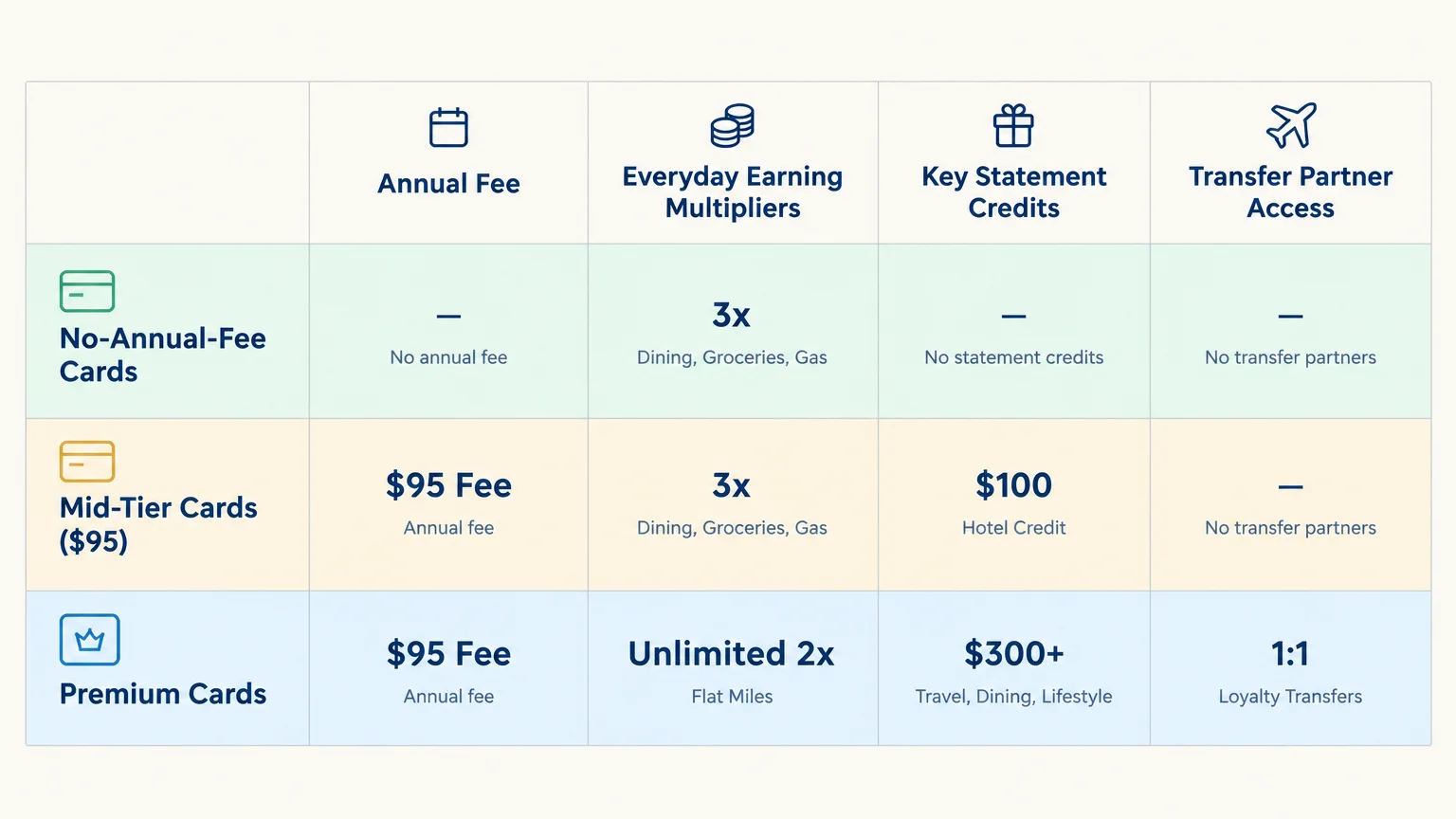
Comparing annual fees against reward structures clarifies which card fits your budget. Here is how the top options stack up side by side.
| Card Name | Annual Fee | Top Earning Categories | Key Travel Credits | Best Strategy |
|---|---|---|---|---|
| Chase Sapphire Preferred® | $95 | 3x gas, EV charging, dining, groceries | $100 hotel credit; up to $120 Global Entry | All-around everyday spend |
| Capital One Venture | $95 | Flat 2x miles on everything | Up to $120 Global Entry / PreCheck | Hassle-free flat earning |
| Citi Strata Premier℠ | $95 | 3x gas, groceries, dining, flights, hotels | $100 annual hotel savings benefit | High grocery and fuel spend |
| Wells Fargo Autograph Journey℠ | $95 | 5x hotels, 4x airlines, 3x travel & dining | $50 annual airline statement credit | Direct travel bookings |
| Wells Fargo Autograph® | $0 | 3x dining, travel, gas, transit, streaming | None | Zero-fee category earning |
| Capital One Venture X | $395 | 10x hotels/cars, 5x flights, 2x other | $300 travel credit; 10k bonus miles | Frequent airport travel |
| American Express® Gold | $325 | 4x dining (up to $50k), 4x groceries (up to $25k) | $120 Uber Cash | Heavy food spending |
Review this grid against your current monthly spending habits. The right card should reward the purchases you already make without forcing artificial spending.
How Transfer Partners Turn Ordinary Points into High-Value Bookings
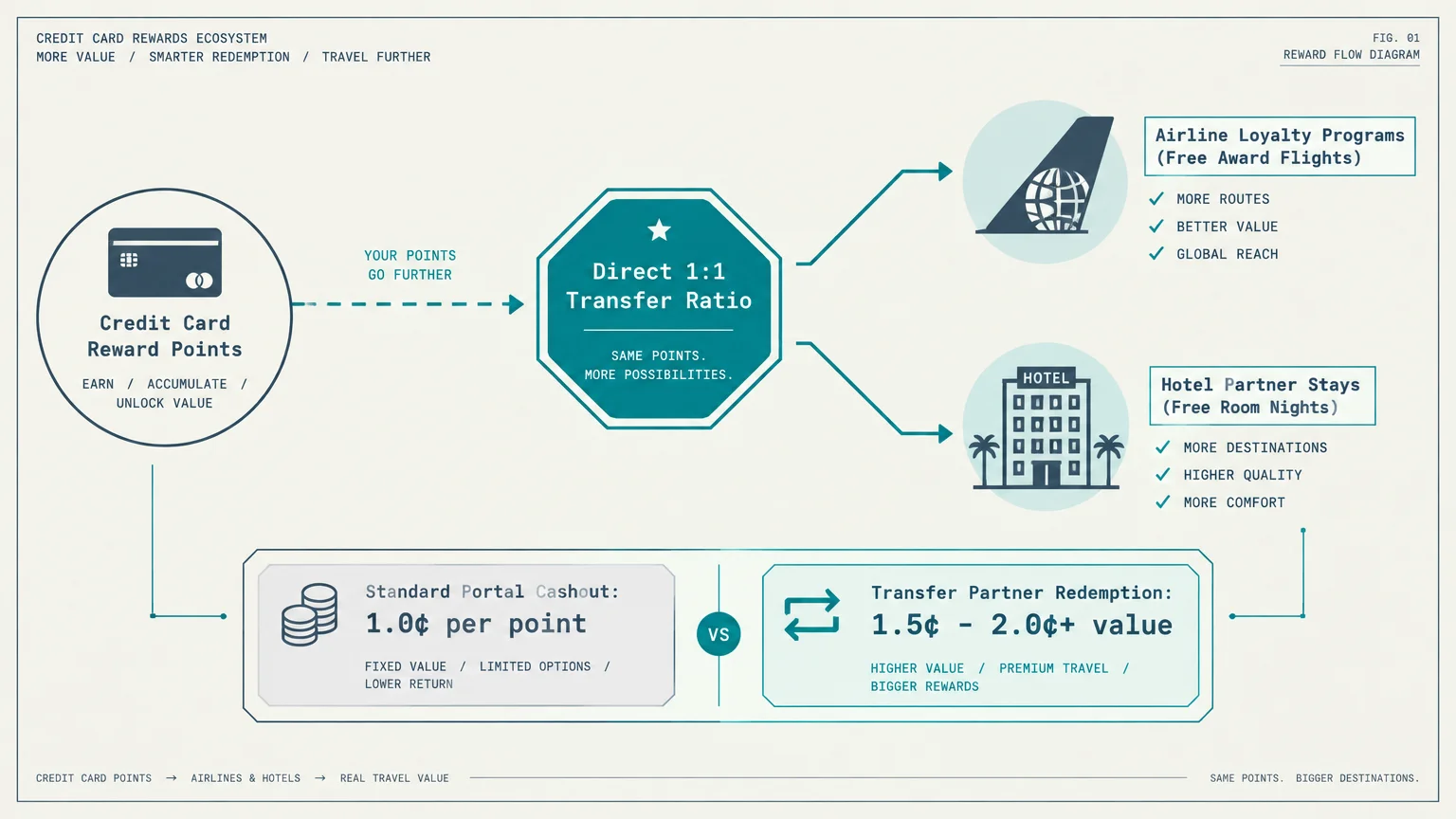
Most beginners redeem travel points directly through a bank’s booking portal for a flat value of one cent per point. While simple, this approach leaves substantial value on the table.
Transferable currency programs—such as Chase Ultimate Rewards, Capital One Miles, and Citi ThankYou Rewards—allow you to move points directly to partner airlines. This unlocks award chart sweet spots.
For example, transferring 30,000 points to an airline program might book a transcontinental flight that costs $600 in cash. That yields a redemption value of two cents per point.
According to trusted traveler program guidelines from U.S. Customs and Border Protection, Global Entry membership costs $120 for five years. Using card credits for these fees frees up cash for actual travel costs.
Keep your points in the flexible bank program until you confirm award seat availability with the airline. Once points transfer to an airline, you cannot move them back to your credit card.
Financial Reality: APRs, Fees, and Pending Legislation
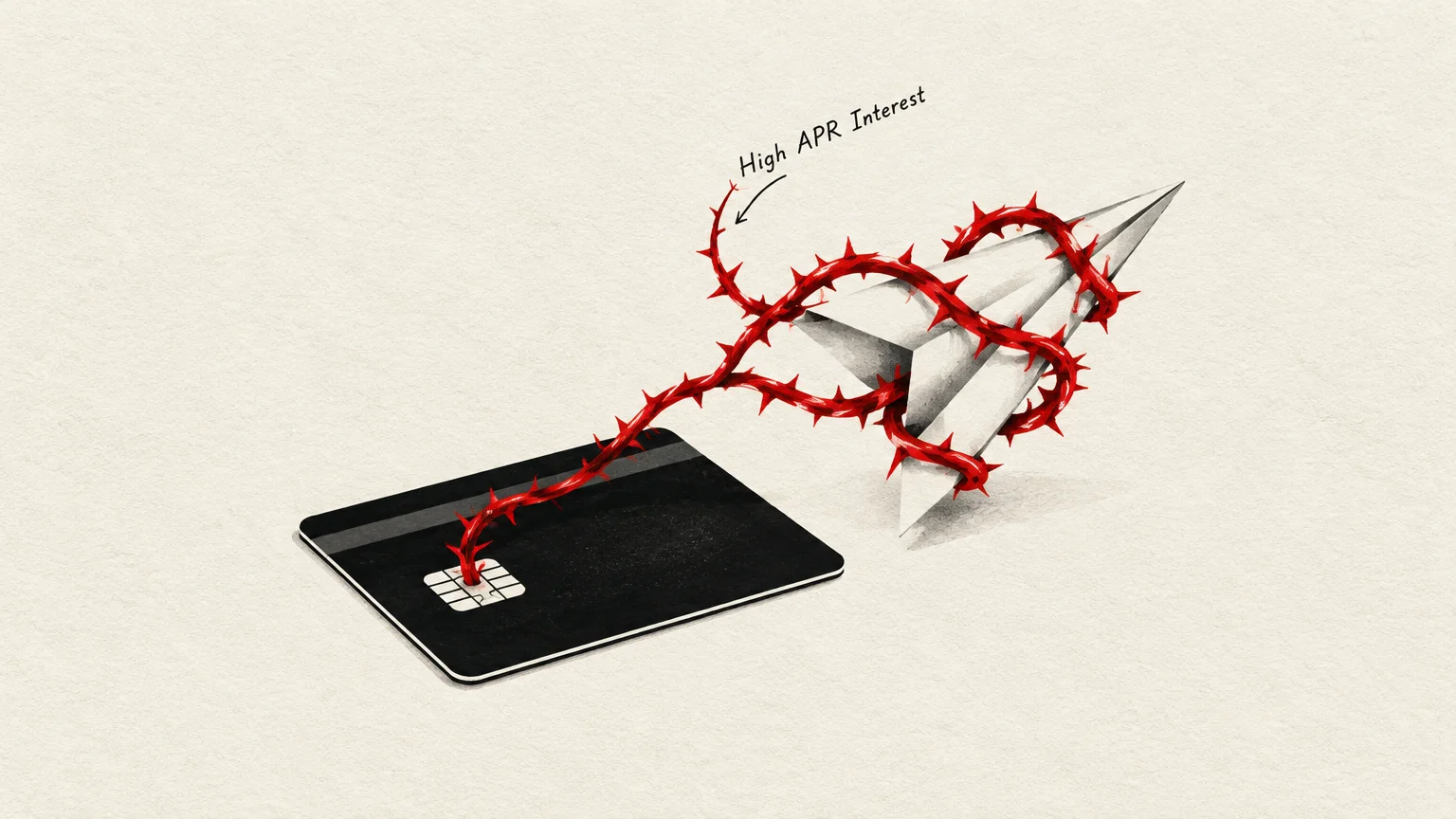
Travel rewards cards offer valuable perks, but their financial mechanics require strict discipline. Carrying a balance completely erases the value of any points you earn.
Official data from the Federal Reserve consumer credit reports shows the average APR on credit card accounts assessed interest reached 22.36% in August 2026. Across all accounts, the average APR stood at 21.19% in the third quarter of 2026.
A central bank rate increase of 25 basis points on September 16, 2026, brought the U.S. Prime Rate to 7.00%. If you pay 22% interest to earn 2% back in travel rewards, you are losing money on every transaction.
Late payment penalties remain steep. The Consumer Financial Protection Bureau (CFPB) previously attempted to cap late fees at $8, but a federal court vacated that rule on April 15, 2025.
Standard credit card late fees remain at $30 to $41 per occurrence. Congress introduced the Credit Card Fairness Act in January 2026 to revive the $8 fee limit, but standard penalties remain active today.
Meanwhile, the Credit Card Competition Act of 2026 was reintroduced in January 2026 with bipartisan support. The bill seeks to lower merchant swipe fees by mandating competing payment routing networks.
Major financial institutions caution that reduced interchange fees could lead banks to scale back travel rewards programs. Maximizing travel points now protects you against potential future program devaluations.

Common Mistakes to Avoid
Navigating travel credit cards requires proactive account management. Avoiding common pitfalls ensures your rewards program remains fully profitable.
- Carrying a Revolving Balance: Never carry a monthly balance on a rewards card. High interest rates eliminate any rewards value within weeks.
- Manufactured Spending for Bonuses: Do not buy items you do not need simply to hit an introductory spending threshold. That turns rewards into an unnecessary expense.
- Letting Statement Credits Expire: Cards like the Chase Sapphire Preferred and Amex Gold provide annual or monthly credits. Set calendar reminders so these credits do not go unused.
- Ignoring the Southwest 2027 Rule: If you want to earn the Companion Pass via credit card welcome bonuses, secure your card before the December 2, 2026 cutoff.
- Hoarding Rewards Points: Airline loyalty programs frequently devalue their award charts. Treat points like perishable currency and redeem them rather than stockpiling them for years.
Establishing automated balance payments protects both your credit score and your budget. Treating your card like a debit account guarantees positive returns.

Getting Expert Input
While travel credit cards offer practical consumer perks, complex financial situations may require professional guidance. Consider consulting a professional in these specific scenarios:
- Managing Business vs. Personal Travel Deductions: If you use personal cards for deductible work travel, consult a certified public accountant (CPA) to ensure compliant bookkeeping.
- Resolving Credit Utilization Challenges: If applying for new rewards accounts drops your credit score before a mortgage application, speak with a licensed credit counselor.
- Navigating High-Debt Transitions: If you carry high-interest revolving balances, consult a nonprofit credit counselor rather than opening new rewards cards.
- Structuring Estate Distribution of Points: Large balances of airline miles and bank points require specific estate planning language to ensure heirs can inherit them.
Financial professionals help ensure your credit management aligns with broader wealth-building and tax-reduction strategies.
Frequently Asked Questions
What credit score do I need for the best travel rewards cards?
Most mid-tier and premium travel cards require a good to excellent credit score. Generally, you need a FICO score of 670 or higher, with the best approval odds starting above 720.
Are travel credit cards worth it if I only take one trip a year?
Yes, provided the card has a low or zero annual fee. Mid-tier cards with useful credits can pay for themselves, allowing your everyday grocery and gas spending to fund that yearly trip.
Do credit card travel points expire?
Points earned in major bank programs like Chase Ultimate Rewards or Capital One Miles do not expire as long as your account remains open and in good standing.
Should I pick a cash-back card or a travel rewards card?
Choose cash back if you prefer simple statement credits and want no maintenance. Choose a travel card if you want to leverage transfer partners for higher redemption value on flights and hotels.
Final Takeaway
Earning travel rewards does not require high spending or luxury tastes. Aligning a card with your highest budget categories—like gas, groceries, or housing—turns unavoidable daily costs into meaningful travel savings.
Always pay your balance in full each month to prevent interest charges from eroding your earnings. This is general informational content based on widely accepted guidance. Individual results vary. Verify current details—rules, prices, eligibility, regulations—with official sources before making important decisions.
Last updated: October 2026. Rules, prices, and details change—verify current information with official sources before acting on it.









Leave a Reply