

Routine expenses quietly drain retirement income when service plans renew automatically year after year. Conducting a focused annual bill review protects your fixed budget and stops subtle price creep before it compounds.
Service providers alter rate schedules, local tax districts update exemptions, and federal healthcare rules shift regularly. Ignoring these recurring updates means paying hundreds or thousands of dollars in unnecessary expenses.
Taking control of recurring bills takes only an afternoon of disciplined financial review. Double-checking your accounts ensures you keep more of your hard-earned retirement savings right where they belong.
1. Medicare Part D and Medicare Advantage Plans
Health insurance represents one of the largest ongoing expenses in retirement. Prescription drug formularies and provider networks shift every January, impacting your wallet.
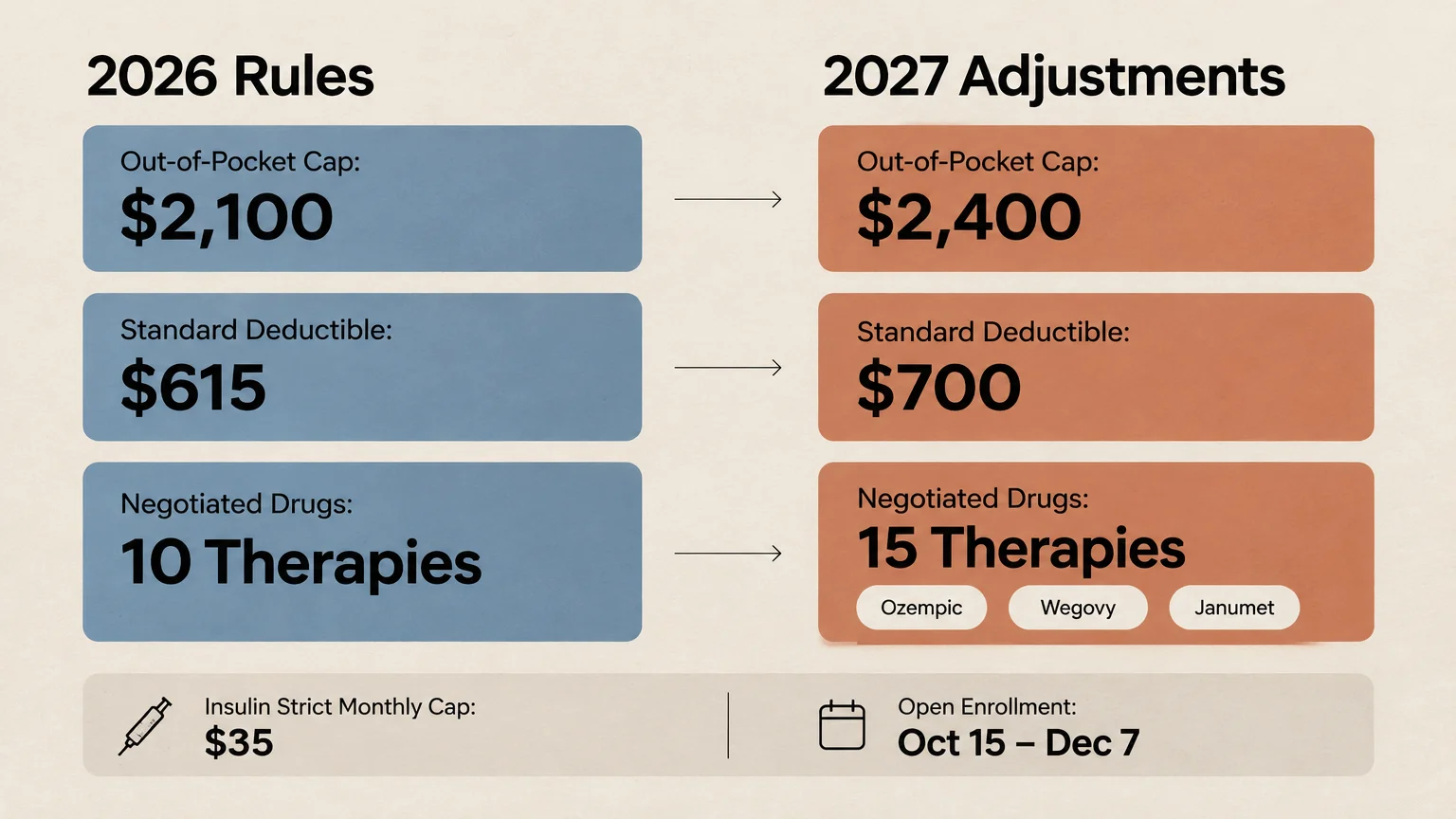
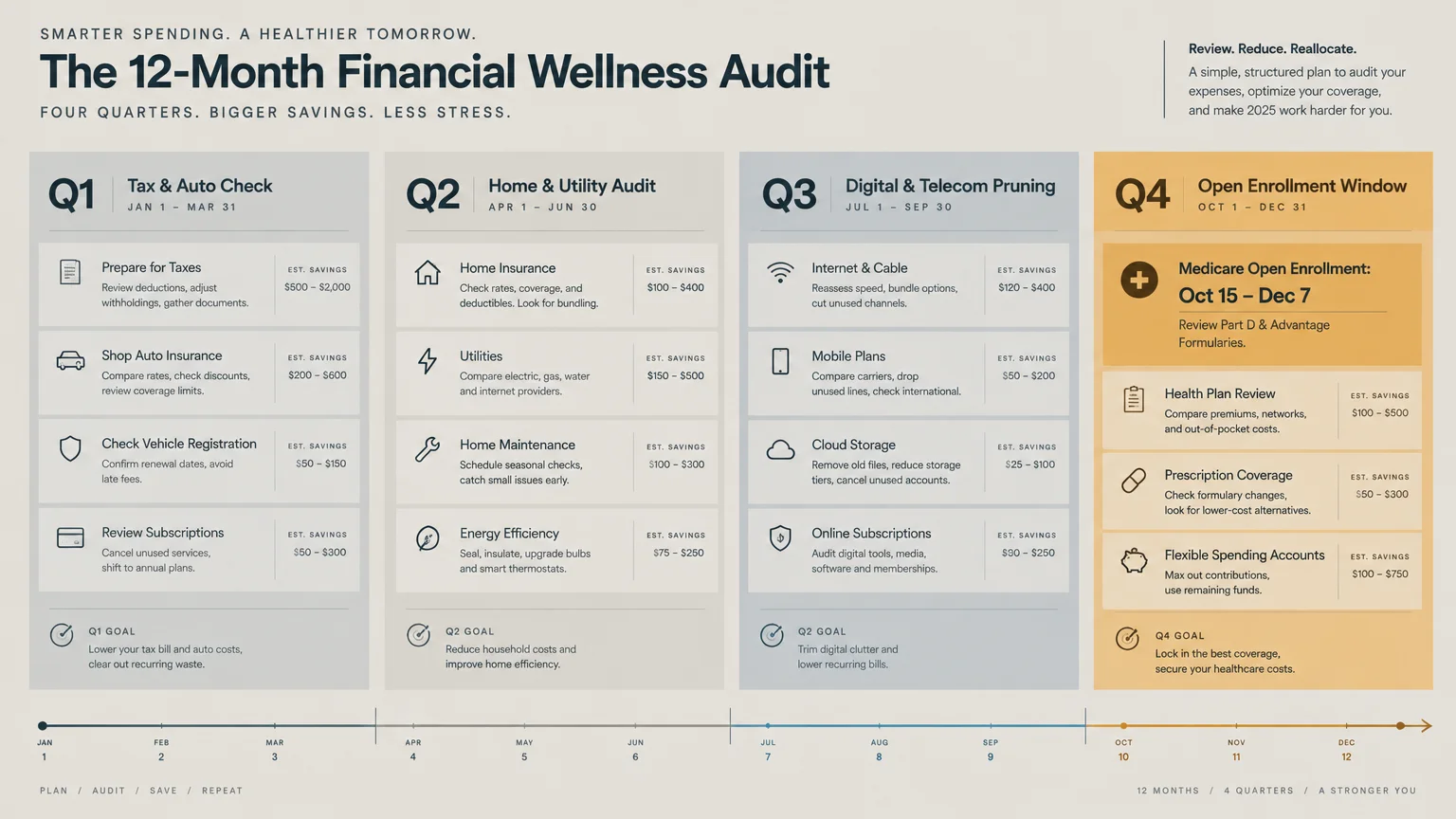
According to Medicare.gov, the Medicare Annual Open Enrollment window runs from October 15 through December 7 each year. Any plan adjustments you select during this period take effect on January 1, 2027.
Under Inflation Reduction Act rules, the annual out-of-pocket cap for covered Part D prescription drugs sits at $2,100 in 2026. This cap increases to $2,400 in 2027.
The maximum standard Part D deductible is $615 in 2026, which rises to $700 in 2027. However, covered insulin remains strictly capped at $35 per month.
A temporary federal Part D premium stabilization subsidy concludes at the end of 2026. Standalone drug plan premiums may spike heading into 2027, making comparison shopping vital.
In addition, negotiated prices for the first 10 Part D drugs took effect on January 1, 2026. Negotiated prices for 15 additional Part D drugs take effect on January 1, 2027.
These newly negotiated therapies include widely prescribed medications like Ozempic, Wegovy, Rybelsus, Trelegy Ellipta, and Janumet. Check your plan formulary annually to confirm that your specific dosages remain covered affordably.
2. Medicare Part B Premiums and IRMAA Surcharges
Basic Medicare coverage costs rise over time and require ongoing scrutiny. The standard Medicare Part B monthly premium is $202.90 in 2026, alongside a $283 annual deductible.
Federal trustees project this base premium will rise to $209.50 per month in 2027, paired with a $292 annual deductible. You must verify that your monthly billing reflects the appropriate tier.
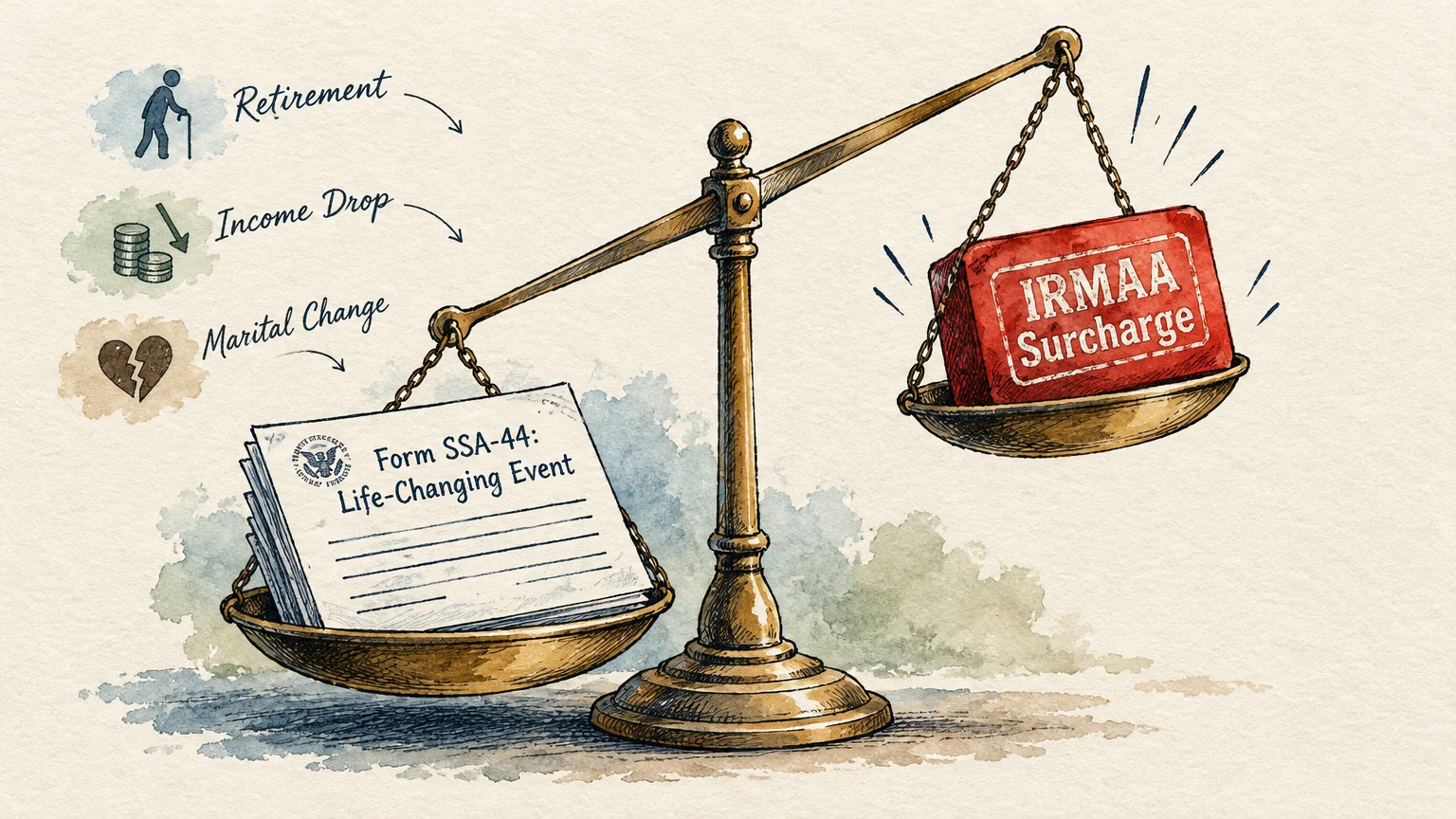
Higher-income retirees face an added surcharge called the Income-Related Monthly Adjustment Amount, or IRMAA. The government calculates this surcharge based on your federal tax returns from two years prior.
A sudden drop in income after leaving the workforce often triggers an unwarranted IRMAA bill. You should never accept an outdated surcharge without investigating your actual income changes.
The Social Security Administration allows beneficiaries to appeal this extra charge after experiencing life-changing events. You can file Form SSA-44 to request a formal premium reduction.
Qualifying life-changing events include retirement, marriage, divorce, or the loss of income-producing property. Filing this single document can save you thousands of dollars each year.

3. County Property Taxes and Senior Assessment Exemptions
Real estate taxes remain a relentless burden for homeowners on a fixed income. Data from ATTOM reveals that the average single-family homeowner pays $4,427 annually in property taxes.
Fortunately, nearly every state offers property tax relief programs designed specifically for older residents. These initiatives include senior homestead exemptions, assessment freezes, and income-based tax credits.
Most jurisdictions activate these programs when a homeowner reaches age 65, though Washington state begins relief at age 61. Check your local county assessor guidelines to confirm eligibility requirements.
County assessors rarely apply these exemptions automatically to your account. You typically must file an initial application and submit periodic verification forms to maintain your tax reduction.
You should also review your property valuation notice each spring. Challenging an inflated assessment with recent sales data can permanently reduce your annual tax liability.
For retirees who itemize deductions, the federal State and Local Tax (SALT) deduction cap is $40,000 for 2025. This cap increases slightly to $40,400 for the 2026 tax year.

4. Auto Insurance Policies and Commuting Mileage
Driving habits fundamentally change once you leave the daily workforce. If you no longer commute to work five days a week, your auto insurance premiums should reflect that reduced road risk.
Insurers typically classify vehicles as commute-use or pleasure-use based on declared annual mileage. Dropping below 7,500 to 10,000 miles per year usually triggers a lower-mileage rating discount.
Review the declarations page on your current auto insurance policy carefully. If the document still lists your pre-retirement mileage, call your agent immediately to request an updated classification.
You can also leverage statutory education discounts to trim your monthly insurance payments. Currently, 34 states and Washington, D.C., legally mandate insurance discounts for older drivers who complete approved safety courses.
These state-approved mature driver courses usually apply to motorists starting at age 50 or 55. Completing the brief class secures a 5% to 15% rate discount lasting for three full years.
Pay-per-mile insurance programs offer another compelling alternative for occasional drivers. These policies charge a small base rate alongside a low per-mile fee, tracking actual miles driven.

5. Homeowners and Hazard Insurance Coverage
Homeowners insurance premiums have surged nationwide due to elevated replacement costs and severe weather events. Allowing your policy to renew without a thorough inspection often results in costly overcharges.
Examine your dwelling coverage limits to ensure they accurately reflect actual rebuilding expenses. You do not need to insure the underlying land value, which never burns or blows away.
Adjusting your comprehensive deductible from $500 to $1,000 or $2,500 can substantially lower your annual premium. Maintain a dedicated cash reserve to cover that higher deductible if damage occurs.
Ask your insurance carrier about discounts for home security systems, smoke detectors, and updated plumbing. Installing a smart water shutoff valve often earns an immediate policy credit.
Check whether you carry outdated policy endorsements or obsolete riders on specialized personal property. Removing coverage for jewelry or collectibles you no longer own produces instant monthly savings.
Bundling your homeowners coverage with your auto policy remains an effective way to lower total insurance costs. Always request comparative quotes from independent brokers before accepting standard renewal terms.

6. Mobile Phone Plans and Senior Carrier Rates
Many retirees remain locked into expensive legacy cellular plans designed for heavy business travel. Major telecom carriers frequently charge premium rates for bloated data packages you may never fully utilize.
Dedicated 55-plus mobile packages and specialized mobile virtual network operators (MVNOs) deliver substantial savings. These carriers utilize the same national cellular towers as the major networks at a fraction of the cost.
For example, Consumer Cellular provides plans starting at $20 per month for one line with 1GB of data and unlimited talk and text with autopay. They also provide exclusive discounts for AARP members.
T-Mobile features an Essentials Choice 55 plan at $45 per month for a single line or $60 total for two lines with autopay. That equates to just $30 per line for unlimited service.
Low-usage users can explore Connect by T-Mobile prepaid packages starting at $15 per month for 5GB of data. Other specialized carriers like Lively offer plans from $14.99 per month.
Mint Mobile likewise offers introductory plans starting at $15 per month. Check your phone’s actual Wi-Fi data usage before paying for unnecessary unlimited mobile data tiers.

7. Home Internet and Broadband Access
Broadband internet access is an essential utility, yet monthly bills climb steadily through promotional expirations and equipment rentals. An annual review helps eliminate subtle equipment fees and unnecessary speed packages.
Note that the federal Affordable Connectivity Program (ACP) ended on June 1, 2024. Retirees seeking federal broadband assistance must now look to the permanent FCC Lifeline program.
According to the Federal Communications Commission, Lifeline provides qualifying households up to $9.25 per month off broadband or bundled services. Standalone voice services receive up to $5.25 monthly.
Residents on qualifying Tribal lands can receive up to $34.25 per month through the Lifeline benefit. You qualify if you participate in Medicaid, Supplemental Nutrition Assistance Program (SNAP), or Supplemental Security Income (SSI).
You also qualify if your household income sits at or below 135% of Federal Poverty Guidelines. In 2026, that threshold is $21,546 for a one-person household and $29,214 for a two-person household.
Purchasing your own compatible modem and Wi-Fi router eliminates monthly equipment rental fees permanently. That simple hardware purchase often pays for itself within six to eight months.

8. Electric and Natural Gas Utility Rates
Heating and cooling costs fluctuate wildly with seasonal demand, placing pressure on monthly retirement cash flow. Reviewing your utility bills annually allows you to level out expenses and capture state-sponsored energy relief.
The federal Low Income Home Energy Assistance Program (LIHEAP) assists roughly 6.7 million households annually with seasonal bills. Federal guidelines mandate priority consideration for households with adults aged 60 and older.
Qualifying for LIHEAP often provides automatic entry into the Department of Energy’s Weatherization Assistance Program (WAP). WAP serves households earning up to 200% of the federal poverty level with free efficiency upgrades.
Because state LIHEAP funds are distributed on a first-come, first-served basis, submit applications as soon as seasonal windows open. A brief delay can mean missing out on significant utility credits.
Contact your local power utility to ask about balanced billing or budget billing programs. These programs average your annual power usage to produce a predictable monthly payment throughout the entire year.
Evaluate time-of-use rate structures offered by your electric supplier. Shifting heavy appliance use to off-peak afternoon or late-evening hours can noticeably reduce your recurring monthly charges.

9. Streaming Services and Digital Entertainment
Digital entertainment options have fragmented into dozens of competing platforms, leading to subscription creep. It is common to pay for three or four video services that you rarely open during the week.
Audit your bank and credit card statements to list every active recurring media subscription. Cancel any platform that you have not watched or listened to over the past thirty days.
Adopt a rotating subscription strategy rather than maintaining multiple active services simultaneously. Subscribe to one streaming service for two months to enjoy specific shows, cancel it, and rotate to another platform.
Check whether your mobile provider, internet service, or credit card includes complimentary streaming subscriptions. Many premium rewards cards and cellular packages bundle free access to major streaming networks.
Do not overlook free municipal resources available through your public library system. Most local libraries offer free access to digital platforms like Kanopy and Hoopla for streaming movies and audiobooks.
Switching from monthly billing to an annual subscription on platforms you watch daily can discount the cost by 15% to 20%. Confirm you truly use the platform year-round before committing to annual billing.

10. Financial Advisory and Account Maintenance Fees
Wealth management fees and hidden account charges can quietly erode your retirement portfolio over time. A seemingly small 1% asset management fee drains tens of thousands of dollars across a prolonged retirement.
Review the annual fee disclosures and custodial statements for your individual retirement accounts and brokerage portfolios. Ensure that advisory services provide measurable value that exceeds the ongoing fees deducted from your principal.
Inspect the internal expense ratios of your underlying mutual funds and exchange-traded funds. Switching from high-fee active mutual funds to low-cost passive index funds instantly lowers your portfolio overhead.
Watch for low-balance fees, paper statement surcharges, and annual custodial maintenance deductions. Many financial institutions waive these charges if you transition to electronic statements and automated transfers.
If you work with a financial planner, consider moving from an assets-under-management model to an hourly or flat-fee arrangement. Paying for advice only when you need it preserves your investment balance.

11. Recurring Club Memberships and Service Warranties
Auto-renewing memberships and aftermarket warranty contracts represent an overlooked source of unnecessary spending. Consumers frequently pay for extended service contracts that duplicate standard consumer protections or existing warranties.
Double-check your wholesale warehouse club memberships, roadside assistance plans, and gym subscriptions. If you rarely visit physical warehouse stores, downsize to a basic tier or cancel the membership entirely.
Many Medicare Advantage plans include complimentary gym memberships through programs like SilverSneakers or Renew Active. Paying out-of-pocket for a fitness membership when your health plan covers it wastes money.
Scrutinize third-party home warranty policies that claim to cover residential appliances and heating systems. These contracts frequently contain complex claim exclusions and high service fees that outweigh actual repair payouts.
Cancel redundant identity theft monitoring services if your credit card companies already provide free credit monitoring. Most modern credit issuers track your credit score and alert you to suspicious activity for free.
Annual Bill Review Strategy at a Glance
An annual bill audit generates significant savings when scheduled logically across the calendar year. Tracking specific renewal dates prevents auto-renewals from locking you into outdated pricing tiers.
The comparison table below highlights key financial targets, necessary actions, and optimal review windows to guide your annual audit.
| Expense Category | Key Review Action | Optimal Review Window | Potential Financial Impact |
|---|---|---|---|
| Medicare Drug & Health Plans | Compare formularies, copays, and newly negotiated drug lists | October 15 – December 7 | Hundreds to thousands in out-of-pocket drug savings |
| Medicare Part B (IRMAA) | File Form SSA-44 if post-retirement income dropped significantly | Immediately upon receipt of notice | Elimination of monthly surcharges up to hundreds per month |
| Property Taxes | Apply for senior homestead exemptions and appeal valuations | Early spring (assessor window) | Reduces county tax bills by $500 to $2,000+ annually |
| Auto Insurance | Lower annual mileage classification and take safety course | Policy renewal date | 5% to 15% discount plus low-mileage rate cuts |
| Cellular Phone Plans | Switch to 55+ plans or discount MVNO providers | Anytime (no-contract plans) | Saves $20 to $50 per month per line |
| Broadband Internet | Check FCC Lifeline eligibility and buy personal modem | Promotional expiration date | Saves $9.25/month subsidy plus $15/month rental fee |
| Energy Utilities | Apply for LIHEAP grants and enroll in balanced billing | Early fall / seasonal opening | Direct heating credits and stabilized monthly bills |
Reviewing accounts systematically throughout the year prevents decision fatigue and produces steady savings. Aligning each bill review with seasonal deadlines ensures you capitalize on state and federal programs.

Worth Keeping in Mind
Conducting an annual bill review requires attention to fine print and administrative rules. Overlooking specific conditions can accidentally trigger penalty fees or coverage gaps.
- Early termination penalties: Canceling or modifying internet and telecom contracts mid-cycle can incur early termination charges. Always verify contract expiration dates before switching providers to avoid unexpected penalty fees.
- Coverage lapses: Never drop an existing homeowners or auto insurance policy before securing binding coverage with a new carrier. A single day of coverage lapse can trigger higher future rates and legal complications.
- Medication formulary changes: Switching Medicare drug plans based solely on low monthly premiums can lead to severe medication expense. A cheap plan may place your critical prescriptions in a high-cost specialty tier.
- Strict exemption deadlines: Missing your county assessor’s homestead exemption filing deadline can forfeit an entire year of property tax savings. County offices rarely grant retroactive tax credits if you submit late documentation.

When to Get Professional Help
While shopping for lower cell phone rates is straightforward, other recurring expenses involve complex regulatory and tax codes. Seeking professional assistance protects your finances in high-stakes situations.
- Navigating complex healthcare transitions: Consult a State Health Insurance Assistance Program (SHIP) counselor if evaluating Medicare plan options feels overwhelming. SHIP provides free, unbiased assistance to help you evaluate drug tiers and network coverage.
- Disputing formal property assessments: Consider hiring a certified real estate appraiser or local property tax consultant if appealing an assessment on a high-value home. Professional appraisal data significantly strengthens your formal appeal before county review boards.
- Appealing IRMAA surcharges: Partner with a certified public accountant (CPA) when appealing complex IRMAA surcharges or calculating capital gains impacts. An experienced accountant ensures your Form SSA-44 documentation aligns perfectly with federal rules.
- Restructuring portfolio advisory fees: Engage a fee-only fiduciary financial advisor when auditing investment portfolio fees and annuity contracts. Fiduciary advisors must prioritize your best financial interests rather than earning product commissions.
Frequently Asked Questions
How often should retirees review recurring expenses?
Review major insurance policies and utility plans once a year during their designated enrollment or renewal seasons. Streaming services and digital subscriptions warrant a brief quarterly check.
Does shopping for auto insurance hurt my credit score?
No, gathering auto insurance quotes triggers only a soft inquiry on your credit report. Soft inquiries do not impact your credit score or damage your financial profile.
Can I challenge my property tax assessment every year?
Most jurisdictions allow homeowners to appeal their assessed value annually during a specified spring window. Check your county assessment notice for precise dispute deadlines and evidentiary guidelines.
What happens if I miss the Medicare Open Enrollment deadline?
Missing the fall enrollment deadline locks you into your current plan for another calendar year. You must wait for special enrollment conditions or the next annual window to switch coverage.
Taking Action on Your Recurring Expenses
Taking control of your recurring expenses provides immediate breathing room in your monthly retirement budget. A few disciplined phone calls and online reviews can liberate thousands of dollars each year.
Dedicate one afternoon each season to audit a few targeted accounts on this list. Protecting your fixed income from unnecessary inflation keeps you in control of your financial future.
The information here is meant for educational purposes; specific circumstances—including health conditions, finances, location, and goals—may require different approaches. When in doubt, consult a licensed professional or check official sources directly.
Last updated: October 2026. Rules, prices, and details change—verify current information with official sources before acting on it.









Leave a Reply